

I would like to welcome Thomas Taylor to my blog today to talk about his Eerie on Sea series, published by Walker Books.
Thank you for inviting me onto your blog, Anita.
Tell us a little about yourself and your inspiration for the Eerie on Sea series. Was it always planned to be five books?
I’m an author and illustrator of children’s books, though I’m mostly writing these days.
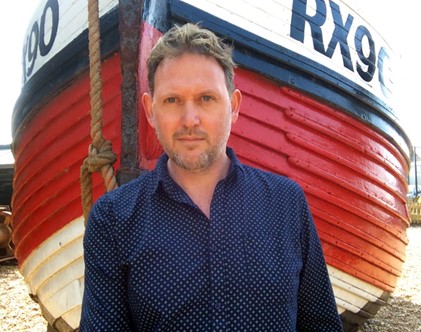
My Eerie-on-Sea books are inspired by my experience of moving to a seaside town in 2010, and discovering how such places are in the off season, when the tourists have gone home, and the weather turns bad. Winter by the sea is a moment of dramatic sunsets, bonkers weather, strange sights and eccentric characters. This is also the best time to find treasures washed upon the beach. It’s the season when those local legends of sea creatures and smuggler ghosts, which seemed so laughable in the summer, suddenly make you look over your shoulder as you hurry home in the dark.
As for the number of books, I can’t say it was always planned to be five. But As I wrote Malamander I realised that there was far more material than could be accommodated in just one book. The auction that saw Walker acquire the book resulted in a three book deal, however A trilogy also never seemed enough for me. The question I faced as I wrote Gargantis, the sequel to Malamander, was how many books more than three should I aim at? Seven seemed to be pushing things too far, but five had a nice round feel to it. And I could see that five books would allow me the space to resolve Herbie and Violet’s narrative arc properly, whilst also telling five distinct stories. I was very happy when Walker agreed.
What would you say are the underlying themes of the series as a whole?
There is a strong theme of things being lost and things being found running through the books, like letters through a stick of rock: Herbie’s job as Lost-and-Founder; Violet’s past as a baby who was lost, and who now wants to be found; Herbie’s own past as a boy who was washed up on the beach and has to find himself; the countless little examples of the same in the secondary characters, from lady Kraken’s back story, to the magical experience Mr Seegol had as a young man and which he longs to experience again.
As a keen beachcomber, I’ve seen the way lost things are changed by the tide, and repurposed by the people who find them: Yesteryear’s broken lemonade bottle is today’s sea glass gem, and tomorrow’s piece of jewellery. But it’s also the ‘mermaid tears’ of legend: trash turned to treasure by the tide, and then turned to story by human imagination.
Friendship is another theme. As is trust, and the importance of doing what’s right, and of trusting ones own instincts to determine what is right.
Was the passing of time between each book important for the Eerie on Sea series and why?
It was a challenge certainly. Most readers, I think, didn’t notice that the five books take place over the course of a single year, until I pointed it out in the last book, Mermedusa. The series runs from Midwinter to Midwinter, with a large gap over the summer, during which the town of Eerie-on-Sea becomes ‘Cheerie-on-Sea’ — replacing the letters C and H that blow off the pier every year, and pretending the be a normal little seaside town again, to attract tourists.
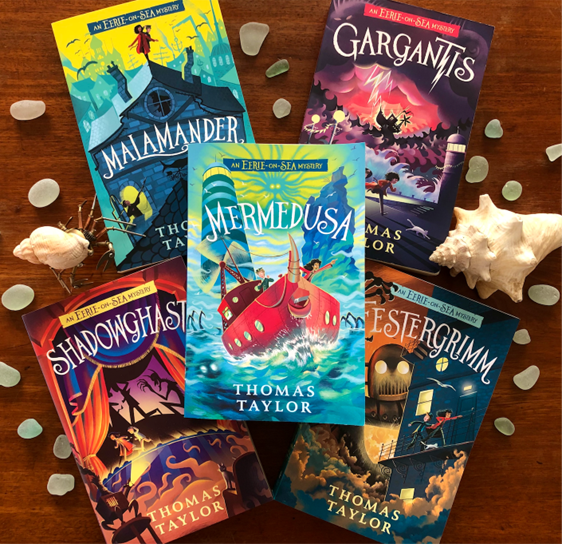
With the five adventures fitting into the autumn and winter of a single 12 month period, I had to make sure that the consequences of one book were still felt in the next. It also gives a relatively tight period for character growth to take place in. But I felt strongly that I couldn’t let Herbie and Violet grow out of their childhood as the stories ticked by, and they are as approximately ‘twelvish’ at the end as they were at the beginning.
How did you manage to conclude all the mysteries and tie up all the plot points from all five books without missing anything? Talk us through your planning process to achieve this.
I don’t really plan my books. I tend to rely on a lot of day-dreaming, then a lot of feverish story telling. I pay for this sloppy technique whenever I take a wrong turn and have to undo a few chapters. But it does keep things fresh and surprising. For example, in Malamander I had no idea that Erwin the cat would have the magical quirk that he has until he exhibited it in a scene. I got goosebumps when that happened, so, of course, I kept it in, in hopes that the reader would get goosebumps too.
I also have very good and observant editors.

How did you come up with the names of each of your monsters and the legends behind them for each of the books in the Eerie-On-Sea series.
With Malamander, I realised that even though I was creating a legend about a sea monster, I could help the legend seem more ‘real’ if I based its name on a real word. After listing a lot of probably candidates, I hit on ‘salamander’ because I saw that if I changed the S to an M, I would have a ‘Mal’ sound. Mal in French and Spanish means ‘bad’ or ‘evil’, which works in English too: think of ‘malevolent’ and ‘malign’. So ‘Malamander’ sounded monstrous to me.
Having done this once, it was then a challenge to create the other titles. But in brief: Gargantis was a squashing-together of ‘gargantuan’, ‘gigantic’ and ‘Atlantis’, Shadowghast was a simple joining of two words to evoke a kind of spectral creature, Festergrimm was a play on Frankenstein, the themes of which are touched on in the book, and Mermedusa is ‘mer’ from mermaid bolted onto ‘Medusa’ from Greek myth.
Will you be revisiting Eerie-On-Sea? What’s next?
I would love to write another Eerie-on-sea book one day, but it would be a standalone, and not part of Herbie and Violet’s story arc. I think Herbie and Violet would be in it though, but as secondary characters. In the meantime, I’m working on a new idea which is proving hard to get right, but which is exciting. All I can say about that is it will have more of the same sort of intrigue, mystery, creatures, magic, nice things to eat, good friends and dastardly going-on.
What writing advice would you give to people aspiring to be a children’s book writer?
I find it hard to give advice. Certainly, I think an aspiring writer for children needs to be very aware of current children’s books, and reading the books that are being published right now. However, it’s important to write the books you want to write and believe in, and not work to trends or over worry about what others are doing. Good storytelling, compelling voices, and rich characterisation are always in high demand, even if you are writing in a genre that seems over-represented. So, enjoy your own stories! Readers will notice if you don’t.
What are your social media links where can people find out about you and your books?
Instagram is probably my main social media these days (@thomskagram), though I’m still on Twitter, or whatever it’s called (@ThomasHTaylor). My website is: http://www.thomastaylor-author.com
Where is the best place for people to buy the Eerie-On-Sea series?
Your local independent bookshop! Or, failing that, any branch of Waterstones. If you would like a signed and drawn-in book, then please order through www.hastingsbookshop.co.uk, and leave a note in the order form. That’s my local indy. Thank you!
Keep your eyes peeled for my review of Mermedusa, the final book in teh series, which is due to go live on the 18th October. That is this Wednesday.

Thank you again Thomas for agreeing to be interviewed for my blog.
 Much To Do About Writing
Pingback: Book Review: Mermedusa | Much To Do About Writing