Category Archives: An Interview with…

An interview with… Stephen Potts

In Dec 2008, I interviewed award-winning screenwriter and novelist, Stephen Potts, about the research he did for his books and screenplay adaptations.

Pullman and Potts

(c) Stephen Potts

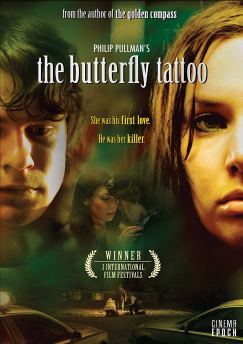
In 2007, he was commissioned to adapt Philip Pullman’s 1992 novel of doomed teenage romance, The Butterfly Tattoo, as a feature film. It was directed by Phil Hawkins. The film toured festivals in 2008, winning several awards (including Best Adaptation at the New York Independent Film Festival), and reaching 75 on IMDb’s moviemeter, before a US/UK cinema. The DVD was released in 2009.

BT DVD

Stephen told me:

“I’m aware I write visually (hence my interest in screenwriting). Unless I see a scene in my head I can’t write it.” Stephen Potts

He does not have a set method for research as he believes it should be appropriate to the task. It was interesting to discover that adapting The Butterfly Tattoo didn’t require visits to Oxford, where it’s set, as he had lived there for eight years. But it did require him to read and re-read the book, every interview Pullman had given where it was discussed, and every review of the book he could find.

Stephen explained:

“The questions here, in adaptation, were different: what was Pullman trying to achieve? What was the essence of the story? What are the inessential features, which could be changed to fit the different form of a feature film?” Stephen Potts

Stephen emphasised how the temptation, when you’ve invested time, money and effort in your research, and you’ve unearthed interesting nuggets, is to crowbar it all in to what you’re writing. He revealed he had to tell himself repeatedly that he was not writing history, but a story. If a piece of information served a story purpose, and was interesting to boot, all well and good: but he was adamant that the story must never serve as a showcase for More Interesting Facts.

“In writing, you must kill all your darlings.” William Faulkner

Stephen Potts has been nominated twice for the Carnegie Medal (Hunting Gumnor, 2000; Tommy Trouble, 2001) and short-listed for the inaugural Branford-Boase Award (Hunting Gumnor, 2000) and Askews Prize (Compass Murphy, 2002).

You can read the full interview in the December 2008 #87 issue of Writers Forum. You can find out more about Stephen Potts and his books on his website.

An interview with… Alison Rattle

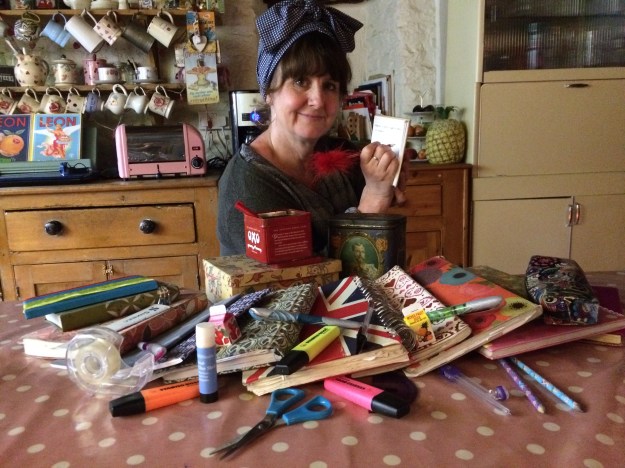
In June 2016, I interviewed Alison Rattle about her passion for stationery for the Papers Pens Poets blog. You can read the full feature on her and her stationery here.

Alison Rattle pic

Alison told me she does not have a favourite pen she just picks up the first thing to hand.

“When I’m writing a book I usually start off on my laptop, but then very quickly reach for a pen and notebook. There’s something very freeing, peaceful and intimate about letting your imagination run wild across a beautiful clean page.” Alison Rattle

She told me she always buy a new notebook whenever she starts a new idea for a book.

“It’s a brilliant excuse to add to my collection, but also so exciting to hold those clean, fresh pages in my hand, knowing that before long they’ll be covered in words I can’t even imagine yet.” Alison Rattle

Her most glamorous and expensive notebooks tend to be received as presents as Alison revealed she only buys reasonably priced ones, but even so they have to be pretty.

“Once I start writing in a notebook, I’m not precious about it at all. They all end up being scruffy, well-worn things that contain not only the workings of my book, but scribbled recipes, telephone numbers, shopping lists etc… a snapshot of my life during the writing process.” Alison Rattle

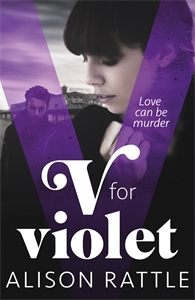
v for violet 1

Alison normally writes gritty crime thrillers, published by Hot Key Books. But her latest books includes two whimsical collections of quotations published by Carlton Books. They are compilations of over 1500 amusing and insightful quotations from well-known writers, politicians, film stars, artists, musicians and philosophers.

You can follow Alison on Twitter @alisonrattle

An interview with… Ruta Sepetys

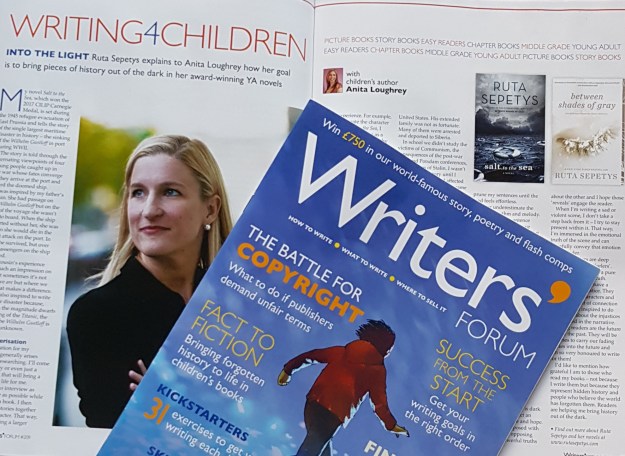
In my Writing 4 Children double spread, in the March issue of Writers’ Forum, I interview Ruta Sepetys about how she is bringing underrepresented pieces of history out of the dark in her award winning YA novels.

Ruta Sepetys2

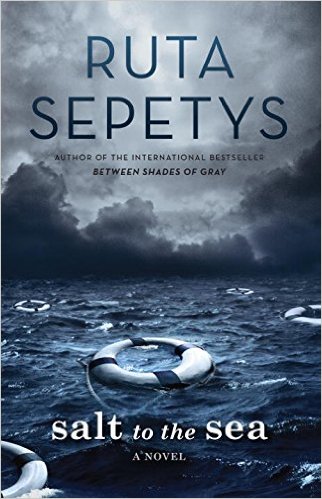
For example, her novel Salt to the Sea, which won the 2017 CILIP Carnegie Medal, is set during the 1945 refugee evacuation of East Prussia and tells the story of the single largest maritime disaster in history—the sinking of the Wilhelm Gustloff in port during WWII. The story is told through the alternating viewpoints of four young people who are all hunted and haunted by tragedy, lies, and war. Their fates converge as they arrive at the port and board the doomed ship.

Salt to the Sea cover

Ruta explained how she was inspired to use the true story of her father’s cousin who had passage on the Wilhelm Gustloff but on the day of the voyage she was unable to board the ship. When the ship departed without her, she was certain that she would die in the port under Soviet attack. She survived, but over nine thousand passengers on the Gustloff perished.

“My cousin’s experience made such an impression on me. It issues the reminder that sometimes it’s not where we are—but where we aren’t—that makes a difference. I was also inspired to write about the maritime disaster because although the magnitude dwarfs the sinking of the Titanic, the story of the Wilhelm Gustloff is virtually unknown.” Ruta Sepetys

Her use of family history was also true of the first novel she had published by Puffin, Between Shades of Gray, which won the 2012 Golden Kite Award for fiction and was made into the movie, Ashes in the Snow. This novel chronicles the Soviet occupation of the Baltic States and the exile and deportation of countless victims to Siberia. The story follows Lina Vilkas, a fifteen-year-old artist who is arrested by the Soviet secret police and deported to Siberia with her mother and younger brother.

The story was inspired by two young women who were deported and also by Ruta’s father who fled Lithuania when he was a boy and spent nine years in refugee camps before arriving in the United States.

Ruta told me:

“I try to inject an equal balance of love and hope. When love is juxtaposed against violence, the two opposing forces reveal powerful truths about the other.” Ruta Sepetys

Her latest novel, The Fountains of Silence, is set in Madrid in 1957 during the Spanish Civil War.

The Fountains of Silence

It tells the story of eighteen-year-old Daniel Matheson, the son of a Texas oil tycoon, who arrives in Madrid with his parents hoping to connect with the country of his mother’s birth through the lens of his camera only to be plunged into one of history’s darkest corners.

You can read my full interview with Ruta Sepetys in the March 2019 #209 issue of Writers’ Forum.

To find out more about Ruta and her books take a look at  her website: www.rutasepetys.com. Or follow her on Twitter @RutaSepetys

An interview with… Sally Piper

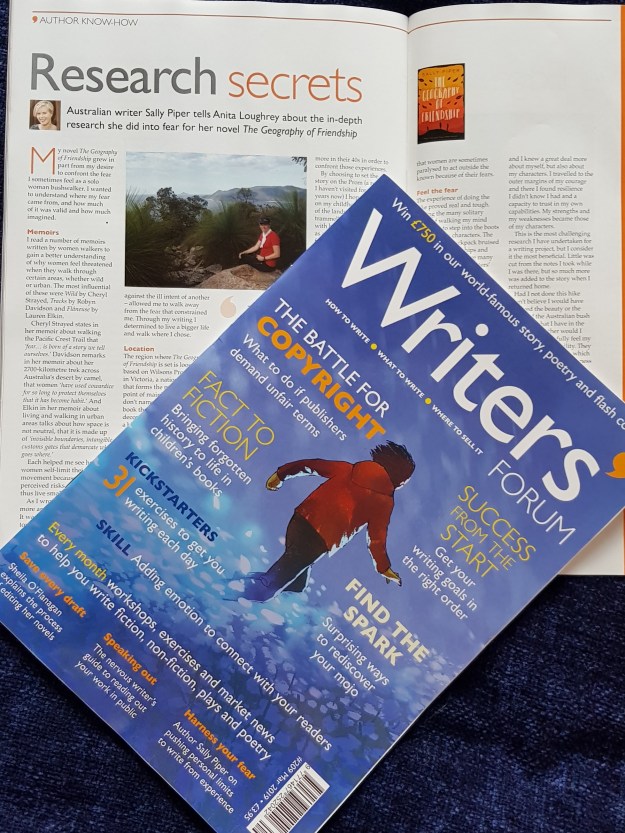
Australian writer, Sally Piper told me all about her research into fear for my Research Secrets column in the national writing magazine Writers’ Forum this month. She revealed that as a solo woman bushwalker she often felt afraid and wanted to know where this fear came from.

Sally Piper2

When I first found out about this I thought Fear was a very strange thing to want to research. Where do you start? Sally Piper started by reading memoirs of other female walkers and discovered how women self-limit their free movement because of real and perceived risks, which can cause themselves to live smaller lives.

“Fear… is born of a story we tell ourselves.” Robyn Davidson

This discovery inspired her to write her novel, The Geography of Friendship.

geography of friendship high resHer novel is about female friendships under pressure and is based loosely on the national park, Wilsons Promontory in Victoria, Australia where she had played as a child. But she had to deconstruct the landscape a bit to fit her purposes.
Ultimately it was inevitable that to really feel the fear she was going to have to do the walk herself. So to really understand what it was like to walk the Prom she undertook the 5 day hike alone noting how she felt, the weather, the terrain and how sounds were distorted by the absolute quite.


Sally believes that if she had not done the hike she would not have captured the beauty or the threats  of the Australian Bush the way she did in her novel.

Her advice to other writers is to experience first hand what you hope to subject your characters to.

“Research can sometimes occur by osmosis. Before I’d even taken my first step on the hike I started to collect new material for the novel, most notably by the way others (mainly women) responded to me doing the hike alone.”

Sally Piper

To find out more about Sally and her books check out her website: www.sallypiper.com. Or follow her on Twitter @SallyPiper

You can read the full interview in the March 2019 issue #209 issue of Writers’ Forum.

An interview with… Sarah Stewart

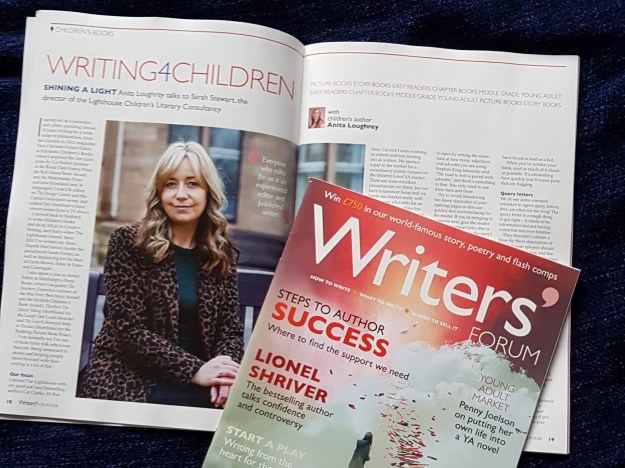
In the February Issue of Writers’ Forum I have interviewed Sarah Stewart the director of the Lighthouse Children’s Literary Consultancy about her career and the services she offers to children’s and YA book writers.

writing 4 children - lighthouse4

She started The Lighthouse with her good friend, Cat Clarke, when they were both working as editors. Sarah was the UK editor of The Hunger Games at Scholastic and has also worked for the excellent Edinburgh based publisher, Floris Books.

The feature contains valuable advice about opening lines and query letters. They also link up writers with agents  when they feel they’ve read a good, strong submission.

Some of Sarah’s advice includes:

If you’re writing for younger children, a sense of immediacy is a bonus in an opening; I like a bit of meandering description when I am read adult fiction, but not if I’m looking at something aimed at seven year olds.

You can read the full interview in the Feb 2019 #208 issue of Writers Forum. To find out more about the Lighthouse Children’s Literary Consultancy and their services you can view their website: www.lighthouseliterary.co.uk or follow them on Twitter at: @thelighthouseuk 

An interview with… Penny Joelson

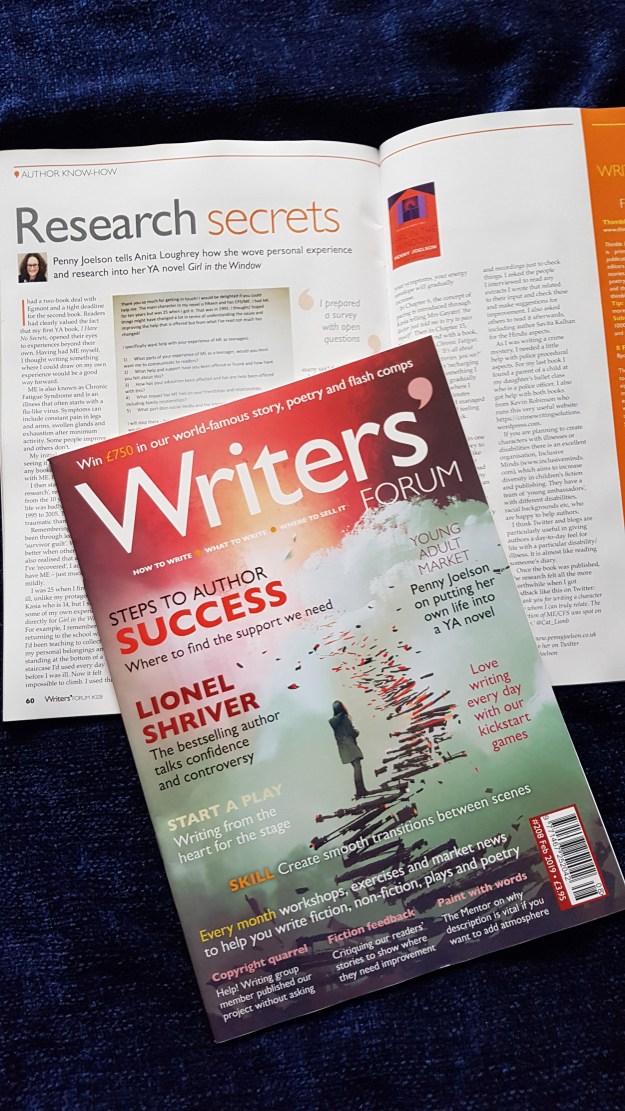
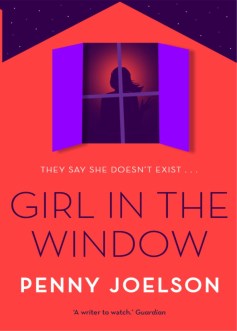
My Research Secrets slot in Writers’ Forum features YA writer, Penny Joelson. She explained how she wove personal experience and research into her YA novel, Girl in the Window.

research secrets - penny joelson4

The book is about a teenage girl called Kasia, who has ME so spends most of her time staring out the bedroom window. Nothing ever happens on Kasia’s street so when she sees what looks like a kidnapping, she’s not sure whether she can believe her own eyes. she notices a girl in the window opposite and hopes she saw something too but when Kasia goes to find her she is told there is no girl.

In the feature you can see a copy of the interview that Penny used as part of her research to gain a young teenage perspective of ME.

I prepared a survey with open questions and an option to add further information. I was overwhelmed with the response and the moving stories I read.

Penny explained that while some research needs to be done before writing, she prefers to write a first draft and then do more research, check facts and add details. This stops her from info dumping and the feeling she must include everything she discovered.

covers

You can read the full interview in the Feb 2019 #208 issue of Writers Forum. You can find out more about Penny Joelson and her books on her website: www.pennyjoelson.co.uk or follow her on Twitter @pennyjoelson

An interview with… Rebecca Colby

In the January 2019 #207 edition of Writers’ Forum, I interviewed high-concept picture book writer, Rebecca Colby about the importance of rhyme and rhythm in children’s books.

RebeccaColby-9

Rebecca told me:

When I began writing children’s picture books, I naturally gravitated towards writing in verse. But the industry professionals at the writing events I attended warned against it. Phrases I heard many times included:

  • Rhyming books are too difficult to translate.
  • We can’t sell co-editions.
  • It’s hard to rhyme well.

While I knew these statements to be true, I also knew that children love rhyme, and these warnings didn’t stop publishing houses from buying books in rhyme.

In the feature she demonstrates how she uses onomatopoeia, repetition, juxtaposition and prediction to write fun and imaginative that children love. Here is an example from her picture book Motor Goose Rhymes that Go! published by Feiwel & Friends.

Motor Goose_Spread 2sm

Her message to other writers who want to write rhyming picture books, is to try and come up with fifty ideas and give these ideas plenty of time and space to grow.

Rebecca Colby3

In a forthcoming book entitled How to Write Picture Books that Knock Editors (and Agents!) Socks Off, Rebecca Colby will share some games which makes the task of starting to write less daunting and provides loads of tips for writing high-concept picture books. More details will be available on her website later in the year.

Find out more here: www.rebeccacolbybooks.com and follow her on Twitter: @amscribbler


An interview with… Savita Kalhan

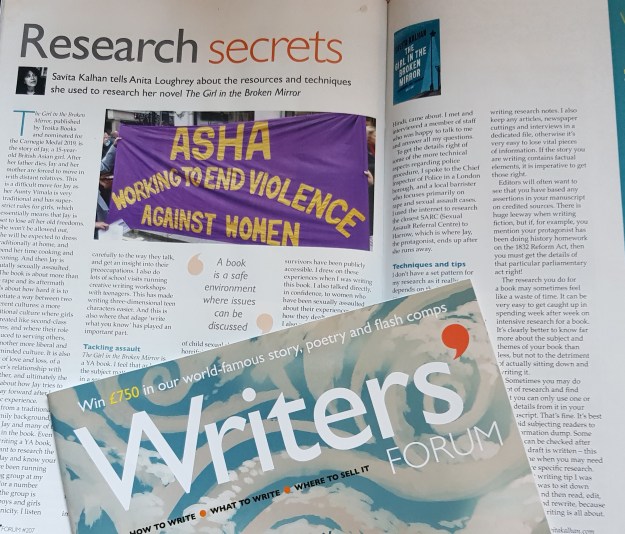
Savita Kalhan’s latest novel The Girl in the Broken Mirror published by Troika Books and nominated for the Carnegie Medal 2019 is the story of Jay, a 15-year-old British Asian girl who is raped. Savita told me all about the resources and techniques she used to research this YA novel for my Research Secrets column in the national writing magazine Writers’ Forum.

Savita Kalhan6

Savita explained:

Sadly, as the #metoo and #timesup movements have illustrated in recent times, the incidence of sexual assault is much more prevalent than once thought, and stories of survivors have been publicly accessible. I drew on these experiences of survivors when I was writing this book. I also talked directly, and in confidence, to women who have been sexually assaulted about their experiences and how they dealt with them. I also spoke to friends and relatives of victims.

Savita does not have a set pattern for her research but her tip to other writers is even though you can get caught up in your research and you may feel you have wasted your time it is better to know far more about the themes and subject of your book than to know less. But the best tip she was ever given was:

The best writing tip I was ever given was to sit down and write, and then read, edit, fact-check, and rewrite, because that’s what writing is all about.

You can read Savita Kalhan’s Research Secrets feature in the January issue #207 of Writers Forum.

You can find out more about Savita and her books on her website www.savitakalhan.com

Or follow her on Twitter @savitakalhan


An Interview with… Simon Whaley

In June 2016, I interviewed Simon Whaley for Papers Pens Poets about his love of stationery. Simon revealed why paper and pen beats modern technology hands down.

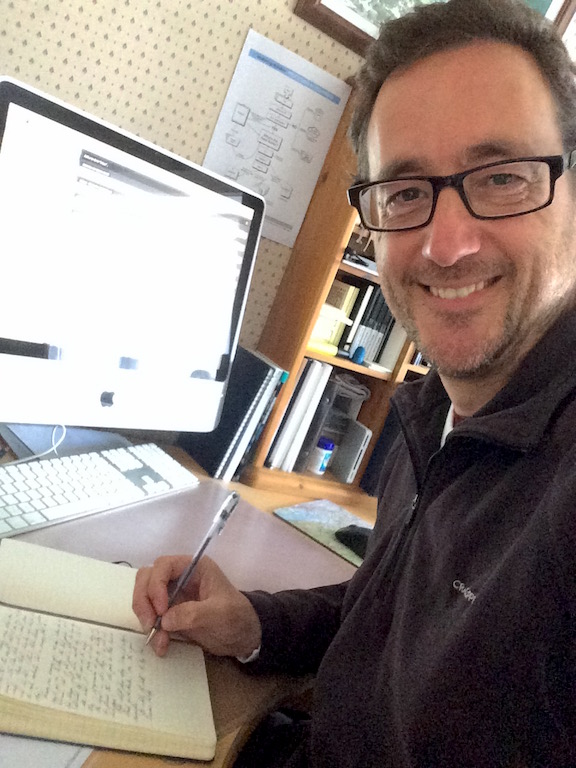
Simon Whaley writing in his notebook

His favourite pen is the Pentel Superb BK77, in black ink.

I love it because it’s easy to hold and has a fine ballpoint nib.

He absolutely adores Moleskine notebooks and claims they are the perfect notebooks for writers. They are hardback, which makes them ideal for writing in wherever you may be: desk, chair in the garden, bed, or out on the hills.

I use two sizes of Moleskine notebook: the Classic Pocket and the Classic Large.

You can find out more about Simon Whaley’s stationery passions on the Papers Pens Poets blog: www.paperspenspoets.co.uk

Find out more about Simon Whaley and his writing here: www.simonwhaley.co.uk  and on Twitter: @simonwhaley

An interview with… Philip Ardagh

In August 2016, for my Writing 4 Children slot in Writers’ Forum I interviewed one of mine and my children’s favourite authors, Philip Ardagh.

wf178-august-2016

He has been writing for over twenty five years and has over a hundred children’s books published, including The Moomins: The World of Moonminvalley, a series of books for the National Trust and the Stick and Fetch Investigate adventures.

He told me:

I suspect that I was born wanting — needing — to write. I filled old diaries and exercise books with my scribbles from a very early age, and English was my favourite subject at school. I knew that I wanted a career as a writer but had no real concept of the idea that one could earn a living as an author.

Philip’s  seven quick fire tips for writing for children are:

  1. Do a job you love
  2. Explore all aspects of the job
  3. Never dumb down
  4. Write the manuscript
  5. Never write yourself out
  6. Keep everything
  7. Make time to write.

Some advice I feel we all need to remember was:

Whoever you’re writing for — whether it be adults or children — the most important part is the actual writing. Not blogging about it, not telling people you’re a writer, not Tweeting or Facebooking about it, but ACTUALLY writing. Once you’ve written and rewritten and rewritten however many times, THEN is the time to start worrying about your social media presence.

To read Philip Ardagh’s essential tips in more detail take a look at #178 August 2016 issue of Writers’ Forum.

You can follow Philip Ardagh on Twitter @PhilipArdagh