Category Archives: An Interview with…

Special Guest: Q & A with Helen Peters

I’m thrilled to welcome Helen Peters to my blog today to talk about her latest book Friends and Traitors, which is featured in The Guardian’s Summer Books Roundup.

Helen Peters is an award-winning author whose books have been nominated for the Carnegie Medal, shortlisted for the Waterstones Children’s Book Prize and named as the Independent Bookshops Children’s Book of the Month and The Times Children’s Book of the Week.

Other books she has written include: Anna at War, Evie’s Ghost, The Secret Hen House Theatre, its sequel The Farm Beneath the Water, and the Jasmine Green Animal Rescue series. Her stories are adventures with themes of bravery, family and friendship.

Friends and Traitors is a gripping World War II story about how two girls foil an aristocratic plot to bring down the government and hand the country to the Nazis. When Sidney Dashworth’s school is evacuated to a huge stately home in the countryside, she thinks she’s going to spend the war being very bored. At least her brother must be having fun, flying his Spitfire all over France.

However soon Sidney and a housemaid called Nancy discover that the Earl is up to no good. He has secret night time meetings with mysterious men from the government and seems to be hiding something sinister on his land. They set about stopping the Earl and his evil plotters in this exciting middle grade mystery. At first it’s all terribly thrilling, investigating by creeping about at night and finding secret passageways, but soon everything takes a deadly turn. Sidney’s brother goes missing over France and the war hits home with a terrible reality.

Now let’s find out more about this intriguing historical mystery set during WWII.

********

Tell us a little about your inspiration for Friends and Traitors?

After Anna at War was published, my editor asked if I would write another book set in the Second World War. At the time, I was living and working at Roedean, a girls’ boarding school on a clifftop above Brighton, which had been evacuated to a hotel in the Lake District in the summer of 1940, when, with the threat of an imminent Nazi invasion, Brighton was no longer considered safe. I’ve always loved boarding school stories, and I liked the idea of writing about an evacuated boarding school during World War 2.

Then I read an article about how English country houses were used in the Second World War, and discovered that several grand stately homes were used to house evacuated boarding schools. I like to combine different genres in my novels, so I wanted it to be an upstairs/downstairs story as well as a boarding school story. I wanted to have another girl in the house who was the same age as the schoolgirls but who was having to work as a maid because her family couldn’t afford for her to stay at school. My paternal grandmother came from a wealthy family, but my maternal grandmother came from a poor family, so although she was clever and loved learning, she had to leave school at fourteen and go out to work as a housemaid. So I’ve always been very aware of how family money or the lack of it can affect people’s lives and set equally talented children on very different paths.

What research did you have to do to write Friends and Traitors?

So much! I had to research the lives of girls from wealthy families and girls who were working as servants. I had to find out about life in girls’ boarding schools in 1940. I had to find out what was happening in the war and what was being reported in the British press on a daily basis in the spring and summer of 1940. And I also had to learn about British traitors and fifth columnists at the time. I read dozens of history books, letters, diaries and memoirs. I also subscribed to the British Newspaper Archive so that I could read the British newspapers from every day in May and June 1940, when the book is set.

How did you develop your 1940’s characters and their voices so children today could identify with them?

For the characters’ voices, it really helped to read letters, diaries and memoirs, and listen to recorded interviews. Although life for children in the 1940s was very different from today in many ways, a lot of their concerns were the same: friendships, school and family life, and wondering what life would be like for you as an adult, as well as worries about the state of the world. So I hope there is plenty going on in the lives of my characters that children today can identify with.

What is the most difficult part of your writing process? 

Writing the first draft is always hard – conjuring up characters and their world, plus trying to create a page-turning plot and making sure the facts are accurate. Doing all of that at once is really difficult, and it takes me several drafts to get everything in place. With each draft it generally gets slightly easier, although there are still sections in later drafts where I get stuck or lose confidence, and when that happens I have to force myself to just keep going, and trust that it will get there in the end.

If you could meet Sidney Dashworth, what would you say to her?

Sidney probably changes more than any other character in the book, so it would depend at what point in the story I met her. If I met her at the beginning, I’d remind her that just because someone isn’t wealthy, that doesn’t make them less intelligent; in fact, often the opposite is true. If I met her at the end, I’d give her a big hug and tell her she’d been amazing.

Is there anything else you would like to tell readers about Friends and Traitors?

Friends and Traitors includes so many of the elements I loved in books when I was a child: a huge old house with rumours of ghosts and secret passages, and brave, ingenious children who solve mysteries, stand up to bullies, and carry out daring and dangerous plans. I hope you’ll enjoy it!

Where is the best place for people to buy your book?

If you have a local bookshop, please buy it there! If it’s an independent bookshop, you may well end up with a signed copy, as I signed over a thousand copies exclusively for indie bookshops. If you don’t have a local bookshop, you can buy it online at bookshop.org, which supports independent bookshops. Or if you’d like a signed and personalised copy, you can order through the website of my local indie, The Book Nook in Hove and I will walk down there and write in it for you before they post it to you.

Thank you Helen for being a brilliant and most generous guest. I look forward to reading more of your books in the future.

********

You can find out more about Helen Peter’s on her website: www.helenpetersbooks.com and follow her on Twitter: @farmgirlwriter.

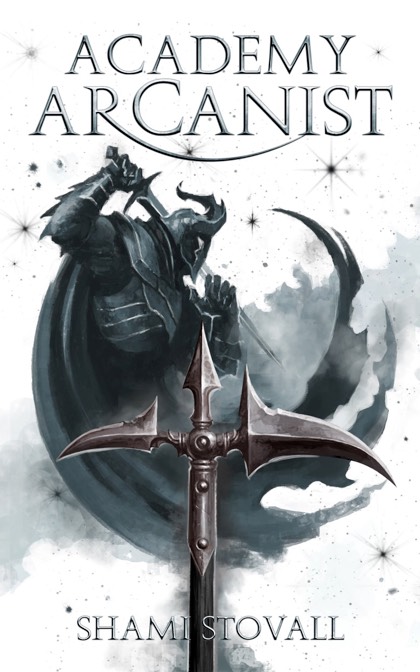
Blog Tour – Academy Arcanist by Shami Stovall

Please join Shami Stovall on the next stop of her blog tour for her fantasy YA novel, Academy Arcanist.

Gray Lexly, son of a candlemaker, wants to escape his life of old-world technologies and study at the prestigious Astra Academy, a school for arcanists—those who can wield magic. But Gray has a major problem. Every night, as he sleeps, he’s visited by monsters. When they injure Gray in his dreams, he wakes with the same wounds in real life. On the night Gray might finally die in his nightmares, he is saved by the kind and mysterious Professor Helmith, a powerful arcanist. She offers to protect Gray and invites him to attend Astra Academy.

Before that can happen, Gray must bond with a mystical creature, such as a unicorn, pegasus, or kitsune, to become an arcanist himself. Whatever he bonds with will determine his magical abilities, so he must choose wisely. When trouble finds Professor Helmith, Gray must become powerful enough to help her and fend off the terrible nightmares, before it’s too late.

Shami Stovall is a multi-award-winning author of fantasy and science fiction.

Before that, she taught history and criminal law at the college level, and loved every second. When she’s not reading fascinating articles and books about ancient China or the Byzantine Empire, Stovall can be found playing way too many video games, especially RPGs and tactics simulators.

My stop on tour consists of an author interview.

********

Tell us a little about yourself and the inspiration for your book Academy – Arcanist

 Hey there! My name is Shami (that’s my full name, it’s not short for anything, and it’s not an alias). I love reading, video games, my two dogs, and my husband! Sci-fi and fantasy have always been my jam, and I’m so lucky to get to write stories for my living.

The inspiration for Academy Arcanist is equal parts Pokémon and Harry Potter. I love monster-catching video games, and I loved the fantastical world of Harry Potter, so obviously I had to merge the two!

Talk us through your writing process.

I typically outline all of my novels into three act structures. After that, I add in minor subplots, and then I get to writing. Once written, I submit the novel to my author’s group, and then some beta readers. Once I’m happy with the story, I get it all professionally edited. It’s a lengthy process, but I think it’s well worth it.

What is your favourite thing about writing fantasy?

 My favourite part about writing fantasy is developing the magic system. I love really interesting uses for abilities! I’m especially drawn to shadow and light magic, or the ability to copy or steal magics. Any stories that involve those things are just -chef kiss- good.

What are the underlying themes of your novel, Academy – Arcanist?

The underlying themes are about growth and confronting fears. Gray, the main character, desperately wants to grow out of his small environment, but dangers are lurking around every corner. Or in his case, they’re lurking in his dreams! And he must face them in order to save his professor.

How did you create and keep tabs on your fantasy world in Academy – Arcanist?

 I do love outlines. It helps me keep the story on track, and it helps me to develop all the characters and magic at an easy pace.

Do you listen to music whilst you write, if so what do you tend to listen to?

 I LOVE listening to video game soundtracks while I write! I prefer no lyrics, and I love to have emotional music tied to the tone of the scene I’m writing. It’s a lot of fun, actually, and I highly recommend to others.

What writing advice would you give to people aspiring to be a fantasy novel writer?

Just write.

That’s always my number one advice. It takes people (on average) 10,000 hours of practice to get good at a skill, so you should start writing RIGHT NOW if you want to become good. And don’t worry if it’s not the best thing ever.

You can’t edit a blank page!

Get your thoughts out there, and you can “fix” everything later.

Is there anything else you would like to tell readers about your books and Academy – Arcanist?

I love interesting characters and dramatic endings. All my books have over-the-top finales. Sorry, not sorry?

Thank you Shami for agreeing to be interviewed on my blog. It has been fun. I have enjoyed finding out about your writing process.

********

You can discover more about Shami Stovall on her website: www.sastovallauthor.com

Or follow on Twitter @GameOverStation and Facebook @SAStovall

The best place to purchase a copy of Academy Arcanist by Shami Stovall is Amazon.

You can read reviews of Academy Arcanist on Amazon and Goodreads.

I would like to thank The Write Reads for inviting me on the tour. Thank you.

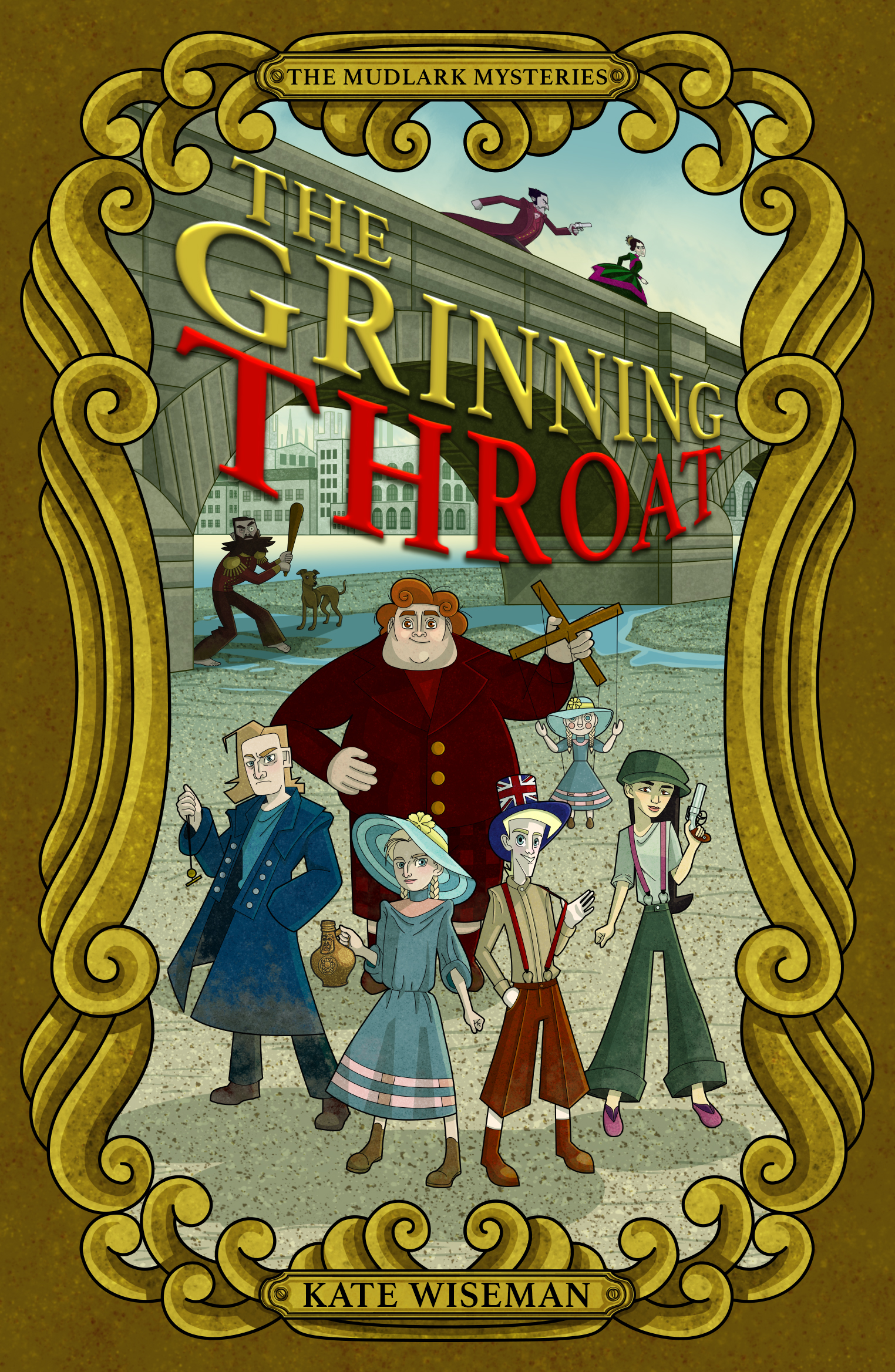
Blog Tour – The Grinning Throat by Kate Wiseman

For my slot today in The Grinning Throat blog tour I have the great privilege of interviewing the author, Kate Wiseman.

The Grinning Throat is the first in a new historical middle-grade series of The Mudlark Mysteries about orphans living in Victorian London. Our main protagonists are Joe is 15 years old and Edie is 13. Forever worried that they will be sent to the dreaded workhouse, they scratch out a living the best way they can by mudlarking on the foreshore of the River Thames and selling their finds to the notorious Hempson. One day they discover something macabre, and it will change their lives forever. 

‘My first thought is that it’s a pig that someone has lost to the river. Perhaps it fell off one of the barges that choke up the Thames. They’re a constant feature, toiling up and down, day and night, giving off black smoke that clings to the water.’

The Grinning Throat by Kate Wiseman

Kate Wiseman writes middle grade and YA fiction and has a specific interest in writing historical fiction. She grew up in Oxford in the 1970s. She has won the Eyelands price twice and holds a BA and an MA in literature and creative writing.

Her degrees gave her the courage to do what she’d always dreamed of doing: being a writer. Since then she has had many books published by ZunTold including, her middle grade Gangster School series and a YA fantasy, Icarus and Velvet. She loves visiting schools to deliver workshops in creative writing. Many of them are based on her own mudlarking finds. 

Without any further ado I will proceed with the interview…

********

Tell us a little about yourself and the inspiration for your book The Grinning Throat.

I’m a lifelong reader, of course. I think all authors are. I came to writing fairly late – about 7 years ago – and have been fortunate enough to have my MG and YA books published in several languages.  My first novel for adults – about a girl who disguises herself as her brother to fight in the First World War – will be published next summer.

My devotion to mudlarking is more recent. A friend and I went mudlarking with an acquaintance  a couple of years before lockdown and I was completely hooked. I’ve always loved history and historical fiction and mudlarking is history-hunting and treasure-hunting all mixed up! I started making plans to write a series on mudlarking.

It made sense to me to set it in Victorian times, when mudlarking was a recognised and fairly unenviable way for the very young and very old to scratch a living. This was in the days before there was social assistance for people in need. That creates a sense of urgency to the adventures of my characters. They aren’t mudlarking for pleasure, as I do. It’s a survival tactic.

Why did you decide to write a book about mudlarking for children?

It had to be for children because the majority of mudlarks were children. I think today’s kids will be amazed if they put themselves in the shoes of the Victorian mudlarks. Not that many of them had shoes! I think they’ll be astonished at how kids were allowed to live back then.

What has been and/or what would be your greatest find when mudlarking?

My greatest find would be a bellarmine jug, sometimes called a witch bottle. There’s one that features quite heavily in The Grinning Throat. I’ve found fragments but never a whole one. They’re very, very rare. If I found a bellarmine jug, I think I’d scream and dance around the foreshore in a very alarming way.

Witch bottles were usually used to avert witchcraft. Sometimes they’re found with hair and nails and urine and other fairly unpleasant things sealed up inside them. I have a friend with a 17th century cottage who found one under his front door, buried there to prevent witches and curses entering the house. For the purposes of my story, the characters use a bellarmine jug to set a curse on a very evil man. If you want to know if it works, you’ll have to read the book.

How did you decide on the title of The Grinning Throat?

In my book, the Grinning Throat are a gang of European anarchists who like to cut the throats of their victims. I once read a description of that kind of injury, likening it to a kind of lipless smile. The image stayed with me.

At the beginning of the 20th century, there was a gang of Serbian anarchists called The Black Hand. One of them assassinated Archduke Franz Ferdinand, which started the First World War. I was thinking about them when I devised the name.

What research did you have to do into the Victorians and the workhouses to write The Grinning Throat?

I teach English Language and Literature, including the works of Dickens and Conan Doyle and Stevenson, and I studied Victorian literature at university, so I already had a decent knowledge of how Victorians lived and what they believed in. The workhouse was designed to punish the poor for being poor, and everyone dreaded having to enter it. It was a last resort for most and many never came out again.

I did a lot of research into the circumstances under which mudlarks lived. There’s a book by Henry Mayhew called London Labour and the London Poor, which was a real eye opener. Mayhew was a social commentator who tried to record the working conditions for all kinds of poor workers in Victorian London. Some of the jobs people had to do were absolutely ghastly.

I also had to check out when certain buildings and landmarks were put up, so I didn’t make any goofs. For instance, I would like to have included Tower Bridge, but it wasn’t opened until 1886 and the Mudlark Mysteries are set in the 1870s. I hope I haven’t missed anything.

Is there anything else you would like to tell readers about The Grinning Throat and other books you have written?

The Grinning Throat is the first in a series of historical adventures with mudlarking at their core. The second one – The Hampstead Terror – is set in the world of  toshers – mudlarks who operated in London’s sewers. I think it’s coming out next year.

I’m currently working on the third one – The Cursed Skull – which focuses on Wapping and the site of Execution Dock. I have plans for two more. Each book is narrated by a different member of the group of friends that form in The Grinning Throat. I love writing them and hope readers of mystery and history will love them too.

********

You can find out more about Kate on her website: katewiseman.co.uk. She is on Instagram as @kittywise999, on Facebook as Kate Wiseman, Twitter as @KateWiseman and TikTok as @katewiseman99.

You can purchase a copy of The Grinning Throat by Kate Wiseman direct from the publisher ZunTold, or any bookshop will be able to order it in, if it’s not in their stock. It’s also on Amazon.

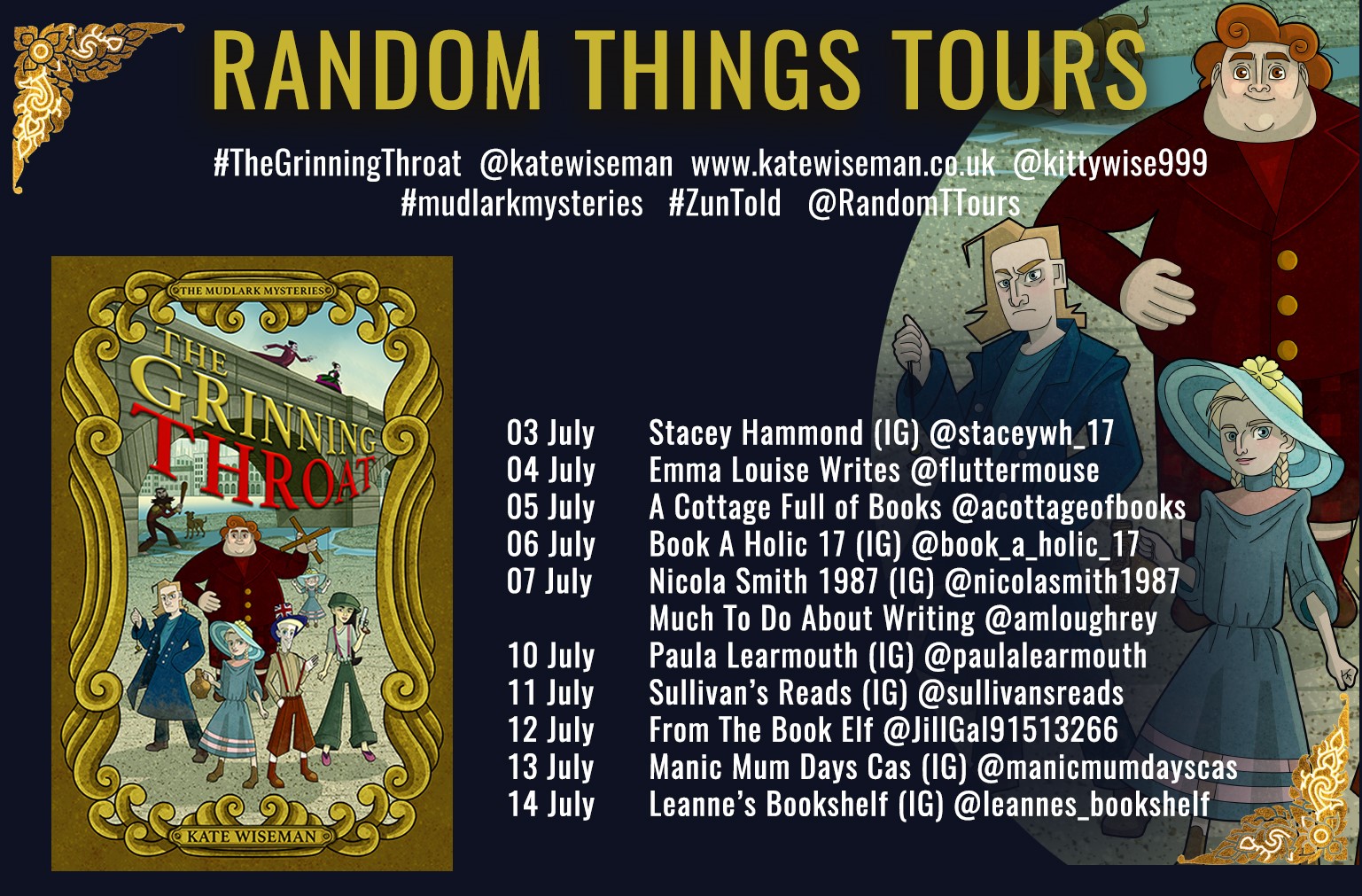
To follow the rest of the tour check out the schedule below:

I would like to thank Anne Cater from Random Things Tours for inviting me to take part in this blog tour. Thank you.

Special Guest: Q & A with Lorraine Gregory

I am thrilled to have Lorraine Gregory as a special guest on my blog today to celebrate the launch of her latest novel, Interdimensional Explorers.

Lorraine has had various jobs over the years including school dinner lady, chef and restaurant manager but she has always had a secret desire to be a writer. She writes middle grade fantasy, with zany characters, which zip off on adventures, fighting monsters and evil villains.

Interdimensional Explorers is the first in a brand-new sensationally spacey, action-packed adventure. Nothing exciting ever happens on twelve-year-old Danny’s estate. That is until he falls through a locker in his grandad’s workshop and finds himself in an Interdimensional Lost Property Office! And – even weirder – his new boss is a giant purple squid on a segway.

Now Danny, best mate Modge and annoying cousin Inaaya find themselves in charge of returning alien items to all corners of the universe. But someone – or something – is determined to stop them. And there’s NOTHING these evil aliens won’t stop at to achieve complete multi-dimensional domination, even trapping Danny and his friends on a planet a million light years away from Earth.

Now for the part you’ve all been waiting for… the interview.

********

Hi Lorraine,

Thank you for agreeing to be interviewed on my blog on the day of Interdimensional Explorers release, Thursday 8th June 2023.

The multiverse has been something that has fascinated and inspired me since I used to watch Sliders as a child, so when I heard about your latest book Interdimensional Explorers I just had to learn more about it.

So to start, please tell us a little about yourself and the inspiration for your book, Interdimensional Explorers.

Hi Anita, thanks for inviting me on your blog. I’m a mixed race kid brought up on a council estate and I never saw myself in books growing up. I wanted to give kids like me a story – not an issue story – but an amazing sci fi adventure.

Why did you decide to write a book about the multiverse for children?

Having a multiverse gives me so many options and opportunities for different worlds and ideas. It allows me to play around with world building as much as I like which is what I love to do. At the same time I hope it will spark children’s imaginations and encourage them to explore more sci fi.

What comes first for you the plot, or the characters, and why?

It’s always characters for me. I have to find them first and the plot grows around them. It’s important to me that the characters drive the story because their motivations and reactions are key to making any story believable.

What are the underlying themes of your novel, Interdimensional Explorers?

I think there are a few, loyalty, friendship and learning to believe in yourself no matter where you come from or what other people might think.

How much research did you need to do for your book? 

Because the sci fi in my book is more fiction than science not a huge amount! I did read up on some theories about multiverse’s but everything is quite vague so I felt happy to just let my imagination go wild!

If you could be a character in any of your books, who would you be?

That’s quite a tricky question. I write quite a lot of evil villains and I’m mean to most of my main characters! I’d maybe be Tingle from Maker of Monsters because she has the confidence of all cats and I’d love a bit more of that!

What writing advice would you give to people aspiring to be a children’s book writer?

Read as much as you can! You can learn everything about story structure from reading, and then write as much as you can. Try different genres and styles until you find one that works for you, explore different ideas till you find one that you can’t ignore and then polish it as much as you can. Then  try and find a crit group – online or in person – and get people to read your work and give you feedback, then start editing your work. Repeat the process.

How did you celebrate when you finished writing Interdimensional Explorers?

Interdimensional explorers was written during Lockdown and opportunities to celebrate were limited so I treated the family to a takeaway and a movie for putting up with me writing all the time!

Thank you Lorraine for taking the time to answer my questions for my blog, Much To Do About Writing, I am looking forward to reading the next book in the series.

Thank you for having me Anita and all the great questions. The next book will be heading to Earth in March 2024!

********

You can find Lorraine on twitter @authorontheedge and you can check out her website Lorraine Gregory Author: www.lorrainegregoryauthor.co.uk

Lorraine recommends the independent bookshops like https://chickenandfrog.com and https://rocketshipbookshop.co.uk as two of the best places to purchase her books. You can also order online at at uk.bookshop.org, an organisation with a mission to financially support local, independent bookshops.

An interview with… Lynne Hackles

For my last ever Research Secrets interview for the national Writing Magazine, Writers Forum I was lucky enough to interview Lynne Hackle about how she researched her romantic comedy when she was unable to go out of the house.

Lynne first wrote this romantic comedy novel, back in 2002 and states it is actually more comedy than romance. It didn’t have a title back then and she put it away and rediscovered this gem in 2020 when Covid struck. She explains she had learnt a lot in twenty years and knew it could be improved.

Lynne told me she was about to do a major rewrite when my brother died from Covid. Losing a younger sibling is hard and Lynne revealed she had a sort of breakdown because she found she couldn’t, and didn’t want to, go out. This meant she couldn’t get out to do any research and she really needed to find out how Job Centres worked.

She explained this was a problem because her opening chapter started with my main character, Gail, being in a Job Centre and she hadn’t been inside one since she wrote the first draft. There was only one solution – to set her story back in time. She decided that beginning it in the first few days of the new millennium would save her the stress of trying to go out into the world and risking a panic attack.

Gail starts off in the Job Centre because her boss has made her and her best friend, Dilys, redundant. The two women, both fifty years old and with no qualifications, find it impossible to find work so start a cleaning agency. Gail, stuck between an eccentric mother and a wayward daughter, lists her problems, the final one being to get laid, and then starts to solve them all, with what she hoped would be help from her imaginary agony aunt.

Lynne told me she always had a secret dream to be an agony aunt and always turn to the problem pages in magazines first. She has even used some of the problems she’s read to help her write short stories, many which were published in the weekly woman’s national magazines.

Gail needed an agony aunt but, instead of writing to one, she conjured up her very own. This lady in pink was going to be a proper agony aunt, kind and helpful, similar to the ones in the book, but she turned into one of those characters novelists talk about – the ones who have their own ideas as to what they are going to do. Sometimes she offered advice, sometimes she turned up when she wasn’t wanted, and she also had days off, refusing to answer questions.

Really, she was about as much help to Gail as thermal knickers in a heatwave. Her part grew as the book progressed and grew even more when Cahill Davis Publishing and Lynne came up with the title, Gail Lockwood and her Imaginary Agony Aunt.

The shop from which Gail was made redundant actually existed in Worcester. Lynne revealed she once once worked there selling all sorts of interesting stuff like miners’ knee pads and gas mask holders. There were lots of baskets filled with miscellaneous goods and every morning they would take shoe rails and coat racks outside. she remembered her easy-going manager asking her to make a price label for some men’s grey Mac’s.

Using a felt tipped pen she drew a picture of the back view of a man with no trousers on, arms holding his Mac’ wide open and his bare bottom revealed in the split at the rear and added ‘Flashers Macs’ and the price. All the Macs were sold by the end of the day. She borrowed the men’s grey Mac’s and other stock for her fictional store BJ’s, called that because the owner, Bradley Jones, used his initials for the name, though Gladys and Dilys said it stood for Bloody Junk. Bradley was a cross between the manager of the original shop Lynne had worked at, and her boss from the building society she worked at later. In the novel BJ’s moved itself to an optician’s she had worked at in Malvern.

Lynne kept Malvern library in its original place but replaced Malvern Hills with a new housing estate and moved the whole town a little closer to Birmingham. She explained it was like looking at that entire area and stirring things around to get a new place. Lynne believes you need to be able to see where a story is set.

“I could have drawn a map but because of using a place I knew well, I kept Chenwick, in its entirety, in my head.”

Lynne Hackles

To research her other settings such as, Spain and Australia, she started watching A Place In The Sun in particular couples looking for homes in Spain. One pair wanted an apartment near a golf course and immediately, she knew this was exactly what she needed for Gail’s ex-boss to retire to. As for Australia, Dilys uses some redundancy money to go to her daughter’s wedding there.

“I asked my friend Glynis Scrivens, who I call my cyber-sister, for help. She made sure the times and seasons were correct. I’d watched Neighbours in its early years and seen what a hotel could look like and the sort of houses that were in Ramsay Street. Television can come in very useful.”

Lynne Hackles

Gail’s mother, Pearl, plays a good-sized part in the story. Her eccentricities included the way she dressed, jumping through different eras. No two days were alike. The 1960s weren’t a problem. Pictures of girls wearing mini-skirts, crocheted dresses, and white boots were all over Facebook. Going back to the 1950s meant trawling though shutterstock.com and pinterest.com. One outfit Pearl wore came directly from the film, Doctor Zhivago. Lynne said she enjoyed researching these different fashions from different eras by looking at photos and dress patterns on the internet.

Her tip for other writers and for anyone unable to go out, whatever the reason may be, then the internet is a wonderful resource. Not just Google, but friends online too. Ask a question and you’ll get lots of responses.

To find out more about Lynne Hackles and her books visit her website: www.lynnehackles.com

Blog Tour – Sunbolt by Intisar Khanani

Today it is my turn on the blog tour for Sunbolt by Intisar Khanani. This tour is part of the Book Bloggers’ Novel of the Year Award (BBNYA). This year, the BBNYA is celebrating the 55 books that made it into Round Two with a mini spotlight blitz tour for each title. BBNYA is a yearly competition where book bloggers from all over the world read and score books written by indie authors, ending with 10 finalists and one overall winner.

If you want some more information about BBNYA, check out the BBNYA Website: https://www.bbnya.com/ or take a peek over on Twitter @BBNYA_Official. BBNYA is brought to you in association with the @Foliosociety (if you love beautiful books, you NEED to check out their website!) and the book blogger support group @The_WriteReads.

Sunbolt is a young adult fantasy about an orphan called Hitomi. The winding streets and narrow alleys of Karolene hide many secrets, and Hitomi is one of them. Orphaned at a young age, Hitomi has learned to hide her magical aptitude and who her parents really were. Most of all, she must conceal her role in the Shadow League, an underground movement working to undermine the powerful and corrupt Arch Mage Wilhelm Blackflame.

When the League gets word that Blackflame intends to detain—and execute—a leading political family, Hitomi volunteers to help the family escape. But there are more secrets at play than Hitomi’s, and much worse fates than execution. When Hitomi finds herself captured along with her charges, it will take everything she can summon to escape with her life. Sunbolt is publsihed by Purple Monkey Press.

The author, Intisar Khanani, grew up a nomad and world traveller. She has lived in five different states as well as in Jeddah, on the coast of the Red Sea. Intisar used to write grants and develop projects to address community health and infant mortality with the Cincinnati Health Department, which was as close as she could get to saving the world. Now she focuses her time on her two passions: raising her family and writing fantasy. She is the author of The Sunbolt Chronicles, and the Dauntless Path novels, beginning with Thorn.

My stop on the Sunbolt tour takes the form of an author interview.

********

Hi Intisar,

Welcome to my blog. It is with great pleasure that I end your magnificent blog tour for Sunbolt with an author interview.

Tell us a little about your writing career and your latest novel, Sunbolt?

I’ve had a pretty varied writing career – I indie published my first novel, Thorn, back in 2012, and then jumped into writing The Sunbolt Chronicles. Then in 2017, HarperTeen picked up Thorn, along with a companion novel (that accidentally turned into a duology). I just put out the last book in the duology – A Darkness at the Door – last summer, and am cycling back around to this series. I’m re-releasing Sunbolt as well as Book 2 through a lovely little indie co-op called Snowy Wings Publishing (yay new cover!) in the lead-up to getting out Book 3. So I’ve done both indie, trad, and hybrid publishing (that last one was indie for North America, and trad through the UK!), and am excited to back in the indie sphere for this series!

What are the underlying themes of your novel, Sunbolt?

Sunbolt has a few different themes at play—from belonging and in-group/out-group relations, to colonization of the mind, to learning to make allies in the most unlikely places (by which I also mean, compassion). I’m sure some readers will also find other things that speak to them—for example, Hitomi deals with grief from both parent death and abandonment. While that’s a smaller thread, it’s definitely there.

What is your favourite thing about writing for young adults?

Young adults are questioning the underpinnings of their world, their looking sideways at authority and pushing back at injustice, and experiencing so many things for the first time. They also pack a lot of hope for the future—they’re not giving up, they haven’t hit some kind of overblown cynical middle-age where they just throw the towel in. Not at all. They’ve got their fire and their not afraid to use it. They’re an amazing group to write for, and having the chance to explore those realities through my writing is an absolute gift.

Is there an aspect of writing for young adults you wish someone had told you when you started out?

Not really. I’ve learned a lot as I’ve been writing, but I don’t have any major regrets as yet. I think just bearing in mind that writing is a journey, as is learning your craft, is a great help. None of us can get everything right the first time, or even the fifth. That’s okay! Just do your best, both in telling your story and making sure you do no harm in doing so.

What’s your favourite writing snack or drink?

I really love a flavored hot chocolate! I mix up my own varieties, as I tend to like less sweetener in my chocolate. Right now my two favorites are peppermint hot chocolate and a spicy blend that includes ginger, cinnamon, and red pepper (plus more!).

How did you celebrate when you finished Sunbolt?

I don’t tend to celebrate too much beyond grabbing a bowl of ice cream. XD For me, a lot of the satisfaction is in doing the work. But some of my happiest moments are getting tagged on reviews where the story meant something special to a reader. I always hope for that with my stories, and there have definitely been a couple of really special (to me) reviews that I think back to for Sunbolt.

What are your social media links where can people find out about you and your books?

I use the handle @booksbyintisar pretty much anywhere I go. Right now I’m most active on Instagram @booksbyintisar and Twitter @booksbyintisar … though really, I’ve been reducing my social media usage overall to help both my mental health and my writing time (talk about a time suck!). That said, I do have a monthly newsletter where I love to chat with readers and also share my news, and currently have a new story going out a chapter a month to subscribers. You can find out more at booksbyintisar.com/newsletter.

Thank you for agreeing to be interviewed on my blog for the last stop of your Sunbolt blog tour.

Thanks so much for having me!

********

You can find out more about Intisar Khanani and her books on her website: https://booksbyintisar.com/ and follow her on Twitter @BooksByIntisar and Instagram: @booksbyintisar.

You can buy a copy of Sunbolt by Intisar Khanani from Goodreads: https://www.goodreads.com/book/show/35696827-sunbolt and Amazon: https://www.amazon.co.uk/Sunbolt-Chronicles-Book-1-ebook/dp/B00DE2RXEM

An interview with… Liz Flanagan

For the last ever issue of Writers’ Forum #254 May 2023 I interviewed Liz Flanagan about her inspiration and worldbuilding for the Wildsmith adventure series.

Liz explained the spark for the Wildsmith stories occurred in the strange quiet summer of 2020 when life was so starkly different from what we’d expected. Before her daily walk of those lockdown months, Liz had never realised how essential walking in the woods was for her mental health.

“Even in those dark and worrying times, as soon as I was outside under the trees, I started to feel better, and I’d return from my walk more able to cope.”

Liz Flanagan

She found writing was an anchor for her and tried new things to keep busy when her other work was cancelled. She discovered she enjoyed writing for younger children. Her agent, Philippa Perry, suggested writing a middle-grade series, full of magic and hope. It’s not a massive leap to see where Liz got the idea for a beautiful forest, fostering magical animals, and discovering the magical power to heal animals and speak to them.

Liz elaborated she had been fostering cats and kittens for an animal charity, and so had three unexpected additions to their household during lockdown – a very nervous young cat and her two kittens. She often wished she could speak to her foster animals to reassure them and to find out what was wrong when they were ill or scared.

She told me she believes fantasy lets us explore real-world problems in an oblique way that can be safe for young children. Perhaps all writers do this: taking the stuff of our lives and weaving it into stories, even if it’s not immediately apparent where each element came from?

Liz said she started sketching out ideas on a piece of paper – characters, issues, locations – and this grew into a detailed chapter by chapter outline. Her outlines tend to be about a quarter of my final word count as she thinks it is think easier to make changes to a plan than it is to rewrite a whole story. She created a map, and added to it as the series grew. She also did sketches of rooms and locations around Grandpa’s house to make sure it made sense on the page. Joe Todd-Stanton’s bought these places brought to life with his incredible art.

In terms of worldbuilding she needed to be clear on the magical attributes of her characters from the start. she explained it had to be consistent within the story world and also have limits – otherwise there’s no tension. But, the witches’ spells and the wildsmith’s magical healing were described in more detail quite late on in the writing process.

After writing the first two books Liz realised the passage of time was important. and decided that time passing at the rate of around one season per book should be a feature, which is highlighted on the covers. Book one has glorious green summery forest leaves, and book two has lovely autumnal shades.

The story developed with a longer-term conflict in the shape of the war, which begins in book one and is resolved by book four. Then each story has an individual problem to solve, connected with rescuing a particular magical creature (or being rescued by one in the case of book three). There are several baddies who re-appear, as well as friends whom Rowan isn’t sure she can trust.

Liz revealed it was a challenge to keep the conflict mainly happening ‘off-stage’ so it remained age-appropriate and not too scary, but early reviews from teachers have been really encouraging. Having short chapters helps to keep the children turning the pages. It gives you that structure and encourages a natural ‘cliff-hanger’.

“My protagonist needed to have a very clear goal throughout, even if this changes as the story develops. I’m used to having lots of action in my older books, so I wanted to make these younger books equally exciting. However, it was certainly a challenge for me, learning how to write simply while keeping the pace, learning what to leave out and what to keep in.”

LIz Flanagan

LIz’s writing tip for writing for children is to think back to your own childhood. She said one thing we know really well is the childhood we experienced and how we ourselves felt as a child of different ages. So we have this incredible resource, if we can access these memories.

“Having once been a bookish, animal-fixated child who loved to climb trees, I definitely think I wrote Wildsmith: Into the Dark Forest for the seven-year-old I once was.”

Liz Flanagan

And even if we can’t retrieve our own memories, we can observe the children around us. Liz found this a helpful place to start: instead of trying to please everyone, select a child you know, or the child you once were, and write to please them.

Liz Flanagan can be found at: https://lizflanagan.co.uk, Twitter @lizziebooks, Instagram @lizziebooks17

To read the complete feature you can purchase a copy of #254 May 2023 issue of  Writers’ Forum by ordering online from Select Magazines.

To read my future Writing 4 Children or Research Secrets interviews you can invest in a subscription from the Writers’ Forum website, or download Writers’ Forum to your iOS or Android device.

Blog Tour – Inheriting Her Ghosts by S. H. Cooper

Today it is my turn on the blog tour for Inheriting Her Ghosts by S. H. Cooper. This tour is part of the Book Bloggers’ Novel of the Year Award (BBNYA). This year, the BBNYA is celebrating the 55 books that made it into Round Two with a mini spotlight blitz tour for each title. BBNYA is a yearly competition where book bloggers from all over the world read and score books written by indie authors, ending with 10 finalists and one overall winner.

If you want some more information about BBNYA, check out the BBNYA Website: https://www.bbnya.com/ or take a peek over on Twitter @BBNYA_Official. BBNYA is brought to you in association with the @Foliosociety (if you love beautiful books, you NEED to check out their website!) and the book blogger support group @The_WriteReads.

Inheriting Her Ghosts is a Victorian gothic horror novella. Eudora Fellowes discovers she’s the sole heir of her estranged great-aunt’s seaside manor house High Hearth, so leaves her childhood home with her two faithful hounds hoping for a peaceful escape and a new start.

But High Hearth is a place of tragedy and deception, and Eudora discovers that the secret to her great-aunt’s clandestine history lies behind the door with no key. She soon realises Inheritance often comes with strings attached, but rarely are they as tangled as those hanging over High Hearth. What awaits is a dark legacy shrouded in half a century of secrets. It doesn’t take long before Eudora realizes she’s not the only one to call High Hearth home.

The author, S.H. Cooper is a Florida based, multi-genre author with a focus on horror and fantasy. Her work has been published by Sleepless Sanctuary Publishing, Cemetery Gates Media, and Brigids Gate Press. In addition to short story collections and novels, she is also the writer for the horror comedy podcast, Calling Darkness.

When she’s not writing, she’s thinking about writing, talking about writing, or sleeping (wherein she dreams about writing). She is kept up and running through the tireless efforts of her extremely supportive family and coffee. Her horror novel, Inheriting Her Ghosts, is published by Sleepless Sanctuary Publishing on the 9th July 2021

My stop on the tour involves an interview with the author, S. H. Cooper about the writing of Inheriting Her Ghosts.

********

Welcome to my blog. Thank you for agreeing to be interviewed by me as part of the penultimate stops of your blog tour for your haunting new book Inheriting Her Ghosts.

Tell us a little about yourself and the inspiration for your book Inheriting Her Ghosts.

I’m an American author of horror and fantasy. I’ve been a writer for as long as I can remember, completing my first novel-length manuscript (which would much later become my YA fantasy novel, The Knight’s Daughter) at eleven years old. While I’ve always loved horror as a genre, I didn’t start writing it until 2016, when my sister suggested I check out the NoSleep subReddit to combat a long bout of writer’s block. It worked like magic and suddenly the words were flowing! Since then, I’ve published a slew of short stories, six books, co-edited two anthologies, and co-wrote a podcast.

Inheriting Her Ghosts drew inspiration particularly from Susan Hill’s The Woman in Black and Guillermo del Toro’s 2015 film, Crimson Peak. I’ve always been drawn to haunted houses and the gothic flair of both works struck a chord with me. The story of IHG came quite unexpectedly as I’d not done much in the gothic vein, and never anything Victorian. One day, I just heard a very distinct voice in my head (that sounded exactly like voice actress Erika Sanderson of The NoSleep Podcast) say, “The house inherited me as much as I did it. We were alike, this house and I…”, and wrote it down, not knowing I’d just met Eudora Fellowes and been given the opening lines to her dark tale.

How do you select the names of your characters?

Honestly, most of the time, there isn’t much of a selection process at all. It often feels less like I’m coming up with stories and more like I’m simply transcribing something that’s being told to me. Crawford Bentley was always Crawford Bentley, I never wondered over what to call Black Shuck and Cerberus. They just were. Eudora was actually a rare exception. She started with an entirely different name that never quite felt right, and early on, my editor, Elle Turpitt, confirmed my suspicion that it seemed off. Without knowing exactly what I was looking for, I started scouring Victorian baby name lists and when I finally came across the name Eudora and surname Fellowes, it just clicked and I knew without any doubt that was meant to be her name.

What is the most difficult part of your writing process? 

Getting in my own head. Longer works in particular give me a lot of time to second guess, cast doubts, and worry over the most minute details that a reader probably won’t even notice, much less question (“Is the color of this furniture appropriate for the time period?”, “Is ‘nightgown’ or ‘night clothes’ the better term?’, etc.). Thankfully I have a wonderful group of fellow author critique partners and, as mentioned before, my editor, Elle. They’re great at helping me work through my own thoughts and excellent motivators.

What part of Inheriting Her Ghosts was the most fun to write?

100% Eudora’s relationship with her dogs, Black Shuck and Cerberus. They’re loosely based on my own dogs and it was so easy and enjoyable to bring the love I have for them to the page. While my pups aren’t as large, intimidating, or (let’s be honest) well trained as their book counterparts, I have no doubt they’d put themselves between me and any perceived danger and I’d definitely throw down with a ghost if it threatened them.

Where is your most productive place to write?

This is my “Don’t be like me, be better” answer: My phone. It’s a horrible habit. Don’t do it. Since I can take it anywhere, location doesn’t matter that much, but it must be totally quiet and uninterrupted. While music can help get me in the mood to write before I actually sit down to do so, it gets shut off the moment I’m ready to put proverbial pen to paper and if anyone interrupts me while I’m in The Zone, I…typically politely ask them to wait until I’m done, but there is some serious side-eye while I do it.

What is the most valuable piece of advice you’ve ever been given about writing?

Take every piece of advice you’ve heard about writing and chuck it out the window. Ok, maybe not the stuff about having to be disciplined and, as with any art form, needing to practice, but most of the other fluff. The “How Stephen King Writes a Billion Novels a Year” and “One Hundred Ways You NEED to Change to Be a Real Author” type schlock. Writing is an extremely personal process and what works for Mr. King might only be a roadblock for you. Maybe you’re a plotter, maybe you’re a panster, maybe you write better with a set word count to reach, maybe it’s easier to never count words at all. The how you do it isn’t nearly as important as the fact you’re just doing it. Figure out your system and grow in the way that works best for you (unless your way is writing on your phone…).

Thanks again for your time in answering my questions. I am looking forward to taking a peek at the last posts in the tour tomorrow.

********

You can find out more about S. H. Cooper and her books on her website: www.authorshcooper.com and follow her on Twitter: @MsPippinacious and Facebook: @pippinacious.

To can buy a copy of Inheriting Her Ghosts by S. H. Cooper on Goodreads: https://www.goodreads.com/book/show/58424258-inheriting-her-ghosts and Amazon: https://www.amazon.com/gp/product/B0977PL7BB.

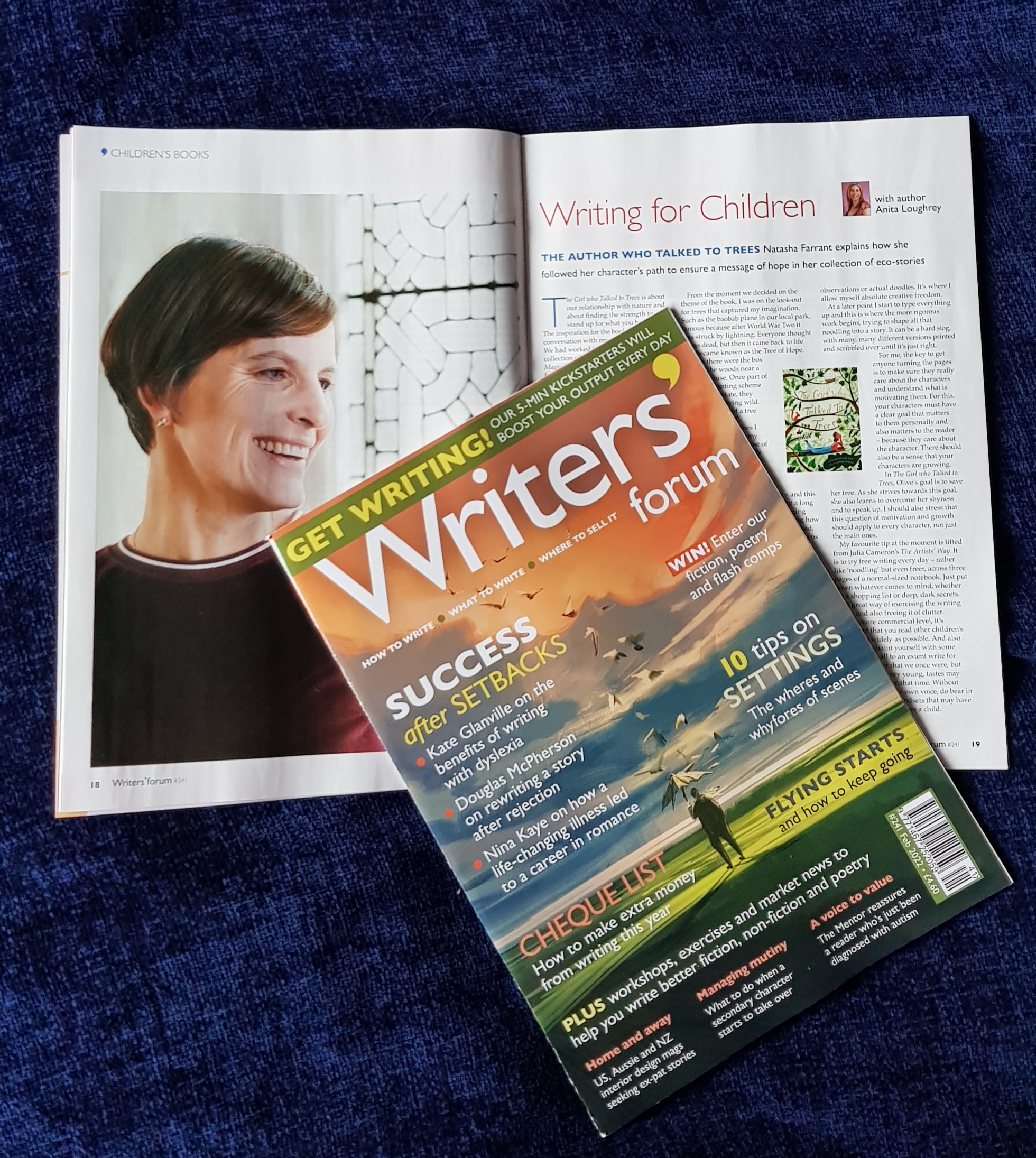
An interview with… Natasha Farrant

When I interviewed Natasha Farrant for issue #241 20 Jan 2022 of Writers’ Forum, she explained how she ensures there is a message of hope in her books for children.

At a fundamental level, The Girl Who Talked To Trees is about our relationship to nature and about finding the strength to stand up for what you believe in. The inspiration for the book was born of a conversation with her publisher at Zephyr. They had worked together on another collection of stories, Eight Princesses And A Magic Mirror and were thinking of ideas for a new book along a similar format. For a long time she had been thinking about how to respond creatively to the climate and ecological crisis.

She said it is so difficult to know how to do this for children – at an existential level, how do you balance the magnitude of the crisis with hope for the future? One of Natasha’s publishing friends suggested to do it through myth and fairy tale, and that really struck a chord with Natasha.

“I knew I wanted to write about the crisis but I also knew I wanted a book that would give hope for the future. I’m not saying trees are going to get us out of this mess, but they are a key part of the jigsaw – and such a relatively simple part.” 

Natasha Farrant

She continued there are two elements to the book: the major element is the stories themselves, but each story is introduced by a number of science facts. Natasha feels stories are such a powerful force in bringing about change, but without the science we’ll get nowhere.

As with all her books, though the themes are serious and the starting point in this case was so huge, the overall aim remained the same: to tell stories which would captivate and transport. She spent a long time thinking about Olive and getting to know her, wondering what traits I could give her that children could identify with.

So:

‘She was clever and kind and intensely shy and her best friend was a four-hundred-year-old oak.’

Extract from The Girl Who Talked To Trees

Which fits, because:

‘When you are so shy you dare not even look at anyone in case they want to talk to you – or worse, want you to talk to them – a tree is a very sensible choice for a friend.’

Extract from The Girl Who Talked To Trees

From the moment they decided on the theme of the book, Natasha was on the look-out for trees which captured her imagination, like the baobab plane in our local park, famous because after World War Two it was struck by lightning. Everyone thought it was dead, but then it came back to life and became known as the Tree of Hope. Then there were the box trees in the woods near one of her friend’s homes. Once part of a formal planting scheme on a grand estate, they were now growing wild. Natasha liked the idea of a tree that had escaped. 

Natasha revealed she prefers to write long hand, using a refillable fountain pen (no throwaway plastic) her husband bought her as a gift twenty years ago. She uses extra-large Moleskine notebooks because she likes their paper, and few things give her greater pleasure than the sensation of ink gliding across those smooth pages.

“This is a serious point: writing is hard, so it’s important to make those bits I can control as pleasurable as possible.”  

Natasha Farrant

The notebook writing is for doodling, or as a fellow writer calls it, noodling. Natasha sets herself a goal of three pages a day for a first draft, and tries not to think too much about what she is writing so it is more like exploring, free to go in any direction she desires. She writes on the right-hand page, leaving the left-hand page free for notes, observations or actual doodles. She allows herself absolute creative freedom.

At a later point she starts to type everything up. Natasha claims this is where the more rigorous work begins, of trying to shape all that noodling into a story. This can be a hard slog, with many, many different versions printed and scribbled over and retyped until it’s just right.

For Natasha, the key to get anyone turning the pages is to make sure they really care about the characters and understand what is motivating them. For this, your characters must have a clear goal, that really matters to them personally and – because they care about the character – also matters to the reader. There should also be a sense that your characters are growing.

In the case of The Girl Who Talked To Trees, Olive’s goal is to save her tree. As she strives towards this goal, she also learns to overcome her shyness and to speak up. Natasha stressed this question of motivation and growth should apply to every character, not just the main protagonists.

Natasha said, if you want to write for children, it’s important that you read other children’s authors as widely as possible. And also that you acquaint yourself with some children.  We all to an extent write for the child reader that we once were, but unless you are very, very young, tastes may have evolved since that time. Without losing sense of your own voice, do bear in mind trends and mindsets which may have changed since you were a child.

You can find out more about Natasha Farrant at www.natashafarrant.com, @NatashaFarrant1 (Twitter) and @natasha_farrant (Instagram)

To read the complete feature you can purchase a copy of #241 20 Jan 2022 issue of  Writers’ Forum by ordering online from Select Magazines.

To read my future Writing 4 Children or Research Secrets interviews you can invest in a subscription from the Writers’ Forum website, or download Writers’ Forum to your iOS or Android device.

An interview with… Rachael Davis

I spoke to Rachael Davis about her experience of working with the children’s book packager Storymix, for the Writing for Children slot in Writers’ Forum issue #253 19 Apr 2023.

Rachael explained book packagers are companies that essentially put together books for publishers by pairing up the right talent with the right ideas. They are NOT a publisher. Once they create a book idea, they commission a writer to do a sample. This sample is submitted to publishers and the book packager will hope to get a ‘traditional book deal’. The writer may receive a percentage of the royalties the book packager is paid by the publisher, but this is not always the case. Sometimes the writers work for a fixed fee.

In some cases, a publisher may approach a book packager with an idea of the type of book/series they are looking for. The book packager will then work up a plot and outline, bring on an author to write the sample, and then the publisher will be given an exclusive first-look opportunity to acquire the series from the book packager. If that particular publisher doesn’t move forward with the project, the book packager would then have the right to try to sell the project to other publishers.

In all cases, it is important to realise that the intellectual property of the book/series belongs to the book packager, not the writer. The book packager is the creator of the series. The writer’s job is to bring their unique creative flare and voice to the project.

Jasmine Richards is the founder of Storymix. She isn’t a fan of the word ‘book packager’, she prefers ‘book incubator’. At Storymix, they have a unique mission to centre black and brown children in super fun, often fantastical adventure stories. Previously, Jasmine worked at a book packager called Working Partners, who developed Beast Quest and Rainbow Magic.

After working as an editor for 15 years, she founded Storymix to bring about positive change in the industry and make sure books on the shelves reflect all children. Jasmine works exclusively with diverse writers and illustrators, providing many of these unagented creatives with an unparalleled opportunity to work with the biggest publishers in the industry.

Rachael told me that back in November 2020, Jasmine reached out to Rachael’s agent to see if I might be interested in sampling for Storymix. She explained the opportunity as a ‘paid creative writing course’. It’s an opportunity to be paid to work with brilliant editors, learning about plot, characterisation. If the book is commissioned, you get to experience the publishing and editorial process. But it is not the same experience as getting a traditional book deal as there is less input at later stages. Jasmine told Rachael about a few different projects and as soon as she described Secret Beast Club she knew it was a project she wanted to be a part of. In Spring 2021, Jasmine commissioned Rachael to sample for Secret Beast Club.

“Thankfully, she loved my sample and it went on submission to publishers in the summer 2021. Puffin snapped up the series in a three-book deal. At this stage, Jasmine brought on the wonderful Clare Whitson to work as my editor who kept me updated with proofs and cover choices, alongside Puffin editor, Jane Griffin.”

Unlike with a traditional publishing deal, when you work with a book packager you don’t have the same level of responsibility for planning, plotting and story arc consistency. This is where the brilliant team at Storymix come into their own. As the writer, your role is to bring the voice and develop strong characterisation.

Often when working with book packagers, you receive less rights and lower royalties. However Rachael would absolutely recommend Storymix. She has found their rates and treatment of authors to be exceptional. But Rachael stressed this is not true of all book packagers and you should make sure you know what you are signing up for. While you can be unagented, having an agent or the Society of Authors check any contracts is important.

The Secret Beast Club series is written under the Pseudonym, Robin Birch. Rachael explained series developed by book packagers, particularly for young readers, are often written under a pseudonym. There are two reasons for this. Firstly, as mentioned the concept is the intellectual property of the book packager, not the writer. Secondly, if a series becomes successful additional writers may be brought in to write subsequent books.

Robin Birch is the collective pen name for children’s writer, Rachael Davis and series creator Jasmine Richards, who is the founder of Storymix and the Inclusive Children’s Fiction Studio. Together with their editors, Clare Whitston and Jane Griffiths. The Secret Beast Club adventure took shape and was brought to life by illustrator Jobe Anderson, designer Jan Bielecki and text designer Anita Mangan.

Rachael’s advice to writers wanting to work with a book packager is to work out who the book packagers are and what types of books they publish. Working Partners is a good place to start, and if you are a writer of colour (agented or unagented) she definitely recommends getting in touch with Storymix.

Some people can be a bit snobby about writers who work with book packagers, because the series plot is developed by the packager and not the writer. Rachael said this kind of collaboration is used all the time in other creative industries such as film and TV, and I personally have had a fantastic experience.

“Not only have I got to be part of a fantastic, ground-breaking chapter book series, but I have also had the opportunity to work with talented editors and hone my writing skills. I would highly recommend writers (agented and unagented, published, unpublished or self-published) consider whether working with a book packager is a good fit for them.”

Rachael Davis

Working with a book packager is not for everyone. Some writers will absolutely thrive, while others might find the lack of creative freedom to deviate from the book packager’s plot line constraining. You also have to be able to work to tight deadlines and not be precious about edits. It is not uncommon for a book packager to make changes to the text after the writer has completed their final draft.

However, if you can embrace the collaborative approach, working with a book packager can be a fantastic way to develop your skills as a writer, and go on to get traditional book deals later down the line. When you submit a sample to a book packager, they are looking for a fresh, original voice. Always keep in mind – what makes you the right writer for the project? Once the plot is created, technically any writer could write it, but what is it that your unique voice will bring to the project?

“At the heart of the Secret Beast Club series is friendship and teamwork, which is ever so fitting because this book has been a real team effort to create.”

Rachael Davis

The first book in the series Secret Beast Club: The Unicorns of Silver Street is out this month and Secret Beast Club: The Dragons of Emerald Yard is released later this year, in July 2023. At the heart of the Secret Beast Club series is friendship and teamwork, which is ever so fitting because this book has been a real team effort to create.

To discover more about Rachel Davis and her writing see her website: www.rachaeldavis.co.uk and follow her on Twitter @RachDavisAuthor & Instagram: @RachDavisAuthor

To find out more about Storymix go to: www.storymix.co.uk

To read the complete feature you can purchase a copy of #253 19 Apr 2023 issue of  Writers’ Forum by ordering online from Select Magazines.

To read my future Writing 4 Children or Research Secrets interviews you can invest in a subscription from the Writers’ Forum website, or download Writers’ Forum to your iOS or Android device.