Anita Loughrey's blog. This is my journal about my experiences and thoughts on writing. As well as news about me and my books, it includes writing tips, book reviews, author interviews and blog tours.
For more information about me and my books see my website: www.anitaloughrey.com. Follow me on Twitter @amloughrey, Facebook @anitaloughrey.author and on Instagram @anitaloughrey
The Secret garden by Claire Freedman and Shaw Davidson
Claire Freedman’s adapted version of The Secret Garden by Francis Hodgson Burnett has been illustrated by Shaw Davidson to produce the perfect picture book for older children. Launched in 2020 to coincide with the release of the new movie.
Follow Mary Lennox from India to Yorkshire, England, and watch her change from a sullen, over-privileged girl who has never tied her own shoes, to a happy, caring young woman. In her adventures, Mary meets Dickon’s, a young boy who can talk with animals. Together they discover the garden hidden behind the mysterious locked door and help her sick cousin, Colin, to recover. Guided by a remarkable red robin, Mary grows simultaneously with the amazing secret garden.
For over a century children, young adults, and adults of all ages have been touched by this masterpiece now it can be enjoyed in this fabulous picture book by KS1 and KS2 too. Claire Freedman and Shaw Davidson encapsulate Mary’s, Dickon’s and Colin’s characters impeccably keeping them true to the originals. This picture book brings the old 1911 classic alive by giving it a new energy. You can really see the garden blooming back to life in this magical adventure.
KS2 children will enjoy reading this book alone and it is ideal for reading aloud to KS1 during story time.
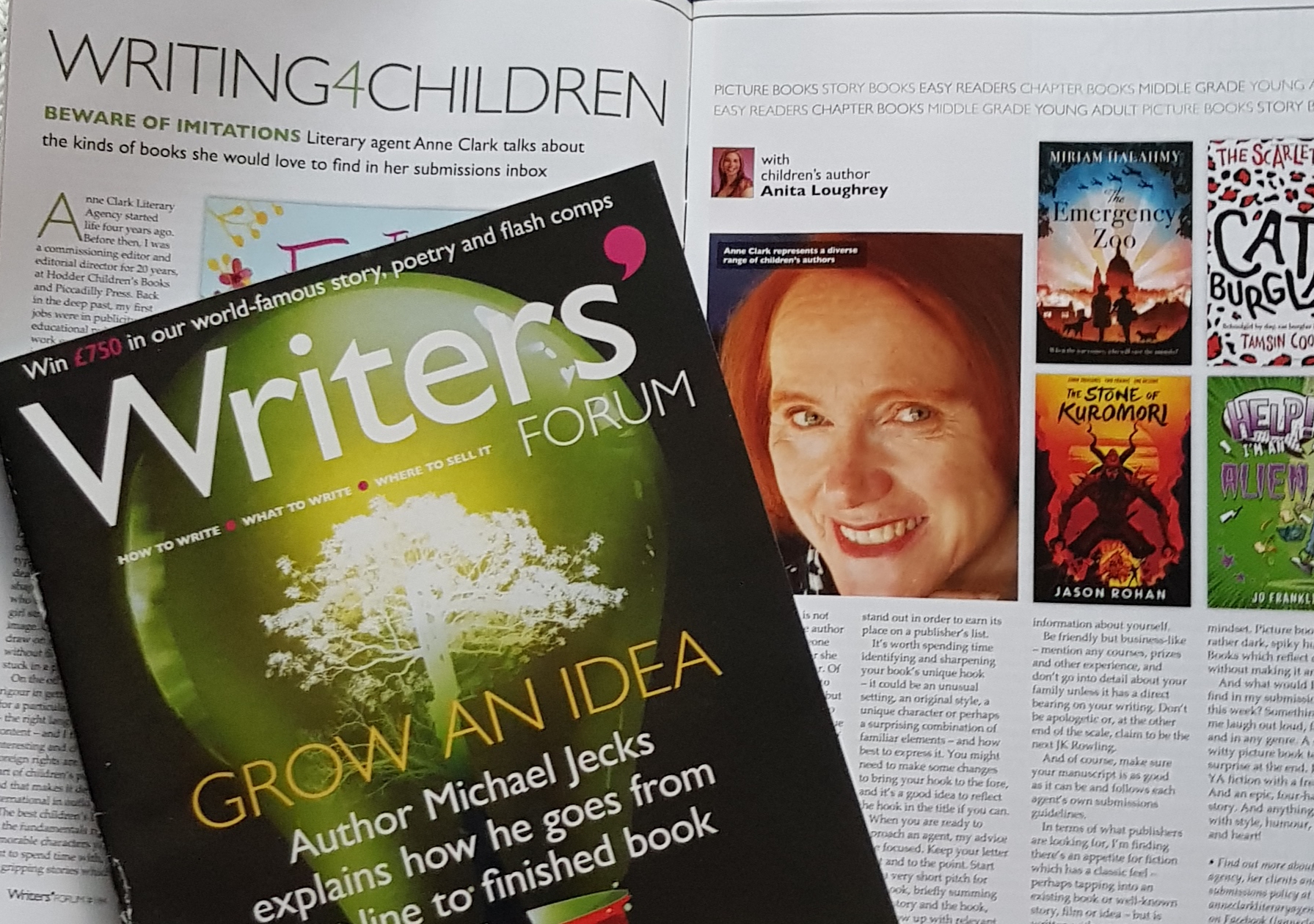
In February 2017, I interviewed literary agent Anne Clark about her children’s book agency and the kinds of books she would love to find in her submissions inbox for Writers’ Forum.
The Anne Clark Literary Agency started life nearly eight years ago. Before then, Anne worked in children’s publishing as a commissioning editor and editorial director for twenty years, at Hodder Children’s Books and Piccadilly Press. Her first jobs were in publicity and educational publishing.
She told me that she started the agency because it was the right time for new adventure, one which meant she could still do the things I like doing most – working with authors and publishers to get new books out into the world for children and teenagers to read and enjoy.
She explained children’s books are a joy because there is such freedom and variety in terms of subject and style. In a typical morning she might be dealing with a clumsy fairy, a shapeshifting cat burglar, a boy who thinks he’s an alien and a girl struggling with her body image. Children’s writers can draw on magic and fantasy without finding themselves stuck in a particular genre. She enjoys rigour in getting things right for a particular age group – the right language, right content. She said foreign rights are also an important part of children’s publishing giving it an international feel.
Anne revealed the best children’s books get the fundamentals correct: memorable characters you want to spend time with, and gripping stories which keep you turning the pages. Successful children’s authors don’t talk down to kids and they often show young people taking control of their worlds in some way, whether it’s a four-year-old with a tricky witch or a teenager with a bullying boyfriend. They may tackle difficult subjects but they offer hope. Her favourite books also stretch readers’ minds, taking them somewhere new and interesting – maybe to a Tokyo where mythical monsters roam, wartime London or inside the head of a refugee.
“An agent needs to be a talent-spotter, able to spot a promising newcomer at a hundred paces; a nurturer of authors, offering editorial direction, honest feedback and encouragement in wobbly moments; a market expert, in touch with trends and editors’ wish lists and pet hates; a shrewd salesperson; a negotiator of deals; and a champion of her authors.”
Anne Clarke
When she opens a manuscript from a new writer, she first looks for the author’s voice, and that comes over very quickly – in the first few lines and certainly within the first page or two. If she like the voice – if it feels confident, distinctive and fresh – she’ll keep reading. But she won’t be sure I want to work on a project until she has read the whole manuscript, because she is also looking for an author who can shape a whole story and take it to a satisfying conclusion.
Anne’s tip to children’s writers is to spend time identifying and sharpening your book’s unique hook – it could be an unusual setting, an original style, a unique character or perhaps a surprising combination of familiar elements – and how best to express it. You might need to make some changes to bring your hook to the fore, and it’s a good idea to reflect the hook in the title if you can.
When you are ready to approach an agent, her advice is: be focused. Keep your letter short and to the point. Start with a very short pitch for your book, briefly summing up the story and the hook, and follow up with relevant information about yourself. Be friendly but business-like – mention any courses, prizes and other experience, and don’t go into detail about your family unless it has a direct bearing on your writing. Don’t be apologetic or claim to be the next J K Rowling. And of course: make sure your manuscript is as good as it can be; and follow each agent’s submissions guidelines!
The World Made a Rainbow by Michelle Robinson and Emily Hamilton
MY first post of 2021 just has to be one with a message of hope so I have chosen The World Made a Rainbow by Michelle Robinson and Emily Hamilton. This up-to-the moment picture book published by Bloomsbury, which gives young children a chance to reminisce and discuss their lockdown experiences and any fears they may have about Covid. This book is ideal for reading at home and in the classroom or for children to explore by themselves in the book corner.
The story encompasses the joy of being at home and the dark times of never knowing when the crisis will end. It carries a message of hope from the start with the line: “All rainstorms must end, and this rainstorm must too.” The text is written in rhyme throughout so when read aloud gives the plot a lyrical feel all children will love.
The thing that immediately struck me about this book were Emily Hamilton’s bold illustrations on the light background. Each colour of the rainbow triggers a memory about her family, or lockdown life and how everyone worked together to make the best of it. Children will love to explore the pictures making up their own stories without necessarily reading the words. In this way this picture book works on many levels and is a book children will want to go back to again and again.
Last year, in the #224 Sept 2020 issue of the national writing magazine Writers’ Forum, I interviewed Nikki Marmery about some of the primary sources she used during her research for her novel On Wilder Seas: The Woman on the Golden Hind.
Nikki revealed she was pregnant when she first read about her protagonist Maria, the only woman on board the Golden Hind during Francis Drake’s circumnavigation voyage. A throwaway line in a popular history book referenced the ‘Anonymous Narrative’, an eye-witness account of the voyage, which states:
“Drake tooke out of this ship a pilate to cary him into the harbor of Guatulco and also a proper negro wench called Maria which was afterward gotten with child between the captain and his men pirates and sett on a small iland to take her adventures.”
She explained that pregnancy focuses the mind on the unique vulnerability of pregnant women, so perhaps this is why she found myself haunted by Maria’s story: a woman alone among men in the extreme environment of a tiny Elizabethan exploration ship, who was ultimately abandoned, just before the ordeal of childbirth, on a waterless desert island in the East Indies.
“I wanted to know everything about her. Where had she come from? How did she end up in this situation? How did it feel to sail into the unknown; to cross the Pacific – heavily pregnant? What happened to her after she was abandoned?”
Nikki Marmery
But she discovered the facts of her life are really scarce. Maria is not mentioned at all in the earliest published accounts of the voyage. All we know for sure is that she joined the Golden Hind on April 4, 1579 from a Spanish merchant ship off the coast of El Salvador, and that she was abandoned nine months later near the Indonesian island of Sulawesi.
With so little to go on, her investigation started more as a crusade of curiosity than a writing project. No historian had written in any detail about Maria. Miranda Kaufmann later published an excellent book, Black Tudors, which discusses her – but more often in histories of Drake, she was unnamed or erased altogether. Nikki realised if she wanted to know more about the possibilities of Maria’s life, she would have to research it herself.
From the secondary sources, she discovered the original manuscripts of Drake’s voyage are kept at the British Library. But it never occurred to her she could visit the library to read them – until friends took her on a tour of the library for her birthday. This was a turning point for Nikki.
“After having read about Maria for so long, to see the handwritten testament of someone who knew her was incredibly moving. The browned and barely legible manuscript has pinprick holes where sparks from a candle have burned the parchment. Marks are drawn in the margin to emphasise key passages. “
Nikki Marmery
Nikki explained that Maria is objectified and dehumanised by every man who has written about her: from the two surviving eye-witness accounts, to 17th century historians such as William Camden – via William Shakespeare, who may have been inspired by her story when he wrote of the witch Sycorax, an African woman who was abandoned pregnant on a desert island in The Tempest – all the way through to modern historians.
Nikki in contrast wanted to imagine what Maria would say about herself – but examples of women’s voices from the 16th century are vanishingly rare. She was delighted to discover the book Afro-Latino Voices: Narratives from the Early Modern Ibero-Atlantic World, 1550-1812, edited by Kathryn Joy McKnight & Leo J. Garofalo, which reproduces the archival records of African women in the New World – crucially, in their own words.
Another book that helped her was Dangerous Speech: A Social History of Blasphemy in Colonial Mexico, by Javier Villa-Flores where she learned how slaves used blasphemy as a strategy of resistance to fight their oppression. By renouncing God, and denouncing themselves, a slave might invoke intervention by the Holy Office, which had the authority to remove a slave from an excessively abusive slave-owner. By threatening to blaspheme before a master inflicted punishment, enslaved people practised a form of ‘moral bribery’, by holding the master accountable for the sin of blasphemy.
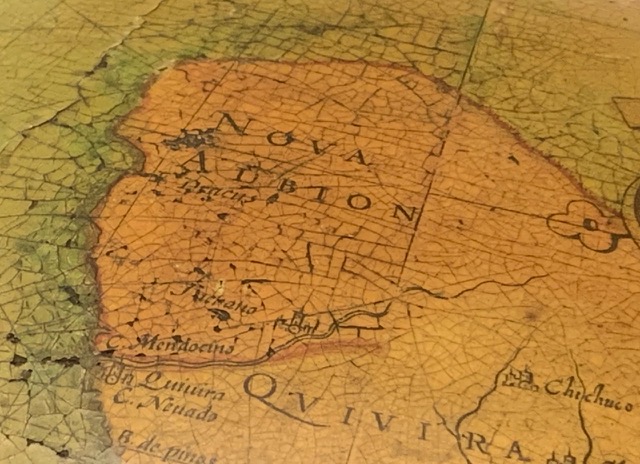
Nikki’s novel unfolds against the backdrop of an enduring mystery of Drake’s circumnavigation voyage: where was his colony, Nova Albion. Drake and his crew lived there for five weeks in the summer of 1579. But when Drake returned home in September 1580, details of his American exploration were suppressed. The Queen did not want the Spaniards to know how far north he had sailed – nor that he was seeking the Northwest Passage, which would give the English a shortcut to the vast riches of Spain’s Pacific-coast New World colonies.
When researching Drake’s voyages, Nikki discovered that secondary sources that discuss the globes are misleading: they claim there are few differences between the two models. But the 1592 globe shows Nova Albion at 46˚N, while the 1603 globe shows it further north at 48˚N, with a redrawn coastline. This is hugely significant. Molyneux had made changes to his globe to receive royal sanction for publication in 1592. But the 1603 globe was made in Amsterdam – not London – thus free from interference.
This discovery, in addition to other unpublished 16th century maps, all showing Nova Albion above the 40th parallel north, gave her the confidence to set Nova Albion in her novel on Vancouver Island, rather than California. It also offered her the freedom to fictionalise more fully what happened there, which led to my suggestion of a far more shocking end to the colony than the sources suggest.
2020 did not go as good as I had hoped. So many author visits were cancelled throughout the spring and summer terms and some of my books were postponed, due to this awful crisis we have all had to strive through. I have managed to drag myself back on my feet with the launch of my new virtual visits, which are proving to be a great success. You can book for for a visit through my website contact page or Authors Aloud UK.
In 2021 I hope to continue growing my followers and publicising my books. If you would like to help me with this goal please follow my blog and follow me on Facebook, Twitter and Instagram. You can also follow my dogs Instagram account here.
Also later in 2021, my new picture books will finally hit the shelves after being postponed for a year. So keep an eye out for them.
I hope you all have a healthy 2021 and it brings everything you wish for.
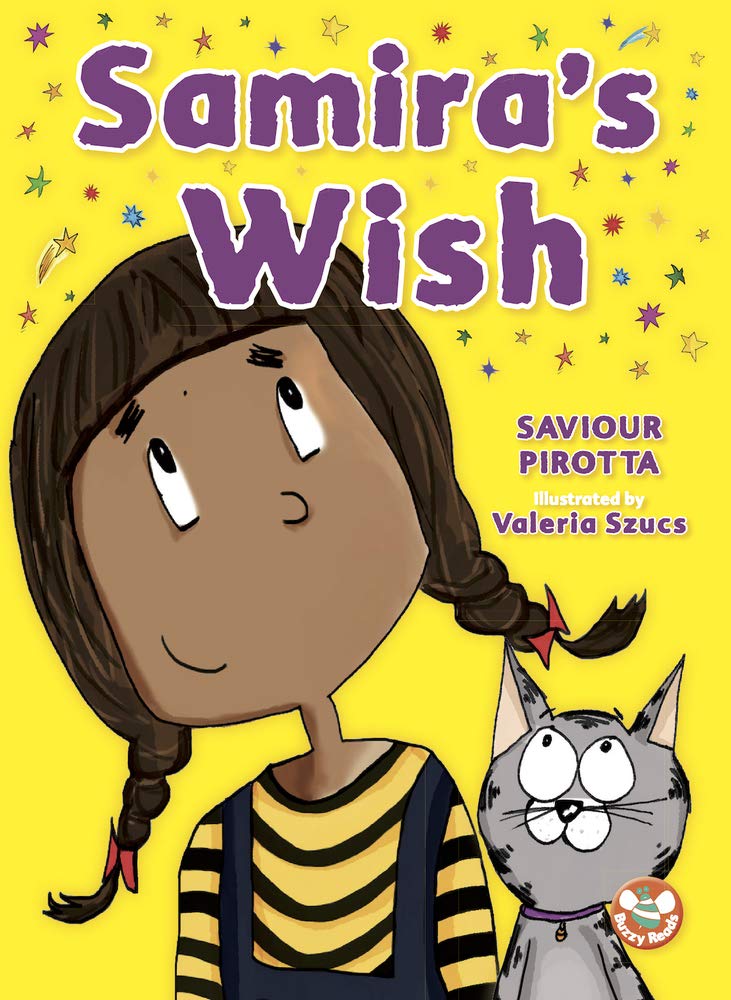
Samira’s Wish by Saviour Pirotta and Valerie Szucs
The Wacky Bee Buzzy Reads series that were released in 2020 are a great quick read ideal for Key Stage Two children to read alone.
Samira’s Wish is about a young girl who always puts others first before herself. When her grandparents come to visit she decides to make them beans on toast for breakfast as a special treat but her dad has eaten all the beans. Luckily, Mrs April the scary owner of the corner shop has one tin of beans left. Samira discovers that this is not ordinary tin of beans. They are magic beans. With every mouthful a wish can be made. But the wishes her family make do not make things better for everyone.
This book could be used as part of a PSHE lesson to stimulate discussion on sharing, being considerate, consequences and the importance of sometimes putting yourself first. It could also encourage creative writing sessions by getting to children to think of what they would wish for and the pros and cons of their own wishes.
There are some brilliant fun facts about baked beans and a healthy recipe to make home-made beans on toast at the back of the book. the recipe could be used at home or as a food technology lesson at school.
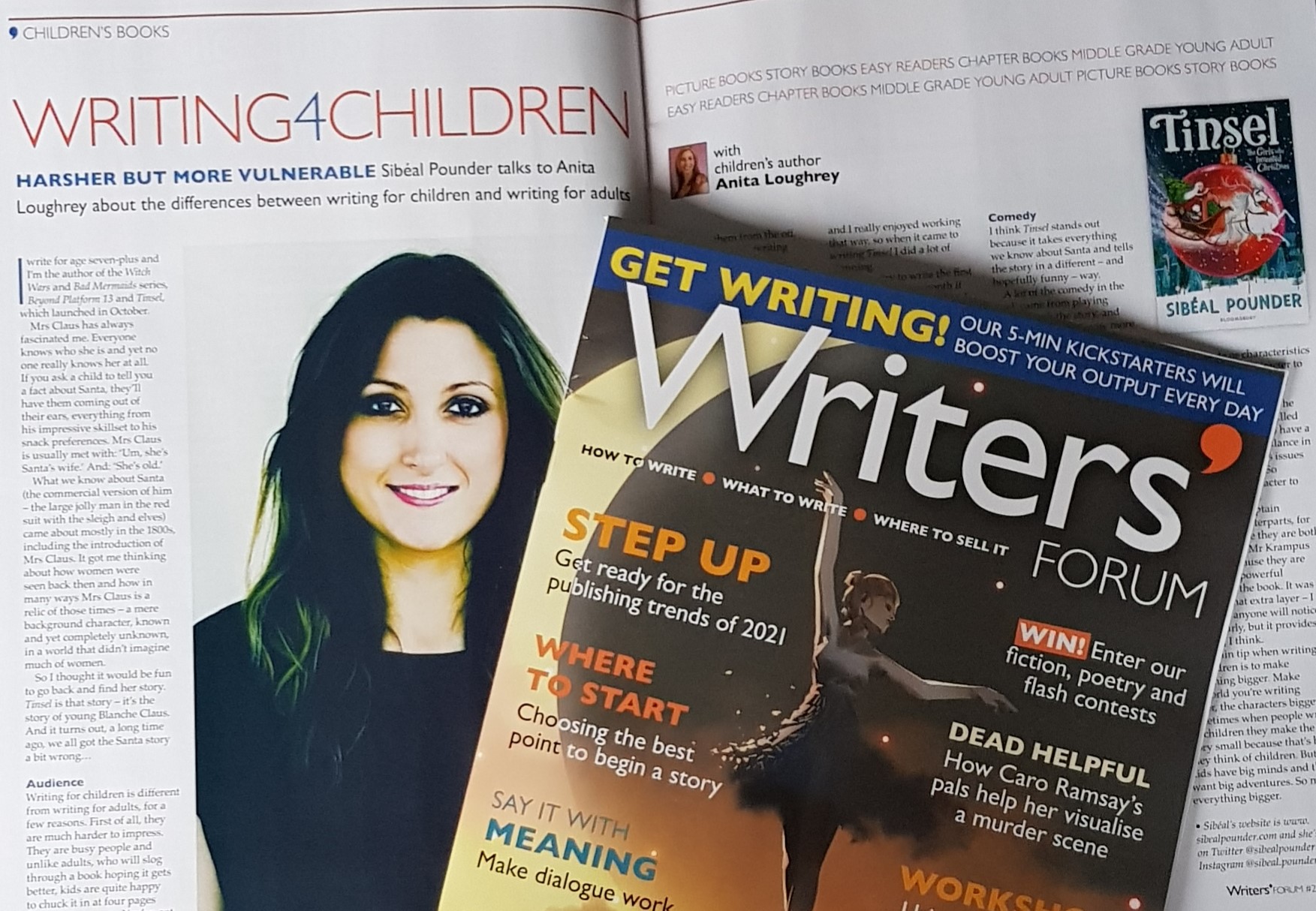
For my Writing 4 Children column in Writers’ Forum this month, I interviewed Sibéal Pounder about the differences between writing for children and writing for adults.
She writes for age 7+ and is the author of the Witch Wars, the Bad Mermaids series, Beyond Platform 13 (which is the sequel to Eva Ibbotson’s The Secret of Platform 13) and Tinsel, which was launched on Oct 29th 2020.
Sibéal explained writing for children is different from writing for adults for a few reasons. First of all, they are much harder to impress. They are busy people and unlike adults who will slog through a book hoping it gets better, kids are quite happy to chuck it at four pages deep and move on. You’ve got to hold their attention, impress and entertain them from the off.
Another reason writing for children is different is they are more vulnerable as readers. I don’t mean that to be patronising, I think kids are often smarter than adults. It’s just when adults read a book we do so with a lot of context about the world already in place. We read with a clear understanding that the author’s experiences and views may inform the content, and we come to it with a robustness and a critical eye.
Adults see books as something they read, children see books as somewhere they go. They learn from what is said and how characters are portrayed, what roles they are given and how they are treated. It’s a huge responsibility to write for children – the stories can shape how they think and feel, and you have to be very careful with that.
Two books I’d really recommend on the topic are Why You Should Read Children’s Books Even Though You Are So Old and Wise by Katherine Rundell. And Sway by Dr Pragya Agarwal, which is about unconscious bias – I found it hugely useful and eye-opening. I’d really recommend it if you’re a writer, especially a writer for children.
Each book presents its own challenges. It doesn’t get any easier! I wasn’t a big planner as I felt it was quite restrictive, but I did plan Beyond Platform 13 in great detail, down to each chapter, because it was an Estate project and Eva Ibbotson’s family and the publisher had to approve the outline before the work began. I found the planning transformative and really enjoyed working that way, so when it came to writing Tinsel I did a lot of planning. She revealed:
“Mrs Claus has always fascinated me. Everyone knows who she is and yet no one really knows her at all. If you ask a child to tell you a fact about Santa, they’ll have facts coming out of their ears – everything from his impressive skillset to his snack preferences. Mrs Claus is usually met with, ‘Um, she’s Santa’s wife.’ And, ‘She’s old.’”
Sibéal Pounder
What we know about Santa (the commercial version of him – the large jolly man in the red suit with the sleigh and elves) came about mostly in the 1800s, including the introduction of Mrs Claus. It got her thinking about how women were seen back then and how in many ways Mrs Claus is a relic of those times – a mere background character, known and yet completely unknown, in a world that didn’t imagine much of women. So she decided to find her story. Tinsel is that story – it’s the story of young Blanche Claus. And it turns out, a long time ago, we all got the Santa story a bit wrong…
I think Tinsel stands out because it takes everything we know and tells the story in a different (and hopefully funny) way. With Tinsel a lot of the comedy came from playing around with what we know now about Santa and having the reader know more than the characters. It’s set over a hundred years ago when the Santa story began and, after delivering the presents, Blanche reads the newspaper reports and exclaims, ‘They think I’m an old-bearded man called Santa Claus?’ Carol the elf assures her, ‘It’ll never catch on.’
Tinsel has quite a small cast (if you don’t count the thousands of elves all called Carol), and I wanted to have a sense of underlying balance in the book as it explores issues around gender bias. So I wanted every character to have a counterpart. Blanche and Captain Garland are counterparts, for example, because they are both adventurers, Mr Krampus and Carol, because they are the two most powerful characters in the book. It was fun to add that extra layer – I don’t think anyone will notice it but it provides a balance, I think.
When writing for children make everything bigger. Make the world you’re writing bigger, the characters bigger. Sometimes when people write for children they make the story small because that’s how they think of children. But kids have big minds and want big adventures – make everything bigger.
Thank you to all my followers, friends and family for the tremendous support you have given me over this extremely difficult year for us all. You have all been amazing. I have been blogging for two years now and although I found it very difficult to continue to write during the first lockdown your encouragement and positive comments helped me to get back on my feet and get going again. I hope you have found the information I have shared with you over 2020 useful and informative.
If there is anything you would like me to write about, any books you would love to see me review, or any of my interviews you would like me to share, please let me know.
I look forward to posting many more book reviews and interviews next year. If there is anything you would like me to write about, any books you would love to see me review, or any of my interviews you would like me to share, please let me know.
I wish you all a fantastic Christmas even though your family and loved ones may be unable to be with you.
Witch is a remarkable debut novel, which encompasses the themes of betrayal, family, friendship, identity, revenge, self-discovery and sibling rivalry. The graphic descriptive nature of the opening scenes makes them emotionally difficult to read but sets the tone and atmosphere of the book. The fear and superstition, which permeates this novel draws the reader in.
The fiery, red-haired main protagonist, Evey, is a fascinatingly flawed character who blunders through life, heart first. Her voice is unique depicting the time and place the novel is set – firmly in 17th century Wiltshire. She is determined to avenge her mother’s death at the hands of the vicious witch hunters which conflicts the promise she made to her mother that she would keep Dill, her younger sister, safe.
Keeping this promise is confounded by the fact she is jealous of Dill, believing she was their mother’s favourite as she inherited the magick and this is why their mother gave Dill the mysterious scrying stone and not her. This jealousy is magnified by Evey’s constant rejection of Dill’s nick-name for her, Eveline of the Birds. Their complicated relationship is well constructed and realistic.
Evey is torn between the duty of the promise, her love for Dill, and the tormenting jealousy that threatens to rip them apart. She refuses to accept magick also flows through her own veins and she is the strongest witch of them all. This refusal to accept her fate makes her an unreliable narrator.
In her anger, Evey steals the scrying stone from her sister in the night and goes to hunt her mother’s murderers who are gathering for the witch-trials. She leaves Dill with their mother’s elder sister, Aunt Grey, who unknown to them is a collaborator with the witch hunters. Finbar Hawkins clearly shows how accusations of witchcraft were used as a weapon against independent, strong and resourceful women, portraying an era where women were persecuted for using traditional herbal medicines.
A dramatic grim depiction of cruel times and the strength found in sisterhood and friendship. I particularly liked the friendship and love between Evey and Anne, ‘Green Eye’ the daughter of Lord Whitaker the local magistrate. Together they fight against the male dominated system and their betrayers. When the line between using magic to heal and using magic to harm becomes blurred, Anne is there to steer her on the correct moral path.
The plot concludes in a climatic crescendo in the final scenes when Evey is finally forced to accept her powers and realises she has to work with her sister to bring balance. Her gradual acceptance of her powers is highlighted by the change in her emotions and how she grows to understand her mother and the gifts she has inherited.
This novel is a spectacular emotional roller-coaster steeped in history, myth and folklore.
In my Research Secrets column this month, I interview psychological thriller writer, Caro Ramsay, about some of the research techniques she has used for her crime novels.
Caro explained
“I always like to do something different with a book, which is not easy within the constraints of a long running series. So I wanted to try a story line that covered two novels while each novel in itself can be read as a standalone; The Suffering of Strangers and The Sideman.”
Caro Ramsay
The inspiration for her main storyline struck her when she was sitting on the side of a Scottish mountain, in torrential rain, gale force winds – it was the height of summer – watching a single walker on the other side of the hill tackling the West Highland Way. She had a feeling the walker was female. Caro was aware in that glen, you are a long way from a mobile phone signal.
For her research, she uses location visits, then the internet, then newspapers on the internet. With regard to research and police procedural her job as an osteopath means she treats lots of police and criminal lawyers. She often asks them for truthful answers about work conditions i.e. short staffed, too much paperwork, inter office politics. Caro said it’s these seemingly mundane minutiae which lends a sense of realism, not the procedures being correct (within reason).
Her advice would be to ask a lawyer about how the cops work and vice versa, then you will get the nitty gritty truth. She explained saying ‘I’m novelist and I’d like to know x, y and z,’ will get you the textbook version, not what happens in reality.
For Caro, the location fires the imagination for the story. She lives in the west coast of Scotland so the scenery is very dramatic. But Caro revealed that she steals setting ideas from elsewhere. For example, she was at Prince Edward, Lake Ontario, Canada looking at the water, slowly just walking along the scrub on the shore, through a hedge with long grass and wild flowers, when she realised my feet were hitting something hard. When she kicked back the soil it revealed a black and white tiled dance floor. A quick internet search and a few questions in a local café uncovered the sad story of the hotel that used to stand there. Caro used incorporated this into Durness on the North West tip of Scotland for The Sideman.
Caro told me sometimes it’s more prudent to write it and then find out what you need to know. Although she admitted to driving around in her small campervan looking for body deposition sites.
“There’s a famous road in Scotland called the Bealach na Ba, the pass of the cattle. It has hair pin bends at altitude, steep drops etc. The top is like a remote moon landscape. While having a coffee in a pub close by I saw the insignia of the SAS above the bar and a little research told me they did indeed train there, and that’s an important part of The Sideman story. So I got somebody to lie down at the top and pretend to be dead! I also ask friends to act dead then I move them around until they can’t be seen.”
Caro Ramsay
Sparks of stories also come to Caro through ‘incidental research’. The best thing is to ‘reverse research’. Find out what you need to know, use it, end of. Avoid information dumps. Keep away from the rabbit hole of the internet. Good research peppers the story with authenticity, it should never be obvious. Bad research bogs the story down. Caro said:
“A good tip is to not stop typing when you feel you need a particular word. I type in the word ‘wombat’ and get to the end of the draft. I believe Ian Rankin does the same but he uses capitals. Then when the draft is complete do a ‘find’ and fill in the detail.”
Caro Ramsay
Chatting to people, anybody, eavesdropping on conversations, people watching, are good ways to inform your characters. Caro’s tip to other writers is to keep your ears open. Everybody has a story. Never throw away anything, buy books of lovely post it notes, never be without your notebook. The most inconsequential fact or photo can percolate at the back of a writer’s mind and become the germ of a novel. Caro said:









 Much To Do About Writing