Book Review: Sky Pirates: Echo Quickthorn and the Great Beyond 

Title: Sky Pirates: Echo Quickthorn and the Great Beyond

Written by: Alex English

Illustrated by: Mark Chambers

Published by: Simon & Schuster

Sky Pirates

An exciting, fast-paced action adventure starring a determined and feisty female main protagonist called Echo. Alex English weaves an enchanting tale with great characterisation and outstanding world-building skills. The immensely detailed descriptions of Lockhart, Port Tourbillion and the Violet Isles create vivid images of these wildly inventive places. The story had me gripped from the start.

Eleven year-old Echo has grown up believing that nothing exists outside the city walls of the Kingdom of Lockfort – there is only the barren and then the edge of the world. Echo is King Alfons ward as she was abandoned as a baby outside the palace doors. The only clue to her heritage is a small gold and emerald hairpin that was clipped to her baby blanket. To keep everyone safe King Alfons has locked the gates of Lockfort and they will only open when the prophecy has been fulfilled. Echo feels trapped and out of place and wishes there was more.

Her wish comes true when eccentric Professor Mangrove Daggerwing accidently crashes his airship into her bedroom window. He shows her a map full of magical places just waiting for her to explore. Together with her extremely intelligent pet lizard, Gilbert, and the introverted entomologist, Prince Horace who stowed away in the airship, Echo sets off on an incredible adventure to find out who her parents are. On their journey they encounter giant butterflies, mechanical dragons and of course… notorious sky pirates.

Horace and Echo have a brilliant prickly relationship that grows to real friendship. I particularly liked the way the reluctant adventurer Horace develops the courage to stand up for what he believes at the end of the book.

A great escapist book to read alone or to listen to in the book corner or at bedtime. A must read for fans of Peter Bunzl’s Cogheart series. I can’t wait to read what is next in store for Echo Quickthorn.

This book was previously reviewed for NetGalley.

An interview with… Kit Berry

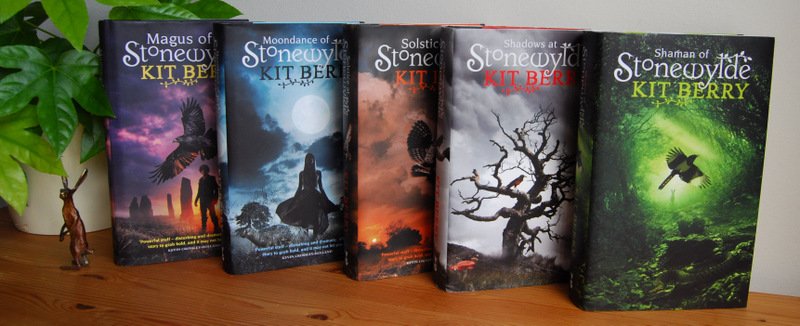
This month I have interviewed Kit Berry about the research she did into pagan beliefs for her YA series, Stonewylde.

Stonewylde is a five book series set in Dorset, in an imaginary setting, inspired by the beauty of the landscape and Kit’s interest in folklore and earth-based spirituality.  Stonewylde is a pagan community, with a beautiful stone circle where ceremonies are held at the eight festivals. 

“I wrote the series several years ago, starting the first book back in 2003. This was after a magical close up encounter with a hare one evening in local woods. My mother had recently died, and the hare stared deep into my eyes, sitting only a couple of metres from me, and stayed like that for a couple of minutes. I felt so honoured.  I went home and researched hares on my computer – and discovered their links to witchcraft and paganism.”

Kit Berry

Kit explained she was quite naïve about paganism and got involved with an online group, where a woman took her under her wing and told her how to cast a circle in my sitting room at the full moon. She was a single mum with three teenage boys, and also a school-teacher – so this wasn’t quite as simple as it seemed. The woman had told her she needed to be ‘sky-clad’, (naked) and was very prescriptive about how to set up the ritual space.  Kit has never been one for following rules, but decided to follow her instructions to the letter.  She banned her boys from entering the sitting room and cast her first circle.  When she’d finished, she went to turn the lights on again and fused the entire house.

Back in 2004, the YA market was just opening up, and although most of the editors enjoyed the story, they weren’t sure it was suitable for youngsters.  Kit’s agent advised her to self-publish. After selling over 20,000 copies of each of the first three books she acquired a new agent who got her a six figure deal with Orion Books under the Gollancz imprint– for the first three Stonewylde novels and two more, which she was planning to write.

Kit told me that for her research she picked anyone’s brains that she felt knew about ancient pagean sites. However she discovered quite early on that a lot of so-called knowledge is in fact pure supposition.

“Pagan people seem particularly prone to this – presenting an idea as fact, when we have no way of truly knowing how and what ancient people worshipped, nor how they conducted their rituals. So I had to use my imagination, but used facts wherever possible. For example, we know Stonehenge and other ancient circles have stones that align with the summer solstice sunrise, so I used this fact to add authenticity. The first rays of light at dawn on the summer solstice shining on one of the stones is a significant moment in the Stonewylde series.”

Kit Berry

The estate of Stonewylde is based on the Charborough Estate, which Kit used to drive past regularly in the 1990s.  This was at a time when there was a lot in the news about secret cults, and places cut off from the world with powerful leaders.  She told me how she would look at the long stone walls and the magnificent gates to this estate and let her imagination roam freely. Unfortunately, the estate isn’t open to the public so she couldn’t visit, although since the books were published she has done a charity event there, giving a talk and signing books.

Kit Berry at a book signing

Kit told me her most unusual research had to be the Villagers’ toilets. She did a lot of research into long drop/pit latrine toilets, because there’s no running water in the Village so obviously they wouldn’t have flushing toilets. 

Her research tip is not to take everything at face value. She suggests writers should look for several sources to check the authenticity of what you’ve discovered and especially be wary of people telling you information – much of it may be brilliant, but a lot of people do make things up, or base facts on very flimsy evidence and hearsay, or what they’d like to believe. So always use more than one source of information if it’s important; nowadays with so many search engines online, this is comparatively easy to do.

Kit explained that doing the research for Stonewylde was fascinating, and shelearned a lot but it’s so easy to get bogged down with research and feel you don’t yet know enough to start writing the story. It’s also a procrastination technique of course. Remember you can find out a lot about a subject, but you don’t want to overload the reader with too much of it. So stick to a few salient and relevant facts, and leave it at that.

You can find out more about Kit Berry and her books on her websites: www.kitberry.com and www.stonewylde.com

Book Review: The Lost Magician

Title: The Lost Magician

Written by: Piers Torday

Cover illustrated by: Ben Mantle

Published by: Quercus

The Lost Magician

The Lost Magician is an exciting and unique quest that has significant parallels to C S Lewis’s The Lion, the Witch and The Wardrobe. The story is set in 1945 just after the Blitz in London. Two brothers and two sisters, Simon, Patricia, Evelyn and Larry Hastings are sent to stay with their aunt, Professor Diana Kelly, who lives in Barfield Hall, a large house in the countryside. The book opens with an omniscient narrator who talks directly to the reader, explaining why the children have been evacuated and how they discover the mysterious library hidden in the attic. The reader is then swept along on a phenomenal adventure written from all four children’s point of view.

Larry is the first to venture into the library and the magical world of Folio where he meets a fairy knight called Tom Thumb riding on the back of a butterfly. In true CS Lewis style his brother and sisters will not believe the library exists. Until Eve the more scientific of the children discovers the entrance for herself but where Larry went to the land of the Reads, Eve goes to the non-fiction world of the Unreads which is ruled by the notorious Jana, Secretary of the Unreads whose mission is to rid the world of fiction.

The desire for knowledge and the free-will of imagination are pitted against each other in the epic battle scenes between the reads, un-reads and Never-reads in an eternal battle. The children’s only hope is to search for the magician who created the library but he has been lost for centuries.

This novel highlights why a good range of diverse books are essential throughout the world and demonstrates the importance of libraries to society and the need for more good librarians.

The Lost Magician is a celebration of the importance of reading.

An interview with… Isabel Thomas

For my Writing 4 Children column, in the October 2020 issue of Writers’ Forum magazine, I interviewed Isabel Thomas about writing narrative non-fiction for children using her picture book Moth: An Evolution Story as an example.

Isabel explained that Moth: An Evolution Story is a picture book retelling of a classic evolutionary biology case study of natural selection in action. The story of the peppered moth’s adaptation to the environmental effects of the Industrial Revolution here in England. This book is published by Bloomsbury and has recently been released as a paperback.

She told me how she first encountered the story of he peppered moth at university, where she studied Human Sciences, a degree that’s grounded in evolutionary biology. Natural selection and adaptation were introduced onto the primary school curriculum in England quite a few years ago, but Isabel realised children start asking the big questions about life at a much younger age, pretty much as soon as they can talk. Questions like Where do we come from? and Why are there so many different plants and animals?

“I realised the peppered moth story could the perfect way to introduced natural selection and evolution to young children, and indeed to parents who had studied it ages ago and forgotten how it works.”

Isabel Thomas

Her aim was not to create a ‘science non-fiction book’ but a read-aloud narrative that has the power to entrance audiences of any age, and conveys the beauty and wonder of natural history at the same time. Isabel uses the picture book approach to help children make meaningful emotional connections with science, so the desire to understand the world scientifically becomes part of them. Children are familiar with narrative, with the page turn of a picture book, with moments of change and peril and hope. Woven into this familiar fabric, the building blocks of the theory of natural selection aren’t presented as obstacles of hard fact but become almost intuitive for readers as they predict what will happen on the next page turn.

“My top tip is to fastidiously footnote as you go, then you will always have that link back to your sources. Once I’ve amassed information and ideas, it’s a bit like I have a huge pile of Lego bricks. The next stage is beginning to assemble it into something that is greater than these individual parts. Choosing the best way explain or convey my excitement about a subject.”

Isabel Thomas

Isabel suggests writers should try and surprise readers, whether that’s through including the very latest science (rather than sticking rigidly to curriculum-linked content), or in the way you use language, or in the way that connect different areas of life. The way to do this is to surprise yourself, rather than trying to follow a recipe. She stipulates writers aspiring to write children’s creative non-fiction should read a lot of children’s creative non-fiction, as this is the best way to absorb language level and parameters – but don’t imitate.

“Be unexpected and make each pitch and project unique to you, as this is what will grab readers’ (and publishers’) attention. If you can think like an 8-year-old, you’re on the right track.”

Isabel Thomas

Another writing tip from Isabel is not to ‘write for children’ as you will risk ending up with either dry or patronising text. Her suggestion is to write as if you were talking to a friend about something you find absolutely fascinating because a good non-fiction book doesn’t make the reader feel like they’re learning from an expert – it makes them feel like THEY are the expert.

You can find out more about the different types of non-fiction Isabel writes on her online portfolio www.isabelthomas.co.uk or follow her on Twitter @isabelwriting and on Instagram @isabelthomasbooks

Book review: If You Were Night

Title: If You Were Night

Written by: Mượn Thị Văn

Illustrated by: Kelly Pousette

Published by: Kids Can Press

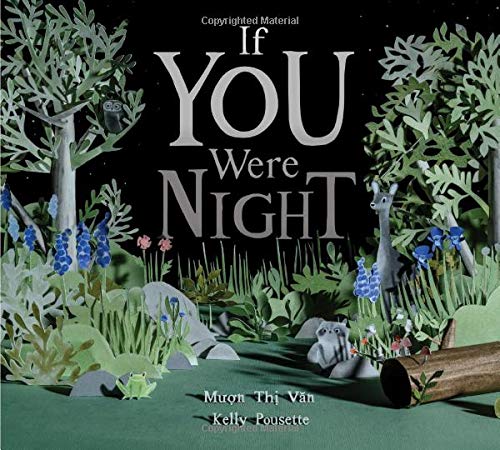
This enchanting picture book asks the reader a series of questions like: “If you were night, what would you do?” It encourages the reader to walk into the night on an adventure to explore what they can find and to consider how they would act and respond to the breath-taking stimuli such as an otter splashing, a spider stitching by starlight or a slug munching.

There is a poetic, calm and lyrical feel to this beautiful picture book. It is certainly a unique and fantastical exploration of the natural world at night that engages all the readers senses. The illustrations are amazing paper-cut dioramas that brings the night alive with wildlife and magic – each one more evocative than the last. The children will spend hours examining the intricate cut-outs to spot the creatures and learn more about their world.

The ideal book for bedtime reading and to lull your small child into a sleep full of miraculous dreams about what happens outside when the sun goes down. It could be used in the classroom to support topics and discussion on nature and the natural environment and will help to encourage their observations skills and encourage curiosity.

A book to cherish.

An interview with… Sahar Mustafah

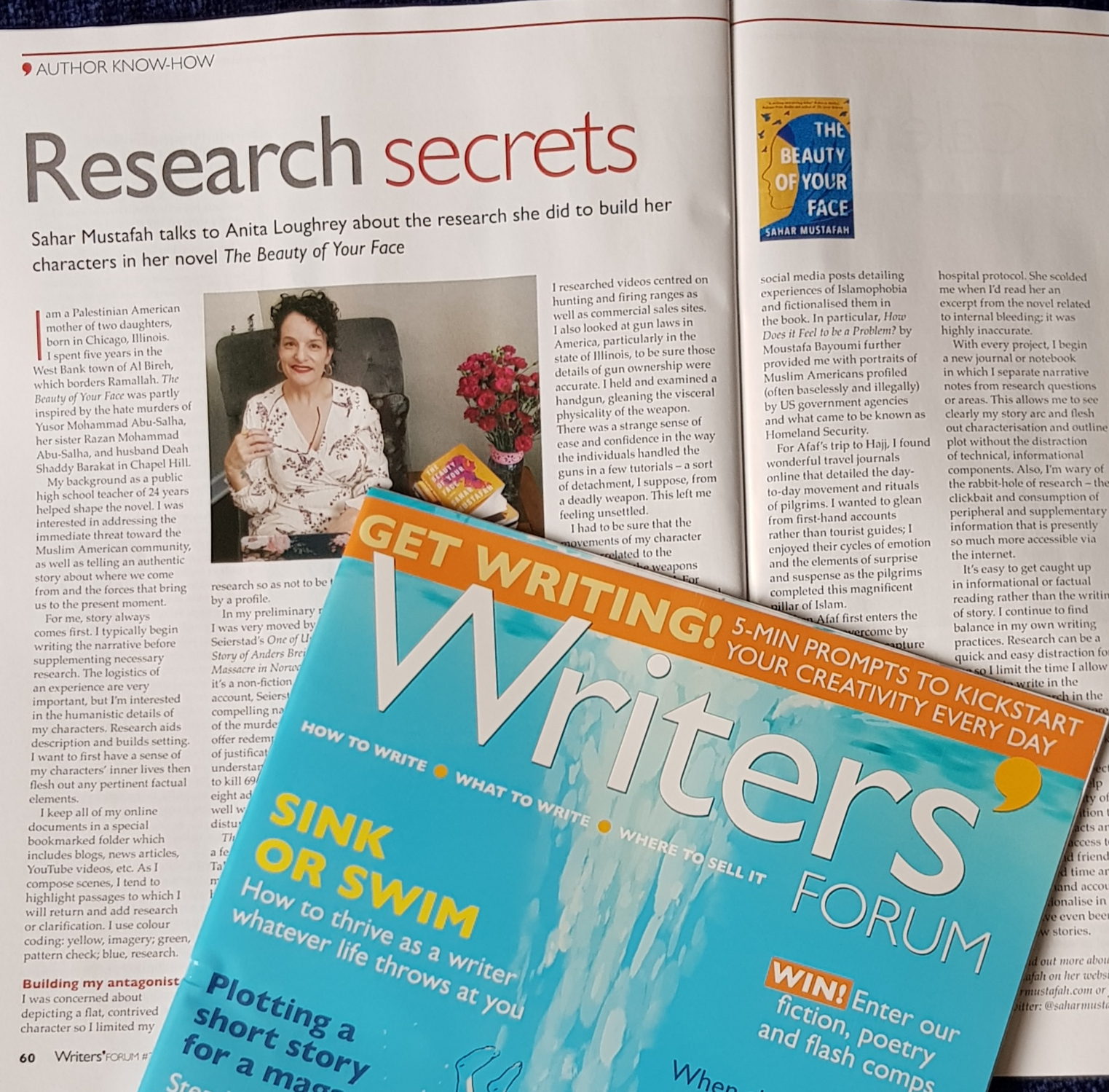
For the October 2020 edition of the national writing magazine, Writers’ Forum, I interview Palestinian-American author, Sahar Mustafah about the research she did to build her characters in her novel The Beauty of Your Face.

Sahar told me she was interested in addressing the immediate threat toward the Muslim American community, as well as tell an authentic story about where we come from and the forces that bring us to the present moment. For her, story always comes first. She typically begins writing the narrative before supplementing necessary research and she is particularly interested in the humanistic details of her characters.

Sahar explained research aids description and builds setting. She wanted to first have a sense of her characters’ inner lives then flesh out any pertinent factual elements. She did not want to depict flat, contrived characters so she limited her research so as not to be trapped by a profile.

“In my preliminary research, I was very moved by Åsne Seierstad’s One of Us: The Story of Anders Breivik and the Massacre in Norway. Though it’s a nonfiction, journalistic account, Seierstad offers a compelling narrative of the life of the murderer which doesn’t offer redemption or any sort of justification, as much as an understanding of how he had come to kill 69 young people and eight adults at a camp. It’s quite well-written though indelibly disturbing.”

Sahar Mustafah

Her protagonist, Afaf’s, storyline came, in part, from her personal background and the stories others have shared with her from her community. Her experience in Palestine allowed her to build that world when referenced in the novel in realistic ways, as well as having mostly lived and been raised in Illinois.

“After 9/11, my family and friends were experiencing near-daily incidents of harassment and discrimination at their local schools or on a trip to the grocery store.”

Sahar Mustafah

With every project, she begins a new journal or notebook in which I separate narrative notes from research questions/components. This allows Sahar to see her story arc clearly and flesh out characterization and outline plot without the distraction of technical, informational components. Sahar Mustafah’s tips to other writers when they are researching is to be wary of the rabbit-hole of research, i.e. clickbait and consumption of peripheral and supplementary information, which is presently so much more accessible via the internet.

“It’s easy to get caught up in informational or factual reading rather than the writing of story. I continue to find balance in my own writing practices. Research can be a quick and easy distraction for me so I limit its time. I tend to write in the morning so research in the latter part of the day is more productive for me.”

Sahar Mustafah
The beauty of your Face by Sahar Mustafah

As a lover of stories, Sahar explained she seeks out informal interviews with individuals relating to aspects of her research. She believes these help to preserve the humanity of the experience, in addition to providing technical facts and information. Her family members and friends who have provided time and interesting first hand accounts have been the seed of new stories.

You can find out more about Sahar Mustafah on her website www.saharmustafah.com or follow her on Twitter: @saharmustafah

An interview with… Peter James

In September 2009, I interviewed crime writer, Peter James, author of the international bestselling Detective Superintendent Roy Grace series, published in over 30 languages, spends a day a week out with the Police and has recently been made Patron of Sussex Crimestoppers.  He told me all about his research for, Dead Tomorrow, published by Macmillan, June 5th 2009. This was one of the most shocking and fascinating interviews I have ever undertaken.

Peter James 1 - Low Res

Peter told me that for him, research is as important an element in writing his novels as character and plot. He views each of these elements as an inseparable trinity.

“Each of my Roy Grace novels has its genesis in a true story or in research facts – as indeed do all of my previous novels.” (Peter James)

The central story of Dead Tomorrow is a single mother, Lynn Beckett, whose 15 year old daughter, Caitlin, is suffering liver failure.  Unless she gets a transplant within weeks she will not survive. Knowing the true fact that 3 people die every day in the UK waiting for a transplant, Lynn panics that the system will let her daughter down and goes on the internet. She discovers a German organ broker who can obtain a liver for her but at a terrible financial and human price.

He explained the spark for Dead Tomorrow came from a chance conversation at a dinner party, back in 1998. He was seated next to multi-award winning documentary film maker Kate Blewett – best known for the harrowing The Dying Rooms. She asked Peter how much he thought his body was worth as a soup of chemicals. Peter had no idea and Kate informed him it was worth about 50p. She then asked how much he thought he was worth in body parts as a reasonably healthy human being and stunned Peter by telling him the black market price for a healthy teenage or adult human is around $1m.

You can get up to $400k for your liver, the same again for your heart-lungs, $60k for each kidney, then your skin, eyes, bones, and a few other bits and pieces…. The reason being there is a world shortage of human organs, caused by improvements in transplant techniques, a reluctance for people to donate, and most ironic off all, by more people wearing car seat belts – which means they don’t die of head injuries so much any more, leaving their bodies – and internal organs – intact. As a result, three people die every day in the UK, waiting for a transplant. Around 20% of people on the liver transplant waiting lists will die before they get one – in the USA the figure is as high as 90%.
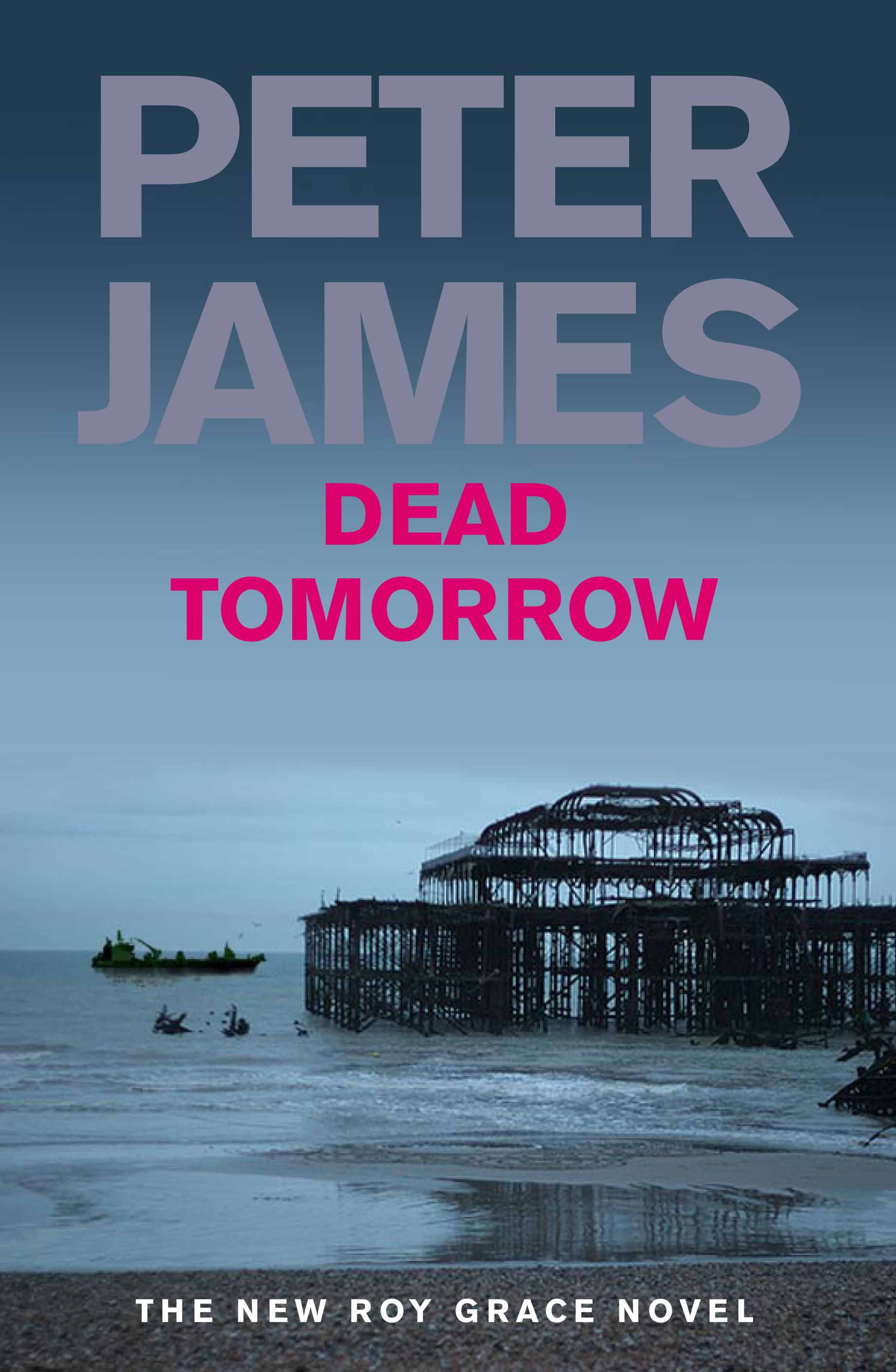
Dead Tomorrow

In the past decade a huge international market for human organs has evolved.  In some countries it is illegal in others, it openly goes on. China has been steadily lowering the threshold of the death penalty for several years running, executing prisoners with a single head-shot and selling their bodies to Taiwan. Manilla in the Philippines is now known as One Kidney Island. You can go there for an all-inclusive price of about £50k, and get a kidney transplant. In India, in some castes, women routinely sell one kidney before they get married, for their dowry, and are joyfully happy with the $250 they receive.  In Columbia, the mafia are making more money out of human organ trafficking in some parts of the country, than from drugs.

As a true example of the illicit trade, in 1990, eminent British kidney transplant surgeon, Dr Raymond Crockett, who Peter has interviewed, was struck off the medical register for nine years for illegally buying kidneys, for UK patients, from four students in Turkey.

James told me he wrote a story for HBO Television in the USA several years ago.  It was about an eight-year-old street kid called Juanita who was begging outside El Dorado Airport in Bogota, Columbia.  She was arrested by the police and handed to a care agency.  From there she was put in an orphanage, a beautiful home in the country, with other kids her age.  When she was fourteen, the parents of a teenage girl in the USA, desperate for a liver, paid the Columbian mafia $450,000.  Juanita, who was a match, was killed and all her organs were harvested. Peter said:

“I am sure you are think that as I write fiction, that story was fiction.  But sadly it wasn’t, it was true…” (Peter James)

For each novel, it is not just the lives of his villains and victims that he researches. Peter explained keeping current with the police and getting the correct police procedures right is absolutely crucial. Early in Dead Tomorrow, a dredger hauls up the body of a recently dead teenager from the seabed, just off the coast of Brighton. Peter needed to understand how a dredger works, and what it does, so he spent a day at sea on a working one, off Shoreham.  Then he needed to understand what the police would do in this instance, and was told a Police dive team – the Specialist Search Unit – would go out and search the seabed for clues. 

“The SSU kindly took me out to sea on a training exercise – and there I learned too much information…!!!  I always had a romantic notion that being a police diver must be a great gig – you get to swan around in scuba gear, getting paid to do what you love. Wrong! It was explained to me that the police almost always dive in zero visibility – in muddy canals full of barbed wire and rusting supermarket trolleys and jagged metal, or in sewers, or in weed-strewn lakes, or the bottom of the English Channel which is always churned up.” (Peter James)

In the interview Peter explained the procedure is to drop a weighted line down to the sea bed, then connected to the surface by a voice line and air line, they sink down, carrying a 200 metre cable over their shoulders, with a weight on each end of it – this is called a “jackstay”.  They then lay it out in a straight line on the sea or river bed, and swim back, holding the line in one hand and sweeping in the pitch darkness with the other.  If they find nothing, they move the weights a foot to the right or left, gridding out the bed.  When they find a body, under their strict procedures, they have to hug it, in case a current carries it away, and radio to the surface for a colleague to descend with an airbag to raise it to the surface.  They will have no way of knowing whether this body has been there for days, or weeks or months, and it is likely to be crawling with crabs.

Peter James next Roy Grace novel, Find Them Dead is due to be released July 2020.

Find out more about Peter James and his books on his website: www.peterjames.com

To read the complete feature you can purchase a copy of #95 Sept 2009 Writers’ Forum by ordering online from Select Magazines.

To read my latest Research Secrets or Writing 4 Children interviews you can invest in a subscription from the Writers’ Forum website, or download Writers’ Forum to your iOS or Android device.

Book Review: The Pirates are Coming!

Title: The Pirates are Coming!

Written by: John Condon

Illustrated by: Matt Hunt

Published by: Nosy Crow

The Pirates are Coming

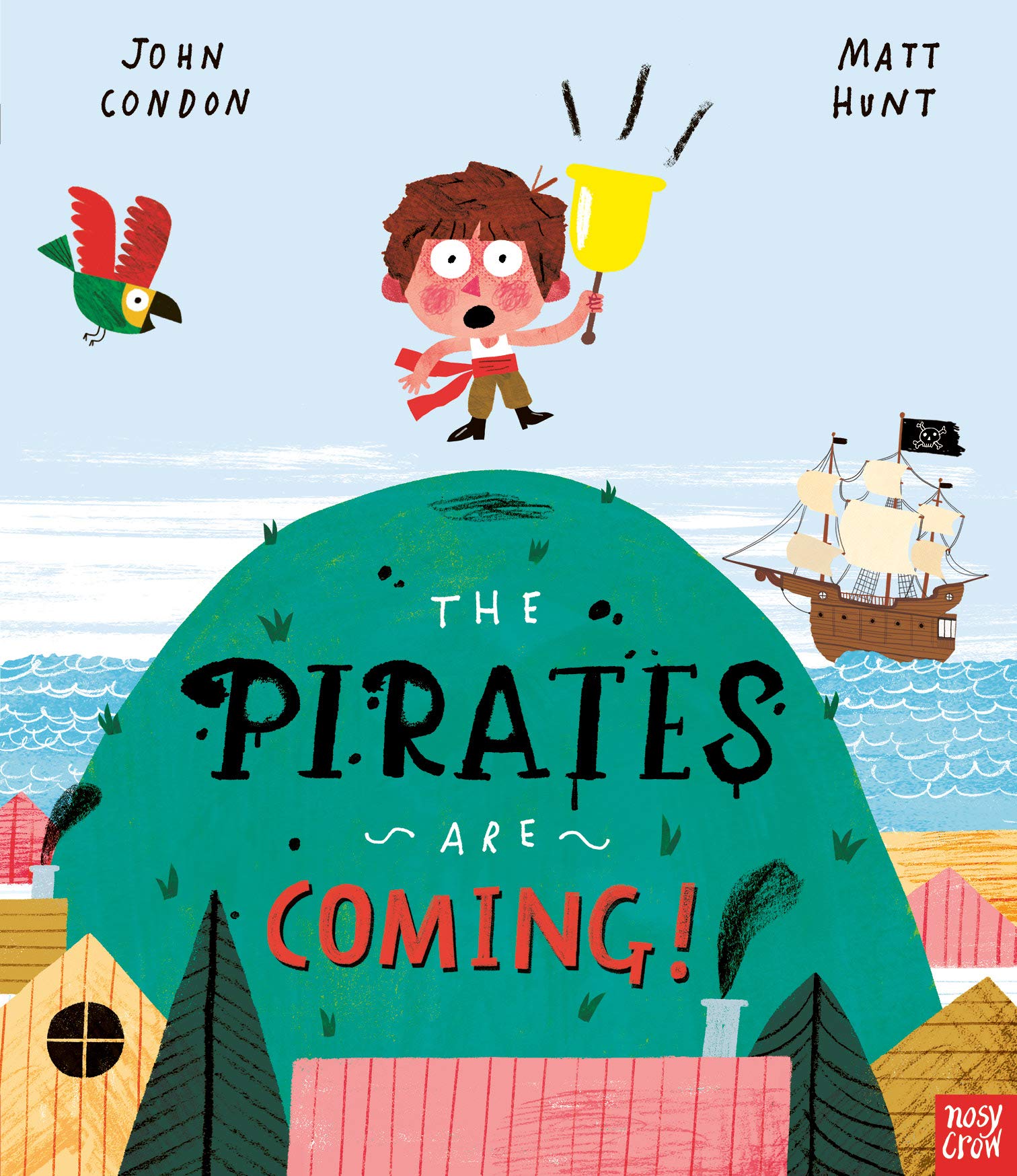
The Pirates are Coming is a captivating tale about Tom who climbs the hill each morning to watch for pirates to arrive at the village. John Condon uses knowledge of eh classic story The Boy Who Cried Wolf to its advantage to set up a humorous and satisfying twist ending.

Unlike The Boy Who Cried Wolf story, Tom is not being naughty when he cries, “The Pirates are Coming!” as he really does believe he has spotted a pirate ship. Tom’s dad explains what a pirate ship looks like with patience and understanding, which gives the text a heart-warming feel.

I like the ingenious ways the villagers hide from the [pirates in the illustrations by Matt Hunt. Young readers can explore the pictures to see if they are able to find where each villager is hiding providing an interactive reading experience.

This book could be used to extend observation skills by looking at a selection of different silhouettes and asking the children to guess what the object is. An ideal book for stimulating discussion on families and relationships.

An interview with… Laura Wilson

In Oct 2009, I interviewed historical and psychological crime writer, Laura Wilson, about her research tips and techniques for my Research Secrets column in the national writing magazine Writers’ Forum #96.

Laura-Wilson-Freeway-300

Laura Wilson explained why for both historical and crime writers research is important. she said:

“There’s a standard piece of advice given to people who are starting to write fiction – write from your own experience. I would venture to suggest that if you are, like me, a writer of crime novels, it’s not very useful. What are you supposed to do? Go out and murder someone and then say, ‘Sorry, Officer, I was just doing it for research?’ It also rules out writing historical novels, science-fiction, fantasy, and quite a lot else besides.”

She explained that if you are not going to create a fictitious town or village, you can make your task easier by choosing to set your work in an area you know well. Laura often writes about the West End of London, as she lived and worked there for a number of years and is very familiar with it. However she did make it clear, a writer should always be allowed to take liberties. For example, she once moved a whole seaside town five miles down the Essex coast, although she pointed this out in the acknowledgements so the readers, if they choose to look at them, were forewarned and didn’t write her letters pointing out the ‘mistake’.

Another tip Laura gave in he feature to make life easier was give your protagonist a job you have done yourself. For example, Dick Francis, the ex-jockey, writes stories set in the world of horse-racing. Research for him must be comparatively simple, because he has both the knowledge and the contacts. Laura admitted sometimes too much knowledge can get in the way and hold up the action. The best piece of advice about writing she has ever come across is from Elmore Leonard, who says, ‘Leave out the boring bits’.

It’s always tempting to slip in factoids because you know them, forgetting that the reader wants a narrative, not a lot of information about coal-mining or dry-cleaning or how to put on a crinoline or whatever it happens to be.

She is adamant story-line must always be paramount, and don’t let anyone tell you different, as there’s a risk that research becomes a displacement activity that holds up the business of writing.  she explained there should be two main reasons for research: the first is to ensure that your story-line will stand up, and the second is to underpin your work with authenticity and truth.

she told me there are some practical steps one can take to find things out: the police and other experts are astonishingly helpful, provided that you are specific in your questions. Go to the library, do your homework, and work out exactly what it is you need to know first. Buying drinks or lunch usually pays dividends.

It’s important, too, to confirm things you think you already know – get it confirmed by another source. There’s a lot of debate about the efficacy of the internet as a research tool they need to be checked against something more reliable. People’s memories can be faulty, too. Nothing beats a spot of physical research – as Black Beauty said, ‘Feeling is believing’.

Research can bring your nearer to the characters. Laura said: 

“While writing my fifth novel, The Lover, I had great difficulty getting into the mind of the killer, Jim Rushton. The book is set during the Second World War and Rushton is a fighter pilot, so, after consulting the genuine articles, I booked myself a trip in the nearest machine I could get to a Spitfire, a Harvard Training plane which had been modified to seat two people.

I discovered for myself the amazing adrenaline rush other pilots had described to me.” (Laura Wilson)

T6harvard

To read the complete feature you can purchase a copy of #96 Oct 2009 Writers’ Forum by ordering online from Select Magazines.

To read my latest Research Secrets interview you can invest in a postal subscription from the Writers’ Forum website or download Writers’ Forum to your iOS or Android device.
For more information about Laura Wilson and her novels take a look at her website: www.laura-wilson.co.uk

Resolve the problem

In any story there will be a problem the character has to face and those problems have to be resolved by the end of the story. Often readers will be anticipating the ending they hope to see. They will have recognised the strengths and weaknesses in the characters and they will want them to overcome their problems and solve them in a satisfying way through their own resolve and intelligence.

problem solving2

A common mistake for many new writers, writing their first children’s novel is to have an adult whether it is a parent/carer or in some cases a total new character who is actually a stranger to the reader, storm in a save the day. This is not a satisfactory ending and in a lot of cases it feels as if the author has cheated, in the same way as waking up and finding it was all a dream. I know as a reader I want the resolution to be because of the actions of the hero of the story.

This resolution should be built up in a series of stages throughout your plot so it does not come out of the blue. It needs to make sense to the reader. Satisfying story endings use elements from the story’s beginning and middle. Here is one idea for a step by step approach, which I use in my own writing:

steps to solve the problem

Step One

Clearly describe what the problem is so it is clear to the reader and state why this is an issue for your protagonist. Make it clear to the reader why it is your hero’s problem not anyone else’s and why they are the only one able to solve it.

Step Two

Initially the problem is going to cause some anxiety or fear. Ensure you make it clear in your writing how your character feels about the problem. They may be frustrated or angry or need to employ techniques to help them calm down and think clearly. It should be clear to the reader why they feel upset, annoyed, scared, etc.

Step Three

Show your hero’s thought process as they work through the problem. As a writer, it is helpful to brainstorm as many different solutions to the character’s problem as possible. In your brainstorm write why each idea will or why it will not work. Remember effective story resolutions come from the protagonist’s actions. Not every solution will work and not every story has a happy ending but they do have to make sense.

problem solving

Step Four

Write short scenarios to describe what would happen if your character undertook each of the solutions you came up with. Think:

  • Was the solution safe? A safe solution means no one will be hurt or upset.
  • Was the solution fair? How do the other characters in your story feel about each idea for the solution.
  • Did the antagonist get his comeuppance? In children’s books especially the reader wants good to overcome evil and friendship to prevail.

Step Five

Have the problem escalate as the story progresses. Each time they attempt to solve the problem it either becomes worse, or they are confronted by another obstacle. They may think they have solved the problem then realise the effect it has had on others and need to fix this. A solution may create a totally new and larger problem.

Step Six

Finally your protagonist is able to resolve the problem by learning from their mistakes and through their own determination and intelligence. Your character should have grown in some way and the other characters should be satisfied with the way the problem was resolved and any loose ends are tied just like when knitting a jumper.

The ultimate aim is to have a happy reader.

happy reader

You want them to keep reading to find out if your protagonist solves the problem and most importantly your reader should feel something at the end of the story. I hope this helps.he problem.