Book Review – Creative Writing

Title: Creative Writing: How to unlock your imagination and develop your writing skills

Written by: Adèle Ramet

Published by: How To Books

How To Books

This book is ideal for the beginner writer who wants an overview of the different genres whether they are writing for children or adults. It covers both fiction and non-fiction and has chapters on character, setting, dialogue, using personal experiences and how to submit to publishers.

Following the familiar how to book format, each of the ten chapters concludes with a handy checklist and an assignment to help you develop your skills and put what you have read into practice. There is also a very useful list of addresses for writing organisations and societies, as well as lists of websites and further reading where you can find more information.

I also have some of Adèle Ramet’s other books on my bookshelf:

Creating a Twist in the Tale: How to Write Winning Short Stories for Women’s Magazines

Writing Short Stories and Articles: How to Get Your Work Published in Newspapers and Magazines

And I have had the pleasure of attending one of her ‘Writing a Twist in the Tale’ workshop. I found her no-nonsense, direct to the point style was reflected in Creative Writing: How to unlock your imagination, develop your writing skills and get published.

Adele Ramet does not ‘tell’ you how to write better, she ‘shows’ you through concise, easy-to-understand examples. By following her advice, you’ll be able to recognise the areas that need sharpening in your own writing and know how to improve them. It is the kind of book you’ll want to refer to time and time again. Packed full of useful ‘insider’ tips on creating professional, potentially lucrative manuscripts it provides a comprehensive guide on how to write on a variety of topics.

It is full of essential tips to hone your skills and help you decide which area of writing you want to concentrate on, or specialise in. In my opinion, Creative Writing is a useful addition to the bookshelf and an invaluable tool for all aspiring authors.

This book was sent to me by the How to Books publishers to review on my blog. There is always a worry when I review books what happens if I don’t like it but, I must say I really like the format of the How to Books. I like the way they use case studies and checklists and they have assignments, so you can practice. A couple of my favourite books published by How To Books are the Pamela Cleaver books on writing for children:

Writing A Children’s Book: How to Write for Children and Get Published

Ideas for Children’s Writers: A Comprehensive Resource Book of Plots, Themes, Genres, Lists, What’s Hot and What’s Not

An interview with… Alison Rattle

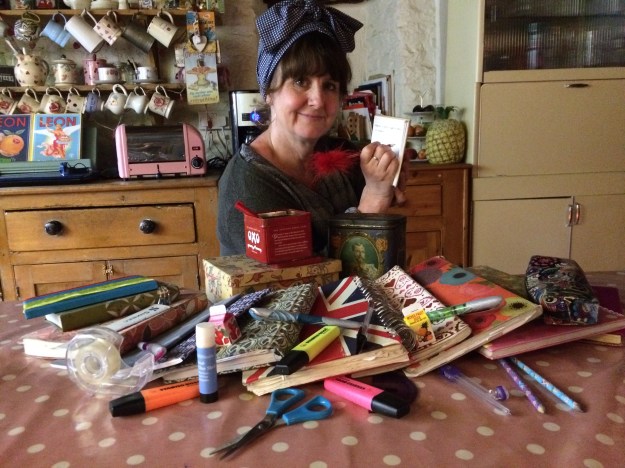
In June 2016, I interviewed Alison Rattle about her passion for stationery for the Papers Pens Poets blog. You can read the full feature on her and her stationery here.

Alison Rattle pic

Alison told me she does not have a favourite pen she just picks up the first thing to hand.

“When I’m writing a book I usually start off on my laptop, but then very quickly reach for a pen and notebook. There’s something very freeing, peaceful and intimate about letting your imagination run wild across a beautiful clean page.” Alison Rattle

She told me she always buy a new notebook whenever she starts a new idea for a book.

“It’s a brilliant excuse to add to my collection, but also so exciting to hold those clean, fresh pages in my hand, knowing that before long they’ll be covered in words I can’t even imagine yet.” Alison Rattle

Her most glamorous and expensive notebooks tend to be received as presents as Alison revealed she only buys reasonably priced ones, but even so they have to be pretty.

“Once I start writing in a notebook, I’m not precious about it at all. They all end up being scruffy, well-worn things that contain not only the workings of my book, but scribbled recipes, telephone numbers, shopping lists etc… a snapshot of my life during the writing process.” Alison Rattle

v for violet 1

Alison normally writes gritty crime thrillers, published by Hot Key Books. But her latest books includes two whimsical collections of quotations published by Carlton Books. They are compilations of over 1500 amusing and insightful quotations from well-known writers, politicians, film stars, artists, musicians and philosophers.

You can follow Alison on Twitter @alisonrattle

Write Like What You Talk

You can cheat the eye but you can’t cheat the ear, so always read your story aloud. Stories are oral and this is why voice is important. So write like you talk. It really is as simple as that. Say something. Then write it. Record it so you can really listen to what you have written.casette recorder

If it sounds stilted or wooden, stop and think about what you’re trying to say. Say what you want to convey aloud. Then write it down. A group reading or performance is even more useful since each reader, like an actor, will deliver their lines of dialogue at a different pace. When writing dialogue less is more, so use limited speech tags.

However, it is not only the way the characters talk that is important, spend time trying to understand why your characters say the things they do, and how they feel about it. Think about the characters and their motives:

  • What would she do?
  • What happens next?
  • What would she say?

Make these motives plausible. Get into the body of your character.

costume

Create character sketches and think about their off the page activity so you can step into your characters shoes and know how they would react and speak in a given situation.

  • Where do they live?
  • How do they talk?
  • What non-verbal mannerisms do they have?
  • What food do they like?
  • What is their taste in music?

All these things can contribute to developing your character’s voice. I spend many hours talking aloud to myself and acting out bits of my WIP just to see how it sounds and works with the action. Oh yes, and don’t forget to use the correct punctuation so your reader knows how it should sound. A quick speaking exercise you can try is to say these three sentences aloud. Notice how the emphasise is on different words in each sentence.

You’re going to be in Strictly Come Dancing.

You’re going to be in Strictly Come Dancing!

You’re going to be in Strictly Come Dancing?

This doesn’t mean your whole book should be full of exclamation marks though. Too many exclamation marks is off putting and in my opinion lazy writing!

Book Review – Moth

Title: Moth

Written by: Isabel Thomas

Illustrated by: Daniel Egnéus

Published by: Bloomsbury

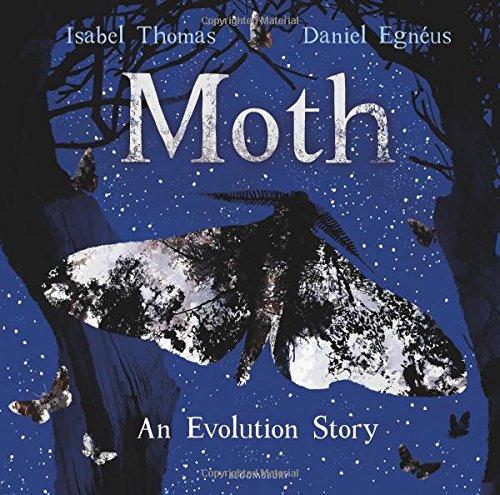
Moth

This creative non-fiction picture book tells the story of the tiny peppered moth and its quest for survival. Against a lush backdrop of lichen-covered trees, the peppered moth lies hidden until the world begins to change. Moth by Isabel Thomas introduces the concept of natural selection and adaptation in a fun and visually stimulating way.

The theme of light and dark are encompassed throughout the moth’s story of how it negotiates the dangers of life, from the blue tits and other predators, to human interference. Learn how the moth adapts over the centuries to survive the pollution of the industrial revolution. Landscapes change as cities grow and people’s magnificent machines stain the land with soot yet the peppered moth struggles on. The illustrations are spectacular stencils in keeping with the light and dark theme.

It is a clever, thought-provoking way of introducing evolution. A great book for teaching camouflage to young children and ideal for inspiring the children’s own art work linked to camouflage.

This book review was previously published on the online Armadillo Children’s Book Review Magazine.

An interview with… Ruta Sepetys

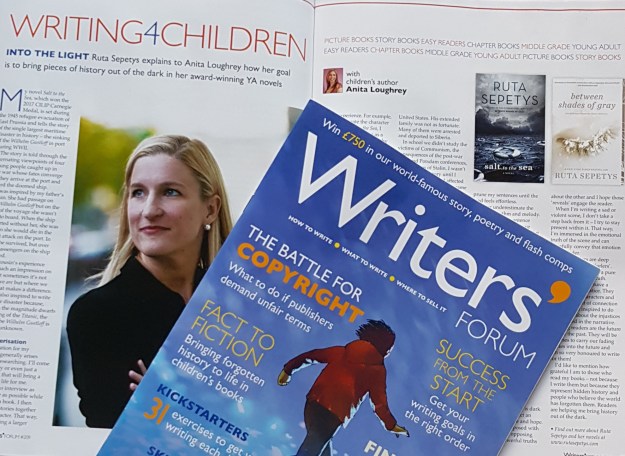
In my Writing 4 Children double spread, in the March issue of Writers’ Forum, I interview Ruta Sepetys about how she is bringing underrepresented pieces of history out of the dark in her award winning YA novels.

Ruta Sepetys2

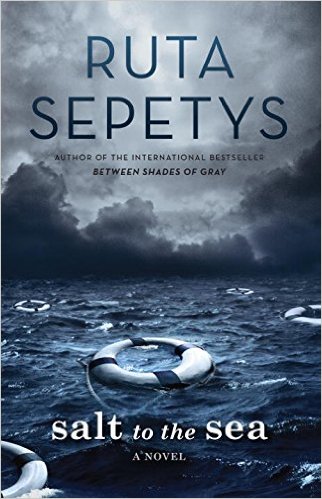
For example, her novel Salt to the Sea, which won the 2017 CILIP Carnegie Medal, is set during the 1945 refugee evacuation of East Prussia and tells the story of the single largest maritime disaster in history—the sinking of the Wilhelm Gustloff in port during WWII. The story is told through the alternating viewpoints of four young people who are all hunted and haunted by tragedy, lies, and war. Their fates converge as they arrive at the port and board the doomed ship.

Salt to the Sea cover

Ruta explained how she was inspired to use the true story of her father’s cousin who had passage on the Wilhelm Gustloff but on the day of the voyage she was unable to board the ship. When the ship departed without her, she was certain that she would die in the port under Soviet attack. She survived, but over nine thousand passengers on the Gustloff perished.

“My cousin’s experience made such an impression on me. It issues the reminder that sometimes it’s not where we are—but where we aren’t—that makes a difference. I was also inspired to write about the maritime disaster because although the magnitude dwarfs the sinking of the Titanic, the story of the Wilhelm Gustloff is virtually unknown.” Ruta Sepetys

Her use of family history was also true of the first novel she had published by Puffin, Between Shades of Gray, which won the 2012 Golden Kite Award for fiction and was made into the movie, Ashes in the Snow. This novel chronicles the Soviet occupation of the Baltic States and the exile and deportation of countless victims to Siberia. The story follows Lina Vilkas, a fifteen-year-old artist who is arrested by the Soviet secret police and deported to Siberia with her mother and younger brother.

The story was inspired by two young women who were deported and also by Ruta’s father who fled Lithuania when he was a boy and spent nine years in refugee camps before arriving in the United States.

Ruta told me:

“I try to inject an equal balance of love and hope. When love is juxtaposed against violence, the two opposing forces reveal powerful truths about the other.” Ruta Sepetys

Her latest novel, The Fountains of Silence, is set in Madrid in 1957 during the Spanish Civil War.

The Fountains of Silence

It tells the story of eighteen-year-old Daniel Matheson, the son of a Texas oil tycoon, who arrives in Madrid with his parents hoping to connect with the country of his mother’s birth through the lens of his camera only to be plunged into one of history’s darkest corners.

You can read my full interview with Ruta Sepetys in the March 2019 #209 issue of Writers’ Forum.

To find out more about Ruta and her books take a look at  her website: www.rutasepetys.com. Or follow her on Twitter @RutaSepetys

Market Research

One of the most difficult things about breaking into children’s writing is finding the right market for your manuscript. Many new writers are in such a hurry to be published they send their manuscript out to as many publishers as they can and often before it has even been edited properly. This is a big mistake.

It has also been recommended that you don’t write a word until you have a firm contract. In practice this often does not work as for educational writing, the deadlines are so tight the contract often does not arrive until halfway through a project or even after you have finished writing the book. Getting a commission before you start to write may be true of educational work but, less true for fiction. Even so, if you are interested in writing for the education market, it is worth writing and asking for any writer’s briefs. That’s information about projects they are developing and not their underwear.

pants

Don’t send picture book manuscripts to publishers that only print educational non-fiction, or primary school educational non-fiction to a publisher that focuses on secondary education. I know this seems obvious, but we hear over and over how writers send their work to inappropriate markets. It’s important to research your markets regularly as sometimes publishers who used to publish picture books may only be concentrating on mid-grade now.

OLYMPUS DIGITAL CAMERA

Research the different publishers and what they produce. Look at their catalogues online, or go to book fairs and pick up a copy of their new catalogue, or go to an independent bookstore and browse.  Your local library will have books publishers have previously published, which you can browse and get a feel for the publisher’s style.

Make lots of notes. Look at the titles and the title page with current editorial contact information on. Pay close attention to the focus of the books. The more time you spend on this preliminary research, the more likely you’ll be to find the right publisher for your work.

Book Review – Benny’s Hat

Title: Benny’s Hat

Written by: Juliet Claire Bell

Illustrated by: Dave Gray

Published by: Pomelo Pip

Benny's Hat

This is a picture book about empathy and surviving despair at the loss of a loved one. A book definitely made for sharing, Benny’s Hat will have you weeping from start to finish.

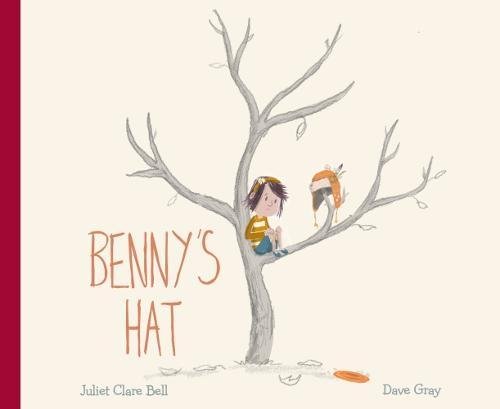
It is about a young girl called Lizzy (nicknamed Friz) whose brother, Benjamin is terminally ill. It is told from Friz’s point of view. This book deals with a sibling dying in a subtle way, through Friz’s actions and reactions to the deterioration of her brother. It may be delicate, understated storytelling but Juliet Claire Bell’s exceptional ‘show not tell’ skills have a dynamic impact on the reader and their emotions from how Friz gets her nickname to hiding Benny’s hat. The brother and sister exchanges are spot on and despite the tears, brought a little smile to my face.

Juliet Claire Bell’s text and Dave Gray’s illustrations work in perfect unison. The use of pastel shades for the background contrast the orange of Benny’s hat. The layout of the page panels and the vignettes lead you into the bold black page when Friz finds out her brother has died. I particularly liked the use of the trees which start off green and full of leaves and become stark, empty branches to depict Friz’s mood. Then at the end a few green leaves are beginning to grow at the far tips of the branches to symbolise, maybe there can be hope to survive such a traumatic loss.

Benny's Hat2

At the back of the book, there is a note for parent’s by child bereavement counsellor Sue Dale. She provides tips on talking about Benny’s Hat and links to organisations that can help. There are also activities to try that may help children going through bereavement.

I would recommend this book to all parent’s and teachers whether they are helping a child through grief, or not. I strongly advocate it is important to talk about such issues even if it may never be within the child’s experience. If it ever did happen they are more likely to discuss their thoughts and feelings before they get out of hand and understand the way they feel is perfectly normal. I think this book is written sensitively enough to achieve this.

Benny’s Hat is a great way in for discussing and teaching children about compassion and for talking about feelings. If you are a writer, for children or adults alike, it is also the ideal book to study to discover how to evoke emotion in your reader in just a few words.

£2 from each book sold is donated to Edward’s Trust, a children’s bereavement charity,  based in Birmingham.

To find out more about Juliet Claire Bell and her books visit her website: www.julietclarebell.com

To find out more about illustrator, Dave Gray, check out: www.iamdavegray.com

An interview with… Sally Piper

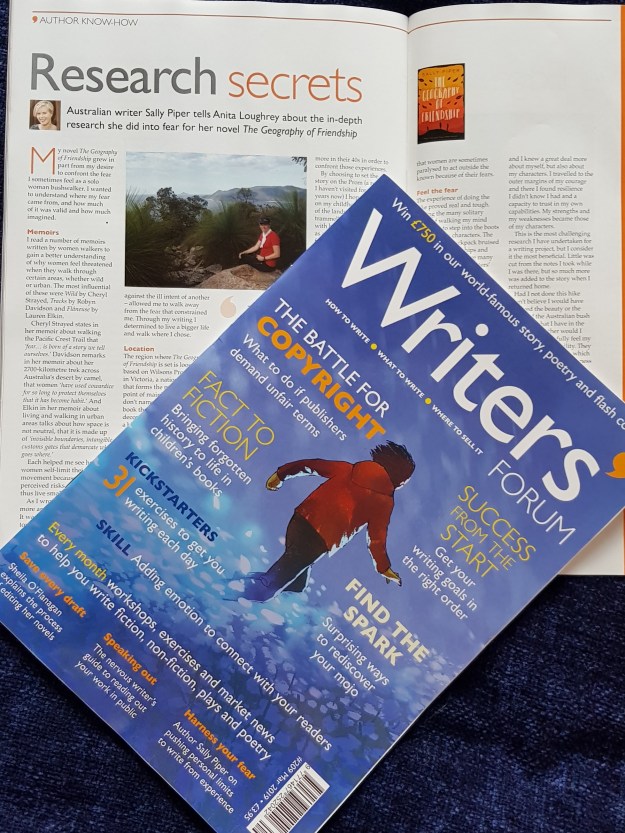
Australian writer, Sally Piper told me all about her research into fear for my Research Secrets column in the national writing magazine Writers’ Forum this month. She revealed that as a solo woman bushwalker she often felt afraid and wanted to know where this fear came from.

Sally Piper2

When I first found out about this I thought Fear was a very strange thing to want to research. Where do you start? Sally Piper started by reading memoirs of other female walkers and discovered how women self-limit their free movement because of real and perceived risks, which can cause themselves to live smaller lives.

“Fear… is born of a story we tell ourselves.” Robyn Davidson

This discovery inspired her to write her novel, The Geography of Friendship.

geography of friendship high resHer novel is about female friendships under pressure and is based loosely on the national park, Wilsons Promontory in Victoria, Australia where she had played as a child. But she had to deconstruct the landscape a bit to fit her purposes.

Ultimately it was inevitable that to really feel the fear she was going to have to do the walk herself. So to really understand what it was like to walk the Prom she undertook the 5 day hike alone noting how she felt, the weather, the terrain and how sounds were distorted by the absolute quite.


Sally believes that if she had not done the hike she would not have captured the beauty or the threats  of the Australian Bush the way she did in her novel.

Her advice to other writers is to experience first hand what you hope to subject your characters to.

“Research can sometimes occur by osmosis. Before I’d even taken my first step on the hike I started to collect new material for the novel, most notably by the way others (mainly women) responded to me doing the hike alone.”

Sally Piper

To find out more about Sally and her books check out her website: www.sallypiper.com. Or follow her on Twitter @SallyPiper

You can read the full interview in the March 2019 issue #209 issue of Writers’ Forum.

Meeting Deadlines

One of my plus points is that I am good at multi-tasking. An important requirement of multi-tasking is setting deadlines.

Whenever, I start a new job I always ask, ‘When do you want it done by.’ Often the reply is as soon as possible but, I find this is not helpful. I prefer to have someone say ‘I want it by next Tuesday,’ or ‘Ten o’clock tonight at the latest.’ This keeps me on track and helps me to organise my workload. If I don’t set myself these time limits I find myself procrastinating and time-wasting by staring out the window or my worse vice, playing computer games.

clock

Deadlines have to be reasonable, whether I’m setting them for myself or they’ve been set by an editor. Some deadlines are tight; rush jobs come up, emergencies occur, and then the pressure is on. Most of the time, it’s possible to merge tasks, working for a while on one thing and then a few days on something else and get it done without undue stress. Sometimes I just need time out from a job and I am pleased I can work on something else to take a break.

WP_20170709_17_17_16_Pro

When I have deadlines set for me, I always break them into smaller tasks, giving myself my own time limit for each chapter or section. It’s nice to give myself a little reward when I achieve it too but, often the personal satisfaction of knowing I achieved what I wanted to do is reward enough. I work within the time available and I’m an organisation freak so this method of working suits me fine.

I would be interested to know how you do it. Do you find it easier to write to deadlines?

Book Review – There’s Only One Kind of Duck

Title: There’s Only One Kind of Duck

Written and Illustrated by: Heather Kilgour

Published by: Heather Kilgour

there's only one kind of duck

This creative non-fiction book encompasses some fascinating, eye-opening facts about ducks within the story of Lee and Alex who are going to the pond to feed the ducks.

Alex insists there is only one kind of duck, but Lee knows better. The author – illustrator, Heather Kilgour, introduces us to a multitude of different species of duck, consolidated by an ingenious duck fact file in the last three spreads. This charming picture book was inspired by the Wetlands Centre in Barnes, London.

Heather’s passion for conservation shines like a beacon on every page. Her superb illustrations demonstrate each duck’s uniqueness and diversity. A duck is simply not just a duck. There are so many different species, that live in different habitats with very different diets. There’s Only One Kind of Duck, carries a very important message for children and their parents – ducks should not eat bread. It makes them ill and pollutes the water.

This book would make the ideal educational gift for your budding conservationist.

“This is a story of diversity that will open your child’s eyes to the richness of the natural world.” Heather Kilgour

It would also provide an excellent introduction into conservation and caring for animals in their natural environment and be used in the classroom to support a topic on animals and their habitats.

To find out more about Heather Kilgour and her illustrations visit her website: www.heatherkilgour.com