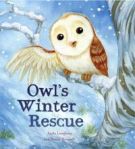
The Book Selling Debate

Over the last few years more and more big bookshops have merged. I believe this reduces the range of books being sold. When I walk into a bookshop like W. H. Smiths and Waterstones I see the same old children’s books on the shelves and almost the same stationery too.

whsmithbookshelf

Specialist books are not getting the publicity or shelf space they have previously had. This is why educational publishers tend to sell direct to schools and libraries rather than to bookshops.

One thing is clear the retailing of books has changed dramatically over the past few years. Supermarkets, such as Tesco, sell books at discount prices and buying books over the Internet, as e-books or second hand, has meant it pays to shop around for the best deal. This is not good for the reader.

As a reader, if you prefer YA trade fiction, sports books or cooking books the contraction in range won’t affect you, as prices will remain low. But, if you prefer more specialist books, your choice will be drastically diminished and the prices will rise. And if you’re someone who just likes to browse, your browsing range is restricted to the choice Waterstone’s, and W. H. Smith’s have decided to offer. This has a knock on effect. It means new authors will find it increasingly difficult to place their books with publishers, as mainstream publishers are concentrating on finding and promoting the ‘big hits’.

To combat this, we should be supporting our smaller local, independent bookstores. OK it may be easier, and more convenient, to buy books online, or to buy them with the weekly supermarket shop but it is reducing your choice as a reader. If books were sold at fixed prices, I do not believe it would change this buying trend.

This is my opinion. What are your views?

Book Review – The Hurting

Title: The Hurting

Written by: Lucy van Smit

Cover and interior design by: Helen Crawford White

Published by: Chicken House

the hurting

The Hurting is the compelling story of revenge and the desire for independence. This young adult Scandinavian noir thriller that will have you turning the pages to devour more. The protagonist Nell has a sister called Harper who has leukaemia. Nell is her main carer as their mother left and their father is an alcoholic. They have moved away from their home in Manchester to live in Norway, so Harper can go to the world centre for epigenetics in hope of being able to turn off the cancer gene causing her atypical leukaemia. At first, I was shocked at Harper’s behaviour and manipulation of her sister but on reflection I realised this really does reflect the reality of sibling relationships that many books fail to convey.

All the characters and their motivations are realistic. Nell always puts her sister’s needs before her own at the expense of applying to Brit school and realising her own dreams of becoming a singer, song-writer. Her life is on hold until her sister can miraculously get better. When she meets Lukas Svad, the adopted heir to a Norwegian oil fortune, she decides to take a chance and run away from her life just like her mother had, or so she thinks.

Lukas is able to manipulate Nell – just like her sister – using love as a weapon. In his grey-blue wolf skin coat he immortalises the dark and dangerous wolf-boy. Together they kidnap Ulv Pup and embark on a soul-wrenching adventure through the Norwegian mountains, stalked by wolves. The novel is full of lyrical prose and descriptions that evoke dramatic images of the Norwegian mountains and fjord backdrop in such a way the whole area takes on a menacing character of its own, foreshadowing the events to come. In the end, after many bad decisions, Nell learns the truth about Lukas, her mother and the baby.

Lucy van Smit’s debut novel is full of twists and turns fuelled by the need to feel loved.

An Interview with… Simon Whaley

In June 2016, I interviewed Simon Whaley for Papers Pens Poets about his love of stationery. Simon revealed why paper and pen beats modern technology hands down.

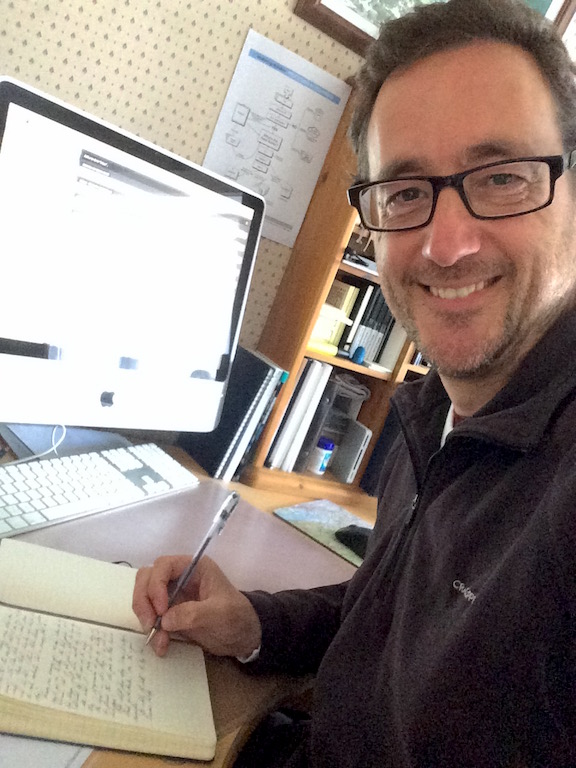
Simon Whaley writing in his notebook

His favourite pen is the Pentel Superb BK77, in black ink.

I love it because it’s easy to hold and has a fine ballpoint nib.

He absolutely adores Moleskine notebooks and claims they are the perfect notebooks for writers. They are hardback, which makes them ideal for writing in wherever you may be: desk, chair in the garden, bed, or out on the hills.

I use two sizes of Moleskine notebook: the Classic Pocket and the Classic Large.

You can find out more about Simon Whaley’s stationery passions on the Papers Pens Poets blog: www.paperspenspoets.co.uk

Find out more about Simon Whaley and his writing here: www.simonwhaley.co.uk  and on Twitter: @simonwhaley

The Publishing World

A big consideration is what the big booksellers want, as if they wont stock the book it wont sell. The book cover can sell the book so how good or enticing the book cover is look is an important part of an editors job. It is the cover that will give the book an edge with the booksellers. It is quite scary the impact the big bookstores have on the publishing world and when you realise they monopolise over 70% of the book selling market it is understandable why writing for children has become more competitive.

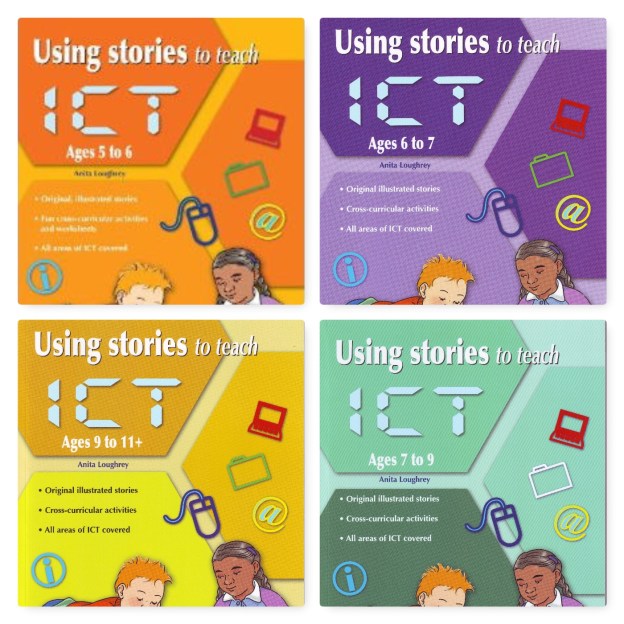
Using story to teach ict collageBook publishing is becoming more commercial and it is true, the big publishing companies increasingly will not back a book unless it is a sure bet. This may be why more authors are self-publishing – to prove they have a viable product. Publishing houses spend a lot of money on marketing. They budget for each book but the author has to get involved with marketing too. Once the book is released you don’t instantly become a best seller.

Nowadays, more gimmicks are being used to sell their books, such as collectable web cards and glitsy book covers that catch your attention on the shelf. Statistics show thin books, for the six-to-eight age range, did not sell as well as thicker books, because they were not so easy to see on the shelf. So publishing houses started to make fatter books. As you can imagine, this makes production more expensive. My Adventure Passport series were packaged in cute little suitcases.Adventure Passports Collage
Editors are an important role in publishing your book, whether you are writing for children, adults, education or trade. But they don’t have the scope to build a writer up over a number of books in the way they use to. Their job is to see the book all the way through not just to edit it. So be an original voice. Remember you are sending your manuscript to someone who reads over 500 a year. Ask yourself: Would an editor or agent jump off a bridge for your book? To spend so much time on a book, you have to be a fan.

Book Review – The Adventures of your Brain

Title: The Adventures of your Brain

Written by: Dan Green

Illustrated by: Sean Sims

Published by: Macmillan

The Adventures of your Brain

The Adventures of your Brain is an ingenious, interactive lift-the-flap book by Dan Green. It has flaps hidden beneath flaps, wheels, pull-tabs and pop-ups to fire up every child’s imagination. Jam-packed full of tiny details to explain complex issues in an easy to understand fashion. There is an over-riding theme of everyone being unique, which would make an ideal discussion in the classroom.

It is a book you can return to again and again and learn something new each time. Dan Green displays his excellent scientific knowledge in a clever and succinct way. Children will discover fascinating facts and all about the intriguing intricacies of the human brain whilst having fun.

Utterly brilliant.

This book review was previously published on the online Armadillo Children’s Book Review Magazine.
An interview with… Philip Ardagh

In August 2016, for my Writing 4 Children slot in Writers’ Forum I interviewed one of mine and my children’s favourite authors, Philip Ardagh.

wf178-august-2016

He has been writing for over twenty five years and has over a hundred children’s books published, including The Moomins: The World of Moonminvalley, a series of books for the National Trust and the Stick and Fetch Investigate adventures.

He told me:

I suspect that I was born wanting — needing — to write. I filled old diaries and exercise books with my scribbles from a very early age, and English was my favourite subject at school. I knew that I wanted a career as a writer but had no real concept of the idea that one could earn a living as an author.

Philip’s  seven quick fire tips for writing for children are:

  1. Do a job you love
  2. Explore all aspects of the job
  3. Never dumb down
  4. Write the manuscript
  5. Never write yourself out
  6. Keep everything
  7. Make time to write.

Some advice I feel we all need to remember was:

Whoever you’re writing for — whether it be adults or children — the most important part is the actual writing. Not blogging about it, not telling people you’re a writer, not Tweeting or Facebooking about it, but ACTUALLY writing. Once you’ve written and rewritten and rewritten however many times, THEN is the time to start worrying about your social media presence.

To read Philip Ardagh’s essential tips in more detail take a look at #178 August 2016 issue of Writers’ Forum.

You can follow Philip Ardagh on Twitter @PhilipArdagh

Writing Pitfalls

These pitfalls are relevant to all novel writing, no matter what genre or age group you are writing for. They are also a great reminder for our writing at the beginning of a New Year.

falling

  • Positive characters. How can this be a pitfall? All characters need flaws. By the end of the book they discover a side to themselves they were never aware of and become a better person.
  • Not enough characters. Two characters are not enough; you need three so they can have a relationship.
  • Too many characters. More than four or five characters are difficult to monitor. The reader needs to understand how they feel about each other. Always have a main protagonist and sub-plot the others.
  • Over complicated set-ups. Great stories are simple with one great character, one great goal and good secondary characters. Whatever the set-up is at the beginning of the story it needs to be resolved.
  • Character has no influence on plot and vice versa. Events should escalate until the hero’s problem appear unsolvable. The aim of the protagonist is to restore life back to normal. Each event must be there for a reason. If it does not move the protagonist toward – or away – from their goal in some way, it needs to be cut.
  • Reliance on plot and coincidences. If the characters are not deep enough, they will not be able to resolve their problems.
  • Tension plateaus. There needs to be rising levels of tension.
  • Trust yourself to cut. The work and research is important and will still be there behind the story, like an iceberg.
  • Try not to control your writing too much. You can analyse too much. Trust your instinct. Often a fear of failure can hinder. Writers can be their own worse enemies.

I have used these ideas as a checklist whilst writing and editing my children’s books to keep me on track. I hope you find them as useful as I have.

Happy New Year

hny

new-year-animated-fireworks6

It is the end of the year all ready and time to take stock and think about what I want to achieve next year.

This year I have written sixteen books. That may even be a record for me.


Every year I give up alcohol from the 5th January to the 13th February and every year I have got really ill. My theory is I need the alcohol to kill off the germs. Liquor truffles just don’t do the trick. I have told my doctor my theory and she said if I knew I was going to get ill, I should start taking precautions beforehand. I never thought to ask her what precautions?

So, what are my targets or New Year resolutions for 2019? Well this January I want to give up alcohol without getting ill.

My goal for this year is to build-up my author platform by blogging regularly and hopefully creating a following. If you would like to help me toward this goal please follow my blog and follow me on Facebook, Twitter and Instagram. You can also follow my dogs Instagram account here.

I hope 2019 brings everything you wish for.

HAVE A GREAT NEW YEAR!

An interview with… Jon Mayhew

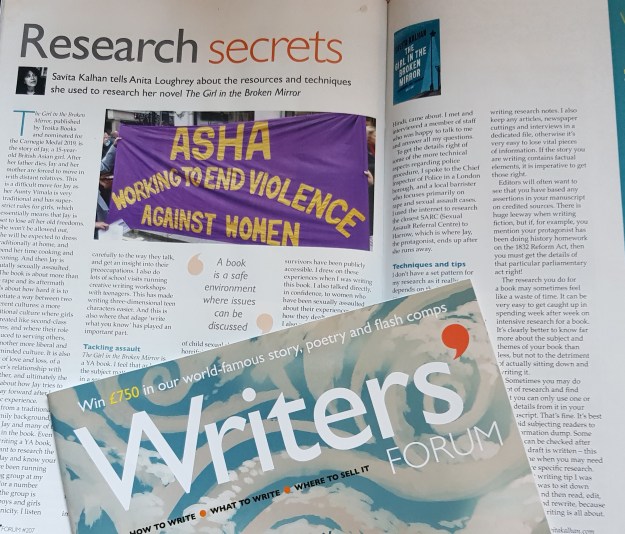
Featured in my Research Secrets column this December is YA writer Jon Mayhew. He told me about the research that went into writing his supernatural adventure, Mortlock.

Mortlock3

His initial idea came from a school production of Oliver.

I was watching the scene in which Oliver is ‘sold’ to Mr Sowerberry the undertaker and the phrase ‘undertaker’s mute’ was used. The idea of a child trudging behind funeral carriages all day intrigued me and I began to wonder what would happen if that child found that he could wake the dead. Alfie Wiggins was born and so the story began.

He spent time researching the streets of the Seven Dials in London to observe the Victorian architecture and recreate the atmosphere in his novel. A trip to Bamburgh Castle where he had the opportunity to view a funeral carriage, the Dee estuary and childhood memories of Liverpool all helped to create a realistic and evocative Victorian London backdrop.

RSJM2

His publisher, Bloomsbury needed Jon to check all the extracts from traditional ballads that preface each chapter were out of copyright. Even though Jon is well-versed in traditional music he was able to check the songs were in the public domain with a trip to the Vaughan Williams Memorial Library in London.

Jon’s advice to other writers is to enjoy your research but enjoy your writing more and don’t let any of those fiddly details get in the way of a good story. He said:

The research is important because it does give the book a sense of realism and it is easier to visualise characters and settings. I like to think of the research used in a book as the tip of an iceberg. Only a little of the research is actually relayed in the book but it’s there, lurking beneath the surface.

This particular interview was first published in Writers Forum in May 2010. You can read the full interview in the Dec 2018 #206 issue of Writers Forum.

You can find out more about Jon Mayhew and his books on his website: www.jonmayhew.co.uk of follow him on Twitter @MayhewJ 

What if…

We have just finished Christmas and I have been watching Christmas movies since early November. I love all the old favourites, especially the different renditions of A Christmas Carol.

EbenezerScrooge

The man who inspired Charles Dickens’, Ebeneezer Scrooge, real name was Ebeneezer Scroggie, a Scottish merchant who died in 1836. Scroggie’s tombstone was moved during redevelopment work and his real identity was temporarily lost and forgotten. His grave, lay unmarked just off the city’s Royal Mile for many years until Edinburgh authorities put up a memorial statue in his memory.

Dickens stumbled upon Scroggie’s tombstone in Canongate Cemetery in 1842, whilst visiting Edinburgh for a lecture. It was the inscription on this tombstone that gave birth to the mean, miserly Scrooge in Dickens’ brilliant novel, A Christmas Carol.

But, in reality, the tombstone read ‘meal man’ rather than ‘mean man’, which referred to Scroggie’s job as a successful corn merchant. The real Ebeneezer was well-known for his generous nature and often enjoyed a good party.

So why was the name and personality of the now most famous Christmas character in history, changed in this way? Maybe, Dickens wanted to protect himself from possible litigation by purposely changing his antagonist’s name, or maybe he simply misread the name on the tomb. We will never know. What we do know is, Dickens wrote in his notebook:

“To be remembered through eternity only for being mean seemed the greatest testament to a life wasted.”

So, was Ebeneezer a victim of Dicken’s poor research? Or were the changes more to do with the wild imaginations of a great writer who thought, ‘What if…’?