Anita Loughrey's blog. This is my journal about my experiences and thoughts on writing. As well as news about me and my books, it includes writing tips, book reviews, author interviews and blog tours.
For more information about me and my books see my website: www.anitaloughrey.com. Follow me on Twitter @amloughrey, Facebook @anitaloughrey.author and on Instagram @anitaloughrey
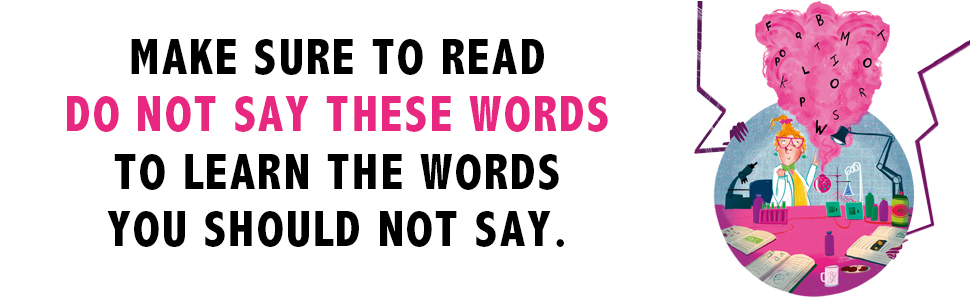
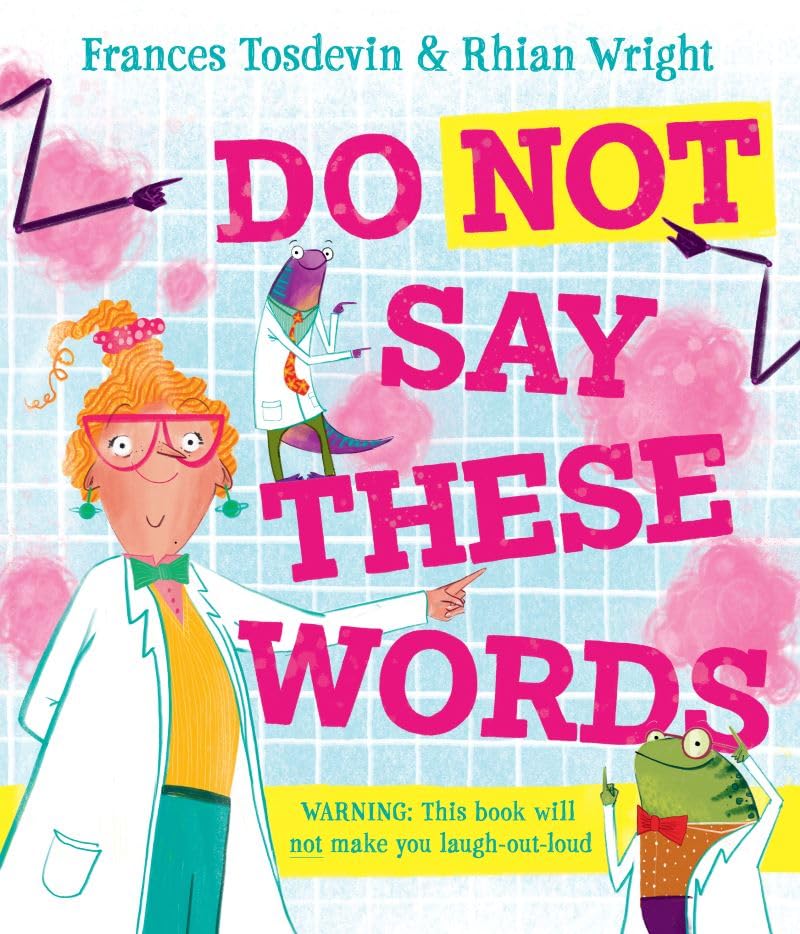
Do Not Say These Words by Frances Tosdevin and Rhian Wright is an absolute giggle-fest. This book delivers belly laughs with a brilliantly bonkers premise that each time we chuckle at cheeky words, we unleash a dangerous Giggle-Gas. If we don’t stop, the whole world might zoom off into space like a rogue balloon with a puncture.
Enter the ever-serious Professor has devised a ridiculous but totally hilarious solution to ban all the funny words. To enforce this, she has invented a machine that changes them into something completely different. Fancy saying Floppy Peach-Cheeks instead of Bottom? Well, you’d better get used to it.
This book is a riot of imagination, encouraging kids to dream up their own side-splitting word swaps. Every page bursts with colour and chaos with Rhian Wright’s bold and bright, edge-to-edge illustrations.
Do Not Say These Words will have children (and grown-ups) laughing out loud, making up their own silly alternatives, and coming back for more. Even the most reluctant reader won’t be able to resist this books charm.
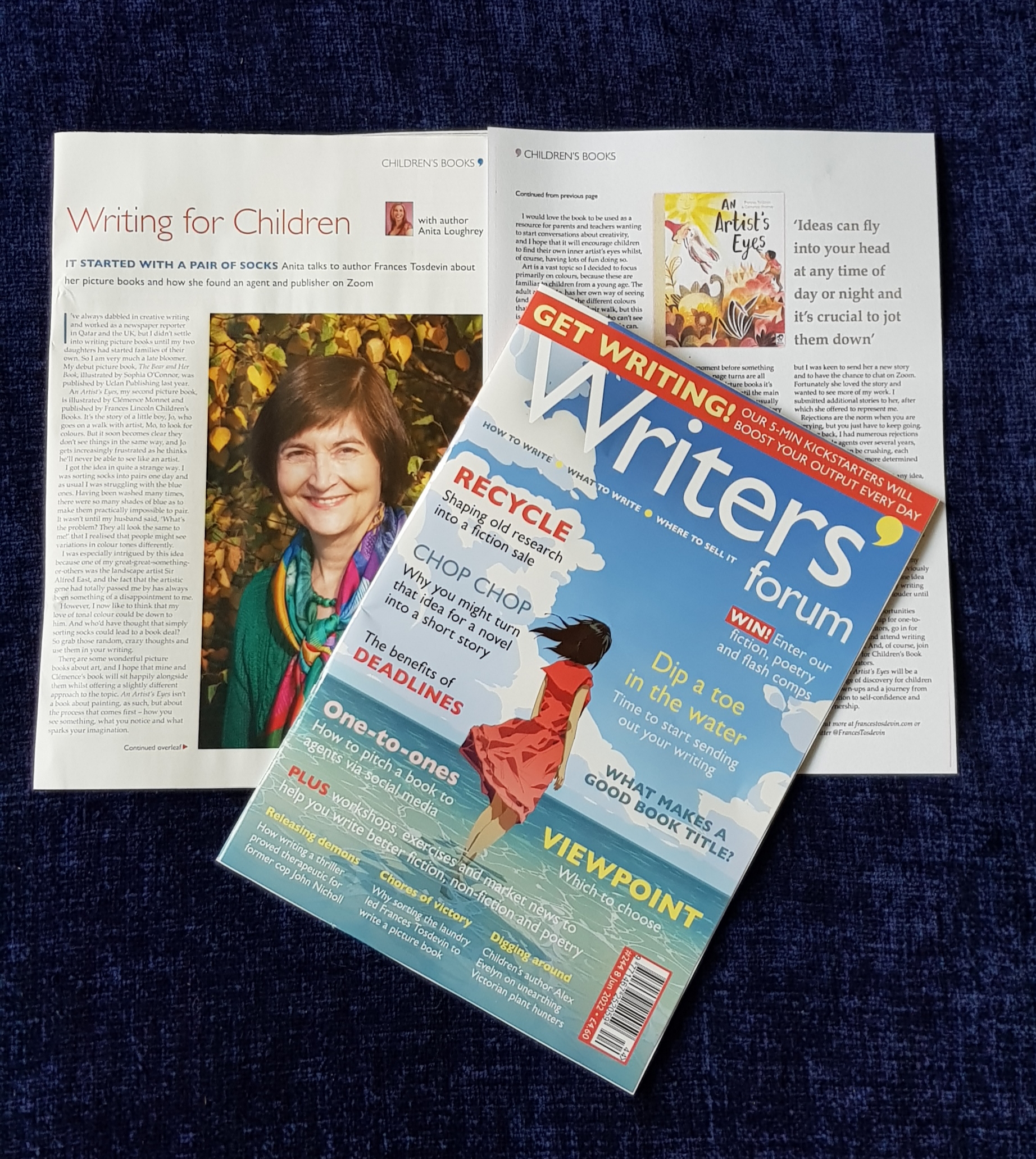
I interviewed Frances Tosdevin for the #244 8 Jun 2022 issue of Writers’ Forum about her writing process from conception to final draft for An Artist’s Eyes.
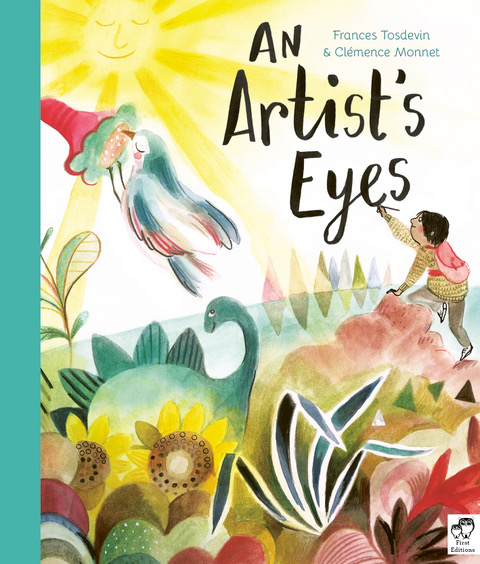
An Artist’s Eyes is illustrated by Clémence Monnet and published by Frances Lincoln Children’s Books. It is the story of a little boy, Jo, who goes on a walk with artist, Mo, to look for colours. But it soon becomes clear they don’t see things in the same way, and Jo gets increasingly frustrated because he thinks he’ll never be able to see like an artist.
It isn’t a book about painting, as such, but about the process that comes first — how you see something, what you notice and what sparks your imagination. Frances revealed she got the idea for an An Artist’s Eyes whilst sorting socks into pairs. The blue ones were so many shades of blue she found them impossible to pair. When her husband told her they all look the same to him, she realised people might see variations in colour tones differently.
Frances said all children’s book writers should grab these crazy thoughts, the ones that come at random times when you’re doing ordinary things, and use them in their writing. She told me she decided to focus primarily on colours because these are familiar to children from a young age.
“An Artist’s Eyes is an empowering book – a clarion call to creativity, if you like – and I hope that it will help children to embrace their own unique way of seeing the world and all the wonderful things in it. I would love the book to be used as resource for parents and teachers wanting to start conversations about creativity and I hope that it will encourage children to find their own inner artist’s eyes whilst, of course, having lots of fun doing so.”
Frances Tosdevin
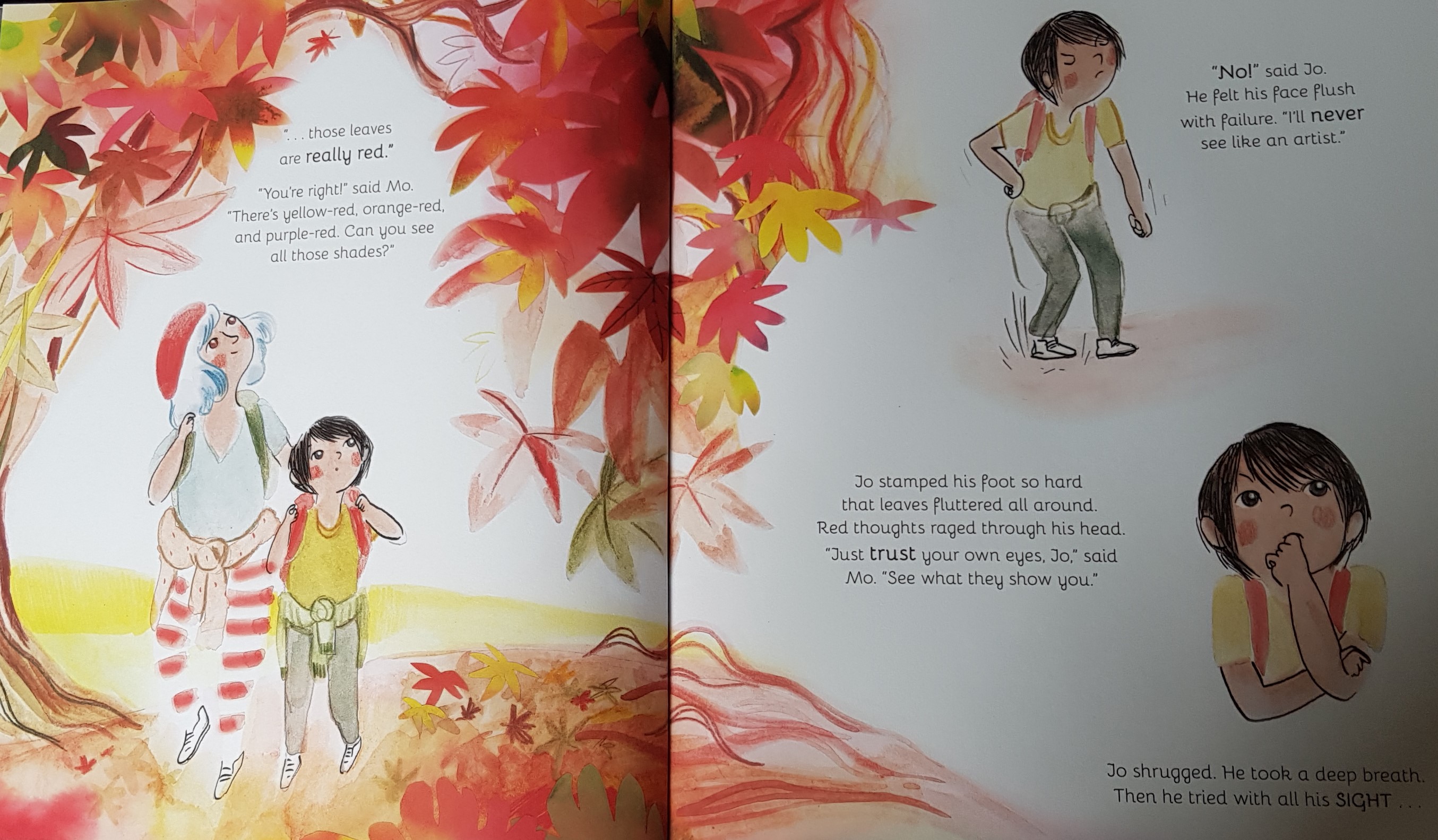
She elaborated that colour is also used in the artwork at key points to convey Jo’s feelings. For example, there is an almost totally black spread, scattered with tiny bursts of colour, to convey Jo’s increasing sense of frustration at not being able to see things in the way Mo can, whilst red is the key to his turning point, when he finally starts to believe in himself and to trust his own artist’s eyes.
Frances explained she prefers to work on several picture book texts at once, because that way, if she hits a block with one and something needs to swirl around in my subconscious a little longer, she has other texts to be working on. She is often found pacing round the kitchen in the middle of the night, working out tricky plot points or strengthening characterisation.
“I love it when the house is dark and quiet, and it’s just me, my thoughts and two slumbering cats.”
Frances Tosdevin
She continued her stories go through numerous drafts, during which time they can change quite dramatically and she spends a good deal of time identifying, and replacing any word or phrase that sounds ‘flat’ to find a more exciting approach. She also roots out text that goes sideways, such as unnecessary details that slow down the story, rather than forwards.
Frances tries to think visually when writing, and pays special attention to page turns. to set up opportunities to surprise the reader. She explained it is a bit like delaying the punchline of a joke, or eeking out a spooky moment before something goes ‘Boo!’ Page turns are all about timing. Plus, in picture books it’s important to build tension until the main character’s lowest point (which is usually in Spread 9) and then to wrap up the story and provide the resolution quite quickly.
Frances warns all picture book writers rejections are the norm when you are querying, but you just have to keep going. She told me she had numerous rejections from multiple agents over several years, and although it can be crushing, each rejection just made hermore determined to write something better.
Her top tip is never to discount any idea, however small. Ideas can fly into your head at any time of day or night and it’s crucial to jot them down. Don’t delay, you might forget your idea. It doesn’t have to be a full-blown concept, it could simply be a pleasing phrase, a quirky title, or a character that demands attention. It could be a feeling you are experiencing, or a sense of place, or a funny situation.
An Artist’s Eyes by Frances Tosdevin and Clémence Monnet
She told me she currently has over 600 ideas on her phone, and a full notebook, as well. One of these idea often wriggles its way to the top of her writing brain and keeps making itself louder until she gives in and writes it. She recommends you take opportunities that come your way, sign up for 121s with agents and editors, go in for writing competitions and attend writing events whenever you can.
An Artist’s Eyes by Frances Tosdevin and Clémence Monnet
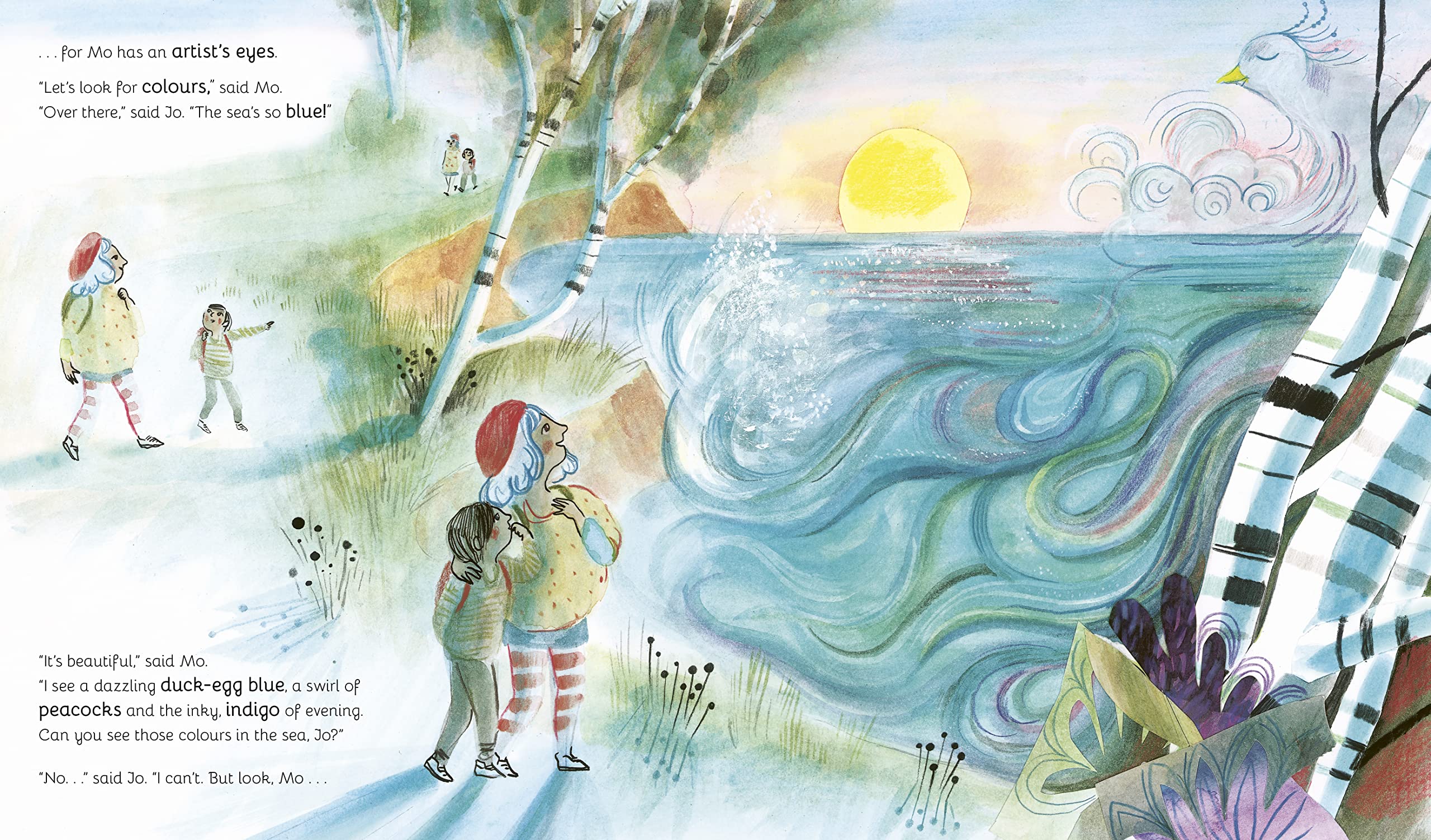
An Artist’s Eyes is a captivating picture book about a little boy called Jo, whose eyes may look the same as Mo, who is an artist, but they see things very differently. He does not see the differences in colour Mo does. She can see:
“…shiny apple-green; the lime of gooseberries and the springy zinginess of moss.”
Extract from An Artist’s Eyes by Frances Tosdevin and Clémence Monnet
Yet the apples, gooseberries and moss just look like green to Jo. No matter how hard he tries his eyes don’t see the variations of shade in the same way Mo the artist. Frances’ text shows the build-up of Jo’s frustration, as he tries to force himself to see the same way as Mo.
As he journeys through the world of colour and creativity, Jo begins to relax and use his imagination. He soon realises he does not have to see the same as Mo, the things he can imagine are completely unique. I love the way Frances Tosdevin shows us how Jo begins to trust his own eyes and how his mindset changes in this empowering story of confidence. Jo starts to appreciate he is able to think and see like an artist but in a totally different way to Mo.
On each spread, Clémence Monnet’s watercolour illustrations compliment the text and vividly show the wide variety of colour Mo can see. I particularly like the way the colours are used to convey Jo’s emotional journey, from the black spread scattered with bursts of colour to illustrate Jo’s frustration, to the angry red spread which highlights Jo’s turning point when he finally starts to believe in himself. This picture book will inspire children to explore the different colours they can see for themselves in the world around them, from the different shades of red in the autumn leaves to the…
“…mellow yellow of melons and the pale pastel of primroses.”
Extract from An Artist’s Eyes by Frances Tosdevin and Clémence Monnet
The perfect book to use in the primary classroom from years one to six to demonstrate to young children how to use the full colour of our imaginations. It could also be used to stimulate art work and experimentation of colour mixing and also the use of shape and pattern. I believe this book is ideal for encouraging children to be more observant of the world around them. It will help them to discover for themselves that our individual perspectives make us all artists because no two artist’s eyes are the same.
An Artist’s Eyes truly is an exceptional and distinctive book to help young readers see how magical the world can be.
You can buy copies of An Artist’s Eyes by Frances Tosdevin and Clémence Monnet from your local bookshop, or online at uk.bookshop.org, an organisation with a mission to financially support local, independent bookshops.


 Much To Do About Writing