Tag Archives: Select Magazines

An interview with… Sophie Anderson

In the October issue of Writers’ Forum #248 Oct 22, I have interviewed Sophie Anderson for my Writing for Children double-page spread, about how Slavic folklore and fairy tales have influenced her novels.
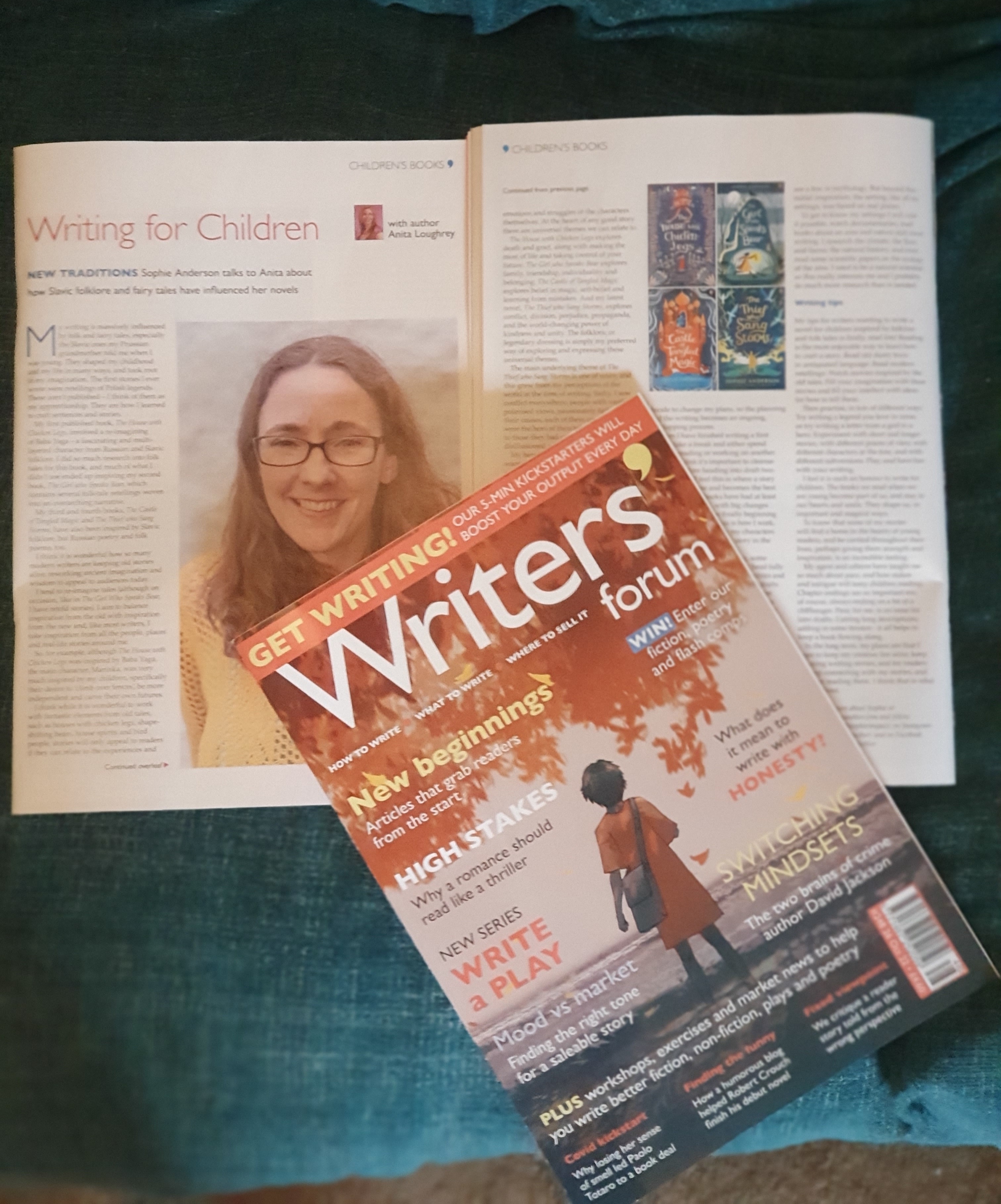
Sophie told me her writing is massively influenced by folk and fairy tales, especially the Slavic ones her Prussian grandmother told her when she was young.

“They shaped my childhood and my life in many ways, and took root in my imagination.”

Sophie Anderson

Sophie’s first published book was The House with Chicken Legs, which involved a reimagining of Baba Yaga – a fascinating and multi-layered character from Russian and Slavic folklore. She revealed she did so much research into folktales for this book, that much of what she didn’t use ended up inspiring her second book, The Girl who Speaks Bear, which contains several folktale-retellings woven into an overarching narrative.
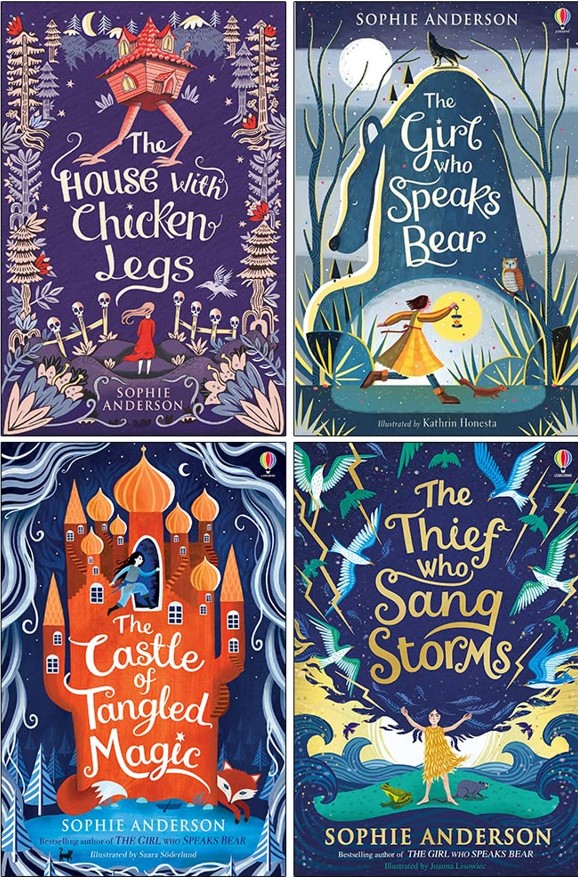
Her third and fourth books, The Castle of Tangled Magic and The Thief who Sang Storms, were also inspired by Slavic folklore, as well as Russian poetry and folk poems.

“I think it is wonderful how so many modern writers are keeping old stories alive; retelling, reimagining and reworking ancient imagination and wisdom to appeal to audiences today. I tend to reimagine tales rather than retell them (although on occasion, like in The Girl Who Speaks Bear, I have retold stories). I aim to balance inspiration from the old with inspiration from the new.”

Sophie Anderson

Sophie explained she takes inspiration from all the people, places and real-life stories around her. The House with Chicken Legs was inspired by Baba Yaga, the main character, Marinka, was inspired by her children, specifically their desire to ‘climb over fences’, be more independent, and carve their own futures.

At the heart of any good story there are universal themes we can relate to. The House with Chicken Legs explores death and grief along with making the most of life and taking control of your future. The Girl who Speaks Bear explores family, friendship, individuality and belonging. The Castle of Tangled Magic explores belief in magic, self-belief, and learning from mistakes. The Thief who Sang Storms, explores conflict, division, prejudice, propaganda, and the world-changing power of kindness and unity. The main underlying theme is one of unity.

“I think whilst it is wonderful to work with fantastic elements from old tales, such as houses with chicken legs, shapeshifting bears, house-spirits, and bird-people, stories will only appeal to readers if they can relate to the experiences, emotions and struggles of the characters themselves.”

Sophie Anderson

She uses folklore and legends as a way of exploring and expressing these themes.
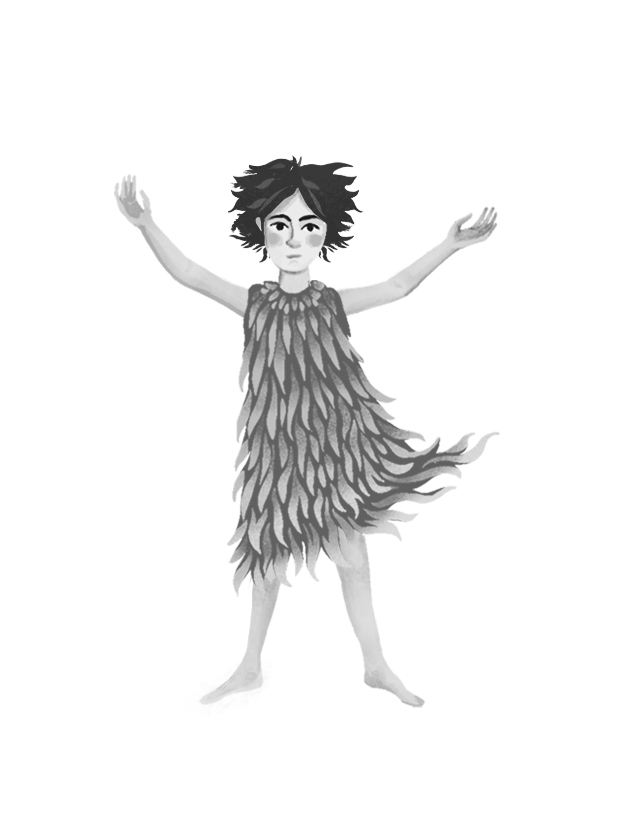
Linnet from The Thief who Sang Storms
Illustrated by Joanna Lisowiec

Sophie revealed her planning process is messy and very paper-based. She told me she fills up notebooks with ideas and stream-of-consciousness free writing and ring-binders with maps and plans, character studies, notes on settings, lists of key events and plot points, and thoughts about possible themes and messages. Once she starts writing the chapters she inevitably changes her plans so it is an organic process. .

Sophie said if a character feels vague and not fully-formed she will do some exercises, like write letters or a diary from that character’s point of view. Or might interview them, take them out for an imaginary coffee for a chat, or write a scene that doesn’t end up in the book, where they are having a day out with a friend.

Her writing tips to writers wanting to write a novel for children inspired by folklore and folktales is firstly, read lots!

“Reading is the most enjoyable way to learn how to craft a story. Read old dusty texts in antiquated language. Read modern retellings. Watch movies inspired by the old tales. Fill your imagination with these stories and fill your intellect with ideas for how to tell them.”

Sophie Anderson

Then practice, in lots of different ways.

“Try writing a legend you love in verse, or try writing a letter from a god to a hero. Experiment with short and longer stories, with different points of view, with different characters at the fore, and with different subversions. Play, and have fun with your writing.”

Sophie Anderson

You can discover more about Sophie on her website: www.sophieandersonauthor.com and follow her on Twitter: @sophieinspace, Instagram: @sophieandersonauthor and Facebook: @SophieAndersonAuthor.

To read the complete feature you can purchase a copy of #248 Oct 2022 Writers’ Forum by ordering online from Select Magazines.

To read my future Writing 4 Children or Research Secrets interviews you can invest in a subscription from the Writers’ Forum website, or download Writers’ Forum to your iOS or Android device.

An interview with… Donna Amey Bhatt

For the September #247 21 Sep 2022 issue of Writers’ Forum I interviewed Donna Amey Bhatt about co-writing a children’s book with her husband, Vikesh. Donna was already a published author with her book, How To Spot a Mum.

Co-writing a book was something new for both of them and Donna was worried it might put a strain on their relationship but found in reality it bought them closer together. Although, the deadline for the book ended up being difficult, as their baby was due. It meant they needed to be much more organised.

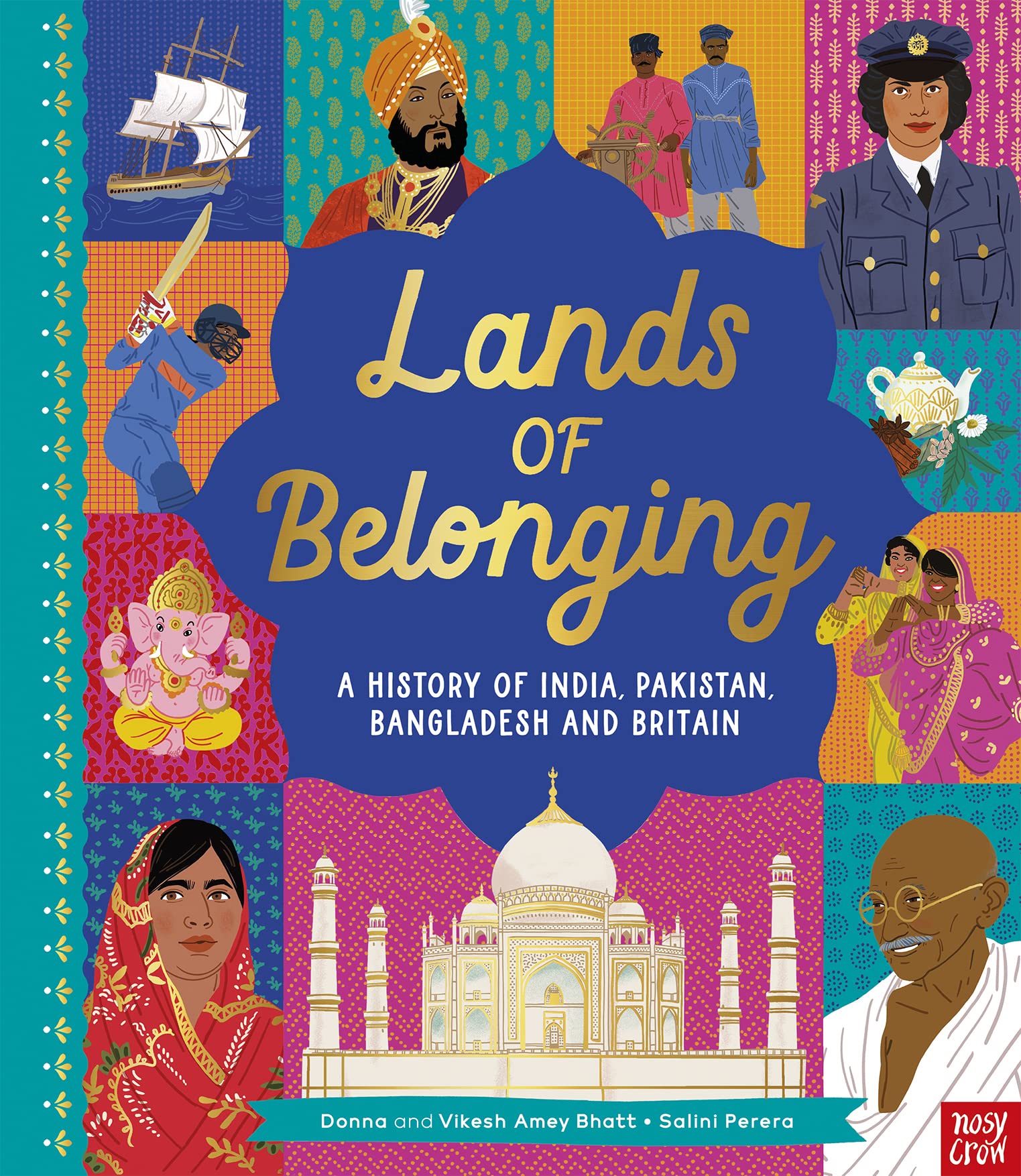
Donna told me Vikesh came up with the idea for Lands of Belonging: A history of India, Pakistan, Bangladesh, and Britain over lockdown, and together they fleshed it out and pitched it. Lands of Belonging is a thrilling exploration of the complicated history of South Asia and Britain, examining what it means to ‘belong’.

In the interview Donna explained one of the things that inspired the book was the fact Vikesh grew up without being told the full history as to why his family lived here. It’s a huge part of the UK’s story that is often overlooked in both schools and the media. They have also found through their work in marketing not many places truly embrace diversity. This is something Vikesh is passionate about changing, and educating the younger generation is where it really needs to start. It is especially topical this year, 2022 as it is the 75th anniversary of Partition.

Donna elaborated how the combined history is often glamourised, things like the Raj and ‘Britannia ruling the waves’ really don’t tell the story of them people from India, Pakistan, and Bangladesh who lived during those times. Their contributions to our country are so huge, and so brilliant they should be acknowledged and celebrated.

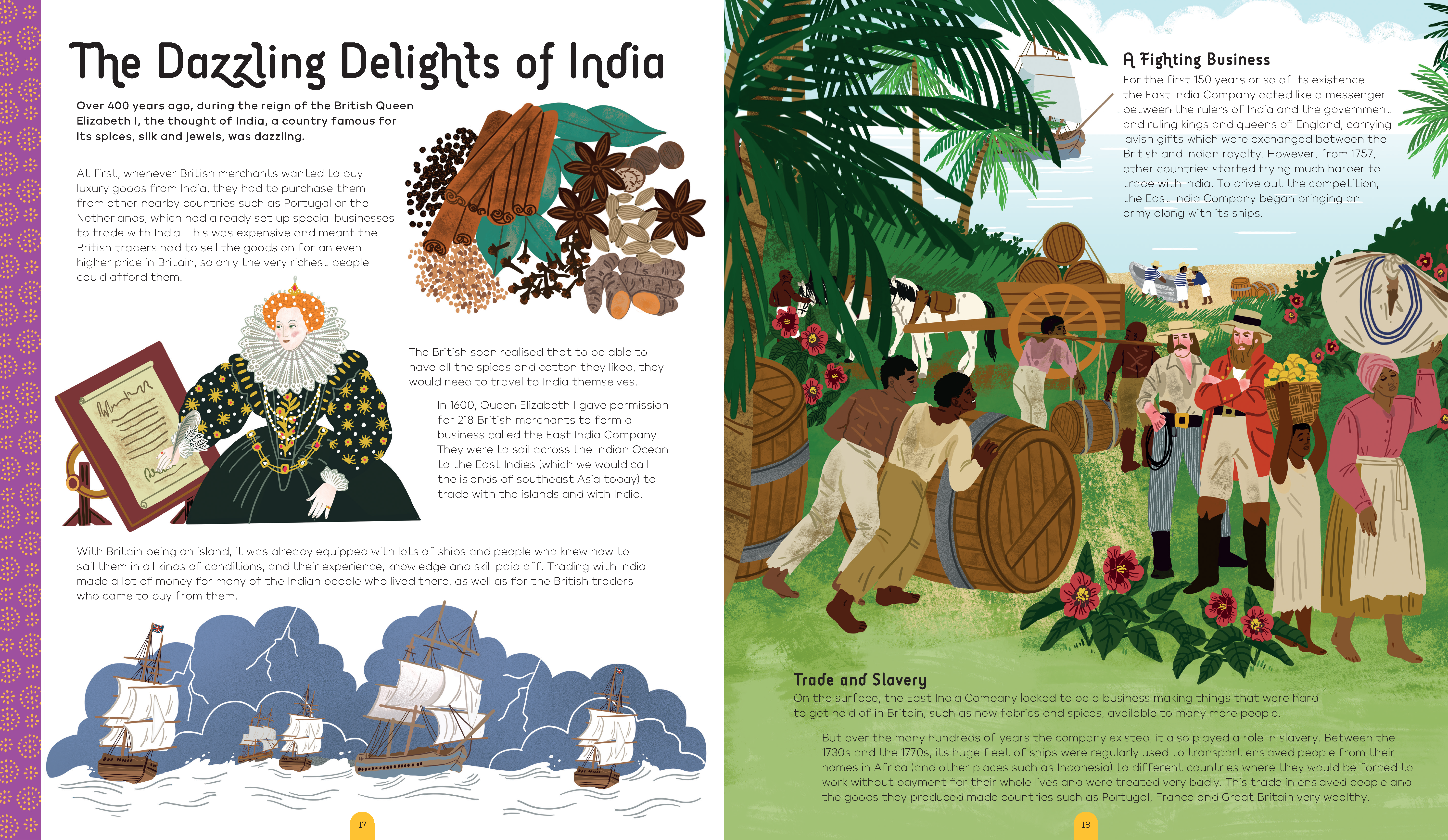
The book is split into two sections. The first looks at the past, and plots the beginning of Britain and India’s relationship, as well as looking at what India was like before it was colonised.

The second half is a look at modern Britain as shaped by Indian, Pakistani, and Bangladeshi people. It was important to Donna and Vikesh to include a diverse variety of Indian culture within the book. She told me that as well as fact checking with friends and family, Nosy Crow were incredibly thorough and provided two academics and many fact checkers to ensure all the information was 100% accurate.

Key to them was the fact they had a brilliant illustrator, Salini Perera, who could show things so beautifully. So, things like talking about traditional dishes and costume didn’t need lengthy explanation. They trusted Salini’s skill and it paid off.

“One of our favourite pages explains a few types of yoga, and Salini has done a brilliant job of showing some of the positions.”

Donna Amey Bhatt

There are plenty of history books that solely tell you what happened in the past but there are not many that explain how these events effect our culture and the world today. Donna explained she believes looking at how the past has led to how we live today is often what draws readers (and potential publishers) in.

Her advice to other writers who want to write about the history of their culture is to try to think of how you can explain things interactively. Maybe there’s an activity you can include that makes your point, or you can use illustration to plot something instead of using too much text. The great thing about writing for children is there’s space to experiment, and many of the rules for writing can be thought more as suggestions.

They both hope Lands of Belonging serves as a helpful reference to people who don’t fully understand this part of history.

Find out more about Donna and her book on Instagram @doonkris and Twitter @doonkris , and her website is www.donnaamey.com.

Donna’s latest book is How to Greet a Gran, published by Quarto. It’s a look at grans all over the world, tells you a little about granny customs in different countries, and vitally; what to call them.

How to greet a gran by Donna Amey Bhatt and Aura Lewis

You can buy copies of all Donna’s books from your local bookshop, or online at uk.bookshop.org, an organisation with a mission to financially support local, independent bookshops. It is also available at Waterstone and Amazon.

To read the complete feature you can purchase a copy of #247 21 Sep 2022 Writers’ Forum by ordering online from Select Magazines.

To read my future Writing 4 Children or Research Secrets interviews you can invest in a subscription from the Writers’ Forum website, or download Writers’ Forum to your iOS or Android device.
An Interview with… Paul Anthony Jones

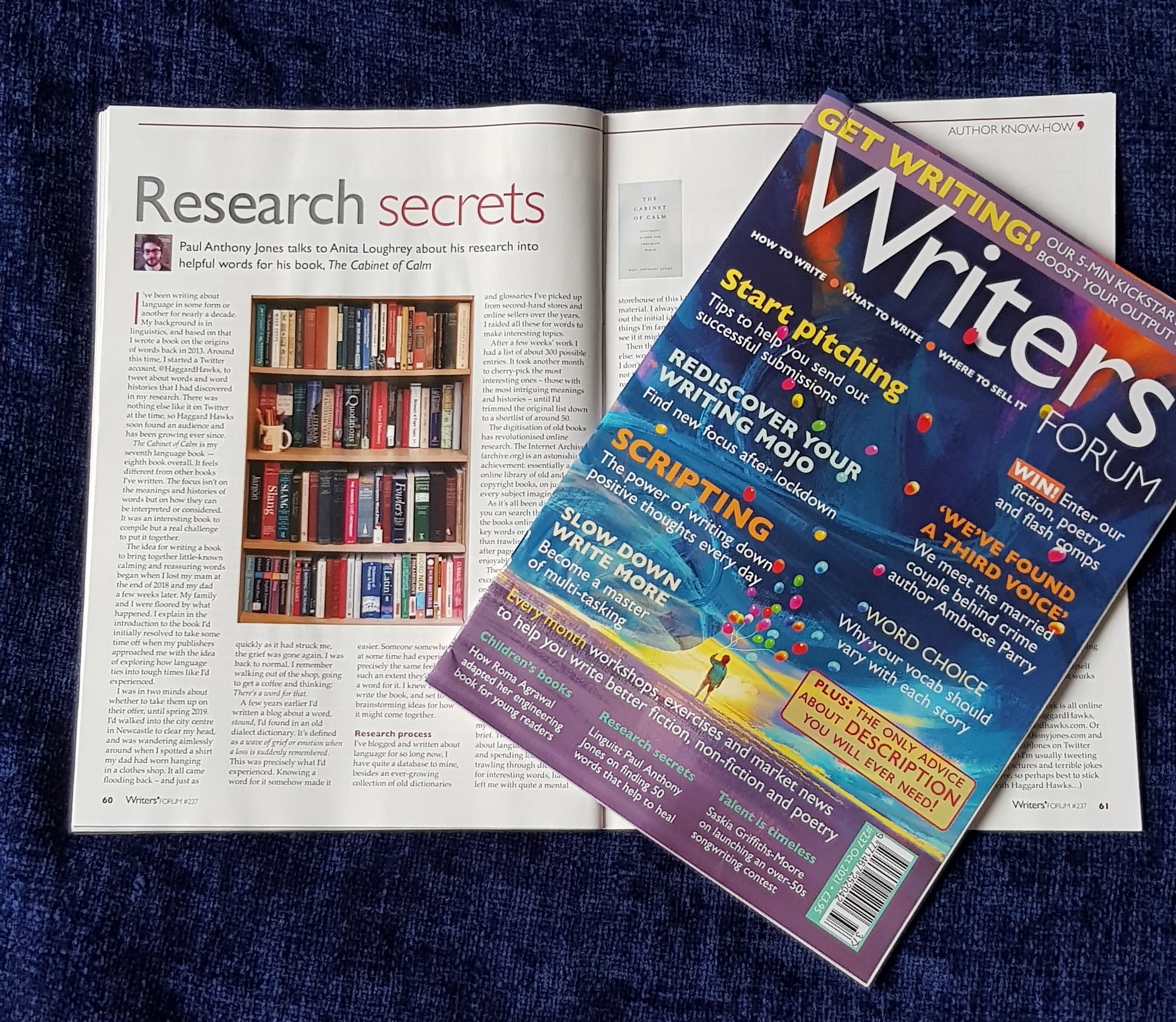
I interviewed Paul Anthony Jones about his research into positive words for his book, The Cabinet of Calm for the #237 Oct 2021 issue of Writers’ Forum.

Paul has been writing about language in some form or another for nearly a decade. His background is in linguistics, and based on that he wrote a book on the origins of words back in 2013. Around this time, he started a Twitter account, @HaggardHawks, to tweet about words and word histories that he had discovered in his research.

The Cabinet of Calm is his seventh language book – eighth book overall. He told me it feels different from other books he has written. The focus isn’t on the meanings and histories of words, but on how they can be interpreted or considered. Paul confessed it was an interesting book to compile but a real challenge to put it together.

“The idea for writing a book to bring together little-known calming and reassuring words began when I sadly, lost my mam at the end of 2018 and my dad a few weeks later at the start of 2019. I and my family were floored by what happened. I explain in the introduction to the book I’d initially resolved to take some time off when my publishers approached me with the idea of The Cabinet of Calm, exploring how language ties into tough times like I’d experienced.”

Paul Anthony Jones

Paul revealed he was in two minds about whether to take them up on their offer, until spring 2019 when he walked into the city centre in Newcastle to clear his head, and was wandering aimlessly around the shops when he spotted a shirt his dad had worn hanging in a clothes shop.

“It all came flooding back—and just as quickly as it had struck me the grief was gone again – I was back to normal. I remember walking out of the shop, going to get a coffee and thinking there’s a word for that.”

Paul Anthony Jones

A few years earlier he had written a blog about a word, stound, he had found in an old dialect dictionary. It’s defined as a wave of grief or emotion when a loss is suddenly remembered. He explained this was precisely what he’d experienced and knowing a word for it somehow made it easier because it meant that someone somewhere at some time had experienced precisely the same feeling, to such an extent they’d coined a word for it. It was at this moment he knew he had to write the book, and set to work brainstorming ideas for how it might come together.

Paul has blogged and written about language for so long now, he has accumulated quite a database to mine—besides an ever-growing collection of old dictionaries and glossaries he has picked up from second-hand stores and online sellers over the years.

One of Paul Anthony Jones’ bookshelves

He explained he raided all these for words to make interesting topics. After a few weeks’ work he had a list of about 300 possible entries. It took another month to cherry-pick the most interesting ones – those with the most intriguing meanings and histories – until he had trimmed the original list down to a shortlist of around fifty.

He divulged whenever he starts work on a new book, there’s three ways it comes together. First, something he already knows gives him the gem of the idea – in this instance the word stound. Secondly, there’s all the other words and etymologies he is already familiar with through his work to fit the same brief. Then there’s everything else: words and etymologies he does not already know, found from researching the new idea. Paul told me this is the best part and makes up the vast majority of material in the final draft. The initial idea forms the foundations, his research builds the rest of the book.

“In The Cabinet of Calm, the first chapter I wrote was actually for a word I found while searching specifically for topics to do with feeling overworked or overwhelmed: cultellation. I’d never spotted this word before; derived from an old surveyor’s tool, it describes the process of cutting a larger task into smaller more manageable jobs. It was the right mix of a brilliant-sounding obscure word, a perfectly appropriate meaning for what I was compiling, and a fascinating and very unexpected etymology.”

Paul Anthony Jones

Paul’s tip to anyone interested in writing about language or words is to track down reliable sources. It makes for much more rewarding research and raises the reliability not only of your work but of this genre of book as a whole. This makes the finished work more robust. You’ll know yourself what constitutes a reliable research source – even then, try to back everything up.

Paul explained The Cabinet of Calm went through quite a difficult draft period, with both himself and his publisher approaching the idea from two different angles. Initially, he wanted to bring together lots of much shorter dictionary-like entries, and divide the book in two halves—the first listing words for worldly problems, and the second for calming, reassuring words to act as their solution. His publisher had a different idea, and pushed him towards writing fewer chapters of more detail and content. It took quite a few attempts to get it right and Paul is happy how the final format works well.

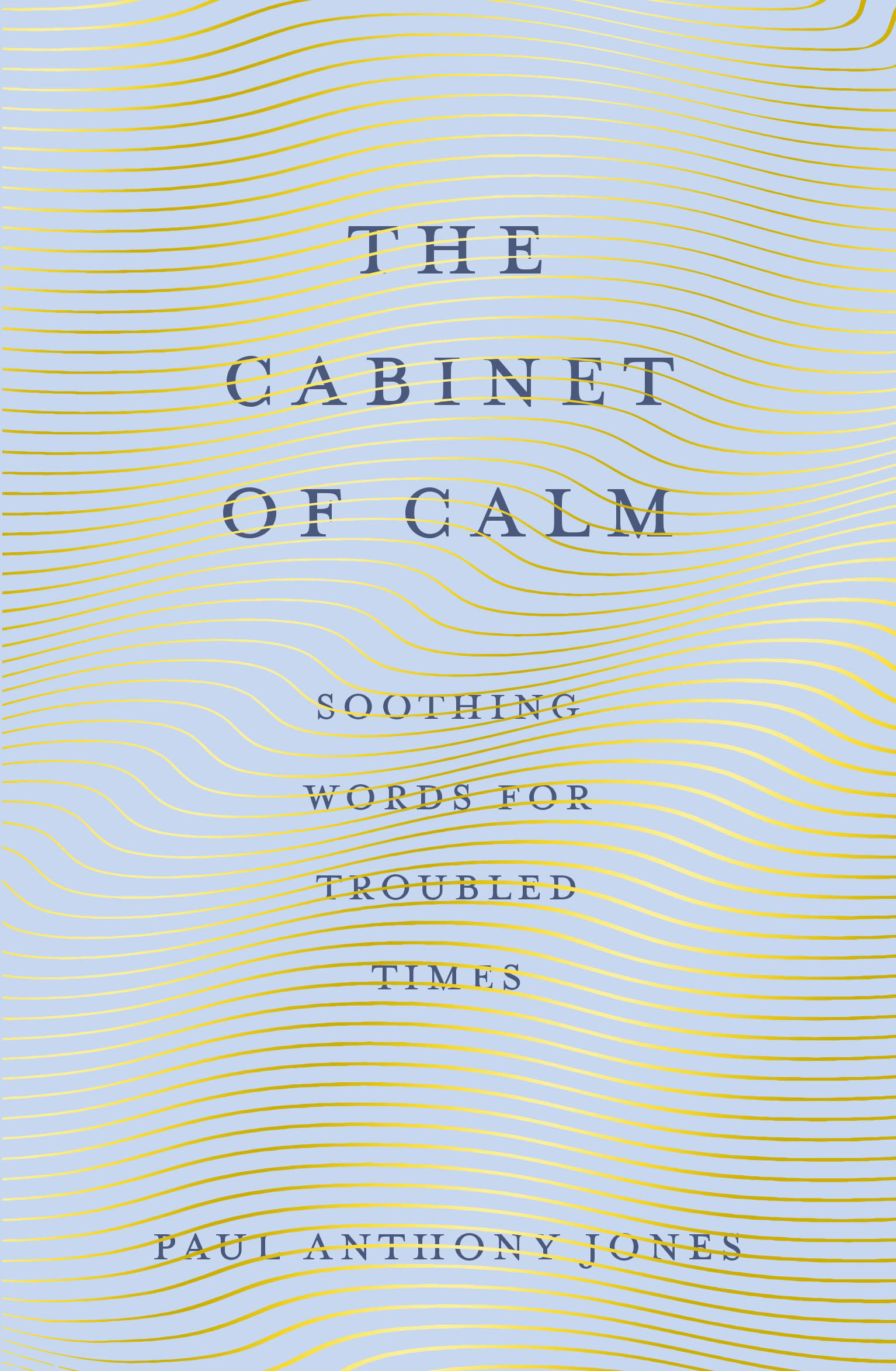
The Cabinet of Calm: Soothing Words for Troubled Times
by Paul Anthony Jones

He advocates, no matter how you find yourself researching, that’s the best way for you. Many writers – especially when they’re first starting out, are overly self-critical, and feel they are not taking their writing or research seriously if they don’t fit the romanticized idea all writers are forever carrying a notepad, jotting down ideas in coffee shops, and pouring over piles of books in libraries. If this is how you work, great! But if it isn’t, it’s fine too.

“Work out what works best for you, and stick with it. By all means take ideas or inspiration from other people, but don’t compare yourself unnecessarily to them. We all have our own ways of doing things, and your writing will be happier and more fruitful if you allow yourself time to figure out what works best for you.”

Paul Anthony Jones

To find out more about Paul Anthony Jones you can follow his personal account on Twitter @PaulAnthJones and his professional account @HaggardHawks. You can also check out his websites: www.haggardhawks.com and www.paulanthonyjones.com.

To read the complete feature you can purchase a copy of #237 Oct 2021 Writers’ Forum by ordering online from Select Magazines.

To read my future Research Secrets or Writing 4 Children interviews you can invest in a subscription from the Writers’ Forum website, or download Writers’ Forum to your iOS or Android device.
An interview with… Emily Ann Davison

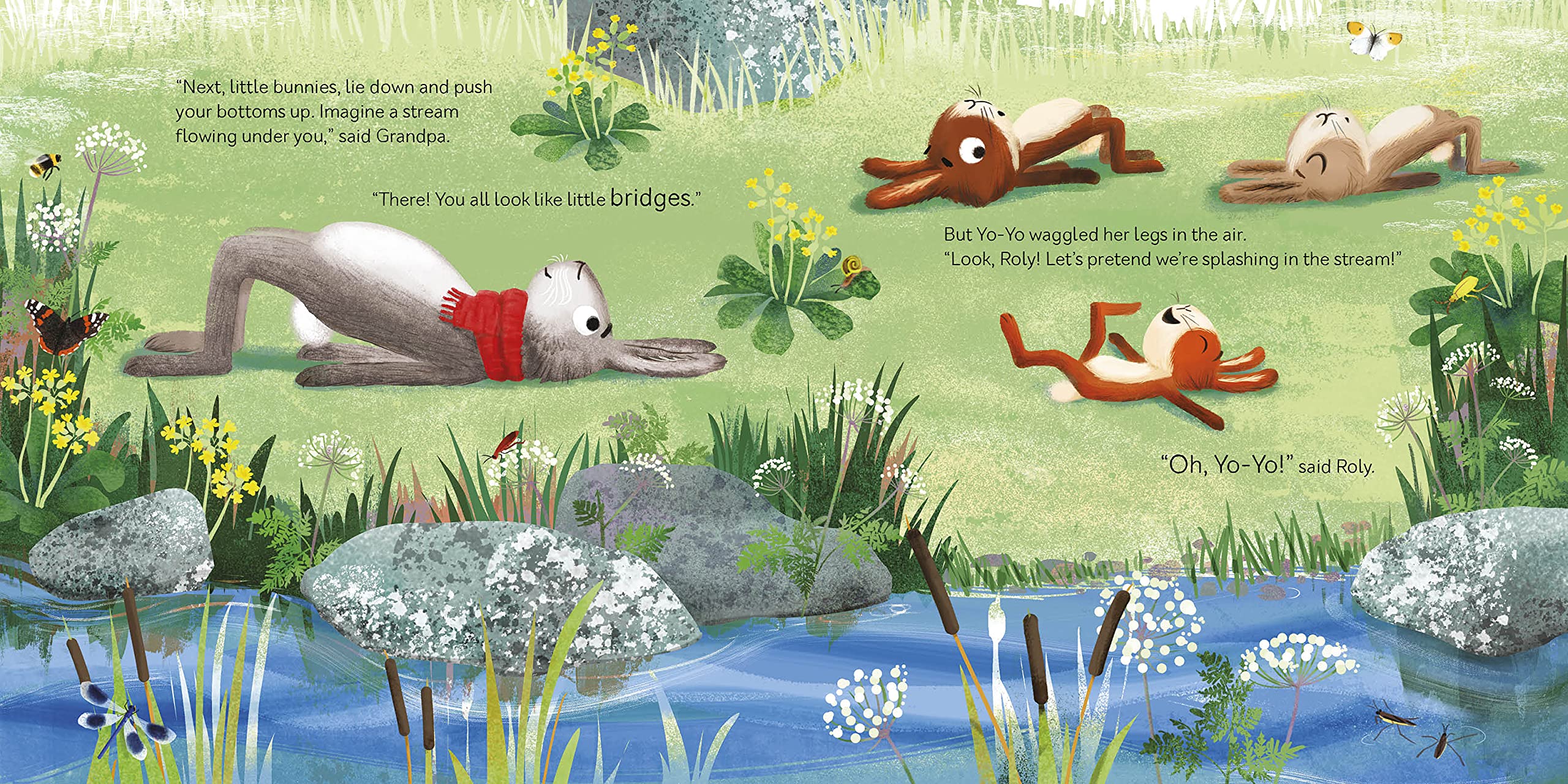
I interviewed Emily Ann Davison about how she developed her characters for her picture book, Every Bunny is a Yoga Bunny, for the #246 17 Aug edition of the UK national writing magazine, Writers’ Forum.

Emily told me as a child she enjoyed writing stories and songs, so it wasn’t really a huge surprise that as a grown up she returned to writing. She also worked with young children for many years, and this is where she discovered her enthusiasm for children’s books, in particular picture books. One day, a picture book idea popped into her head and she revealed now the ideas just won’t stop popping.

She explained the inspiration behind her debut picture book, Every Bunny is a Yoga Bunny which is published by Nosy Crow, came from working with children and being a mother. She understands just how wriggly young children can be, and felt there was a place for a book to help wriggly children feel calm. She wrote this story at a time when her daughter was finding it particularly hard to feel calm at bedtime, so Emily had started to try different relaxation techniques to help her. She discovered the main thing that helped was yoga!

“I’d previously written a draft picture book about a family of monsters doing meditation. Doing yoga with my daughter, reminded me about this story, so I dug it out and transformed it into a story about yoga, calm and mindfulness and features an excitable bunny called Yo-Yo!”

Yo-Yo is a fidgety, bouncy, can’t-sit-still-EVER type of bunny. Grandpa suggests the bunnies try yoga, but even that doesn’t stop her wiggling and giggling. Yo-Yo later finds herself lost and all alone in a shadowy forest. She feels panicky, but maybe Grandpa’s yoga will be able to help… At the end of the book, there are simple step-by-step instructions so children can stretch, feel calm and be a yoga bunny too.

Every Bunny is a Yoga Bunny by Emily Ann Davison and Deborah Allwright

Emily said when writing for young children, it’s important the characteristics or experiences of a character are relatable to a young child’s own life experiences. It was important to Emily, that at the end of the story Yo Yo was still wriggly and giggly, and found it tricky to sit still as she didn’t want the character to change her personality, she wanted Yo Yo to learn a method of feeling calm by using yoga.

Some stories are all about the setting. For Every Bunny is a Yoga Bunny, it is the concept that is most important. Emily told me when writing picture books it is often the characters and concept of the book that dictate the plot and theme.

“Young children have a very short attention span, so it is important to keep the pace going. You need to have some type of suspense in the story or some type of escalation throughout the book.”

She also revealed for a picture book, page turns are important. At each page, you want the child to HAVE to know what happens next. her suggestion is to think of page turns as a ‘flap’ in a ‘lift the flap’ book. The page turn can be used as a reveal. 

Emily’s advice to other writers wanting their picture book manuscript published is – do the research. Research picture books. Research publishers and agents before submitting. Know as much about the world of picture books as you can and try to connect with other picture book writers. The journey is much easier when you have a network of writers around you, who you can share the highs and lows with.

Find out more about Emily on her website www.emilyanndavison.com and follow her on Twitter @emilyanndavison and Instagram @emily.a.davison.

To read the complete feature you can purchase a copy of #246 17 Aug 2022 Writers’ Forum by ordering online from Select Magazines.

To read my future Writing 4 Children or Research Secrets interviews you can invest in a subscription from the Writers’ Forum website, or download Writers’ Forum to your iOS or Android device.

An interview with… Katherine MacInnes

For the #246 17 Aug edition of Writers’ Forum, Katherine MacInnes, explained the challenges of writing a biography for a fatal historical event from the viewpoint of the people who were left behind.

Katherine with the figurehead from the Terra Nova ship that took the Scott expedition to Antarctica. The credit is Kate Stuart, figurehead of Terra Nova by permission of National Museum Wales.

Snow Widows: Scott’s Fatal Antarctic Expedition by the Women Left Behind was Katherine’s way of showing the familiar story of these heroic husbands, fathers, sons and brothers who lost their lives on this epic expedition from the point of view of the women whose lives would be changed by it forever. Her aim was not to analyse, but to try to place the stories in their historical context and let the women speak for themselves.

Snow Widows: Scott’s Fatal Antarctic Expedition by the Women Left Behind by Katherine MacInnes

Katherine told me how these women were truly inspiring.

“If I had chosen my subject on the basis of available material I would not have written Snow Widows. When I first started researching the Snow Widows over a decade ago, they were invisible. I was looking for inspiration at the time because my husband was about to climb Everest (our children were nearly five, nearly three and nearly one). He climbed it and came home, but by then I had discovered the treasures that are Oriana, Kathleen, Caroline, Emily and Lois. They have continued to be inspiring companions for me over the years as I hope they can now be for those who read my book.”

Katherine MacInnes

Katherine elaborated how Oriana Wilson, a true partner to the expedition’s doctor, was a scientific mind in her own right. She was a naturalist and partnered her husband on scientific expeditions to New Zealand.  She was a recognised collector for the Natural History Museum and I discovered two species had been named for her. 

Kathleen Scott, the fierce young wife of the expedition leader was also a renowned artist and sculptor She made portraits of most of the great and the good such as, George Bernard Shaw,  Asquith and was a confidant during his time as PM. 

The indomitable Caroline Oates was the very picture of decorum and everything an Edwardian woman aspired to be. She was very wealthy and sent funds to Cpt Oates.  She’d been widowed before this expedition, and ran a large country estate.  Increasingly private and cautioned the family not to talk to outsiders about Cpt Oates.  

‘Empire’ Emily Bowers had travelled the globe as a missionary teacher. had travelled the globe as a missionary teacher. She was ‘Birdie’ Bowers’ mother.  Her father had been a tailor, but she never admitted her lowly origins. Her daughter married co-op movement’s Sir William Maxwell, and became Lady Maxwell.  She lived on the Isle of Bute, Scotland – so quite remote. 

Lois Evans led a harder life than the other women, constantly on the edge of poverty.  She was a talented and popular singer in South Wales. She wasn’t treated equally with the other wives – getting a much lesser amount of the funds raised for the families, (Evans was a rating, the others were officers). Evans was unfairly blamed for the mission’s downfall – he was assumed to have caused a fatal delay. Scott’s posthumously discovered diary says “loss of reason” but now thought to have had a head injury. 

Her starting point was having the famous story as the obvious performance on the stage and the background people as the story in the wings and then she inverted it. Out of choice, she took a seat that gave her a clear view in to the wings of any theatre, the dancers warming up, the actors mastering their nerves. She wanted to see the back of the embroidery, an x-ray of that famous picture, the ‘making of’ at the end of a film.

Katherine told me one of the biggest challenges was researching the expedition from the women’s perspective as most of these women were intentionally invisible, almost self-erasing. Another challenge was giving these women equal balance within the book. Most of them burned their letters before their death (some of them burned their husband’s letters too). The only letters we have from Oriana Wilson are those that she sent out to friends where the friends kept them.

“I wrote articles in magazines and newspapers in the UK and NZ to ask if anyone had some in their attic. Several people did, including one sketch, the only one of hers that survives. It is, appropriately since her husband was Head of the Scientific Staff on the expedition, of two Emperor Pengiuns. Its rather moving. She drew it in April 1912 before she knew her husband was dead. In her sketch one of the penguins is walking away into the distance.”

Katherine MacInnes

She told me original documents have a special power – a link to the past. So she mined numerous sources including Kathleen Scott’s diary, housed at Cambridge University Library, various archives, family papers and books published by surviving expeditioners. She discovered much has been lost, including 50 letters from Taff to Lois, and Wilson’s correspondence, destroyed by Ory, fortunately after an early biographer had read it.

She also bought a book Edward Wilson, Nature Lover on Amazon. Until then everyone had thought that Kathleen and Oriana were not ‘focsle’ friends. But she found an inscription in that book in a hand she recognised as Kathleen’s. So they can’t have fallen out that badly after all. Handwriting gives us not only an indication of character but of emotion. When Kathleen Scott learns of her husband’s death nearly a year earlier, her normally wide rounded script (three words to a line) becomes small and pinched as she tries to master her emotions. It is a direct cipher to a state of mind in a way that carefully stoical, self-curated words may not be.

Her tip to other writers thinking of writing a biography is to buy file dividers and use them, religiously. And be really suspicious of existing photograph captions, especially if your protagonists were as overlooked as hers were. Katherine found so much mis-captioning even with mainstream photo libraries, archives and authorised biographies of the more famous protagonists.

To read the complete feature you can purchase a copy of #246 17 Aug 2022 Writers’ Forum by ordering online from Select Magazines.

To read my future Research Secrets or Writing 4 Children interviews you can invest in a subscription from the Writers’ Forum website, or download Writers’ Forum to your iOS or Android device.

An Interview with… Rebecca Smith

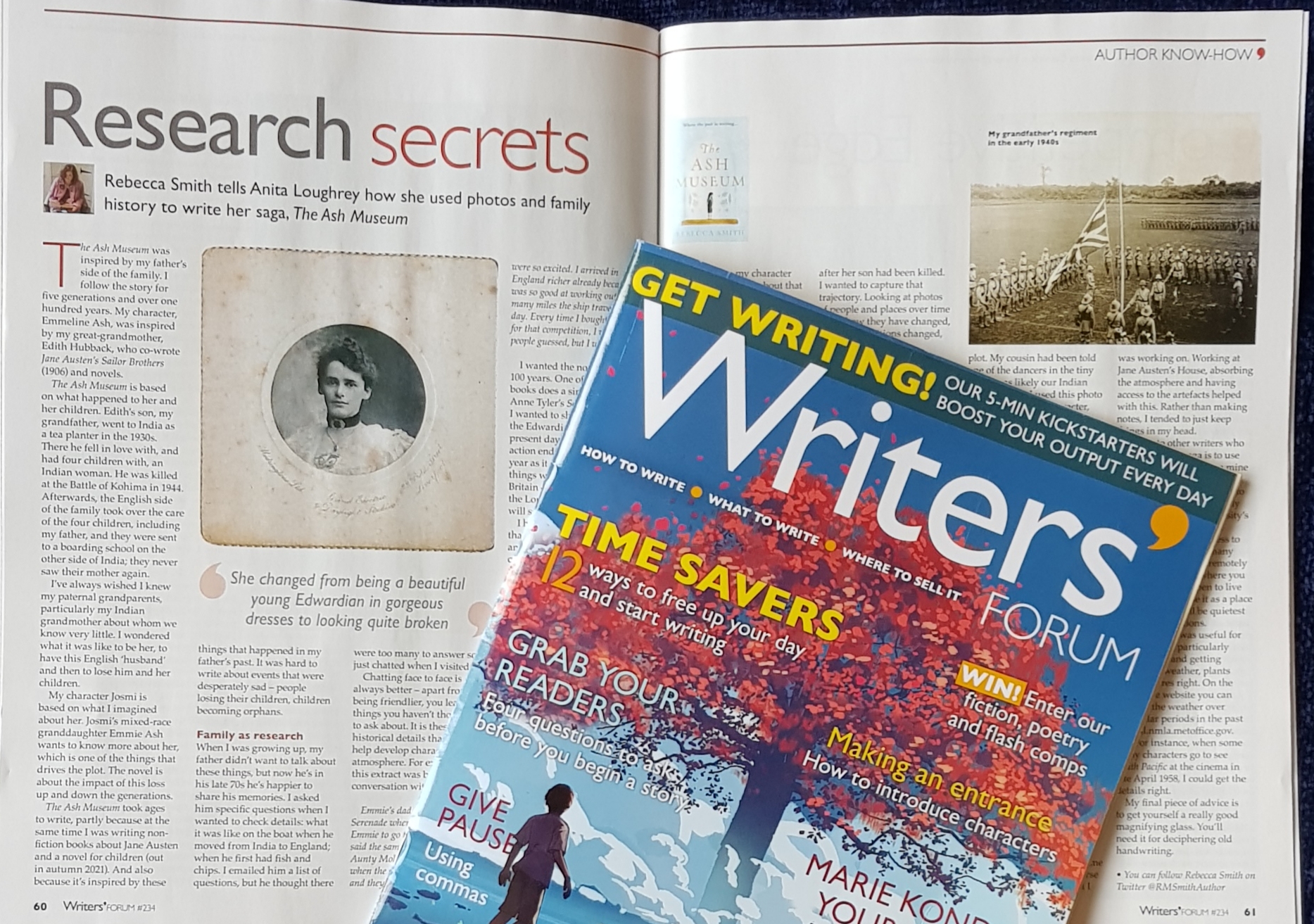
In another author interview flashback, I recount when Rebecca Smith told me she used photos and family history to write her saga, The Ash Museum, published by Legend Press. The interview appeared in my ‘Research Secrets slot of Writers’ Forum issue #234 Jul 2021.

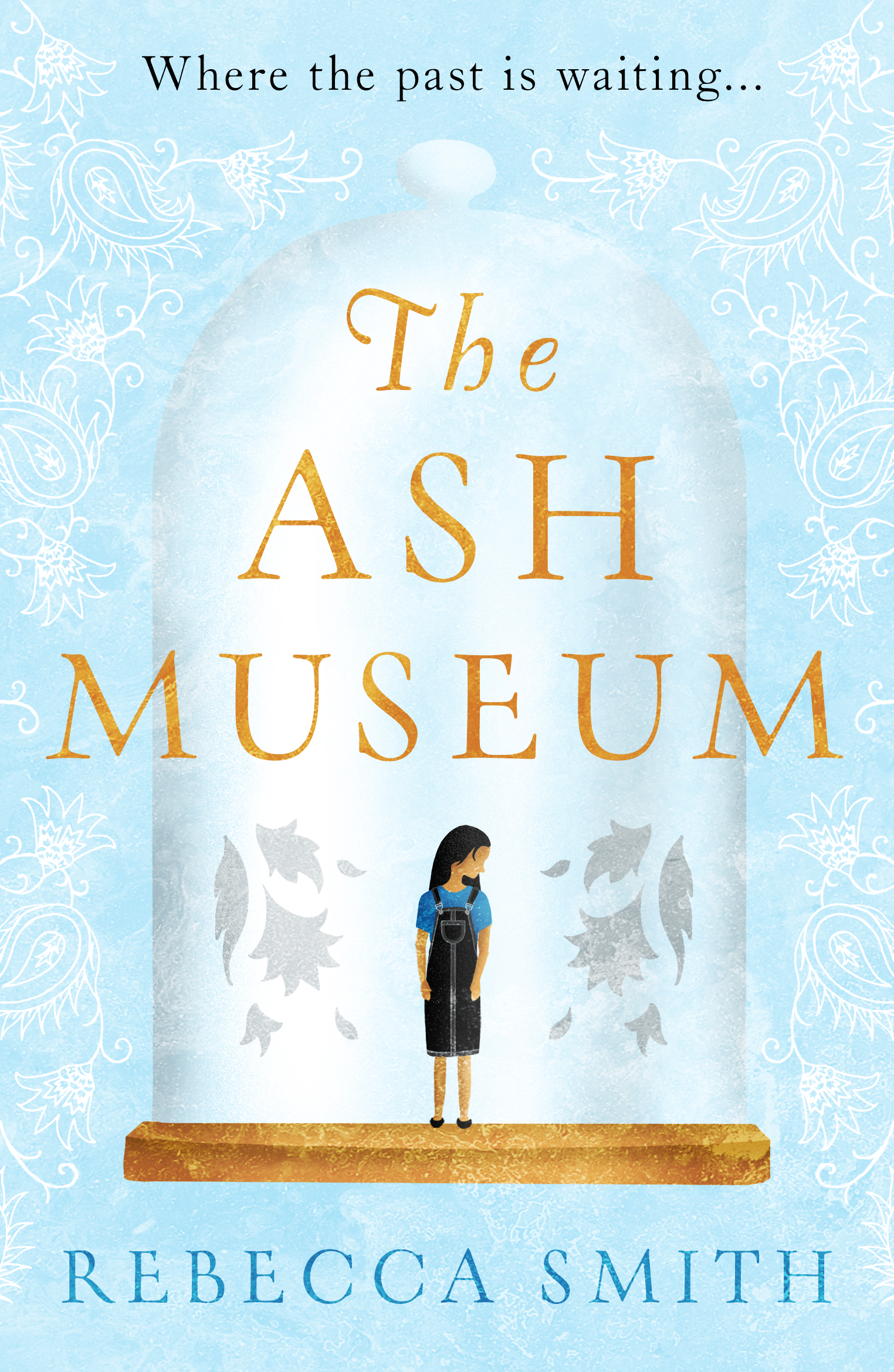
The Ash Museum, is an intergenerational story of loss, migration and Rebecca’s search for somewhere to feel at home, inspired by people on her father’s side of the family and what happened to them. She follows their story for five generations and over one hundred years. The character, Emmeline Ash, was inspired by Rebecca’s great grandmother, Edith Hubback, who co-wrote Jane Austen’s Sailor Brothers in 1906.

The Ash Museum is based on what happened to Edith Hubback and her children. Edith’s son, Rebecca’s grandfather, went to India as a tea planter in the 1930s. There he fell in love with and had four children with her grandmother who was Indian. Her grandfather was killed at The Battle of Kohima in 1944. After this happened, the English side of the family took over the care of the four children (including Rebecca’s father) and they were sent to a boarding school on the other side of India; they never saw their mother again.

“I have always wished I knew my paternal grandparents and great grandparents and particularly wanted to know more about my Indian grandmother, about whom we know very little. I wondered what it was like to be her, to have this English “husband” and then to lose him and her children.”

Rebecca Smith

Rebecca’s character, Josmi, is based on what she imagined her grandmother to be like and is at the heart of her novel. In The Ash Museum, Emmie Ash (Josmi’s mixed-race granddaughter) wants to know more about Josmi, and this is one of the things that drives the plot. The novel is about the impact of this loss up and down the generations.

The Ash Museum by Rebecca Smith

As part of her research Rebecca has collected hundreds of books that belonged to previous generations and she explained these were useful in creating characters and historical changes over the generations.

“We can tell so much by what people like to read. I have maps, books about rock climbing with my grandfather’s annotations, an atlas from the 1920s, and poetry, history, philosophy and most importantly, novels. There is a wealth of information to tap into.”

Rebecca Smith

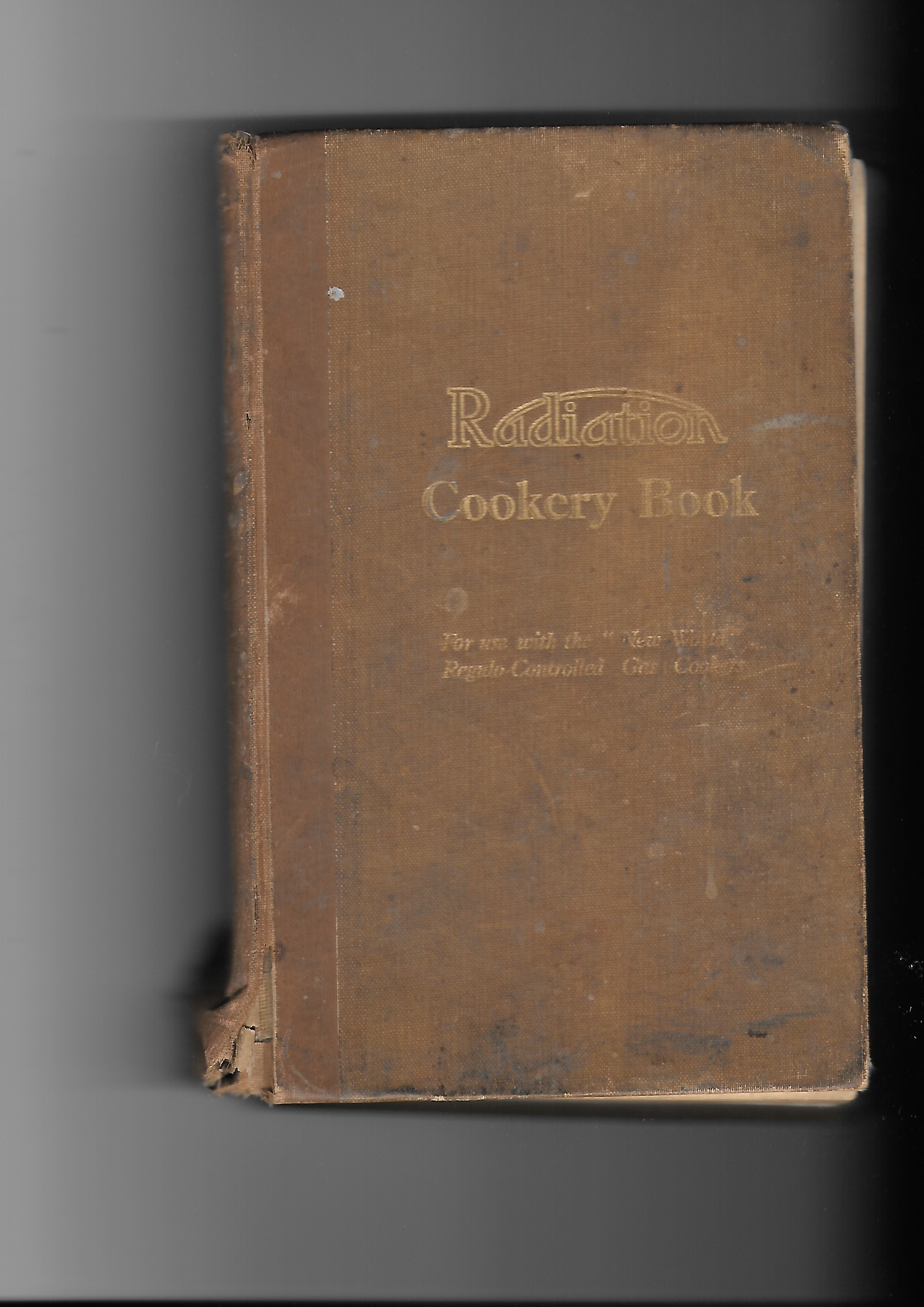
When it came to adding historical details to family meals, she used the only cookery book one of her great aunts had –Radiation Cookery Book: A Selection of Proved Recipes for Use with ‘New World’ ‘Regulo’- Controlled Gas Cookers (19th Edition, 1936). REbecca reckoned it must have come free with her stove. She recognised some of the things she used to cook when she visited and Rebecca tried cooking those and other things herself to get an understanding of the process and how they felt.

The cookery book that belonged to Rebecca’s great aunt

Inspired by her family’s history, she was planning to write lots about The Battle of Kohima where her character, James dies, so she read lots about it and watched documentaries, but in the end Rebecca decided to do things more from his ‘wife’ Josmi’s point of view and ended up with just one very short battle scene. She told me that a lot of her notes and links to articles and images were stored on her phone.

Rebecca explained when she started writing a cousin gave her boxes of family papers. The photos, particularly of when her great grandparents were in Canada, and when her grandfather was in India, were extremely useful. She also found her great grandmother’s diaries kept when her children were small invaluable because her grandmother, Edith Hubback, had recorded things that so many mothers do – funny things her children said and the dates of their first steps and other milestones.

“It was so moving reading these observations 100 years on and knowing what had happened to her children when they grew up.”

Rebecca Smith

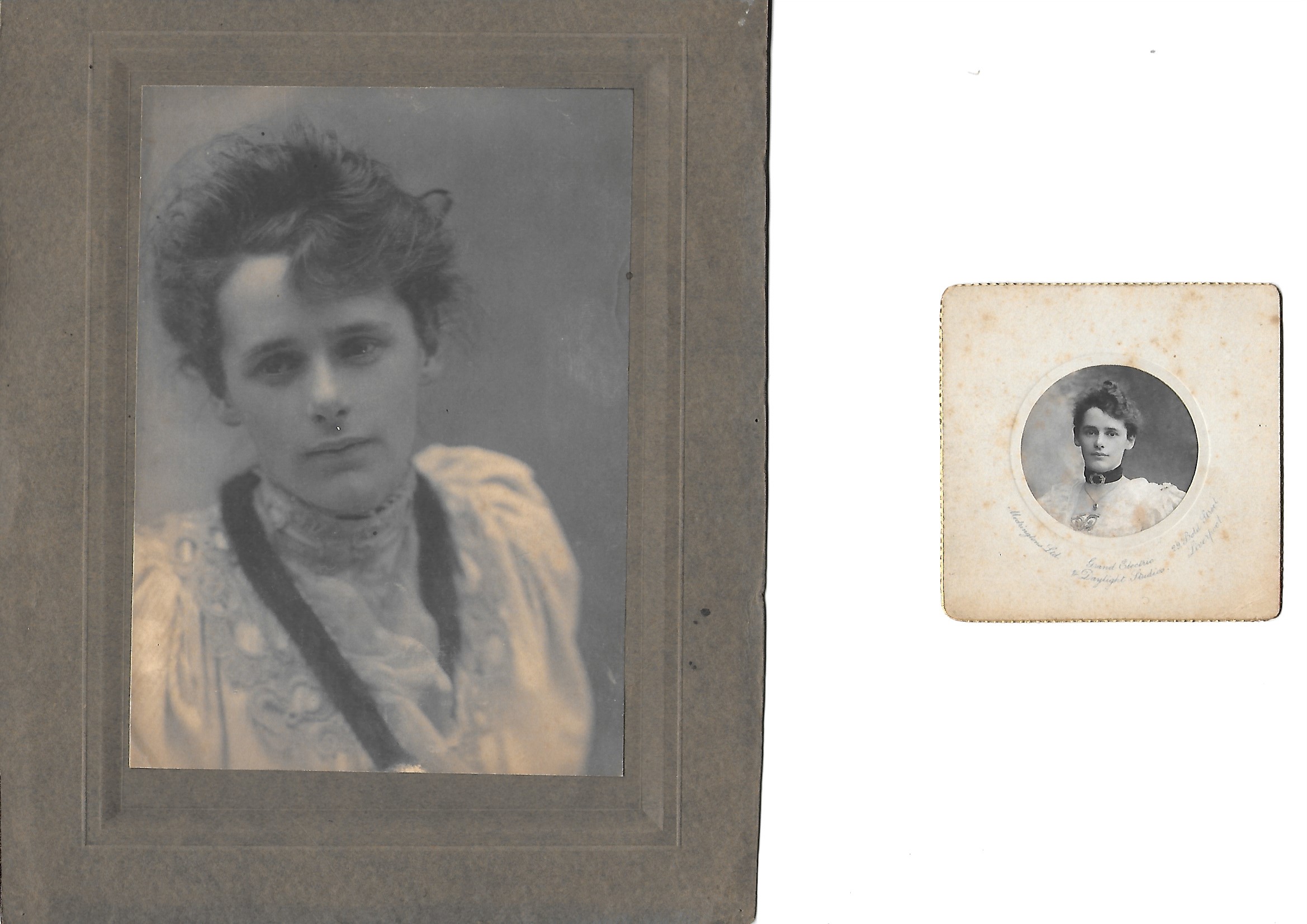
She elaborated that the photos showed how Edith had changed from being a beautiful young Edwardian in gorgeous dresses to looking quite broken in the 1940s after her son, my grandfather, had been killed. Rebecca wanted to capture that trajectory. Looking at photos of people and places over time to see how they have changed and traditions changed helped her to do this.

Edith Brown nee Hubback c.1907

Another great research resource was when she was the writer in residence at Jane Austen’s House. She saw the way the curator (then Louise West) used objects to tell the story of Jane Austen and how much can be conveyed and evoked in an economical way and the importance of the visual in storytelling.

Rebecca told me as people walk around the museum, they learn Jane Austen’s story by looking at small things – a needle case made for a niece, Cassandra’s teapot, the quilt made by the Austen women, and of course the books and letters. this observation made her realise by using objects she could have strong threads in the novel without having to ‘tell everything’ that happened.

“I ended up using objects to structure the novel too – it is in the form of a visit to a museum. I plan around scenes and key images – that helps make the writing more manageable and the finished work (I hope) pacier and more memorable.”

Rebecca Smith

Her tip to other writers who want to write a saga is to use your libraries. Librarians are a wealth of information and always pleased to help. she urges authors to make the most of their library card as it gives you access to wonderful resources, many of which you can use remotely so it does not matter where you live.

You can follow Rebecca Smith on Twitter @RMSmithAuthor and Instagram @rebeccamarysmith7

To read the complete feature you can purchase a copy of #234 Jul 2021 Writers’ Forum by ordering online from Select Magazines.

To read my future Writing 4 Children or Research Secrets interviews you can invest in a subscription from the Writers’ Forum website, or download Writers’ Forum to your iOS or Android device.
An Interview with… Tania Unsworth

This week’s author interview is a flashback to when I interviewed Tania Unsworth For my Research Secrets slot in Writers’ Forum, issue #233 Jun 2021. Tania talked to me about how in-depth research permeates every aspect of her novel, The Time Traveller and the Tiger, published by Zephyr.

Tania told me that even before she began writing the book, she knew she needed to tell part of the story from the point of view of the tiger. But she didn’t want him to be a creature of whimsy or magic. She wanted him to be real. Or as close to real as she could manage, given the impossibility of knowing exactly what it’s like to be another animal. It was important for her to learn as much as she could about the physical characteristics and behaviour of wild tigers.

To do this she started by revisiting two classic books: My India the memoirs of legendary tiger hunter-turned conservationist Jim Corbett, and Peter Matthiessen’s powerful Tigers in the Snow. Then a quick google search turned up The Tiger by John Vaillant. Tania told me the latter extraordinary, beautifully written book was full of information and imagination-triggering insights. It also had a lengthy bibliography enabling Tania to source less well-known – but vital – texts, such as Richard Perry’s The World of the Tiger and Spell of the Tiger by Sy Montgomery.

The Time Traveller and the Tiger by Tania Unsworth

Tania explained she did far more research for The Time Traveller and the Tiger than ended up in the novel, filling her notebook with pages and pages of unused facts, along with drawings of various jungle creatures, because she approached the research in a broad, almost scattershot way, happy to go down any number of online rabbit holes, or wade through scientific accounts detailing how tigers are able to see in the dark or the life cycle of bamboo trees.

“I wasn’t always sure what I was looking for, but I knew it when I saw it; the spark of something I could use, the sudden reshaping of an idea. Casting a wide net in this way made the research process far more dynamic. It didn’t just provide authenticity for my story, it also helped me discover how to tell that story.”

Tania Unsworth

Along with books, Tania scoured YouTube for clips of tigers roaring, growling and ‘chuffing’, and watched documentaries such as David Attenborough’s Dynasties to get a sense of the physical presence of tigers – the way they move and sound and react to their environment.

Her book is set in the jungles of central India, and initially she thought it would be enough to go through Google Images for pictures of ‘Kipling country’, and do a thorough online search on the flora and fauna of the region to find out what a banyan or a peepal or a sal tree actually looked like. But she soon realized that this wasn’t going to be enough. Tania revealed spending a week in Kanha and Bandhavgarh – two tiger reserves in Madhya Pradesh changed everything.

“Setting is important to me as a writer, particularly in this book, where the beauty and fragility of the natural world is a big part of the story itself. You can’t tell what the jungle smells like (wild basil and warm grass) just from looking at pictures. And no audio recording of birds and animals can compare to standing in the forest and hearing them for yourself. The notes I made during my week in India transformed the second draft of my book and helped to bring my story to life with a hundred details. The way that termite mounds glitter with tiny fragments of mica. The sound of dew dropping from leaf to leaf in the early morning. The shafts of sunlight pouring through the trees like columns in a temple…”

Tania Unsworth

Her trip wasn’t just useful in terms of providing authentic details. It also gave herideas for plot and character development. For example, the villain iis a man called Sowerby who operates out of a remote hunting lodge. She had a lot of fun describing his study – a ghastly collection of knick-knacks and furniture, all made from animal parts. The inspiration for this came from a visit to the Museum of Science in Boston where I’d marvelled at the reconstruction of a gun room belonging to a certain Colonel Colby, crowded with animal skins and trophies.

When Tania googled ‘objects made from animal parts’ she came across hundreds of old photographs of items – from chairs to waste-paper baskets – that had been constructed out of various wild creatures. Discovering this long-ago trend for grisly home décor gave credence to my description of Sowerby’s room.

To find out more about Tania and her novels visit her website: www.taniaunsworth.com and follow her on Twitter: @TaniaUnsworth1.

You can read my review of The Time Traveller and the Tiger on my blog here: Book Review: The Time Traveller and the Tiger.

To read the complete feature you can purchase a copy of #233 Jun 2021 Writers’ Forum by ordering online from Select Magazines.

To read my future Writing 4 Children or Research Secrets interviews you can invest in a subscription from the Writers’ Forum website, or download Writers’ Forum to your iOS or Android device.

An Interview with… Rachael Davis

In my Writing 4 Children slot in issue #245 13 Jul 2022 of the UK national writing magazine, Writers’ Forum, Rachael Davis explained to me why books that break stereotypes are important for young children.

She explains representation is so important in children’s books. Rachael revealed the first time she saw herself reflected in a picture book was in Luna Loves Library Day by Joseph Coelho and Fiona Lumbers.

“It was an incredibly emotional moment for me and inspired me to try writing for children myself. For me, creating characters young children will identify with stems from finding your voice. Your unique life experiences will be relatable to a child somewhere and by tapping into your inner child, you can reach them through the stories you tell.”

Rachael Davis

Her debut picture book I am NOT a Prince, illustrated by Beatrix Hatcher, is an inclusive, rhyming fairy tale for the 21st century that challenges gender stereotypes. On a misty lagoon in a fairy tale land, young frogs wait patiently to be turned into princes. When Hopp refuses to be kissed and turned into a prince, the magical frog sets off on an adventure to prove you can be whatever you want to be.

I am NOT a Prince by Rachael Davis and Beatrix Hatcher

I am NOT a Prince is full of universal characteristics and emotions which readers young and old can relate to. This unique picture book is about not having to conform to stereotypes and being proud to be yourself. She hopes will realise that, regardless of gender, race, upbringing and societal expectations, it is okay to be yourself.

Rachael revealed that before the idea for I am NOT a Prince came to her, she had known for a while that she wanted to write a story about being proud to be yourself.

“I wanted to write a story that was inclusive to as many children as possible. I hope lots of children can relate to it, including the LGBTQ+ community.”

Rachael Davis

She explained one of the most important things to remember when writing books for children that have a big theme, such as breaking stereotypes, is that first and foremost you need to write a captivating story. Unless it is an information book, the message should not be overpowering the plot.

While I am NOT a Prince does offer children an accessible way to start a conversation about gender stereotypes, it can also just be read as a fun twisted fairy tale that empowers children to be themselves. If you read the book carefully you will notice that I haven’t used a single pronoun in the book, for any of the characters (not he/him, she/her or they/them). It invites the reader to draw their own conclusions about gender expectations.

Rachael Davis

Her advice to other children’s book writers is that when trying to write for children, originality is key. If you are new to writing, twisting a traditional tale can be a great place to start. You can take confidence from the fact that the original story beats (plot points, the highs and lows) are working well: no soggy middles or pacing issues to be seen. The fun comes in looking at how you can twist the story beats to add even more impact.

However, as fun as it is, finding a knock-out twist can be incredibly tricky. Market research is really important because there are lots of brilliant twisted fairy tales already out there and you need to find your own unique angle. What she loves most about writing for children is that you have the opportunity to write a variety of different types of books.

You can find out more about Rachael and her school visits at www.rachaeldavis.co.uk and follow her on Twitter @RachDavisAuthor and on Instagram @RachDavisAuthor

To read the complete feature you can purchase a copy of #245 13 Jul 2022 Writers’ Forum by ordering online from Select Magazines.

To read my future Writing 4 Children or Research Secrets interviews you can invest in a subscription from the Writers’ Forum website, or download Writers’ Forum to your iOS or Android device.
An interview with… Helen Yendall

I interviewed Helen Yendall about her research for her debut novel, A Wartime Secret. In my Research Secrets slot in issue #245 13 Jul 2022 of Writers’ Forum, you can read all about the research Helen Yendall did for this historical novel set in WWII and how this research inspired her plot, setting and characters.

Helen explained that A Wartime Secret, was inspired by the true story of a bank and its staff that were moved to the countryside for the duration of the war. The main character is feisty Maggie Corbett, who moves from London to the Cotswolds with Rosman’s merchant bank. She’s a fish out of water in many ways. Although it’s set during the war, it’s an upbeat story and one reviewer described it as ‘EastEnders meets Downton Abbey’.

She discovered the story of the bank moving to Upton for the duration of the war, when she visited an exhibition at Upton House called Banking For Victory. This was long before she decided to write a novel about it. The house was reconfigured as it would have looked during the 1940s and Helen revealed she visited it more than once. By the time she realised it would make a great setting for a novel, the exhibition was over. However the National Trust researchers were was able to confirm many of the details she remembered. 

A Wartime Secret by Helen Yendall

Real aspects of Upton House are included in A Wartime Secret: the outdoor swimming pool, in which bank employees swam before work (and which features in an incident in the novel), the Mirror Pool in the grounds, which was filled in during the war, so it didn’t act as a marker for enemy planes and one of the Canaletto paintings, which currently part of Upton House’s art collection.

“I always had Upton House in my mind when I pictured my fictional Snowden Hall but I moved the house slightly, from Warwickshire to Gloucestershire, to create a little distance from the real place.”

Helen Yendall

Helen does a lot of research before she starts to write a novel, as it always gives her ideas for her plot. For example, the real bank – M Samuel & Co – was actually moved from the City of London to Warwickshire in 1939, as soon as war broke out. Helen decided to move the bank in 1940, once the Blitz had started. She told me this was vital for the very first scene of the book when Maggie is lying face down on the floor of a bus, during a raid, an idea that she said came from The People’s War by Felicity Goodall. This book contains an extract from a woman’s diary, describing her reactions in an air raid.    

Primary sources were invaluable to Helen. She explained when you’re writing historical fiction, you really need to try to immerse yourself in that time. If you can read letters or books written in that time or watch films made during that era it all helps.   

But her research was not always plain sailing. Helen discovered several thousand adult Jews were smuggled into Britain during WW2 but couldn’t find out anywhere how this was done. So, although it features in her story, she had to be vague and non-specific about it and let the reader imagine contacts and underground organisations for themselves.

“Sometimes you simply won’t be able to find something out and you can spend hours and end up no further forward. If this happens to you, ask yourself if it’s absolutely essential to the story, or can I get around it in some way? Sometimes, if you’re a little vague about how something might have happened, I think that’s better than putting in lots of details that might actually be wrong.”

Helen Yendall

For A Wartime Secret, Helen needed to know how long it would take a letter to arrive and then how long it would take for her character to receive a reply, within Britain. She struggled to find this out so in the end, she emailed her question to an expert at the Postal Museum https://www.postalmuseum.org/  and had an answer within a few days.

Another valuable resource for Helen were the 1940s Facebook pages she belongs to. She said someone on those will often answer a question, if she is stuck. However, she reminds people it is wise to double-check information found via social media.

“It is worth joining a few relevant groups that are interested in the same era as your novel is set. They can provide a wealth of information, photographs and helpful links.”

Helen Yendall

For people wanting to do their own research into WWII, Helen suggests looking at the British Newspaper Archive as it contains 50 million pages of news stories from 1699 to 2009. She explained it is a paid subscription service, starting at £6.67 a month if you subscribe for a year and there are lots of articles available for free.

Helen warned it’s very easy to get carried away with your research and end up with much more material than you can ever feasibly use, at least in one novel. Her advice is no to try to cram in everything you learn about a period of time. Be selective. If one strand won’t fit into this book, perhaps you can use it for another – a sequel perhaps.

Follow Helen her on Twitter: @helenyendall and on Facebook: @helen.yendall. You can also check out the posts on her blog at: www.blogaboutwriting.wordpress.com.

To read the complete feature you can purchase a copy of #245 13 Jul 2022 Writers’ Forum by ordering online from Select Magazines.

To read my future Writing 4 Children or Research Secrets interviews you can invest in a subscription from the Writers’ Forum website, or download Writers’ Forum to your iOS or Android device.

An Interview with… Jules Wake

For the #238 Nov 2021 issue of Writers’ Forum, I interviewed Jules Wake about the research for her historical novel inspired by Latimer House.

Jules told me she had no intention of writing a historical novel but the idea for The Secrets of Latimer House was one of those wonderful, serendipitous times when a fully formed idea just popped into her head, literally overnight, inspired by a talk by the real life events that took place at Latimer House in Buckinghamshire during World War II. The house, home to a secret POW camp housing senior officers of the German armed forces, was bugged from top to bottom, so that their every conversations could be recorded. 

The Secrets of Latimer House by Jules Wake

She explained that this in itself was fascinating, however what really sparked her interest was the number of women at the house who were involved in a wide variety of roles from interrogating prisoners, translating transcripts from German to English and analysing data through to compiling intelligence reports.

“Writing a historical novel during lockdown presented quite a challenge compared to writing my next novel The Cosy Cottage in Ireland, written by my alter ego, Julie Caplin. For this I was able to rely heavily on You Tube videos to visit numerous tourist locations by proxy.”

Jules Wake

Jules elaborated that when it came to writing The Secrets of Latimer House, she had to be more innovative because she couldn’t use a lot of the usual channels for her historical research during the lockdowns. she told me she would have normally started by visiting the Imperial War Museum or the National Archives at Kew which holds many of the original reports and documents from Latimer House. Unfortunately, with the National Archives closed, she couldn’t do as much original research as she would have liked, so had to do a lot of desk research instead.

This involved reading a lot of books. Jules told me she read a number of reference books for research and was careful to find a second source of the same information and to use historical accounts as inspiration to create fictional versions.  For example, in one reference book there was a detailed account of how someone was recruited to work at Latimer.  Jules described how she created a fictional alternative to this scene by reading up on the process from different sources.

She explained that Michael Smith’s, The Debs of Bletchley Park, gives several different accounts of Wrens being recruited to Bletchley Park, as does Sara Baring’s autobiographical account of her life at Bletchley in The Road to Station X. From these she constructed her own recruitment scene based on the sort of things that would have happened, rather than on exactly what did happen.  

Jules said reading more generally about wartime Britain was also invaluable, enabling her to write with a better understanding of what ordinary people experienced during the war. It gave her a flavour of what people’s lives were like and their different attitude towards everything from views on foreigners, bombing raids and joining up through to American GIs, the black market and rationing. 

“As my story is narrated in third person but from the view point of three different characters from very different backgrounds, it was important for me that each of them used the right sort of language.  I nearly came a cropper when I wanted to use the phrase, ‘in slow motion’.  The technique of slow motion in films hadn’t been invented in 1943! I also spent a lot of time googling the origin of phrases and items that we take for granted.”

Jules Wake

She particularly recommends reading self-published titles, which can be goldmines of information as they’re often written by real enthusiasts and experts with access to first-hand accounts. For example, Derek Nudd’s Castaways of the Kriegsmarine (his grandfather was actually the Commander at Latimer House) is an incredibly detailed account of information garnered from prisoners at the house, which gave Jules a lovely insight into what went on at the house, including the fact that prisoners were taken out on trips. This allowed her to create her own scene of prisoners being driven around London which was loosely based on true accounts of prisoners going out on journeys designed to undermine their confidence in the success of the German bombing campaigns.

She revealed, the accounts of the German Jews living at Latimer house who worked as listeners and translators, including Egon Brandt and Franz Lustig were invaluable. Both were  German Jews who had escaped to Britain and their memories helped shape one of her characters, in particular their views of the German prisoners and the work they were doing.  

Her advice to writers of historical fiction is to use your research to inform and direct but not to let yourself be led by it. Readers want to know that they are in safe hands but hate being patronised by too much superior knowledge.

You can find out more about Jules wake on her website www.juleswake.co.uk and on Twitter @Juleswake.

To read the complete feature you can purchase a copy of #238 Nov 2021 Writers’ Forum by ordering online from Select Magazines.

To read my future Research Secrets or Writing 4 Children interviews you can invest in a subscription from the Writers’ Forum website, or download Writers’ Forum to your iOS or Android device.