
In my Research Secrets this month, I interview Lucie Whitehouse who revealed how she weaves fact and fiction into her psychological thrillers, so she doesn’t jolt the reader out of the story.

Lucie told me her latest novel, Critical Incidents, launched this month had an unusual beginning. She was working on her previous novel in Brooklyn Central Library one morning when a TV producer in the UK emailed to ask if she had an idea for a female lead investigative character. She replied straight away and said she was thinking about a woman in her thirties, a single mother of a teenage girl, who’s been booted out of her job as a senior homicide detective at the Met and returns in disgrace to her hometown, Birmingham. After she hit send she sat back in surprise. She’d never consciously had the idea. Evidently, though, her subconscious had been hard at work.

In Critical Incidents, Robin, the main protagonist, is technically off the job so for Lucie, it was a gentle introduction to writing procedurals. Her first four novels were psychological suspense and she felt had a lot to learn.


She explained she researched the structure of the Met’s Homicide Command online, reading up about Major Incident Teams, what rank of officer would lead one (a DCI) and how many officers each comprises.
“The police are quite transparent, and a lot of information can be found on a force’s website. For specific queries, you can contact them directly via their site. Forces’ Facebook and Twitter accounts are great resources.” (Lucie Whitehouse)
Lucie said the trick with research is to reassure the reader that you know your stuff without boring his or her pants off, and information dumps because great chunks of undigested information will pull a reader right out of the story.
To get her facts right she does a lot of on-the-ground research in concentrated bursts when she is in the UK. She spends days in Birmingham visiting or finding locations, taking photographs, collecting flyers, pamphlets, café menus, bus tickets and perusing the local history shelves of bookshops (Waterstones on the High Street has a great range). Lucie has found that buying local history books is better done on location than on Amazon, as shops often stock things from local presses.
“Birmingham’s rich history is one of the reasons I wanted to write about it and I read several books not only about the city itself but more broadly its role in the Industrial Revolution. My favourite was A History of Birmingham by Chris Upton.” (Lucie Whitehouse)
Lucie loves stitching in little bits of her own family history. A photo of the Whitehouse Flexible Tubing helped her with the visual details. This is the factory, where her father was Managing Director. It still operates out of this building.

She also enjoys going to the places her characters would go, such as Moor Street Station, the Custard Factory, Stratford Road where Gamil’s bakery is located. She told me Dunnington Road, where Robin’s parents live, is fictional but based on a real street in Hall Green that she walked up and down repeatedly on a sweltering July day and one of her favourite is The Golden Boys statue, known locally as Boulton, Murdoch and Watt, three giants of Birmingham’s proud history as a hub of the Industrial Revolution.
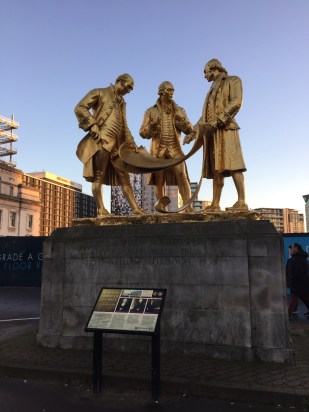
Lucie explained:
“Ninety percent of my research never comes close to the page but doing it allows me to know the world of my book properly and write with confidence. It’s wool-gathering in both senses – by researching, I collect the raw materials but I’m also creating a mental space where I can spin them into something new.” (Lucie Whitehouse)
You can find out more about Lucie and her books at https://www.facebook.com/lucie.whitehouse.9 and on Twitter @LWhitehouse5 and Instagram @lwhitehouse5
To read the complete feature you can purchase a copy of #220 Feb Writers’ Forum from your nearest good newsagents or order online from Select Magazines.


 Much To Do About Writing