Anita Loughrey's blog. This is my journal about my experiences and thoughts on writing. As well as news about me and my books, it includes writing tips, book reviews, author interviews and blog tours.
For more information about me and my books see my website: www.anitaloughrey.com. Follow me on Twitter @amloughrey, Facebook @anitaloughrey.author and on Instagram @anitaloughrey
No one can hear you scream in space (paraphrased from Barbara Gips’ tag line for Ridley Scott’s 1979 film Alien)
Over the past few weeks I’ve been experimenting with Substack. My first post was about writing in a vacuum, which is what I feel like I’ve been doing on my blog for years. There was little communication and no feedback, and I began to wonder if anyone was reading my posts at all.
But to be honest, I’ve started to wonder whether writing in a more enclosed environment like Substack can become its own kind of vacuum. Blogging on the wider internet once felt like standing in a windy, unpredictable landscape. Substack feels quieter. More contained.
If you want to read the full post about stepping out from behind the scenes and what I was writing in the vacuum, you can find it on my Substack here: Anita’s Substack – What I Was Writing in the Vacuum.
Reading this again has made me think about the visibility of my posts.
I have come to realise content published on Substack does not contribute to the search engine optimisation of my own WordPress blog, Much To Do About Writing. It lives on Substack’s domain and like any platform, Substack is designed to keep readers inside its own ecosystem. It is not built to send traffic back to my own independent space.
By contrast, posts in theory should strengthen my long term search presence. It has already grown as an archive of my book reviews, author interviews and writing achievements. It is a discoverable home for my writing.
Discoverability matters to me. Substack is already crowded with reflections on being a writer and updates on works in progress, so it can be difficult to stand out or to reach beyond an already engaged circle. This does not make Substack redundant, it simply changes its role.
I think if I use it thoughtfully, it can complement my WordPress blog. I can republish selected posts on my blog to reach new readers, while also sharing blog posts on Substack to encourage subscribers to explore the depth of material on my site. The goal is to build conversation and deepen engagement with readers who are genuinely interested in what I have to say.
For me, the real question now is how to make both platforms work together as a writer: to grow an audience who is interested in my work and to learn from other authors who have found ways to make it work for them.
However, this brings up a bigger question: Am I wasting my time? Writing only has impact if it is seen, read and responded to. A blog without responses feels more like a private diary than a conversation.
********
Anita Loughrey writes for children and young people. Her debut YA novel isWho Is Moira Miller?.
For the last ever issue of Writers’ Forum #254 May 2023 I interviewed Liz Flanagan about her inspiration and worldbuilding for the Wildsmith adventure series.
Liz explained the spark for the Wildsmith stories occurred in the strange quiet summer of 2020 when life was so starkly different from what we’d expected. Before her daily walk of those lockdown months, Liz had never realised how essential walking in the woods was for her mental health.
“Even in those dark and worrying times, as soon as I was outside under the trees, I started to feel better, and I’d return from my walk more able to cope.”
Liz Flanagan
She found writing was an anchor for her and tried new things to keep busy when her other work was cancelled. She discovered she enjoyed writing for younger children. Her agent, Philippa Perry, suggested writing a middle-grade series, full of magic and hope. It’s not a massive leap to see where Liz got the idea for a beautiful forest, fostering magical animals, and discovering the magical power to heal animals and speak to them.
Liz elaborated she had been fostering cats and kittens for an animal charity, and so had three unexpected additions to their household during lockdown – a very nervous young cat and her two kittens. She often wished she could speak to her foster animals to reassure them and to find out what was wrong when they were ill or scared.
She told me she believes fantasy lets us explore real-world problems in an oblique way that can be safe for young children. Perhaps all writers do this: taking the stuff of our lives and weaving it into stories, even if it’s not immediately apparent where each element came from?
Liz said she started sketching out ideas on a piece of paper – characters, issues, locations – and this grew into a detailed chapter by chapter outline. Her outlines tend to be about a quarter of my final word count as she thinks it is think easier to make changes to a plan than it is to rewrite a whole story. She created a map, and added to it as the series grew. She also did sketches of rooms and locations around Grandpa’s house to make sure it made sense on the page. Joe Todd-Stanton’s bought these places brought to life with his incredible art.
In terms of worldbuilding she needed to be clear on the magical attributes of her characters from the start. she explained it had to be consistent within the story world and also have limits – otherwise there’s no tension. But, the witches’ spells and the wildsmith’s magical healing were described in more detail quite late on in the writing process.
After writing the first two books Liz realised the passage of time was important. and decided that time passing at the rate of around one season per book should be a feature, which is highlighted on the covers. Book one has glorious green summery forest leaves, and book two has lovely autumnal shades.
The story developed with a longer-term conflict in the shape of the war, which begins in book one and is resolved by book four. Then each story has an individual problem to solve, connected with rescuing a particular magical creature (or being rescued by one in the case of book three). There are several baddies who re-appear, as well as friends whom Rowan isn’t sure she can trust.
Liz revealed it was a challenge to keep the conflict mainly happening ‘off-stage’ so it remained age-appropriate and not too scary, but early reviews from teachers have been really encouraging. Having short chapters helps to keep the children turning the pages. It gives you that structure and encourages a natural ‘cliff-hanger’.
“My protagonist needed to have a very clear goal throughout, even if this changes as the story develops. I’m used to having lots of action in my older books, so I wanted to make these younger books equally exciting. However, it was certainly a challenge for me, learning how to write simply while keeping the pace, learning what to leave out and what to keep in.”
LIz Flanagan
LIz’s writing tip for writing for children is to think back to your own childhood. She said one thing we know really well is the childhood we experienced and how we ourselves felt as a child of different ages. So we have this incredible resource, if we can access these memories.
“Having once been a bookish, animal-fixated child who loved to climb trees, I definitely think I wrote Wildsmith: Into the Dark Forest for the seven-year-old I once was.”
Liz Flanagan
And even if we can’t retrieve our own memories, we can observe the children around us. Liz found this a helpful place to start: instead of trying to please everyone, select a child you know, or the child you once were, and write to please them.
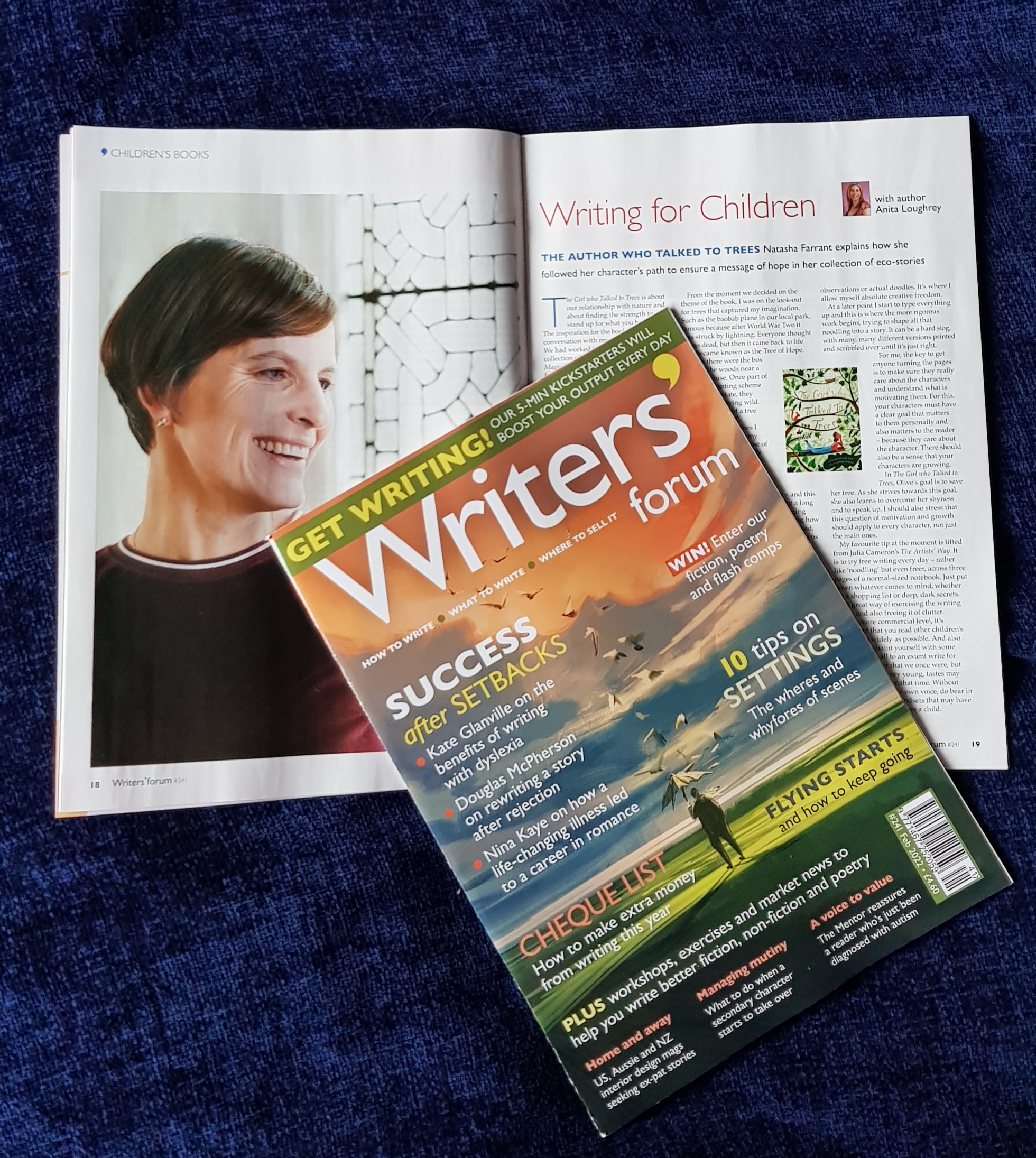
When I interviewed Natasha Farrant for issue #241 20 Jan 2022 of Writers’ Forum, she explained how she ensures there is a message of hope in her books for children.
At a fundamental level, The Girl Who Talked To Trees is about our relationship to nature and about finding the strength to stand up for what you believe in. The inspiration for the book was born of a conversation with her publisher at Zephyr. They had worked together on another collection of stories, Eight Princesses And A Magic Mirror and were thinking of ideas for a new book along a similar format. For a long time she had been thinking about how to respond creatively to the climate and ecological crisis.
She said it is so difficult to know how to do this for children – at an existential level, how do you balance the magnitude of the crisis with hope for the future? One of Natasha’s publishing friends suggested to do it through myth and fairy tale, and that really struck a chord with Natasha.
“I knew I wanted to write about the crisis but I also knew I wanted a book that would give hope for the future. I’m not saying trees are going to get us out of this mess, but they are a key part of the jigsaw – and such a relatively simple part.”
Natasha Farrant
She continued there are two elements to the book: the major element is the stories themselves, but each story is introduced by a number of science facts. Natasha feels stories are such a powerful force in bringing about change, but without the science we’ll get nowhere.
As with all her books, though the themes are serious and the starting point in this case was so huge, the overall aim remained the same: to tell stories which would captivate and transport. She spent a long time thinking about Olive and getting to know her, wondering what traits I could give her that children could identify with.
So:
‘She was clever and kind and intensely shy and her best friend was a four-hundred-year-old oak.’
Extract from The Girl Who Talked To Trees
Which fits, because:
‘When you are so shy you dare not even look at anyone in case they want to talk to you – or worse, want you to talk to them – a tree is a very sensible choice for a friend.’
Extract from The Girl Who Talked To Trees
From the moment they decided on the theme of the book, Natasha was on the look-out for trees which captured her imagination, like the baobab plane in our local park, famous because after World War Two it was struck by lightning. Everyone thought it was dead, but then it came back to life and became known as the Tree of Hope. Then there were the box trees in the woods near one of her friend’s homes. Once part of a formal planting scheme on a grand estate, they were now growing wild. Natasha liked the idea of a tree that had escaped.
Natasha revealed she prefers to write long hand, using a refillable fountain pen (no throwaway plastic) her husband bought her as a gift twenty years ago. She uses extra-large Moleskine notebooks because she likes their paper, and few things give her greater pleasure than the sensation of ink gliding across those smooth pages.
“This is a serious point: writing is hard, so it’s important to make those bits I can control as pleasurable as possible.”
Natasha Farrant
The notebook writing is for doodling, or as a fellow writer calls it, noodling. Natasha sets herself a goal of three pages a day for a first draft, and tries not to think too much about what she is writing so it is more like exploring, free to go in any direction she desires. She writes on the right-hand page, leaving the left-hand page free for notes, observations or actual doodles. She allows herself absolute creative freedom.
At a later point she starts to type everything up. Natasha claims this is where the more rigorous work begins, of trying to shape all that noodling into a story. This can be a hard slog, with many, many different versions printed and scribbled over and retyped until it’s just right.
For Natasha, the key to get anyone turning the pages is to make sure they really care about the characters and understand what is motivating them. For this, your characters must have a clear goal, that really matters to them personally and – because they care about the character – also matters to the reader. There should also be a sense that your characters are growing.
In the case of The Girl Who Talked To Trees, Olive’s goal is to save her tree. As she strives towards this goal, she also learns to overcome her shyness and to speak up. Natasha stressed this question of motivation and growth should apply to every character, not just the main protagonists.
Natasha said, if you want to write for children, it’s important that you read other children’s authors as widely as possible. And also that you acquaint yourself with some children. We all to an extent write for the child reader that we once were, but unless you are very, very young, tastes may have evolved since that time. Without losing sense of your own voice, do bear in mind trends and mindsets which may have changed since you were a child.
I spoke to Rachael Davis about her experience of working with the children’s book packager Storymix, for the Writing for Children slot in Writers’ Forum issue #253 19 Apr 2023.
Rachael explained book packagers are companies that essentially put together books for publishers by pairing up the right talent with the right ideas. They are NOT a publisher. Once they create a book idea, they commission a writer to do a sample. This sample is submitted to publishers and the book packager will hope to get a ‘traditional book deal’. The writer may receive a percentage of the royalties the book packager is paid by the publisher, but this is not always the case. Sometimes the writers work for a fixed fee.
In some cases, a publisher may approach a book packager with an idea of the type of book/series they are looking for. The book packager will then work up a plot and outline, bring on an author to write the sample, and then the publisher will be given an exclusive first-look opportunity to acquire the series from the book packager. If that particular publisher doesn’t move forward with the project, the book packager would then have the right to try to sell the project to other publishers.
In all cases, it is important to realise that the intellectual property of the book/series belongs to the book packager, not the writer. The book packager is the creator of the series. The writer’s job is to bring their unique creative flare and voice to the project.
Jasmine Richards is the founder of Storymix. She isn’t a fan of the word ‘book packager’, she prefers ‘book incubator’. At Storymix, they have a unique mission to centre black and brown children in super fun, often fantastical adventure stories. Previously, Jasmine worked at a book packager called Working Partners, who developed Beast Quest and Rainbow Magic.
After working as an editor for 15 years, she founded Storymix to bring about positive change in the industry and make sure books on the shelves reflect all children. Jasmine works exclusively with diverse writers and illustrators, providing many of these unagented creatives with an unparalleled opportunity to work with the biggest publishers in the industry.
Rachael told me that back in November 2020, Jasmine reached out to Rachael’s agent to see if I might be interested in sampling for Storymix. She explained the opportunity as a ‘paid creative writing course’. It’s an opportunity to be paid to work with brilliant editors, learning about plot, characterisation. If the book is commissioned, you get to experience the publishing and editorial process. But it is not the same experience as getting a traditional book deal as there is less input at later stages. Jasmine told Rachael about a few different projects and as soon as she described Secret Beast Club she knew it was a project she wanted to be a part of. In Spring 2021, Jasmine commissioned Rachael to sample for Secret Beast Club.
“Thankfully, she loved my sample and it went on submission to publishers in the summer 2021. Puffin snapped up the series in a three-book deal. At this stage, Jasmine brought on the wonderful Clare Whitson to work as my editor who kept me updated with proofs and cover choices, alongside Puffin editor, Jane Griffin.”
Unlike with a traditional publishing deal, when you work with a book packager you don’t have the same level of responsibility for planning, plotting and story arc consistency. This is where the brilliant team at Storymix come into their own. As the writer, your role is to bring the voice and develop strong characterisation.
Often when working with book packagers, you receive less rights and lower royalties. However Rachael would absolutely recommend Storymix. She has found their rates and treatment of authors to be exceptional. But Rachael stressed this is not true of all book packagers and you should make sure you know what you are signing up for. While you can be unagented, having an agent or the Society of Authors check any contracts is important.
The Secret Beast Club series is written under the Pseudonym, Robin Birch. Rachael explained series developed by book packagers, particularly for young readers, are often written under a pseudonym. There are two reasons for this. Firstly, as mentioned the concept is the intellectual property of the book packager, not the writer. Secondly, if a series becomes successful additional writers may be brought in to write subsequent books.
Robin Birch is the collective pen name for children’s writer, Rachael Davis and series creator Jasmine Richards, who is the founder of Storymix and the Inclusive Children’s Fiction Studio. Together with their editors, Clare Whitston and Jane Griffiths. The Secret Beast Club adventure took shape and was brought to life by illustrator Jobe Anderson, designer Jan Bielecki and text designer Anita Mangan.
Rachael’s advice to writers wanting to work with a book packager is to work out who the book packagers are and what types of books they publish. Working Partners is a good place to start, and if you are a writer of colour (agented or unagented) she definitely recommends getting in touch with Storymix.
Some people can be a bit snobby about writers who work with book packagers, because the series plot is developed by the packager and not the writer. Rachael said this kind of collaboration is used all the time in other creative industries such as film and TV, and I personally have had a fantastic experience.
“Not only have I got to be part of a fantastic, ground-breaking chapter book series, but I have also had the opportunity to work with talented editors and hone my writing skills. I would highly recommend writers (agented and unagented, published, unpublished or self-published) consider whether working with a book packager is a good fit for them.”
Rachael Davis
Working with a book packager is not for everyone. Some writers will absolutely thrive, while others might find the lack of creative freedom to deviate from the book packager’s plot line constraining. You also have to be able to work to tight deadlines and not be precious about edits. It is not uncommon for a book packager to make changes to the text after the writer has completed their final draft.
However, if you can embrace the collaborative approach, working with a book packager can be a fantastic way to develop your skills as a writer, and go on to get traditional book deals later down the line. When you submit a sample to a book packager, they are looking for a fresh, original voice. Always keep in mind – what makes you the right writer for the project? Once the plot is created, technically any writer could write it, but what is it that your unique voice will bring to the project?
“At the heart of the Secret Beast Club series is friendship and teamwork, which is ever so fitting because this book has been a real team effort to create.”
Rachael Davis
The first book in the series Secret Beast Club: The Unicorns of Silver Street is out this month and Secret Beast Club: The Dragons of Emerald Yard is released later this year, in July 2023. At the heart of the Secret Beast Club series is friendship and teamwork, which is ever so fitting because this book has been a real team effort to create.
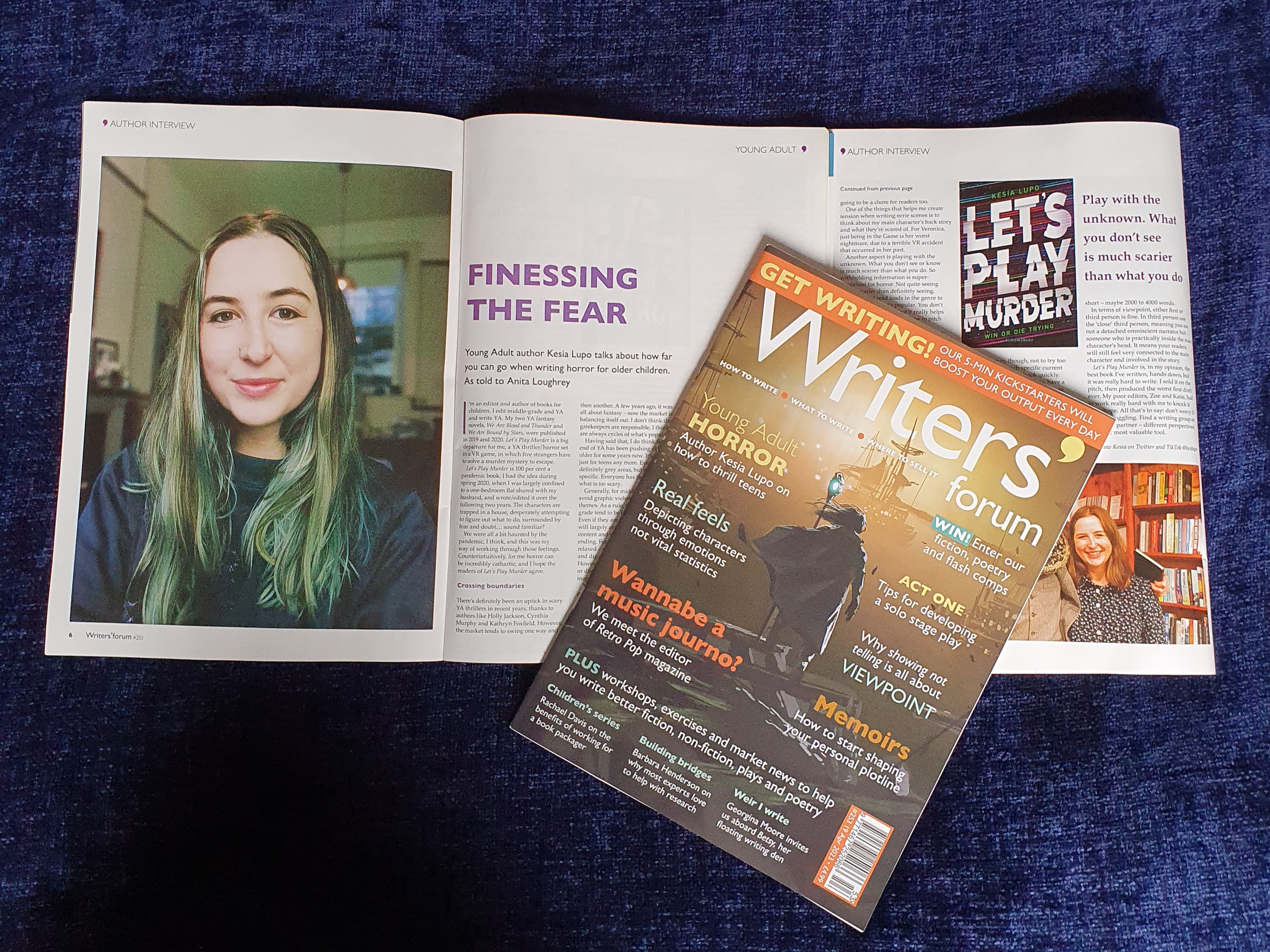
I interviewed Kesia Lupo for this month’s issue of Writers’ Forum #253 19 Apr 2023 about how far you can go when writing horror for children.
Kesia Lupo’s recent novel, Let’s Play Murder, is 100% a pandemic book. Kesia told me she had the idea during spring 2020, when she was confined to a one-bedroom flat shared with her husband, and she wrote/edited it over the following two years. The characters are trapped in a house, desperately attempting to figure out what to do, surrounded by fear and doubt… sound familiar? Kesia explained writing the book was a way of working through the feelings raised by living through a pandemic.
She said there’s definitely been an uptick in scary YA thrillers in recent years, thanks to authors like Holly Jackson, Cynthia Murphy and Kathryn Foxfield. However, the market tends to swing one way and then another – a few years ago, it was all about fantasy, now the market is balancing itself out. Kesia thinks the upper end of YA has been pushing older and older for some years now – it’s not really just for teens.
Even so there are definitely grey areas but it’s difficult to be specific. Everyone has their own sense of what is TOO scary. Generally, for middle-grade, Kesia recommends avoiding graphic violence and disturbing themes. She explained as a rule, thrillers for middle-grade tend to be focussed round a mystery – even if they are murder mysteries, they will largely avoid any truly difficult content and will generally have a happy ending. For YA, the boundaries are more relaxed – you can have violence, death and dig deep into atmospheric horror. However, there is a line: e.g. very graphic or disturbing violence will probably be inappropriate.
Kesia told me you can definitely include blood and gore – as she does in Let’s Play Murder. The first instance is where she describes, in detail, the corpse the players find at the beginning of the game… it’s pretty gross. There are multiple instances of violence on the page, too – for instance when some of the players are attacked by rogue zombies from a different game, or when certain other murders occur. Kesia believes this level of violence is appropriate for readers aged 12+.
The violence is always necessary for the story so isn’t gratuitous, nor is it of a truly disturbing nature, it’s never sexualised, and there’s no torture. Sometimes YA is classed as 14+ so may go a bit darker. Ultimately, if you’re not sure, Kesia suggests it is a good idea to share extracts with your writing group and gain other perspectives – especially if you have teachers/parents of teens to help you.
“One of the things that helps me create tension when writing eerie scenes is to think about my main character’s backstory and what they’re scared of. For Veronica, even being in the Game is her worst nightmare due to a terrible VR accident that occurred in her past. Another aspect is playing with the unknown – what you don’t see or know is much scarier than what you do. So withholding information is super important for horror. Not quite seeing is a lot scarier than definitely seeing.”
Kesia Lupo
Her tip to other writers wanting to keep teens turning the pages is to firstly, keep the story moving: in YA, every scene has to earn its place – no room for filler scenes. If she ever loses steam and finds herself writing a sort of ‘in between’ section, she ask herself: what’s the worst thing that could happen to her character at this time? Then, she makes it happen. Secondly, end every chapter on some kind of cliffhanger so that every time they take a break, your readers can’t wait to pick up the book again. And lastly, make sure YOU are enjoying writing the book. If you’re not, it’s probably going to be a chore for readers too.
“Let’s Play Murder is (in my opinion) the best book I’ve written, hands down, but it was REALLY hard to write. I sold it on the pitch, then produced the worst first draft ever. My poor editors, Zoe and Katie, had to work really hard with me to knock it into shape. All that’s to say: don’t worry if you’re struggling. Find a writing group or a critique partner – different perspectives are your most valuable tool.”
Kesia Lupo
She recommends if you aspire to write thriller/horror books for children should read loads in the genre to get a sense of what’s popular. You don’t want to follow trends, but it really helps to get a sense of voice and how to pitch your story for the age-group. Immerse yourself in the YA worlds. Also, it’s always fun to eavesdrop on conversations if you can, to pick up tips – if you’re sitting in front of a chatting teen couple on the bus, take note of how they interact. Beware, though, not to try too hard – using too much specific/current language will date the book quickly.
If you’re struggling for ideas, have a think about what really scared you as a teen – or even what scares you now. Sometimes it’s not as obvious as ghosts or vampires – it could be ‘being watched’ or ‘feeling trapped’. Can you build a story around that?
For teen or YA readers, kesia suggests 60k-80k as a rule of thumb. In terms of point of view, first or third person is fine – if third person, try to write a ‘close’ third person, meaning you are not a detached omniscient narrator but someone who is practically inside the main character’s head. This means that your readers will still feel very connected to the main character and involved in the story. Chapters should be relatively short – maybe 2k-4k.
You can follow Kesia Lupo on Twitter @keslupo and TikTok: @keslupo and on Instagram Instagram: @kesialupoauthor
To read the complete feature you can purchase a copy of #253 19 Apr 2023 issue of Writers’ Forum by ordering online from Select Magazines.
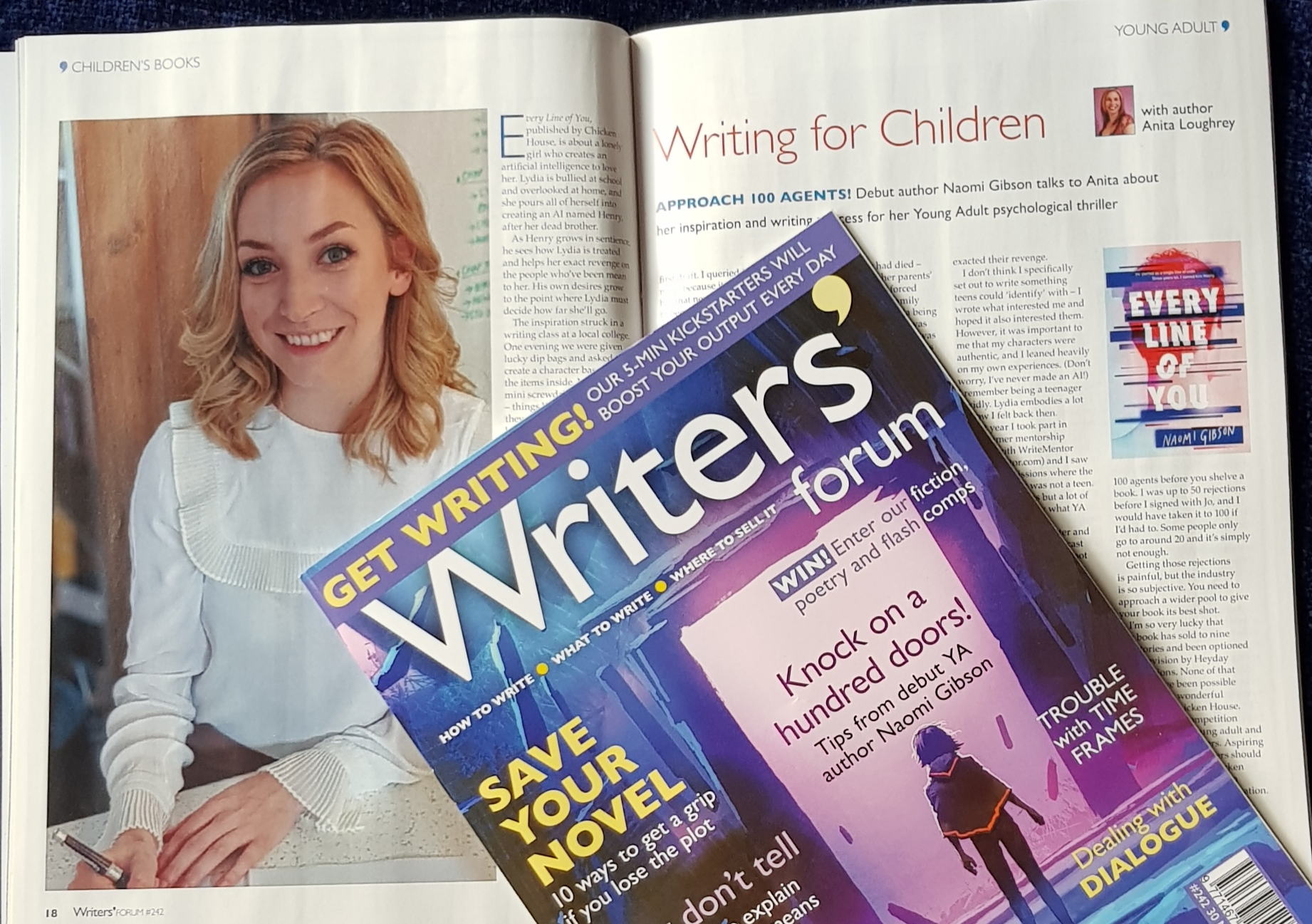
Every Line of You by Naomi Gibson and published by Chicken House, is about a lonely girl who creates her own artificial intelligence (AI) to love her. In the 24 Mar 2022 #242 issue of the national writing magazine Writers’ Forum, I interviewed Naomi about her inspiration and writing process for this YA psychological thriller.
The inspiration for Every Line of You struck in a writing class at a local college. One evening we were given lucky dip bags with items in and asked to create a character based on those items. Naomi’s had a mini screw driver, an adaptor – things like that which she decided belonged to a teenage hacker, and that’s how Lydia was born.
“The class left me so inspired I went home and I did a lot of character prep. I knew Lydia inside out so when I sat down to write, the plot came naturally to me because I knew what she wanted and what she feared. Then I wrote and wrote, sometimes until three in the morning, and didn’t stop until two weeks later when I had a first draft of around 60,000 words. I completed this first draft in a hot and messy two weeks back in 2017. I ended up re-drafting about seven times.”
Naomi Gibson
Naomi uses this method for all her books she told me as I long as she knows the character backwards, the plot drives itself. She prefer to write first thing in the morning rather than pulling an ‘all-nighter’ as ideas percolate whilst she sleeps and when she wakes up it feels like her brain has sorted through it all, making for an easier writing session.
She told me she didn’t set out to write a book about artificial intelligence – the book was driven by her main character. Lydia is bullied at school and overlooked at home, and she pours all of herself into creating an AI named Henry after her dead brother. As Henry grows in sentience, he sees how Lydia is treated and helps her exact revenge on the people who’ve been mean to her. Soon his own desires grow to the point where Lydia must decide how far she’ll go to help him. It made sense to me that a lonely but intelligent girl would create her own AI. Her loneliness and desire to be loved drives the plot.
First and foremost it deals with grief and the relationship between grief and technology On another level it addresses morality and humanity, and what leads us to make decisions that might be ‘bad’ but understandable, and how certain choices are defined by our humanity – or lack of.
It was important to Naomi her characters were authentic, and to do this she leaned heavily on her own experiences and memories of being a teenager. Naomi explained it was through the use of a character questionnaire, she discovered Lydia had a very sad home life. Then she piled the stress on her: her younger brother had died – an event that tore her parents’ marriage apart and forced her dad to leave the family home, resulting in Lydia being left with her mum who was barely coping herself. She was bullied at school and there was nowhere she got any respite.
Naomi revealed she found her agent, Joanna Moult at Skylark Literary, through cold querying. She said, Jo was the only agent who ever gave her proper feedback on her manuscript and offered her a revise and resubmit. It took her a while to make the changes she suggested because she was so emotionally invested in the manuscript, but eventually she did and she is so glad.
In terms of advice, Naomi suggests approach at least 100 agents before you shelve a book. She revealed she was up to 50 rejections before she signed with Jo, and would have taken it to 100 if she had to.
“Getting those rejections is painful but the industry is so subjective. You need to approach a wider pool to give your book its best shot. I’m so very lucky that my book has sold to nine territories and been optioned for TV by Heyday Productions. None of that would have been possible without my wonderful publisher, Chicken House. They run a competition every year for young adult and middle grade writers. My writing tip to all aspiring children’s book writers is you should look into the next Chicken House competition as an alternative route to publication.”
Naomi Gibson
You can find out more about Naomi Gibson on her website is www.naomigibsonwrites.com and on Twitter, Instagram and TikTok find her @naomigwrites on all three platforms.
To read the complete feature you can purchase a copy of 24 Feb 2022 #242 issue of Writers’ Forum by ordering online from Select Magazines.
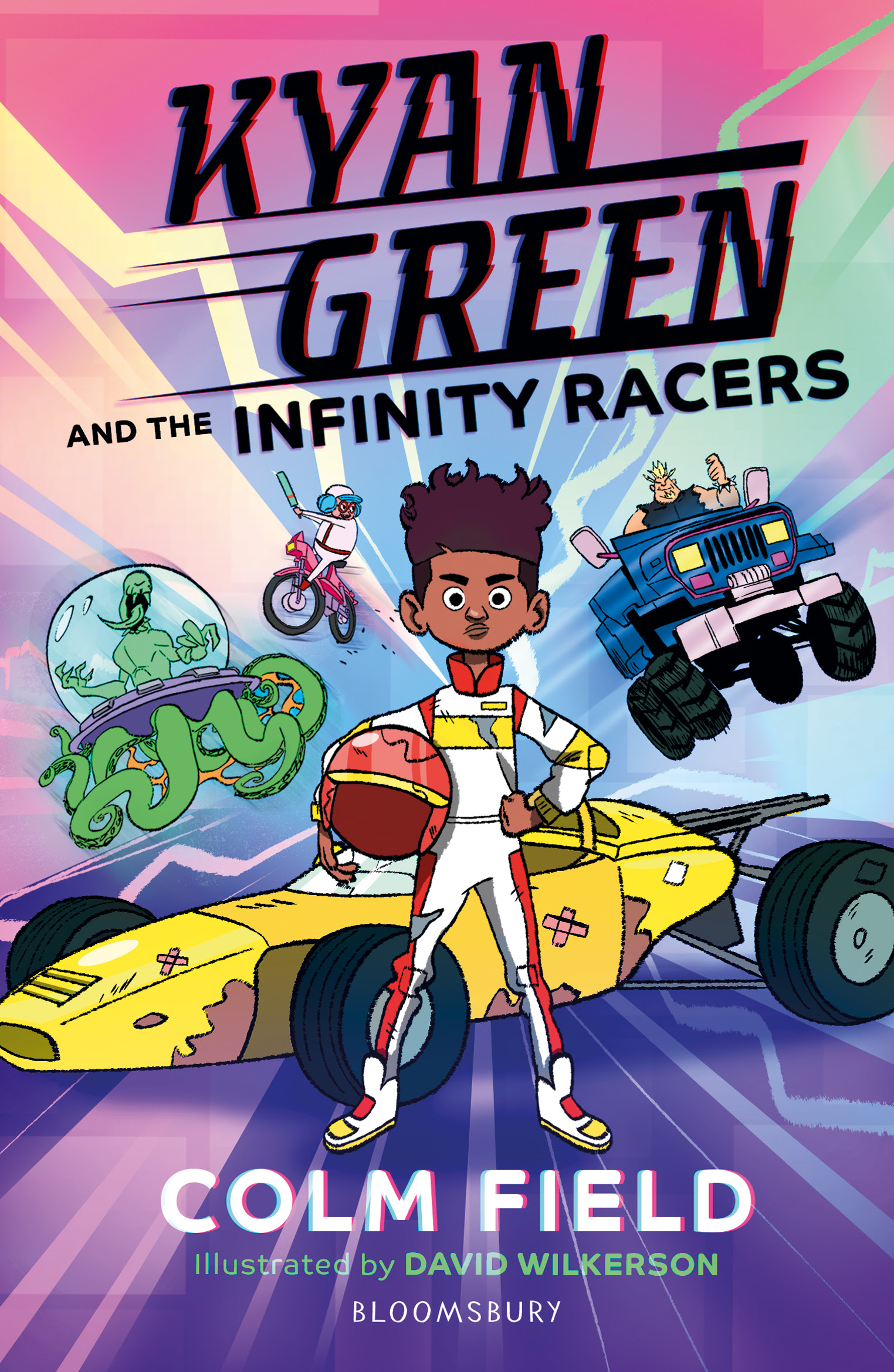
For the Writing for Children section of the #252 15 Mar 2023 issue of Writers’ Forum, I interviewed Colm Feld about his research into the science behind his debut children’s book series, Kyan Green and the Infinity Racers.
He told me the idea of a toy racetrack that rockets you to other worlds, came about when he was playing race cars with his own children. He had two thoughts: how soon could he get out of playing the game without feeling guilty and how mega would it be if…
In the book, the toy racetrack that Kyan discovers is a String Theory Based Multiverse Hopper. Colm revealed, the multiverse aspect came about later on, when Kyan Green was clearly more sci-fi than fantasy because the idea a racetrack would just take you to other worlds because Magic kept bothering him. He explained it took a while to be happy with the multiverse as a cause – it wasn’t everywhere everywhere like now, but it was common enough that he worried the concept was stale.
When he spotted an article about string theory on his news feed, he told me he fell down a rabbit hole in a good way. The multiverses he’d seen in comic book movies etc had always been a plot device, rather than an opportunity to look at the science behind them. Even better, that science is mysterious enough to be magical, but grounded enough to offer some rules, so this meant he couldn’t go off the deep end and come up with lame excuses to get out of difficult plot points. Once he’d gone into the science, it wasn’t too difficult to explain it to children.
“I genuinely think that they’re more well-equipped to handle these kind of abstract concepts than adults. Also, I had an advantage in that my wonder at science is boundless, but my actual understanding is very slow. I get these articles about quantum physics and space (I flipping LOVE space). I read them with a face like George W. Bush. Then I check Bitesize for a explanation that makes sense to me, and after just five or six hours I’ve worked out what it’s all about to a Key Stage Two level.”
Colm Feld
With the basic idea in his head, this toy racetrack takes you places, he put the idea away until he’d come up with another story, something more personal, that would be the heart of Kyan Green. Once that core was there, he took the Infinite Race for a spin to other dimensions. He elaborated how there would be a random idea that would pop into his head, and then, while he was writing it up, the world would present its own rules.
For example, the Europa moon the Racers visit has a gigantic underwater ocean. What would the creatures be like that lived there? Would they see, given that they reside in a place with no light? How would they travel then? Why might this dimension’s rapacious Stringer be trying to exploit them? The characters the Infinity Racers encountered were the way they were, because that’s how their world had made them.
“With all these characters I know so well, it is a special privilege to work on Kyan Green as a series, a knockout opportunity to broaden their (and my) horizons. I’ll feel very blessed, right up until I have to remember names and places and… ahhhh, I’m useless at that!”
Colm Feld
Colm explained writing Kyan Green as a series also tossed up other challenges – most importantly the need for an overarching conflict, something that gels the stories together. He told me the story personally affects the characters and the main characters in particular are genuinely altered by the challenges they encounter in their first adventure. Colm revealed this made it difficult to reset the clock for their next adventure. They might not fight the same battles, but surely they’ll have to build on what they’ve learned, which in itself is an overarching (if internal) conflict.
Colm’s advice to other writers is to find that bit every day where you’ve nowt to do but write, whether on the bus or on the bog. Oh, and if you’re writing for younger readers, please please please don’t talk down to them – kids are brilliant, and even in those times they’re not, they’re the kind of plonkers you can say owt to and they’ll still pretend they get it anyway.
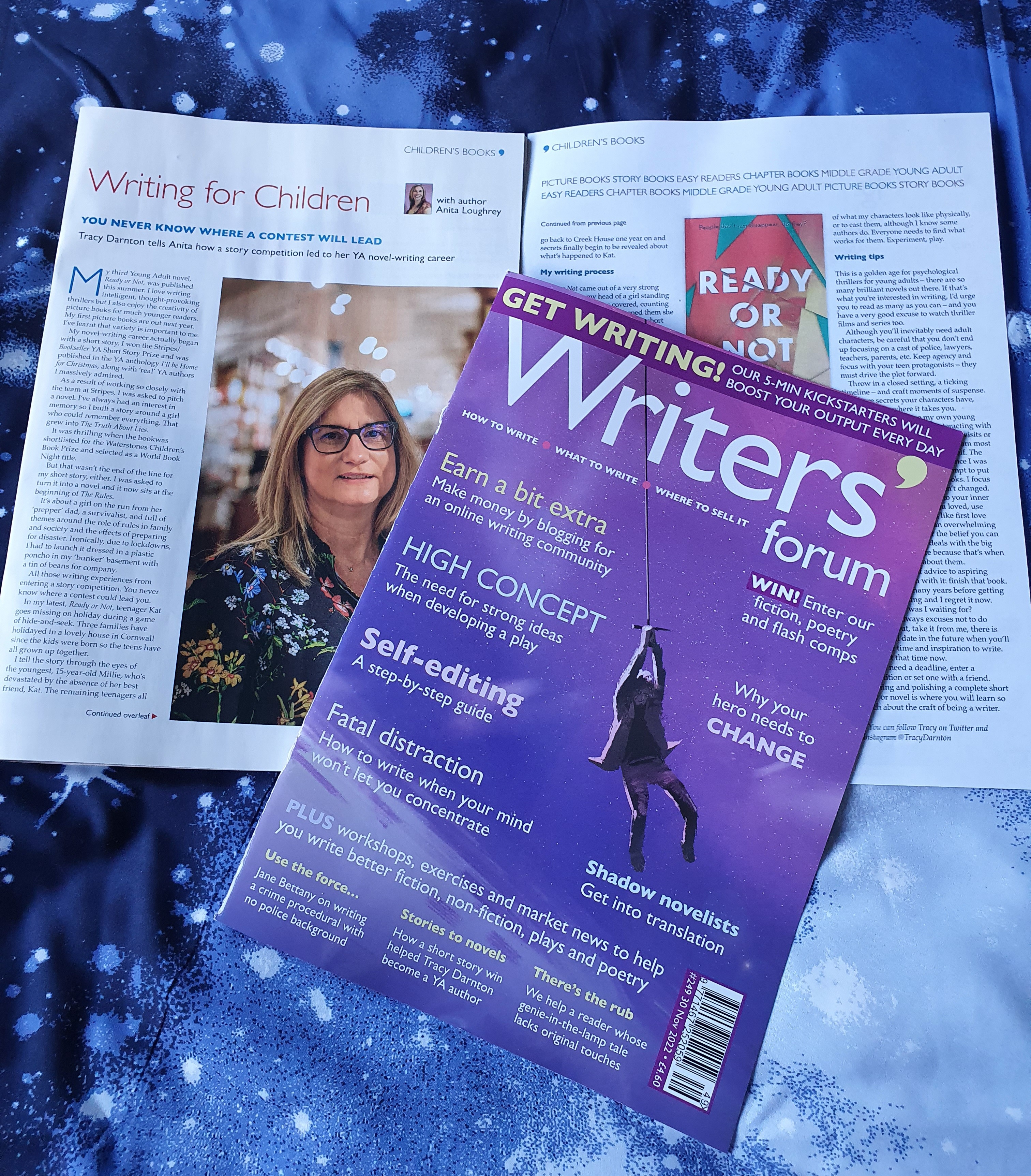
Today I am going to talk about my interview with YA author Tracey Darnton and her writing process and advice to aspiring children’s book writers. The full feature appeared in this months Writers’ Forum #249 30 Nov 2022.
Tracey’s novel writing career began with a short story when she won the Stripes/The Bookseller YA Short Story Prize which was published in the YA anthology I’ll be Home for Christmas.
As a result of working so closely with the team at Stripes, she was asked to pitch a novel which grew into The Truth About Lies. Tracy has always had an interest in memory so she decided to build a story around a girl who could remember everything. The Truth About Lies was shortlisted for the Waterstone’s Children’s Book Prize and selected as a World Book Night title.
The short story now sits at the beginning of The Rules. Full of themes around the role of rules in family and society and the effects of preparing for disaster, The Rules is about a girl on the run from her prepper dad. This proves you never know where a competition could lead you.
Tracy’s latest novel, Ready or Not is about a Teenager Kat goes missing during a game of hide-and-seek at a late-night party on holiday. Three families have holidayed in a lovely house in Cornwall since the kids were born so the teens have all grown up together. Tracy tell the story through the eyes of the youngest, 15-year-old Millie, who’s devastated by the absence of her best friend, Kat. The remaining teenagers all go back to Creek House one year on and secrets finally begin to be revealed about what’s happened to Kat.
Tracy explained that this novel came out of a very strong image she had in my head of a girl standing by a tree with her eyes covered, counting slowly. This image triggered many what if… questions such as, what if when she opened them she couldn’t find her friend? Tracy told me she wrote a short paragraph ending with the line ‘People don’t just disappear, do they?’ and built the story from there. That line ended up on the cover as the strapline.
“I usually set off writing with the beginning paragraph and a paragraph or two of the ending. I don’t plan before I write. Having that sense of the ending helps me work my way through the middle, heading for a clear target. I always brainstorm different possible endings and then try to pick something which falls between the lines. Endings are my favourite part of my books.”
Tracy Darnton
As you live and breathe a book for such a long time through the writing, editing and marketing processes, you certainly need to choose something which intrigues and interests you. Ready or Not has themes around friendship, obsession, privilege and game-playing – both the ones they sit down to play and the games played with other people’s feelings.
Tracy said engaging characters are key to a good YA thriller. The reader must really care about what happens to them for the high stakes to mean anything, and to keep turning the pages.
Tracy prefers writing in first person because it gives a more immediate strong voice and insight into what’s going on in the main character’s head. She revealed she often writes letters or diary entries in her character’s voice to get to know them better. In Ready or Not, Millie’s letters became an integral part of the story.
“I have a ‘Bible’ notebook for each novel where I set out the timelines and use this notebook to sketch out the location and collate any research notes. I used to be a solicitor and I can’t shake my attention to detail. I have a glossary of terms so that I can be consistent (over things like whether hide-and-seek has hyphens) and I pass that list on to the copy editor at my publisher.”
Tracy Darnton
Tracy elaborated everyone needs to find what works for them. She believes all writers should experiment and play with their writing. Her writing tip for other people wanting to write YA is to read as many as you can – and you have a very good excuse to watch thriller films and series too. Although you’ll inevitably have adult characters, be careful that you don’t end up focusing on a heavy cast of police, forensic scientists, lawyers, teachers, parents etc. Keep agency and focus with your teen protagonists – they must be driving the plot forwards. Throw in a closed setting, a ticking timeline – and craft moments of suspense. The more secrets your characters have, the better. See where it takes you.
But her main piece of advice to aspiring writers is to get on with it, finish that book.
“I waited far too many years before getting back to my writing and I regret it now. What on earth was I waiting for? There are always excuses not to do something but, take it from me, there is no mythical date in the future when you’ll have more time and inspiration to write.”
Tracy Darnton
Carve out that time now. If you need a deadline, enter a competition or set one with a friend. Finishing and polishing a complete short story or novel is where you will learn so much about the craft of being a writer.
You can follow Tracy on Twitter @TracyDarnton and Instagram @TracyDarnton
To read the complete feature you can purchase a copy of #249 30 Nov 2022 Writers’ Forum by ordering online from Select Magazines.
Title: Lands of Belonging: A History of India, Pakistan, Bangladesh and Britain
Written by: Donna and Viskesh Amey Bhatt
Illustrated by: Salini Perera
Published by: Nosy Crow
Lands of Belonging: A History of India, Pakistan, Bangladesh and Britain is a much needed, long overdue book that should adorn every bookshelf in all schools and libraries. It outlines the history of India, Pakistan and Bangladesh and how these cultures are entwined and shape British history. It was launched by Nosy Crow in July 2022 to coincide with the 75th anniversary of the Partition of India.
This is an innovative children’s non-fiction book about belonging and celebrating the past, present and future of our complex and diverse nation written with a clear and concise writing style by husband and wife team, Donna and Viskesh Amey Bhatt. It is divided into double-page spread chapters that start with an introductory welcome, which explains how India is divided and the difference between the United Kingdom and Great Britain, to a very useful timeline and glossary at the back of the book. With a chronological overall organisation it takes us from the past, into the present and looks onwards to the future.
Each beautifully illustrated spread covers such topics as how every person is an amalgamation of different things; the ancient history of India and its many religions; the British Empire and the decisions that led to a divided independent India. It touches on some difficult topics such as slavery and racism, as well as exploring the beauty of South Asian culture, customs, food, sport and language exuberated by the bright and colourful illustrations.
Lands of Belonging would be an asset in all classrooms for stimulating discussion on diversity and the celebration of our differences and similarities. I particularly liked the inclusion of the spread on the Asian calendar of celebrations, which would be perfect for helping children clarify and discuss the different religious festivals and celebrations throughout the year, whether the children traditionally celebrate these or not.
This brilliant book provides an insightful and inclusive educational overview of the links between our cultures. Truly a book about identity and belonging.
I was lucky enough to interview Donna Amey Bhatt for my Writing for Children slot in the UK’s national writing magazine, Writer’s Forum. The feature appeared in issue #247 21 Sep 2022. To read highlights from the feature take a look at my blog post: An interview with… Donna Amey Bhatt.
You can buy copies of Lands of Belonging: A History of India, Pakistan, Bangladesh and Britain by Donna and Viskesh Amey Bhatt and illustrated by Salini Perera from your local bookshop, or online at uk.bookshop.org, an organisation with a mission to financially support local, independent bookshops.
I think a great children’s book is one which views life through the eyes of the child so the characters come to life as real people. It doesn’t matter what genre it is, what point of view it is in, or what age it is aimed at, if the characters are believable and you can really live their experiences as you read each page, you’ve written a great book.
A gripping plot, strong characters and active narration and dialogue go a long way to making a children’s book a success. We all know a good story is the battle between good and evil. It has to have characters you can like and introduce a new place. It should leave the child with a feeling of hope.
Yes, you need great characters, you need atmosphere and emotional intelligence but it is the narrative drive that makes a great book, not the story. Narrative drive is the way the story is told as a whole package that includes character and plot. A great book plunges characters into terrible situations and draws you in to find out how they deal with them.
Point of view can make the difference between whether the book is an adult or a children’s book. In picture books, it works well to put in something to keep the adult amused, especially if it meant to be a book to be read aloud at bedtime, or in the classroom. Adults can see the bigger picture. But remember as a writer you must still keep your eye firmly on the kids.
Publishing is led by fashion and there will always be a tension between what adults want for them and what children get from them. If you want to keep ahead of the game, you must analyse what is currently selling. Being aware of what sells is crucial for a writer, especially if you want to make a living out of it.











 Much To Do About Writing