
Today I am excited to welcome Saviour Pirotta to my blog.
Saviour is a playwriter and author of mainly children’s fiction. He has series set in latest books are set in Ancient Greece, the Islamic Golden Age, the Stone Age and Ancient Egypt.

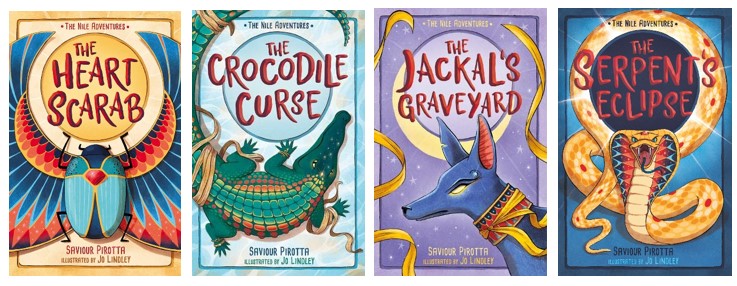
The last book of Saviour’s Nile Adventure series, The Serpent’s Ellipse, is due for release January 2024. Here is the blurb:
After foiling the plot against Prince Khaem, Renni hopes life will return to normal. Except, when Balaal’s father sends a message calling her home, Renni must face the reality that the lives of him and his friends are no longer entwined. As the group splits onto their separate paths, darker forces move in the shadows, intent on claiming the world as their own. Will Renni, Mahu and Balaal discover who are their friends and who are foes, or will the world be plunged into eternal night? Join Renni in the spectacular finale of the Nile Adventures series.
Blurb for The Serpent’s Eclipse by Saviour Pirotta, published by Maverick Books.
Without any more delays let’s get on with the interview.
********
The Serpent’s Eclipse is the last in The Nile Adventure series. What is it like reaching the end of a series? Do you find you need a period of mourning, or do you celebrate?
I always have mixed feelings when I reach the end of a series. I’ve lived with the characters and storyline for a couple of years, sometimes more. I’ve got to know the world they inhabit inside out and it’s always sad to leave a place you have created and loved. At the same time, I’m always itching to tackle a new subject, to get to know new characters and civilisations.
How much research did you have to do for your Nile Adventure series and what was the most unusual research you had to do?
I have been obsessed with Ancient Egypt since hearing the story of Moses at school. I must have been in Year 1. I remember trying to imagine what Pharaoh’s palace would have looked like. In those days there was no handy internet, you had to look up stuff in books, so I spent a lot of time in the library, still my favourite place in the whole wide world along with cafes that serve afternoon tea. I have little notebooks where I write down interesting facts to put in stories and a lot of those snippets of information are often about ancient Egypt.
For my fortieth birthday, I went on a Nile cruise and it inspired The Nile Adventures. Not only were the temples mind-blowing but the river itself was very inspiring. Looking at the villages on its banks was like watching a film. It was so easy to imagine you were back in Ancient Egypt. One afternoon I saw a boy drawing pictures with a reed brush. An older boy was fishing nearby. I took them to be brothers. Renni and Mahu were born in my mind. I did years of research after that, to discover more about their world and their way of life.
Renni, Mahu and Balaal are such strong well-rounded characters. How do you create your Ancient Egyptian characters to fit the era so perfectly yet children today can still identify with them?
Creating characters that ring true in their own time but that today’s readers can also empathise with is the biggest challenge in writing historical fiction. It’s like walking a tight rope. The ancient world was a very different place from our own, in all sorts of ways. To us today, life in Ancient Egypt would have been quite frightening. There were no guarantees. People were very superstitious. They believed the gods were constantly breathing down their necks, always ready to judge and punish them should they break the rules. They weren’t even sure the sun would come up every morning. And yet they had the same hopes and fears we have today. They all wanted to be loved, to be understood, to have fun after a hard day’s work, to celebrate the milestones in their lives. In a way, the world has changed a lot, we have changed a lot, but we have also stayed the same. It’s this duality I try to capture in my stories.
Why did you decide to write The Nile Adventure series from the multiple viewpoint of Renni and his brother Mahu and also the antagonists?
I wanted to explore a rounded Egypt that took the reader beyond the image presented by the leitmotifs of popular Egyptology. Of course, the stories feature gods and mummies and the great annual inundation but I hope they also give kids (and the many adults who seem to be taking to the series) a glimpse of what life would have been like on the banks of the Nile during the height of Egyptian civilisation.

As I see it, there were two sides to Ancient Egyptian life: the glamorous world of Pharaoh’s court and the temples with their tales of magic and the afterlife; and there was also the harsh world of trying to exist on the edge of an arid desert, where the poor mostly remained poor all their life. Renni, the artist, represents the glamorous world of art, poetry and royalty. His brother Mahu, the farmer/sailor represents the challenging reality of everyday life. Princes Balaal is a daughter of the Fenkhu, a Phoenician from the country now known as Lebanon. She brings an outsider’s perspective to the series, someone who is an awe of Egypt but can also be sceptical of its preoccupations and belief system. She stands in for the reader. Paser, the evil and ever-ambitious vizier, brings yet another point of view: that of the privileged and the entitled. Sadly, he is the character closest to present day society. He is actually based, albeit in a vastly exaggerated way, on a real person I knew in Brighton.
When starting a new series do you already have an idea of how many books it will span and what the overall arc of the series will be? Talk us through your initial planning process.
When I first created Renni and Mahu, I had only one book in mind. It was going to be called Valley of the Kings. All I had at that point was the idea of them stealing the general’s heart scarab and his ka, his spirit (or ghost if you like), chasing them for it. I knew the story was going to end with the two very different brothers finding common ground and learning to appreciate each other’s gifts and accepting their downsides. But I had no clue how that was going to happen until I started doing proper research.
Prior to stating The Nile Adventures, I wrote a very successful four book series set at the end of the Neolithic. It was called Wolfsong and I liked the freedom such a big story arc gave me to explore the characters’ possibilities. So I expanded Valley of the Kings into four books. I set myself two rules: Each book had to feature an animal sacred the Ancient Egyptians, and each one had to be set in a different city.
What writing advice would you give to people aspiring to be a children’s book writer?
Three words. Don’t. Give. Up. If your story is any good, someone somewhere will publish it. There’s all sorts of reasons publishers will not take on a book. The subject might not be in fashion. They might have something else in the pipeline that might clash with yours. No one wanted to take a punt on The Golden Horsemen of Baghdad until the Islamic Golden Age was added to the National Curriculum. Now it goes into reprint on a regular basis.
And write for yourself, not for the market. Children are incredibly shrewd critics. They can tell if a voice is genuine. Write from the heart, don’t try to emulate other writers, and you will get there.
Is there anything else you would like to tell readers about your books and writing for children?
My books are my reason for living. I put my heart and soul into them. I am forever grateful that I seem to have found a core readership that like mu stories. It took a long time to find my voice, to tell the stories I want to tell. The main characters in my books have a large part of me in them. I am Nico, the snack-loving scribe in the Ancient Greek Mysteries; I am also Jabir in The Golden Horsemen of Baghdad, a boy who wants to do the right thing but doesn’t know how to do it. Perhaps the character that is closest to me is Wolf in Wolfsong. He starts off not knowing what to do with his life; the world frightens him. He feels inadequate, but in the end, he finds himself. Renni in The Nile Adventures is also partly based on me. He wants to use his gifts to make the world a better place and that is what I try to do with my books.
********
You can follow Saviour on X @spirotta and on Threads as @saviour2858 and on Instagram as saviour2858.
To read my reviews of the previous books in the Nile Adventure series take a look at:
You can buy Saviour Pirotta’s books from any good bookshop. They’re available online at amazon but also direct from the publishers where you can often get great discounts. Here’s the address https://maverickbooks.co.uk/junior-fiction/.
 Much To Do About Writing
Pingback: Book Review: The Serpent’s Eclipse | Much To Do About Writing
Very interesting and inspiring.😊 A fellow Scarbordian?
Ray Cannon writes Ray Cannon’s Nature Notes.
https://rcannon992.com/tag/habitat/
LikeLike