Anita Loughrey's blog. This is my journal about my experiences and thoughts on writing. As well as news about me and my books, it includes writing tips, book reviews, author interviews and blog tours.
For more information about me and my books see my website: www.anitaloughrey.com. Follow me on Twitter @amloughrey, Facebook @anitaloughrey.author and on Instagram @anitaloughrey
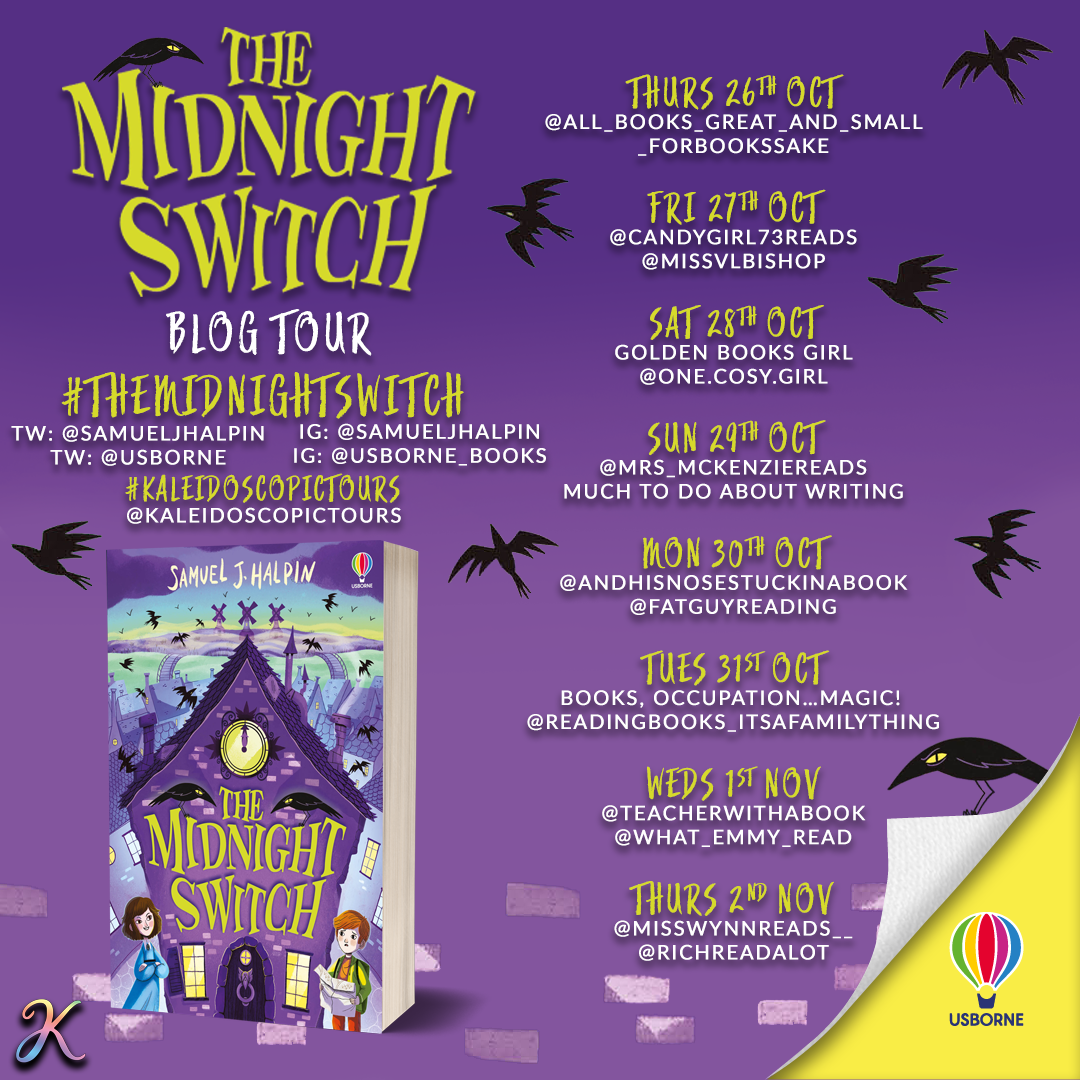
Today is my slot on the tour for The Midnight Switch by Samuel J. Halpin, published by Usborne.
Born in Tasmania with Irish roots, Samuel J. Halpin writes daily. Having studied journalism at the University of New South Wales, Samuel went on to take cinematography at AFTRS, the national Australian film school in Sydney before moving to London and working in comedy TV production.
His children’s books are his answer to a childhood raised on a hodgepodge of fairy tales, crowded bookshelves and cups of hot chocolate.
Summary:
A spooky, quirky adventure of curses and magic, perfect for fans of Malamander and A Place Called Perfect.
When Lewis’s family moves to a faraway town called Barrow, he can’t quite put his finger on what feels so strange about his new home. Everyone is obsessed with superstition, and an old story about floods and witches and a curse, while a mysterious bird watches his every move.
Then his family friend Moira arrives to stay. Only, there’s something peculiar about Moira too. She doesn’t know where she’s from, or even when she’s from, and strange things happen around her. Lewis and Moira are determined to figure out what’s going on in Barrow, but as they unravel secret symbols, riddles and stories of a midnight curse, they find that there might be some truth in the old town tales.
Time is running out, before magic switches up everything they know…
The Midnight Switch by Samuel J, Halpin
My stop on the tour takes the form of an author interview.
********
Tell us a little about yourself and the inspiration for The Midnight Switch
Well I most certainly can! My name is Samuel J. Halpin. The Midnight Switch is my second book – The Peculiar Peggs of Riddling Woods being my first. I’m an author with a feverish love for all things spine-prickling, and love nothing more than an adventure – be that one taking place in my head or high up a mountain. I love nature, folklore, ghouls, ghosts and the way all of these things collide and entangle with one another in the world around us.
What are the underlying themes of The Midnight Switch?
The Midnight Switch at a glance is about the power of friendship to heave us through sometimes terrifying sometimes downright painful circumstances. It’s about loss in some ways (no spoilers!) and how powerful it is to know someone and feel their influence upon you, despite the fact that you may not ever see them again. But its also about Lewis and his Dad. And how difficult it can be to navigate a relationship with a parent who may only want what’s best for you, but demonstrates it an overbearing way.
Are you a plotter or a pantser?
A little of both. A plotter when I know what’s good for me, but a pantser when a good idea strikes, and I shoot off in a particular direction like a renegade fire cracker. Then, when the firecracker idea has had some cold water put on it and it’s all fizzled out, I go back to plotting.
How do you ensure you keep children turning the pages?
By making sure that the twists and turns of the tale are fresh and truly unexpected. I also like to make sure that the themes I explore are relevant and can be understood from many different vantage points.
As an example, I think Lewis’s struggle to understand his Dad in this book is a theme that lots of us can relate to and observe, even if this isn’t our experience of our parent.
I also am a firm believer that children like to be scared. At least, as a kid, I most certainly did. Fear, particularly in books, is something you can play quite safely with and yet experience all the same sensations as if you were walking along a lonely road in the dead of night. Or stepping over somebody’s grave. Or thinking about what might be beneath as you tread deep water.
What is your favourite thing about writing for children?
It gives me the opportunity to go back and remember how different the world looks when you’re a kid. Sometimes that means it can be all the more frightening and overwhelming than when you’re an adult. But the sense of curiosity and wonder – not only for things that are fantastical, but also for people and the way they behave – is truly a thing of great beauty.
If you could spend a day with another popular author, whom would you choose?
Far too many to choose from. E. Nesbit would be up there. As I love the way she made ordinary things so very gripping and otherworldly. But I would like Stephen King to answer for some of my childhood nightmares. Dodie Smith for a punch of nostalgia. Neil Gaiman for…well…Neil Gaiman…it might have to evolve into a bit of a dinner party I’m afraid…is there enough time in this would-be day?
What writing advice would you give to people aspiring to be a children’s book writer?
Write often. And try being as much of a pantser as you can, because all the good ideas come flying out like bats from a belfry when you’re being a pantser.
Is there anything else you would like to tell readers about your books and writing forchildren?
I do love to hide little things in my books. Easter Eggs, of sorts. So if you spot them – do let me know!
There are a couple in The Midnight Switch if you know a thing or two about chess!
What are your social media links where can people find out about you and your books?
I’m @SamuelJHalpin on X/Twitter and SamuelJHalpinon Instagram. And as for finding out about me and my books – I love when people reach out to ask lovely questions. Please feel free to do so!
Where is the best place for people to buy your book?
Anywhere that sells the darn thing! But if you do have the privilege of being able buy it from a local bookshop of yours – I’m sure the booksellers there will be able to steer you in the direction of other wonderful titles too.
********
To follow the rest of the tour please take a look at the schedule:
I would like to thank Bee from Kaleidoscopic Tours for inviting me to take part in this tour. Thank you.
I am thrilled to announce today is my stop on the Ultimate Write Reads Tour for Pax and the Missing head by David Parker.
David Barker lives in Berkshire with his wife and daughter and has a passion for stories, sport and board games. In 2014, he attended the Faber Academy and from that had three climate-fiction thrillers published, The Gold Trilogy, Bloodhound Books.
He joined SCBWI in 2018 because as he wanted to shift his focus to a younger audience. HIs MG debut, Pax and the Missing Head published with Tiny Tree was released 12th October, 2023.
Pax and the Missing Head is a middle grade science fiction, dystopian adventure set in 2057.
Blurb
In a country beset by civil war, New London defends itself behind a giant wall. Inside the city, children are forced to work from an early age, except for the lucky few who train to be leaders in the re-purposed Palace of Westminster. 12-year-old orphaned Pax is brilliant at recycling old tech. He enjoys working on the verti-farms and just wants a bit of peace and quiet. But when that is taken away from him, his only hope is to pass a near-impossible exam and join the other students in Scholastic Parliament. There he’ll make new friends and new enemies. He’ll get tested like never before. And he’ll discover that not everything is quite what it seems under the mayor’s harsh leadership.
Blurb from the back cover of Pax and the Missing Head by David Barker
My stop on the tour will take the form of an author interview.
********
Hi David,
Welcome to my blog.
To start please tell us a little about yourself and the inspiration for your book Pax and the Missing Head.
I’ve been writing for over ten years now. I cut my teeth on the Faber Academy course in 2014 from which grew a trilogy of dystopian James Bond-like thrillers (The Gaia Trilogy, Bloodhound Books). I first started working on a draft of Pax in 2018. It was inspired (if that’s the right word!) by the deep political divisions in this country and in America following the Brexit vote and Trump’s election win. I began to wonder: what if these divisions led to another civil war in Britain? Pax & The Missing Head is set at a time when the initial fighting has died down and New London shelters behind a giant wall. My vision for this future borrowed heavily from my memories of George Orwell’s 1984. The final piece of the jigsaw fell into place when my enjoyment of Harry Potter fused with my interest in the Palace of Westminster and I wondered: what if this building were a school? Scholastic Parliament was born.
How much research did you need to do for Pax and the Missing Head? Tell us about the most unusual research you did.
The great thing about writing a story set in the future is that you can make stuff up! Most of the weird inventions are loosely based on current trends in technology. But I also deliberately set some trends backwards – the Civil War and New London’s isolation has come at a cost to its citizens. For research, I dug out a map of the internal architecture of the Palace of Westminster. But the oddest thing I researched was how to make a foaming blue snake out of fairy liquid and hydrogen peroxide – a chemistry lesson scene that got cut during the edits.
How do you develop your plot and characters?
Once I had the idea for Scholastic Parliament and a divided Britain, I needed a character. A peace-loving child (Pax is Latin for peace), with no parents (they just get in the way of a child-led plot!) and maybe few friends. I needed him to be excluded, at first, from the other pupils at the school, so I imagined a world when some babies were made in test tubes and used as a form of child labour, which is where we find Pax at first. Then I had to decide who the real villain of the story was and how this person threatened Pax’s hard-working but peaceful future. And since I love stories that have a competition at their heart (like Ender’s Game or Ready Player One), I added that as an element of the school curriculum.
Which of the characters do you relate to the most and why?
There are definitely aspects of myself in Pax, although I am must closer to Samuel than Pax when it comes to rules: Pax doesn’t mind bending them, Samuel is a stickler like me. But my favourite character is probably Roacher – a miniature pet robot that Pax builds once he is enrolled at Scholastic Parliament. I would love to own a Roacher for real!
Do you have any writing rituals?
Once I have figured out a setting, the main characters and a rough outline of a plot, I am ready to begin draft one. There follows an intense month or two of trying to write a chapter every morning. I try to leave the afternoon free for reading (keeping up with the current market and looking for inspiration!) or thinking about any knotty problems I’ve encountered with the plot thus far. The next morning, I’ll read over what I wrote the day before, give it a light edit and then I’m back in the zone to write another chapter.
Is there a particular place you like to write?
I wrote my first novel on the train during my commute home from work each evening. It look about 5 years to finish! These days, I write full time and work from home. I’m lucky enough to have a lovely study with a big desk and a nice view out of the window.
What writing advice would you give to people aspiring to write dystopian adventures?
Whatever aspect of a dark future you imagine, make sure it has some real consequences for the protagonist in your story. Make it especially relevant to that person. For example, maybe we all have to live in high-rise apartments because of rising sea levels and the hero is afraid of heights. And the other thing I always try to do (especially with children’s fiction) is to make sure there is hope. Let your readers see the protagonist making the world a better place. Show them we can all make a difference.
Is there anything else you would like to tell readers about Pax and the Missing Head?
I’m very excited to share my first children’s story with the world. I hope you all enjoy it and please remember to leave a review on Amazon, Waterstones or Goodreads. It makes a massive difference to debut authors. Thank you. And look out for book two next year.
Where is the best place for people to buy your book?
It should be available in all the usual places. Bookshop.org is a great website that supports independent book stores. To order Pax through them visit: Pax and the Missing Head.
Thank you David. I think it is so true that it is always good to be able to read a book that leaves you with a sense of hope. You are so right.
Today I am excited to welcome Saviour Pirotta to my blog.
Saviour is a playwriter and author of mainly children’s fiction. He has series set in latest books are set in Ancient Greece, the Islamic Golden Age, the Stone Age and Ancient Egypt.
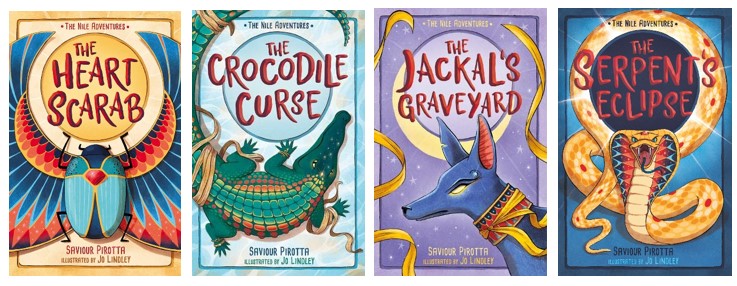
The last book of Saviour’s Nile Adventure series, The Serpent’s Ellipse, is due for release January 2024. Here is the blurb:
After foiling the plot against Prince Khaem, Renni hopes life will return to normal. Except, when Balaal’s father sends a message calling her home, Renni must face the reality that the lives of him and his friends are no longer entwined. As the group splits onto their separate paths, darker forces move in the shadows, intent on claiming the world as their own. Will Renni, Mahu and Balaal discover who are their friends and who are foes, or will the world be plunged into eternal night? Join Renni in the spectacular finale of the Nile Adventures series.
Blurb for The Serpent’s Eclipse by Saviour Pirotta, published by Maverick Books.
Without any more delays let’s get on with the interview.
********
The Serpent’s Eclipse is the last in TheNile Adventure series. What is it like reaching the end of a series? Do you find you need a period of mourning, or do you celebrate?
I always have mixed feelings when I reach the end of a series. I’ve lived with the characters and storyline for a couple of years, sometimes more. I’ve got to know the world they inhabit inside out and it’s always sad to leave a place you have created and loved. At the same time, I’m always itching to tackle a new subject, to get to know new characters and civilisations.
How much research did you have to do for your Nile Adventure series and what was the most unusual research you had to do?
I have been obsessed with Ancient Egypt since hearing the story of Moses at school. I must have been in Year 1. I remember trying to imagine what Pharaoh’s palace would have looked like. In those days there was no handy internet, you had to look up stuff in books, so I spent a lot of time in the library, still my favourite place in the whole wide world along with cafes that serve afternoon tea. I have little notebooks where I write down interesting facts to put in stories and a lot of those snippets of information are often about ancient Egypt.
For my fortieth birthday, I went on a Nile cruise and it inspired The Nile Adventures. Not only were the temples mind-blowing but the river itself was very inspiring. Looking at the villages on its banks was like watching a film. It was so easy to imagine you were back in Ancient Egypt. One afternoon I saw a boy drawing pictures with a reed brush. An older boy was fishing nearby. I took them to be brothers. Renni and Mahu were born in my mind. I did years of research after that, to discover more about their world and their way of life.
Renni, Mahu and Balaal are such strong well-rounded characters. How do you create your Ancient Egyptian characters to fit the era so perfectly yet children today can still identify with them?
Creating characters that ring true in their own time but that today’s readers can also empathise with is the biggest challenge in writing historical fiction. It’s like walking a tight rope. The ancient world was a very different place from our own, in all sorts of ways. To us today, life in Ancient Egypt would have been quite frightening. There were no guarantees. People were very superstitious. They believed the gods were constantly breathing down their necks, always ready to judge and punish them should they break the rules. They weren’t even sure the sun would come up every morning. And yet they had the same hopes and fears we have today. They all wanted to be loved, to be understood, to have fun after a hard day’s work, to celebrate the milestones in their lives. In a way, the world has changed a lot, we have changed a lot, but we have also stayed the same. It’s this duality I try to capture in my stories.
Why did you decide to write The Nile Adventure series from the multiple viewpoint of Renni and his brother Mahu and also the antagonists?
I wanted to explore a rounded Egypt that took the reader beyond the image presented by the leitmotifs of popular Egyptology. Of course, the stories feature gods and mummies and the great annual inundation but I hope they also give kids (and the many adults who seem to be taking to the series) a glimpse of what life would have been like on the banks of the Nile during the height of Egyptian civilisation.
As I see it, there were two sides to Ancient Egyptian life: the glamorous world of Pharaoh’s court and the temples with their tales of magic and the afterlife; and there was also the harsh world of trying to exist on the edge of an arid desert, where the poor mostly remained poor all their life. Renni, the artist, represents the glamorous world of art, poetry and royalty. His brother Mahu, the farmer/sailor represents the challenging reality of everyday life. Princes Balaal is a daughter of the Fenkhu, a Phoenician from the country now known as Lebanon. She brings an outsider’s perspective to the series, someone who is an awe of Egypt but can also be sceptical of its preoccupations and belief system. She stands in for the reader. Paser, the evil and ever-ambitious vizier, brings yet another point of view: that of the privileged and the entitled. Sadly, he is the character closest to present day society. He is actually based, albeit in a vastly exaggerated way, on a real person I knew in Brighton.
When starting a new series do you already have an idea of how many books it will span and what the overall arc of the series will be? Talk us through your initial planning process.
When I first created Renni and Mahu, I had only one book in mind. It was going to be called Valley of the Kings. All I had at that point was the idea of them stealing the general’s heart scarab and his ka, his spirit (or ghost if you like), chasing them for it. I knew the story was going to end with the two very different brothers finding common ground and learning to appreciate each other’s gifts and accepting their downsides. But I had no clue how that was going to happen until I started doing proper research.
Prior to stating The Nile Adventures, I wrote a very successful four book series set at the end of the Neolithic. It was called Wolfsong and I liked the freedom such a big story arc gave me to explore the characters’ possibilities. So I expanded Valley of the Kings into four books. I set myself two rules: Each book had to feature an animal sacred the Ancient Egyptians, and each one had to be set in a different city.
What writing advice would you give to people aspiring to be a children’s book writer?
Three words. Don’t. Give. Up. If your story is any good, someone somewhere will publish it. There’s all sorts of reasons publishers will not take on a book. The subject might not be in fashion. They might have something else in the pipeline that might clash with yours. No one wanted to take a punt on The Golden Horsemen of Baghdad until the Islamic Golden Age was added to the National Curriculum. Now it goes into reprint on a regular basis.
And write for yourself, not for the market. Children are incredibly shrewd critics. They can tell if a voice is genuine. Write from the heart, don’t try to emulate other writers, and you will get there.
Is there anything else you would like to tell readers about your books and writing for children?
My books are my reason for living. I put my heart and soul into them. I am forever grateful that I seem to have found a core readership that like mu stories. It took a long time to find my voice, to tell the stories I want to tell. The main characters in my books have a large part of me in them. I am Nico, the snack-loving scribe in the Ancient Greek Mysteries; I am also Jabir in The Golden Horsemen of Baghdad, a boy who wants to do the right thing but doesn’t know how to do it. Perhaps the character that is closest to me is Wolf in Wolfsong. He starts off not knowing what to do with his life; the world frightens him. He feels inadequate, but in the end, he finds himself. Renni in The Nile Adventures is also partly based on me. He wants to use his gifts to make the world a better place and that is what I try to do with my books.
You can buy Saviour Pirotta’s books from any good bookshop. They’re available online at amazon but also direct from the publishers where you can often get great discounts. Here’s the address https://maverickbooks.co.uk/junior-fiction/.
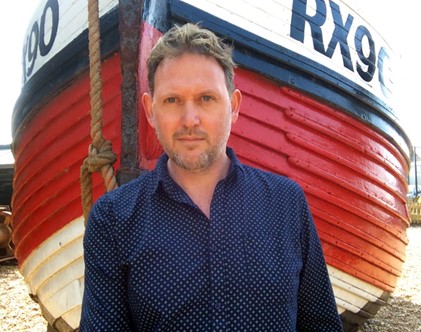
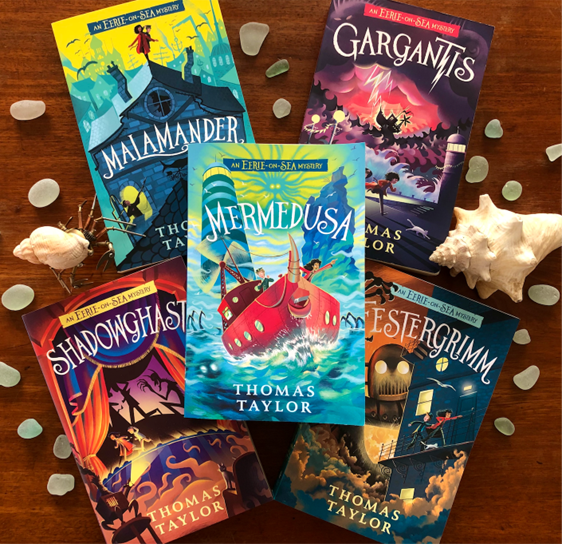
I would like to welcome Thomas Taylor to my blog today to talk about his Eerie on Sea series, published by Walker Books.
Thank you for inviting me onto your blog, Anita.
Tell us a little about yourself and your inspiration for the Eerie on Sea series. Was it always planned to be five books?
I’m an author and illustrator of children’s books, though I’m mostly writing these days.
My Eerie-on-Sea books are inspired by my experience of moving to a seaside town in 2010, and discovering how such places are in the off season, when the tourists have gone home, and the weather turns bad. Winter by the sea is a moment of dramatic sunsets, bonkers weather, strange sights and eccentric characters. This is also the best time to find treasures washed upon the beach. It’s the season when those local legends of sea creatures and smuggler ghosts, which seemed so laughable in the summer, suddenly make you look over your shoulder as you hurry home in the dark.
As for the number of books, I can’t say it was always planned to be five. But As I wrote Malamander I realised that there was far more material than could be accommodated in just one book. The auction that saw Walker acquire the book resulted in a three book deal, however A trilogy also never seemed enough for me. The question I faced as I wrote Gargantis, the sequel to Malamander, was how many books more than three should I aim at? Seven seemed to be pushing things too far, but five had a nice round feel to it. And I could see that five books would allow me the space to resolve Herbie and Violet’s narrative arc properly, whilst also telling five distinct stories. I was very happy when Walker agreed.
What would you say are the underlying themes of the series as a whole?
There is a strong theme of things being lost and things being found running through the books, like letters through a stick of rock: Herbie’s job as Lost-and-Founder; Violet’s past as a baby who was lost, and who now wants to be found; Herbie’s own past as a boy who was washed up on the beach and has to find himself; the countless little examples of the same in the secondary characters, from lady Kraken’s back story, to the magical experience Mr Seegol had as a young man and which he longs to experience again.
As a keen beachcomber, I’ve seen the way lost things are changed by the tide, and repurposed by the people who find them: Yesteryear’s broken lemonade bottle is today’s sea glass gem, and tomorrow’s piece of jewellery. But it’s also the ‘mermaid tears’ of legend: trash turned to treasure by the tide, and then turned to story by human imagination.
Friendship is another theme. As is trust, and the importance of doing what’s right, and of trusting ones own instincts to determine what is right.
Was the passing of time between each book important for the Eerie on Sea series and why?
It was a challenge certainly. Most readers, I think, didn’t notice that the five books take place over the course of a single year, until I pointed it out in the last book, Mermedusa. The series runs from Midwinter to Midwinter, with a large gap over the summer, during which the town of Eerie-on-Sea becomes ‘Cheerie-on-Sea’ — replacing the letters C and H that blow off the pier every year, and pretending the be a normal little seaside town again, to attract tourists.
With the five adventures fitting into the autumn and winter of a single 12 month period, I had to make sure that the consequences of one book were still felt in the next. It also gives a relatively tight period for character growth to take place in. But I felt strongly that I couldn’t let Herbie and Violet grow out of their childhood as the stories ticked by, and they are as approximately ‘twelvish’ at the end as they were at the beginning.
How did you manage to conclude all the mysteries and tie up all the plot points from all five books without missing anything? Talk us through your planning process to achieve this.
I don’t really plan my books. I tend to rely on a lot of day-dreaming, then a lot of feverish story telling. I pay for this sloppy technique whenever I take a wrong turn and have to undo a few chapters. But it does keep things fresh and surprising. For example, in Malamander I had no idea that Erwin the cat would have the magical quirk that he has until he exhibited it in a scene. I got goosebumps when that happened, so, of course, I kept it in, in hopes that the reader would get goosebumps too.
I also have very good and observant editors.
How did you come up with the names of each of your monsters and the legends behind them for each of the books in the Eerie-On-Sea series.
With Malamander, I realised that even though I was creating a legend about a sea monster, I could help the legend seem more ‘real’ if I based its name on a real word. After listing a lot of probably candidates, I hit on ‘salamander’ because I saw that if I changed the S to an M, I would have a ‘Mal’ sound. Mal in French and Spanish means ‘bad’ or ‘evil’, which works in English too: think of ‘malevolent’ and ‘malign’. So ‘Malamander’ sounded monstrous to me.
Having done this once, it was then a challenge to create the other titles. But in brief: Gargantis was a squashing-together of ‘gargantuan’, ‘gigantic’ and ‘Atlantis’, Shadowghast was a simple joining of two words to evoke a kind of spectral creature, Festergrimm was a play on Frankenstein, the themes of which are touched on in the book, and Mermedusa is ‘mer’ from mermaid bolted onto ‘Medusa’ from Greek myth.
Will you be revisiting Eerie-On-Sea? What’s next?
I would love to write another Eerie-on-sea book one day, but it would be a standalone, and not part of Herbie and Violet’s story arc. I think Herbie and Violet would be in it though, but as secondary characters. In the meantime, I’m working on a new idea which is proving hard to get right, but which is exciting. All I can say about that is it will have more of the same sort of intrigue, mystery, creatures, magic, nice things to eat, good friends and dastardly going-on.
What writing advice would you give to people aspiring to be a children’s book writer?
I find it hard to give advice. Certainly, I think an aspiring writer for children needs to be very aware of current children’s books, and reading the books that are being published right now. However, it’s important to write the books you want to write and believe in, and not work to trends or over worry about what others are doing. Good storytelling, compelling voices, and rich characterisation are always in high demand, even if you are writing in a genre that seems over-represented. So, enjoy your own stories! Readers will notice if you don’t.
What are your social media links where can people find out about you and your books?
Instagram is probably my main social media these days (@thomskagram), though I’m still on Twitter, or whatever it’s called (@ThomasHTaylor). My website is: http://www.thomastaylor-author.com
Where is the best place for people to buy the Eerie-On-Sea series?
Your local independent bookshop! Or, failing that, any branch of Waterstones. If you would like a signed and drawn-in book, then please order through www.hastingsbookshop.co.uk, and leave a note in the order form. That’s my local indy. Thank you!
Keep your eyes peeled for my review of Mermedusa, the final book in teh series, which is due to go live on the 18th October. That is this Wednesday.
Thank you again Thomas for agreeing to be interviewed for my blog.
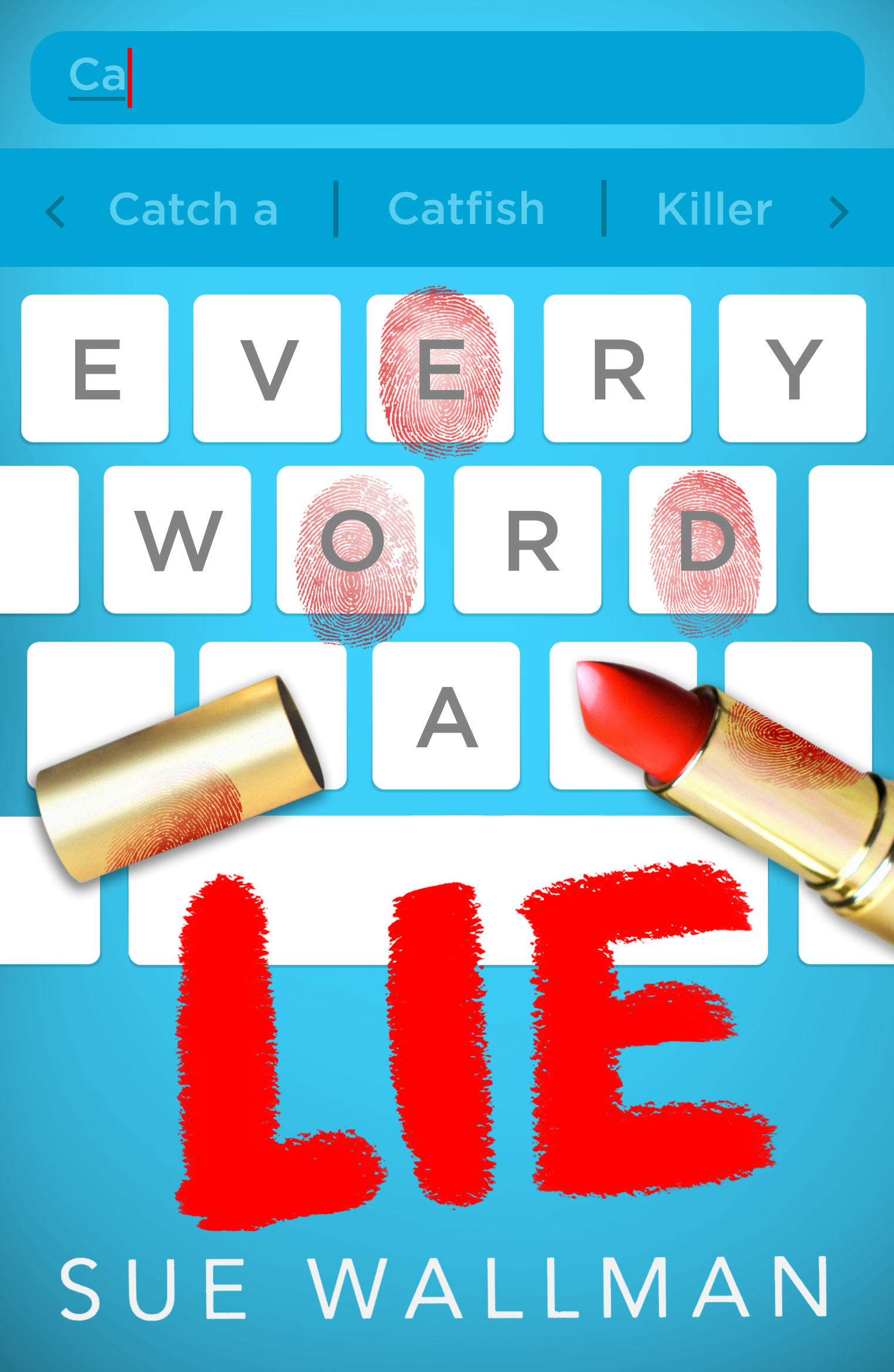
I am so pleased to welcome Sue Wallman back to my blog today as a special guest talking about her latest YA thriller, Every Word A Lie.
Sue has worked for a newspaper in Paris and for magazines in London, She then became a secondary school librarian for six years. Now she is fulfilling her dream of writing and doing writing-related events full-time.
Her journey to publication took eight years, and picked up pace when she won The Woman’s Prize for Fiction First Chapter Award in 2013. Her debut, Lying About Last Summer, was published in 2016. Seven years later she has seven books under her belt.
Her latest book, Every Word A Lie, is a nail-biting story of a catfishing prank that gets out of control and gets deadly. Two friends, Amy and Stan, plan revenge on their prankster friend Hollie by catfishing her as her crush. They only mean to do it for a day or two – but then Hollie ends up dead.
As the catfish continues to strike others, Amy needs to find out: who is really in control of the catfish? Can she trust anyone? And is she the killer’s next target?
********
Hi Sue,
Welcome to my blog. It is great to have you back here and talking about your latest novel, Every Word A Lie. I think the last time you were featured on my blog was March 2020 talking about your research for your award-winning YA thrillers. I am sure Every Word A Lie will be just as popular.
Thank you for having me back on, Anita!
Tell us what was your inspiration for Every Word A Lie and why you decided to write a book about catfishing for the YA market?
This book came about because my editor, Linas Alsenas, asked me if I’d listened to the podcast called Sweet Bobby that everyone in the Scholastic office was addicted to. It’s a real-life story about a woman who’d been catfished over a period of years and it was completely shocking. Catfishing – when someone pretends to be somebody else online – is a huge thing right now, and so many people are affected by it, adults and young people alike. It takes many different forms, from dating and delivery scams to bullying and manipulation, to people trying out different identities or escaping their real lives. But whatever the reason, there is always a victim.
When I spoke to teenagers in my creative writing group about it, they didn’t necessarily know the term catfishing, but they all knew someone who it had happened to, or they had had experience of it themselves. The scary thing is that parents often try to help but can’t and even the police have limited powers.
In my young adult thriller, Every Word A Lie, Amy and Stan are best friends who are part of a friendship group that loves pranks. When they want to get back at their friend Hollie who signed them up to litter-picking as a joke, they message her as a boy they know she has a crush on. Things spiral, Hollie winds up dead, and Amy and Stan are devastated. But the deaths – and the catfish messages – keep on coming…
How do you manage to develop so many different relatable characters with their own unique back stories and traits?
I’m really pleased you think they are relatable. I start with the basic plot and work out what sort of characters I need. In my first draft, however hard I try, my characters are horribly two dimensional, but then when I know the story properly, I flesh them out as authentically as I can. It’s like chipping away to uncover something.
What is your secret to the way you always keep your readers guessing who the murderer is right to the end?
I have to misdirect the reader and hope that I’ve got the right balance of giving enough information but not giving too much away. Sometimes when I’m working on a later draft and there have been multiple changes and I’m in a muddle, and my editor is also too close to it, someone else in the Scholastic office will read it to check that there isn’t a major clanger in there and the murderer isn’t too easily guessed. Then I have to wait and see what readers think. There’s no better feeling than someone thinking it was a really satisfying read!
When you are writing an emotional difficult scene how do you approach it? Talk us through your writing process.
I just go for it and write it how I see it in my head. Often in later drafts when I’m polishing it, I can wring more emotion from it.
What are your favourite authors and how have they influenced your writing?
The authors who influenced me from way back are Anne Tyler, who writes for adults, who conveys so much in a few words. I was astonished by Meg Rosoff’s How I Live Now when it first came out (2005) and E. Lockhart’s We Were Liars (2014) – deceptively simple writing which resonates and is achingly poignant. I also think Holly Jackson is also a great writer and deserves her huge success.
Do you have a particular place you like to write?
I can write anywhere as long as there is coffee and preferably a few snacks to hand.
Now you have several more YA thrillers under your belt what writing advice would you give to people aspiring to be a children’s book writer?
Learn the craft of writing. I didn’t understand about all sorts of things when I started, even though I’d worked as a magazine journalist. Fiction is different. To improve, you need to know about show not tell, how the mid-point of a book is important, and so on. I read a few books about writing, and read successful fiction books, looked up free resources online, was a member of a critique group for a while and joined the Society of Children’s Book Writers and Illustrators.
Is there anything else you would like to tell readers about Every Word A Lie and writing for Young Adults?
Yes, this was the first title of mine that made it through the whole process! All my previous titles were ditched in favour of one thought up by my agent, editor or someone else at the publishers.
Thank you Sue for agreeing to be interviewed on my blog. It has been fantastic having you back and thank you for letting us into your secret to keeping your readers guessing.
To find out more about Sue Wallman and her novels visit her Website: www.suewallman.co.uk. You can also follow her on X: @SueWallman, Instagram: @suewallman and Threads: @suewallman.
You can buy copies of all Sue Wallman’s novels from your local bookshop, or online at uk.bookshop.org which supports local, independent bookshops.
On my blog today I would like to welcome the renowned illustrator Loretta Schauer.
Loretta paints, draws and prints by hand in a variety of media, and finishes her artwork digitally. She is a self-taught artist and has won the Waterstone’s ‘Picture This’ competition in 2011. Since then she has illustrated picture books and fiction titles for a wide variety of publishers. Her first middle grade book as author illustrator is The Legend of Ghastly Jack Crowheart, which is released on Thursday, October 5th 2023 by Anderson Press.
For Lil, life at the Squawking Mackerel inn couldn’t be more miserable. She’s tasked with the sloppiest, grottiest jobs and picked on at every turn. Her only friend is Augustus Scratchy, a cantankerous crow with a habit of stealing. When the dread villain Rotten Bob Hatchet and his gang of cut-throat highwaymen begin attacking travellers on the road, things get really dire.
Joining forces with a new servant boy, Ned, and armed with the contents of the inn’s lost property cupboard, a pocket full of revolting dumplings and some knicker elastic, Lil comes up with a plot to scare off Rotten Bob. And so the legend of Ghastly Jack Crowheart the Demon Highwayman is born!
Dangerous highwaymen, furious crows, ludicrous underwear, and a turnip apocalypse – stand and deliver!
Blurb for The Legend of Ghastly Jack Crowheart by Loretta Schauer
This amazing looking book will be released on October 5, 2023. So we only three more days to wait. I can’t wait to read it see the illustrations.
Loretta has kindly agreed to be interviewed about the inspiration and writing process for The Legend of Ghastly Jack Crowheart.
********
Welcome to my blog Loretta. Please tell us what inspired you to write a book about highwaymen?
Why Highwaymen? – Well, when I was a kid I had a big Smash Hits poster of Adam Ant on my wall so I guess my admiration for a dandy highwayman goes back to then… We see a lot of pirates in kids books but I’ve never seen a recent one featuring highwaymen.
How long have you been writing as well as illustrating for?
I’ve been illustrating for about twelve years. My first book as illustrator was published in 2012 and I became a full time illustrator in 2015. Crowheart is my first title as author and illustrator and it’s the first middle grade fiction title I’ve written – so it’s been couple of years now for the writing. I’ve experimented with a few picture book texts in the past but never quite got them to the stage where they were ready for submission. I also wrote a graphic novel script a long time ago, but again, never got round to submitting it properly – mainly because the pictures were so important to the story, and I never got further than making the first two pages!
For The Legend of Ghastly Jack Crowheart, what came first for you the text or the illustrations? Talk us through your writer-Illustrator process.
The illustrations definitely came first – the characters and setting were there from early on, and that meant there was lots of sample artwork to send out with the story when it went on submission.
The idea for the book started with some character sketches. I love historical fashions so I’d drawn some 18th century ladies or “wig wafters” as I like to call them, and a crow character, Augustus Scratchy, who definitely needed to appear in a book. I had been playing with the idea of a young girl who uses a Highwayman’s disguise to go off on adventures too and somehow they all fitted together. (Must have been all the feathers!)
When I write, I tend to imagine various scenes and incidents, and quickly write them down in no particular order. Then I begin to expand on them; what happens before or after? What links them to the characters inner story? What elements do I need to write about more? This all helps set the tone and voice for the book. I then do some plotting; shaping the narrative, making sure the character’s motivations are clear, and working out where scenes should go, and what’s missing. There’s obviously a lot of cutting of scenes with this process, and I keep a working doc of bits that I “save for later”. They often end up discarded, but it’s all part of the process. I then do a “proper write” which becomes the first draft. Then it’s editing all the way! By this stage I already have a good idea of what I want to show visually, so once the text was approved, I went through the book and made a list of potential illustrations. There were rather a lot so I was expecting to cut most of them , but my editor and designer at Andersen said “let’s have them all!” so it ended up being a heavily illustrated tome!
What would you say were your main protagonist, Lil Scroggin’s best and worst qualities?
Lil is a little over-enthusiastic when it comes to her grand schemes – which gets her into trouble. As does her unfortunate habit of answering back! She tries really hard to fix the mistakes she makes, but the odds are stacked against her and things have a nasty habit of going from bad to worse. She’s brave and funny and deeply empathetic at heart. Her refusal to be taunted into being cruel is evidence of this, as is her relationship with Scratchy the crow and Ned the shy servant boy. She also takes no guff, and she practically runs things at the Squawking Mackerel, despite being on the receiving end of Ma’s temper and the other kid’s mockery.
As for the villain of the story, Rotten Bob Hatchet, would probably want to be just as ghastly and notorious as Jack.
What advice would you give to other illustrators wanting to write their first book?
For me, writing was quite an organic, instinctive process, so I’d say just give it a try. There’s no wrong or right way to approach it. Just as with your artwork, you have to experiment, and get words on the page. The idea is key, and your personal voice is what makes the story unique to you, just like your art. I know many people benefit from going on writing courses to learn about craft, and although I’ve not been on a writing course as such, I’ve definitely absorbed lots of wisdom and tips over the years being involved in the visual side of making books. My punctuation and grammar is terrible, but I write as if I’m telling a story, whether it’s from the character’s point of view (hello drama skills!) or from my own. And that’s the thing, we illustrators are natural storytellers, and illustration is all about communication – so I guess we’re already halfway there!
Do you play music while you work and, if so, what’s your favourite?
I don’t play music while I write, but I do play music or listen to podcasts while I draw.
If I’m feeling stressed and have a stack of deadlines looming I’ll go for some rousing like S.P.O.C.K, as it always cheers me up, but if I’m feeling creative and want to get “in the zone” I’ll listen to something atmospheric and a little bit spooky like Lorn or Fever Ray.
I love listening to history podcasts, and lots of true crime. For some reason there seems to be quite a few kidlit illustrators who like to hear about serial killers while they are drawing fluffy bunnies. I’m not sure why.
Is there anything else you would like to tell readers about The Legend of Ghastly Jack Crowheart?
This is a book full of the things I find funny about life in the 18th century. The second half of the 18th century was fantastically extravagant and thoroughly revolting in equal measure – especially for ordinary people who had to navigate the filth and grime on a daily basis. So if you want to be submerged into a world of ridiculous wigs, pestilential residences, and the indignities of highway travel, this is the book for you. (Spoiler – There’s a lot of mud!)
It’s also the perfect Halloween read, with a lot of creeping about in the woods, a flock of haunted crows and a horrifying demon highwayman on the prowl! Stand and deliver!
Thank you Loretta for your fantastic answers to my questions. It has been a privilege to have you on my blog and I hope we see you again here soon.
To purchase a copy of The Legend of Ghastly Jack Crowheart by Loretta Schauer you can go direct through her publisher Anderson Press here: or from your local indie bookshop, or online at uk.bookshop.org which supports local, independent bookshops.
Today I am delighted to welcome Sarah Coyle to my blog.
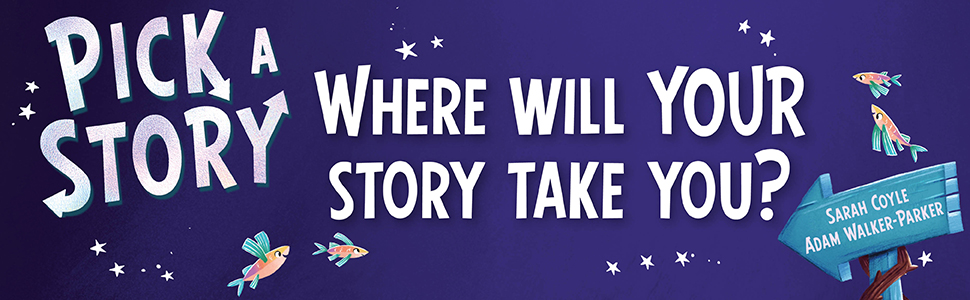
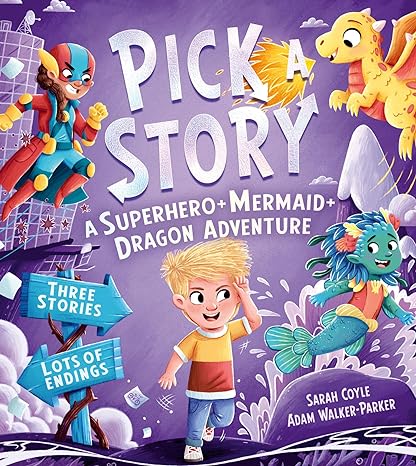
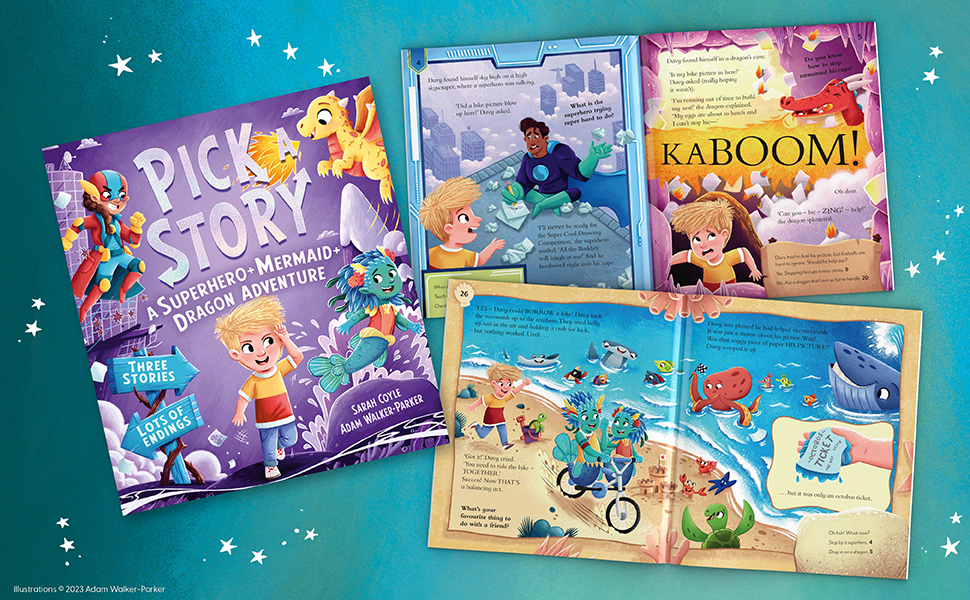
Sarah Coyle is the author of the fabulous Pick a Story series, which encourage children to read in a very different imaginative way. These innovative picture books allow the reader to choose their own story by answering simple questions on where they would like the story to go and turning to the appropriate page in the same way as a game book. In this way, the reader participates in the story by making choices, which does not follow a linear or ordered fashion.
The latest book in the series is Pick A Story: A Superhero + Mermaid + Dragon Adventure.
Sarah has kindly agreed to be interviewed about the writing of her Pick a Story book series.
********
Hi Sarah, welcome to my blog. To start please can you tell us a little about yourself and the inspiration for your Pick a Story book series.
I was a big reader when I was a child. I remember the difficulty I had walking from my bus stop to my door stop reading The Queen’s Nose while simultaneously scanning the ground for magic fifty pieces. Bumping into wheelie bins was a hazard, for sure. But I simply couldn’t put a book I loved down. I want all children to get the chance to love reading as much as I do. So the Pick a Story books are all about encouraging engagement to get our youngest readers hooked on books. With this series, I am particularly trying to catch those kids for whom reading can feel more of a chore by giving them real agency through choice.
Why did you decide to write a choose your own adventure style picture book for children?
I enjoyed the choose your own adventure books. Making decisions about where to go next made reading the books an active experience. They felt close to make-believe, which aside from reading was one of my very favourite things. You were playing as you read. Picture books are a great format for these books because small children are so willing to put themselves in a character’s shoes. I have found that kids are very fast to ‘live’ the adventures in the Pick a Story books.
Is there a lot of planning and plotting for this interactive series? Talk us through your writing process with reference to the latest book Pick a Story A Superhero + Mermaid + Dragon Adventure.
Oh my, yes. The process begins with an empty map with lines where the pages link so I can work out that each theme has equal ‘airtime’. Once themes are chosen and a lead character picked, the real plotting begins. There are many different story arcs with lots of crossover and stitchback and it all needs to feel organic and make sense. The making sense bit is often where I get distracted. A lot of utter nonsense seems perfectly sensible to me. This is where Emily Lamm, my editor at Farshore, comes in to save the day and make sure the whole thing flows nicely.
How do you ensure you keep children turning the pages?
I try to ensure that the choices in the books are as fun and exciting as possible. I also love that every time you make a choice, you flick past other tempting pages that you’ll then want to track down.
The illustrator Adam Walker-Parker and the designers at Farshore have done a glorious job here. The themes have their own colour schemes, so the different worlds pop visually as you pass them. You will certainly want to explore them all. Some pages are easier to find than others too. My hope is that this trickery keeps readers engrossed as they seek out that page with baby dragons on it.
What school events have you devised to support the series?
The school events for these books are more fun than I ever imagined they would be. We basically play the book. That means everyone gets to join in and make choice the whole time. The kids decide where we are going on every page. So every event is unique and I never know what’s going to happen moment by moment. It sounds like madness but it works brilliantly.
What writing advice would you give to people aspiring to write a choose your own adventure style children’s book?
Start at the end. If you know where you’re going, it’s much easier to get there. Select a world, (or worlds), that you love yourself. Maybe you like a ye olde medieval romp? Maybe a shiny sci-fi? These books are meant to be fun so stay where you like spending your imaginative time. And go ballistic with the choices. Make them extremely different, make them maddeningly similar, whatever tickles your funny bone. We can learn a lot about ourselves by the choices we make. These books are a safe space to enjoy making them, so you can afford to be brave exploring that.
Is there anything else you would like to tell readers about the Pick a Story series and writing for children?
Pick a Story is all about getting our youngest readers excited about reading through choice and interactive engagement. There are highly important decisions to make and fun activities on every page. You might end up solving a maze, counting, shouting, or spotting and there’s lots of opportunity to share your thoughts along the way. I always find it interesting to find out what catches a child’s attention. For one reader it might be getting to describe in detail what they would do in a narrative, but another kid will just love getting to shout at a giant squid. I try to keep the interactive stuff varied so there’s room for everyone to enjoy themselves.
Where is the best place for people to buy your book?
An independent bookshop. Give them a call in advance and see if they have a copy of the book or can order it in. If you don’t have an independent bookshop nearby, a lot of the big shops will have them like Waterstones. Of course, there’s always The Website That Starts With the Letter A, but going outside is a healthy part of an active lifestyle, so I’d encourage a real-life visit to a real-life bookshop. Bookshops are gentle, calming places to be, like spas or sunset clifftops. One of the important things for me about Pick a Story is that the books are good value for money. They’re not read in a flash and you can go back to them again and again. But if you can’t afford to buy books at the moment don’t let that put you off getting hold of a copy. You should be able to find all the Pick a Story books at your local library.
Thank you Sarah for such insightful answers. I am sure you have inspired many authors to try and write their own Gamebooks. I wonder where their stories will take them?
Thanks for having me, Anita! Those were fabulous questions.
********
You can follow Sarah Coyle on X (formerly known as Twitter) at: @WriterSCoyle and on Instagram as @writerscoyle
Sarah Coyle will be in Bath for Bath Children’s Literature Festival – Europe’s BIGGEST dedicated children’s literature festival – on the 4th October. Book now at:
I am excited to have Angela Kecojevic on my blog today as a special guest to tell us a little about her latest book for middle grade, Scareground, published by Neem Tree Press.
Angela Kecojevic is a senior librarian, author and creative writing tutor. She has written for the Oxford Reading Tree programme and the multi-award-winning adventure park Hobbledown where her characters can be seen walking around, something she still finds incredibly charming!
She is a member of the Climate Writers Fiction League, a group of international authors who use climate issues in their work. Angela lives in the city of Oxford with her family.
********
Thank you Angela for joining us today. I have had the pleasure of interviewing you before for Writer’s Forum about another of your novels, Train. Scareground is very different, so I am eager to find out more.
Why did you decide to write a spooky middle-grade book based in Greenwich?
I used to live in London, so Greenwich was somewhere I loved to visit. There was something very special about its maritime connections and wonderful history. Plus, the Victorian rooftops made for a great story setting! Throw in a spooky funfair and you have the beginnings of a story. The idea for Scareground came whilst I was driving past Battersea Power Station in London. This was when it was unused – abandoned – a word that sounds far more dramatic and exciting! It looked so dark and eerie that my imagination went wild. I pictured a funfair – one that would be spooky and macabre rising from its depths. And then I remembered Greenwich and decided it would make the perfect setting.
What are the underlying themes of Scareground?
I wanted Scareground to be about more than just the ‘scare’, although this element was lots of fun to write! But I wanted to include friendship and bravery too. Good friends will support our fears – and maybe even work with us to face them, just like Nancy and Arthur do in Scareground. Everyone is afraid of something, and I wanted to highlight this.
Which comes first for you the plot or the characters and why?
In this instance, it was the characters. I pictured Skelter Tombola straight away. He was a charismatic mix of P. T. Barnum and Jack Skellington, the ultimate showman and the ultimate Pumpkin King. Skelter’s walk would be crooked. He would be charming and riddled with mystery. Most importantly, he would help provide the ‘scare’ in Scareground. The plot had been at the back of my mind for a while, but I didn’t want to write about an ordinary funfair.
If you could meet Nancy and Arthur, what would you say to them?
I love this question! I would ask Nancy to teach me to talk to the sky. Her gift is very special and given how unpredictable the British weather is, it would be incredibly helpful. I’ve always been fascinated by the clouds, and this element of the story came from cloud watching! There is also something peaceful about the sky. I imagined it as Nancy’s greatest friend, something she could talk to and confide in. As for Arthur, I would ask him about his adventures as a great explorer, and whether he had met any pirates at sea!
Is there a particular place you like to write?
We live by the river, so I’m lucky that my writing desk looks out over fields and woodlands. There are rabbits everywhere! (And the occasional spider!) It’s quite special. I like to have tea and biscuits at hand, and I often have a spooky soundtrack playing in the background.
Have you ever been on any literary pilgrimages?
No – but now I wish I had. I’m a big fan of J.M Barrie’s ‘Peter Pan’. If I could enter his fictional world, I would jump on a pirate ship and head for Neverland. Or fly past the Second Star to the Right and head down to Mermaid Lagoon! A sword fight with Captain Hook would be pretty cool too! That would be my dream pilgrimage!
If you could tell your younger writing-self anything, what would it be?
Is there anything else you would like to tell readers about your books and writing for children?
I know this sounds cliché, but never give up on something you are passionate about. I have several unpublished books in my drawer, and they are quite happy napping there for a while! Those books taught me many things; they were the books I learnt from and each one meant something different to me. I don’t view them as failures or unsold books. They are my secret projects and it’s OK to love them just as they are!
You can buy a copy of Scareground by Angela Kecojevic direct from the publisher here: Neem Tree Press or online at uk.bookshop.org, an organisation with a mission to financially support local, independent bookshops.
I am really happy to be able to tell you that today is my slot on the blog tour for an exciting new science fiction book for middle grade, Tapper Watson and the Quest for the Nemo Machine by Claire Fayers.
Tapper Watson is just an ordinary Erisean boy who loves adventure stories. But when one of his sixty-seven cousins sends him away on a smugglers’ submarine through the River Lethe to other worlds, he just wants to go home again. On an unscheduled visit to Earth he meets Fern Shakespeare, and a talking plant called Morse, and their adventures begin. And when he finds himself being chased through worlds by a pair of trigger-happy lobster mobsters in search of the mysterious Nemo Machine, Tapper begins to realise that he might not be so ordinary after all…
Claire Fayers grew up in South Wales, went to university in Canterbury, and is now back in Wales where she likes to tramp around castles in the rain, hoping to see dragons. She lives with her husband and two cats who sit on her keyboard and stop her from writing.
When the cats will let her, Claire writes funny, fantastical adventures for children. Her first book Voyage to the Magical North, was Waterstone’s book of the month, and was shortlisted for the Children’s Book Award. Her latest book Storm Hound is set amid the Welsh mountains, combining Norse legend with Welsh myth, dogs, cats and sheep.
My stop on the tour will involve an author interview.
********
Hi Claire welcome to my blog. When I found out the title of your latest book. I was really excited. This is the type of book I just love to read so I am eager to find out more about your writing process.
Please can you start by telling us what your inspiration was for mixing science fiction with Greek mythology into a zany children’s book set on a Jules Verne Nautilus-type submarine?
Hi Anita, and thanks for having me on the blog. I came at it from two directions. My first idea was for a story involving explorers who travelled between worlds but lost a memory every time they ‘jumped’. And then, I thought it might be fun to write a heist story, and one of the earliest heist tales ever is Jason and the Argonauts, which I have loved ever since seeing the Ray Harryhausen film as a child.
Greek myth plus memory loss led me to the Lethe – the river of the Greek Underworld which causes forgetfulness. So, the Lethe became my path between worlds and if you’re travelling on a river whose waters can make you forget your own name, you won’t be doing it in a normal ship. A submarine where you can stay safe and dry is far more sensible.
What research did you have to do for Tapper Watson and the Quest for the Nemo Machine?
I hesitate to call it research, knowing how much work other authors have to do. I watched all my favourite old sci-fi movies, read Jules Verne, HG Wells, Asimov etc. And Douglas Adams, of course. I walked around Swansea Bay and took photos (Swansea is the capital of the world in Tapper Watson’s reality.) There was a plan once for a tidal barrage in Swansea Bay. I made the plans more ambitious and added a multi-world research centre.
When it came to Greek myth, I read up on the rivers of the underworld, and I went over the Argonauts’ quest for the Golden Fleece, and picked out elements that I could use (some of them are very well hidden.)
I still haven’t been on a real submarine, but I’ve seen loads of pictures of them.
Does writing energize or exhaust you and why?
Both! I found the early drafts of Tapper Watson hard to write, partly because of what was going on in real life at the time, and partly because I was trying to bring so many different elements together in one story. But then, after Firefly Press had acquired the book, I met my editor and she made a couple of suggestions that seemed to get right to the heart of the story and I flew through a rewrite in six weeks, adding in all sorts of fun extra details.
I find it very hard to switch off from writing, so whenever I hit a plot problem it nags at me constantly until I find a solution. I have had dreams where I’m trying to solve the plot problem and I’ve woken up exhausted, having not solved it. But it’s worth it in the end – there’s nothing better than the moment when a story comes together.
When writing, Tapper Watson and the Quest for the Nemo Machine, how did keep track of your fictional world and characters? Talk us through your planning process.
With the exception of my Welsh fairy tales, every book has started with a list of random ideas. Tapper’s looked something like this:
A secret: I am very bad at writing outlines. My agent wanted to see an outline and sample chapters before I wrote the book and we worked together on many versions of the outline before we agreed I should go ahead and write the first draft.
I have two Word documents, one for the draft and one for all my planning and worldbuilding notes. I find that I get a lot of my ideas when I’m actually writing, so I alternate between my draft and planning documents, noting things down as they occur to me.
Several months later, I had a very messy first draft and a planning document with detailed notes on all my characters and settings. The first draft was actually very different. The villain didn’t work at all so I took him out and rewrote an entire plot line.
My first few drafts are for getting the story right and then I can start filling in the world-building and humour, which is often the most fun part of the process. A lot of the chapters on Zymandia came in the very last draft, for example.
What is the most valuable piece of advice you’ve ever been given about writing?
Write about the things you love. Even if that is octopod scientists, lobster mobsters and submarines that travel between worlds.
Is there anything else you would like to tell readers about Tapper Watson and the Quest for the Nemo Machine?
It’s an epic tale of space smugglers, alien octopods and trigger-happy lobster mobsters where Swansea is the capital of Earth and the number of legs you have really matters. Look out for the Peace Meal – that came from a random word writing prompt exercise I did with a friend.
Thank you Claire for such a fascinating insight into the world of Tapper Watson. I can’t wait to read the next instalment.
To purchase a copy of Tapper Watson and the Quest for the Nemo Machine by Claire Fayers you can buy direct from Firefly Press: https://fireflypress.co.uk/books/tapper-watson or your local independent bookshop, or online at
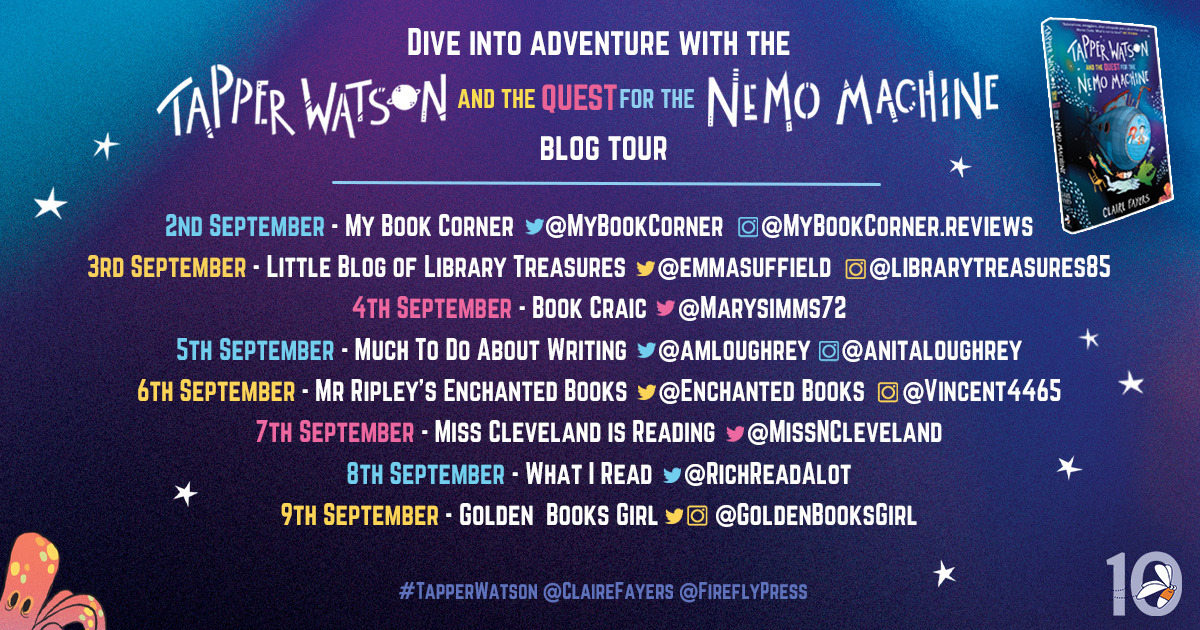
Check out the schedule below to follow the rest of the tour.
I would like to thank Claire’s publicist Graeme Williams from Graeme Williams Marketing for inviting me to take part in this blog tour. Thank you.
I am excited to be taking part in another of The Write Reads Ultimate Blog Tours for Victoria Williamson this time for her fabulous middle-grade novel, Norah’s Ark.
Victoria Williamson is an award-winning author who grew up in Scotland surrounded by hills, books, and an historical farm estate which inspired many of her early adventure stories and spooky tales. After studying Physics at the University of Glasgow, she set out on her own real-life adventures, which included teaching maths and science in Cameroon, training teachers in Malawi, teaching English in China and working with children with additional support needs in the UK. Victoria currently works part time writing KS2 books for the education company Twinkl and spends the rest of her time writing novels, and visiting schools, libraries and literary festivals to give author talks and run creative writing workshops.
Victoria’s previous novels include The Fox Girl and the White Gazelle, The Boy with the Butterfly Mind, Hag Storm, and War of the Wind. She has won the Bolton Children’s Fiction Award 2020/2021, The YA-aldi Glasgow Secondary School Libraries Book Award 2023, and has been shortlisted for the Week Junior Book Awards 2023, The Leeds Book Awards 2023, the Red Book Award 2023, the James Reckitt Hull Book Awards 2021, The Trinity School Book Awards 2021, and longlisted for the ABA South Coast Book Awards 2023, the Waterstones Children’s Book Prize 2020, and the Branford Boase Award 2019.
Her latest novel, The Pawnshop of Stolen Dreams, is a middle grade fantasy inspired by classic folklore. Twenty percent of the author royalties for this book are donated to CharChar Literacy, an organisation working to improve children’s literacy levels in Malawi.
You can find out more about Victoria’s books, school visits and free resources for schools on her website: www.strangelymagical.com
Her latest book Norah’s Ark is about two very different lives. One shared hope for a brighter future. No time to waste. The flood is coming…
Eleven-year-old Norah Day lives in temporary accommodation, relies on foodbanks for dinner, and doesn’t have a mum. But she’s happy enough, as she has a dad, a pet mouse, a pet spider, and a whole zoo of rescued local wildlife to care for. Eleven-year-old Adam Sinclair lives with his parents in a nice house with a big garden, a private tutor, and everything he could ever want. But his life isn’t perfect – far from it. He’s recovering from leukaemia and is questioning his dream of becoming a champion swimmer.
When a nest of baby birds brings them together, Norah and Adam discover they’re not so different after all. Can Norah help Adam find his confidence again? Can Adam help Norah solve the mystery of her missing mother? And can their teamwork save their zoo of rescued animals from the rising flood? Offering powerful lessons in empathy, Norah’s Ark is a hopeful and uplifting middle-grade tale for our times about friendship and finding a sense of home in the face of adversity.
My stop on the tour will take the form of an author interview.
********
Welcome to my blog Victoria. to start us off could you please tell us a little bit more about yourself and the inspiration for your book Norah’s Ark.
As a former teacher, I’ve got to know a lot of children in my years in school, and have been struck by the very wide range of background experiences they bring to the classroom, despite often living in the same area. A lot of my contemporary issue stories explore these differences, and the ways in which they can be overcome so that children can form lasting friendships. In previous books I’ve explored subjects such as cultural differences and neurodiversity. For Norah’s Ark, I wanted to explore something that can have a big impact on children’s educational experiences: class differences – how the cost of living can be a big struggle for some families, while barely affecting others. However, I didn’t want it to be a book about how children from poor families who experience homelessness have negative outcomes while children with stable home lives whose parents have well-paid jobs all have positive experiences. Life is much more nuanced than that, and Norah – who lives in temporary accommodation and relies on food banks, and who initially sees only the positive sides to Adam’s life – eventually comes to learn that Adam’s battle with cancer and his problems with his overprotective parents have led to him to live a much more lonely life than she imagines. Their friendship gives them both something to look forward to and provides them both with hope for a better future – this is a theme that I particularly enjoy emphasising in books, as I’ve often seen the transformative power of friendship in my work as a teacher.
Why did you decide to write Norah’s Ark from a dual viewpoint?
I think empathy is a vital thing to teach children – how to see the world from the point of view of someone else who might live a very different life. While single-narrative stories give children the opportunity to walk in the shoes of someone else and experience their thoughts and feelings, I particularly like using dual narratives to help children explore prejudice and biased initial impressions. We’re all guilty of making assumptions about other people, but dual narrative stories give readers the opportunity to see how two children might make assumptions about each other based on external factors – such as clothes, where they live and how they speak – and how these assumptions make each character feel. Dual narrative stories are particularly good at teaching children that there are two sides to every story, and that two people might experience the same event in very different ways. This can help them to understand a very common occurrence: why, when they argue with someone in the school playground and they come running in to tell the teacher, there are often two conflicting stories being told about the same event, and both children are convinced they’re the one telling the truth about what ‘actually’ happened!
What are the underlying themes of Norah’s Ark?
There are the initial themes which jump out at the reader from the blurb and opening chapters – childhood poverty, childhood illness, bullying, loneliness, homelessness, the cost of living and the problems associated with it (foodbanks, temporary accommodation, zero-hours contracts, lack of certainty and stability for families). But this is very definitely not intended as a ‘doom-and-gloom’ story. Ultimately this is intended as a story of hope – of friendship, overcoming adversity, and of developing close family relationships through honest dialogue.
Where did you get the idea of rescuing such an odd menagerie of animals?
Children love animals – I think that’s why they feature so often in my stories. As adults we tend to think of ‘suitable’ pets as being dogs, cats, rabbits – if there’s space for them – and hamsters if space is an issue. However, children tend to be much more curious about the world, and will befriend pretty much anything that moves! Norah lives in temporary accommodation and can’t have the dog or cat she’s always wanted – she’s not even supposed to keep a hamster in the hostels or B&B the Council moves her and her father to. She loves animals, though, and is always on the lookout for anything she thinks might need to be rescued, which includes baby birds, the occasional hedgehog, and even a spider called Boris!
Is there a particular place you like to write?
I don’t have a writing shed or anything like that! I do need peace and quiet to write, though, and I like to be fairly close to the kettle so I can easily reward myself with endless cups of peppermint tea for getting through particularly tricky pages!
What made you decide to donate 20% of your author royalties for Norah’s Ark to Shelter?
I like to give 20% of my book royalties to a particular charity, as it’s my way of ‘giving back’. I’ve been lucky that I’ve had the opportunity in life to work towards the career I’ve always wanted. Becoming a writer hasn’t been easy, but it has been an option for me. I’d like to make sure my books contribute in some small way to ensuring other children get the option to work towards the career of their choice too. Shelter and Shelter Scotland both do a great job in supporting children like Norah whose families experience homelessness – as well as making a small contribution to this work, I’d like to use this book as an opportunity to open discussions in schools about homelessness and to hopefully help publicise the work that Shelter and Shelter Scotland do.
If you could spend a day with another popular author, whom would you choose?
I know I should pick a current author, but there are so many wonderful authors out there, it would be impossible! I’ve been very lucky to have had many opportunities to spend time with other lovely authors in real life – at book events, festivals, on school visits and even on special occasions such as the recent ‘Children’s Publishing Picnic’ in Edinburgh. So I’m going to cheat a little and pick my favourite author – Jane Austen. I adored her books when I first discovered them in my late teens. I used to swish around the Glasgow University campus in empire-line dresses and lace-up boots with my hairstyles copied from whichever period drama I’d most recently watched. I might not have looked so out of place if I’d been studying English Literature, but since I was doing a degree in Physics at the time, the white lab coat and safety goggles really messed with the Regency Period look I was aiming for!
If you had to describe yourself in just three words, what would those be?
Oh, that’s a tough one! The three words would depend on the day of the week and what mood I was in at the time! I’ve been working hard on a new writing project over the summer, and unwinding after battling with first drafts and edits by watching some of my favourite period dramas in the evening, so I suppose right now I’m:
Lost. In. Austen.
Is there an aspect of writing for children you wish someone had told you when you started out?
‘Don’t write in a vacuum!’
When I first started writing, I thought that you were supposed to hide away for ages while working on your magnum opus and only show it (and yourself!) to the world when you were finished. Now, I always tell other aspiring authors to engage as much as possible with local writing groups, talk to other authors, and attend lots of writing events. It’s really hard to keep the momentum and motivation going on your own, and there are lots of wonderful people out there you can learn from and who will support you on your journey, so the more you share ideas and discuss writing with other people, the better your stories will be.
Is there anything else you would like to tell readers about your books and writing for children?
A bit of a plug here on behalf of myself and other children’s authors, but to all the lovely readers out there – please do consider leaving a book review or even just a rating on Goodreads, Amazon or another website after reading a book! It makes a very big difference in terms of other readers being able to find a particular book, and makes writers like me very happy!
Thank you Victoria for such an insightful look into the writing of Norah’s Ark and the themes behind it. I look forward to reading more of your books in the future.
********
You can find out more about Victoria Williamson, her books, her free resources and competitions for schools on her website: www.strangelymagical.com. She can be found on Twitter (or ‘X’ as it is now!) at: @strangelymagic.
You can buy a copy of Norah’s Ark by Victoria Williamson direct from her publisher Neem Tree Press at: https://neemtreepress.com/book/norahs-ark/. You can also purchase a copy from any independent bookshop or online at uk.bookshop.org, an organisation with a mission to financially support local, independent bookshops.
I would like to thank The Write Reads for inviting me to take part in this ultimate tour. Thank you.
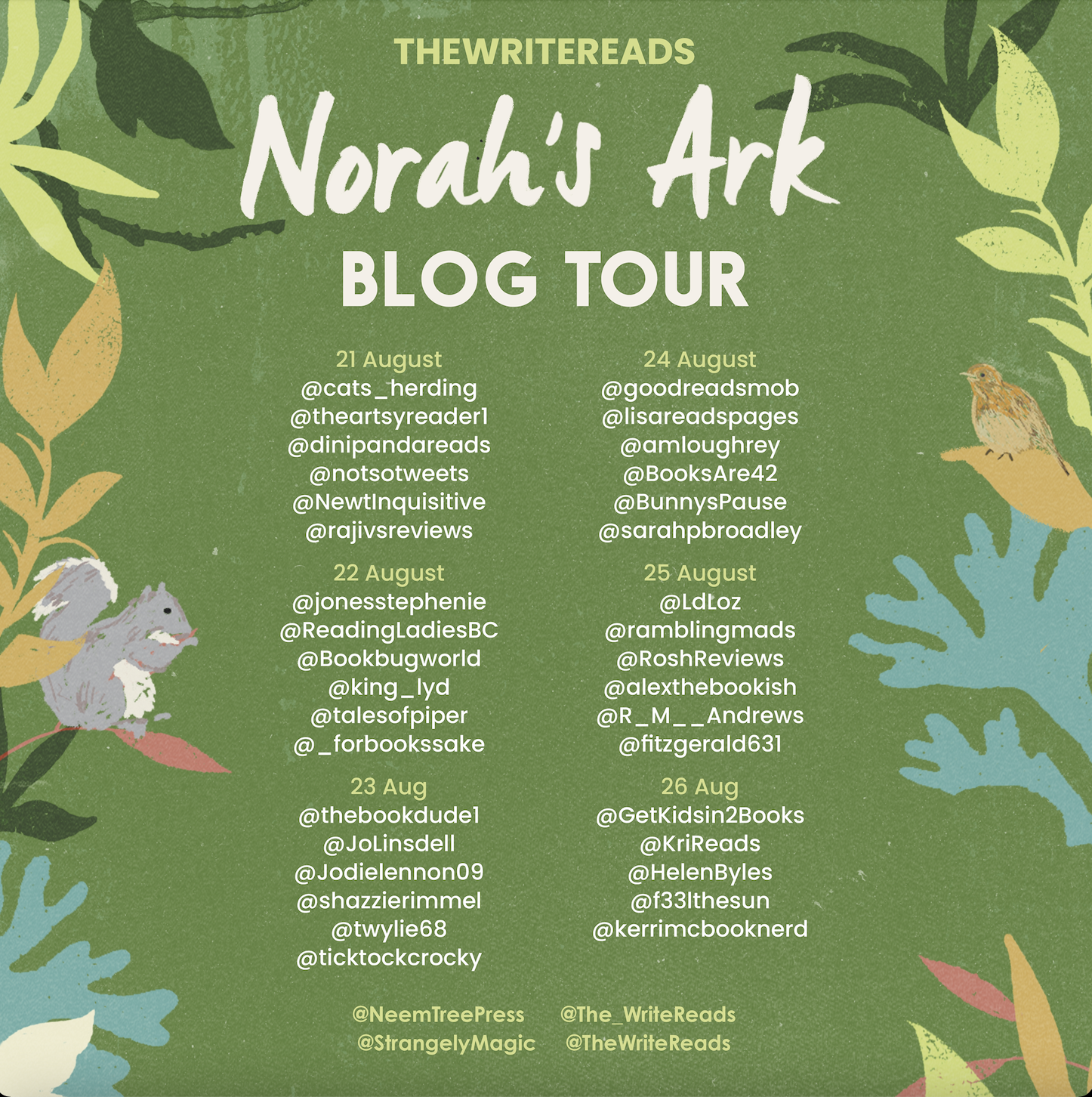
To follow the rest of The Write Reads Ultimate Tour please take a look at the schedule below:



















 Much To Do About Writing