Category Archives: Writing 4 Children

An interview with… Sophie Kirtley

In the latest issue of Writers’ forum I talk to Sophie Kirtley about how she created the fictional worlds in her debut novel, The Wild Way Home, which came out with Bloomsbury in July 2020.

The Wild Way Home tells the story of two very different children: Charlie, who is from our time, and Harby, a boy from the Stone Age. It’s a story of friendship, courage and adventure as Charlie and Harby journey together through the wild green Stone Age forest in search of Harby’s missing baby sister. You can read my review of this mid-grade novel here.

Sophie told me The Wild Way Home was inspired by her own childhood. When she was little she often played with her friends in a wood near where she lived; it was called Mount Sandel Forest. She vividly remembers the feeling of the place – its sense of mystery and seclusion… and wild freedom. Only years later did she realise that in this very forest archaeologists had found the remains of a Stone Age settlement, it was in fact the oldest human settlement in all of Ireland.
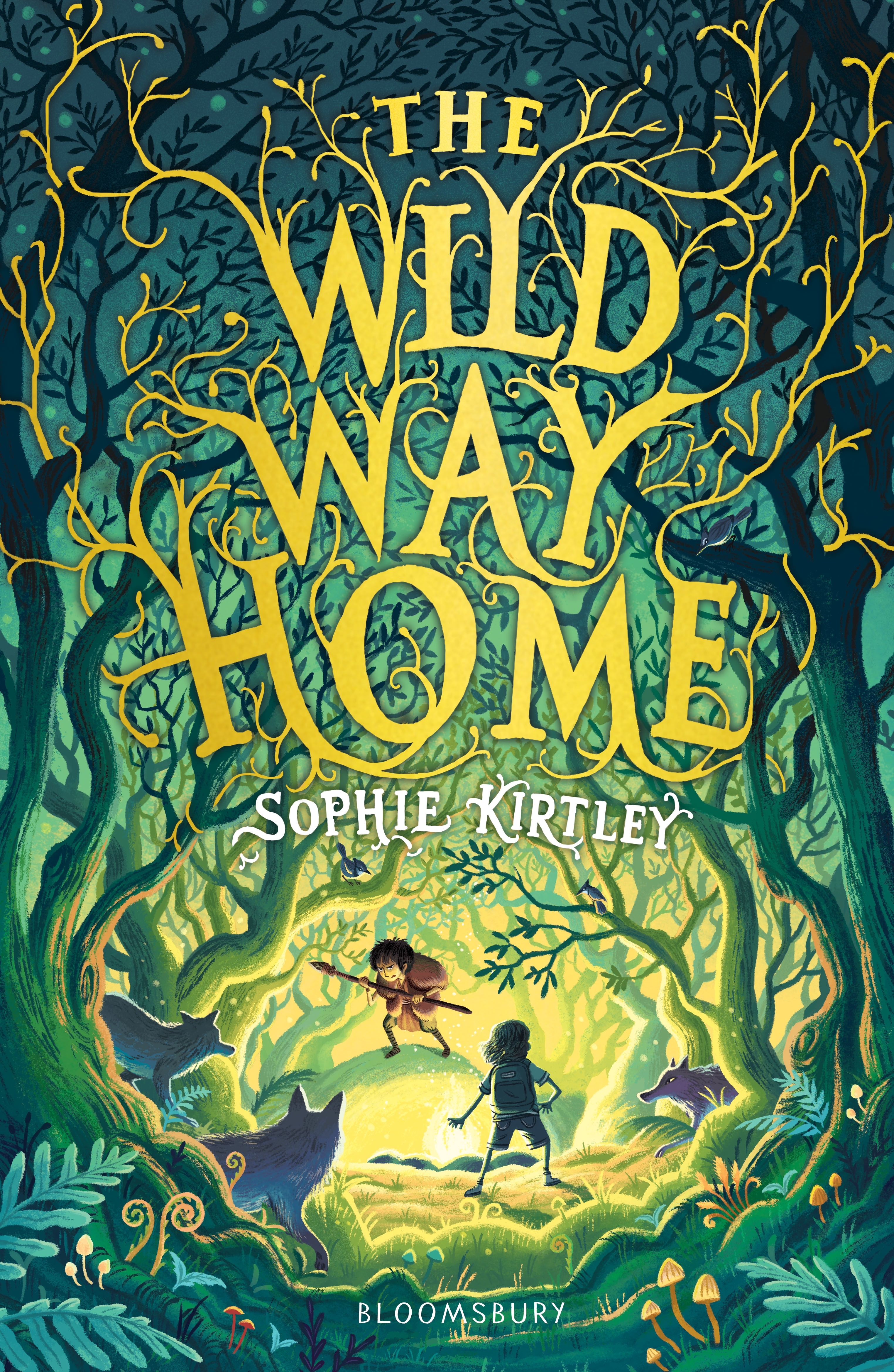
The idea that she’d played somewhere where children had been playing for millennia was the spark which ignited this story; it made her curious about the Mesolithic children who’d played in that forest so many years before she had. She started to imagine what might’ve happened if she’d actually met one of those Stone Age children and that’s how the story-spark ignited and the story-flames raged to become, eventually, The Wild Way Home.

Sophie told me creating a fictional world can be a bit of an overwhelming ask. She explained she works her way outwards from very small details towards creating a bigger picture or building a world. She love interesting objects or strange place names or curious graffiti or fascinating gravestones.

Once something small like this has caught her eye, she let herself interrogate it; asking lots of questions about the possibilities that the small-strange-something might have thrown into her mind.

“Little by little I build all these little details together into something bigger, kind of like creating a story patchwork. In The Wild Way Home I did this with Stone Age small things that fascinated me – artefacts from museums or from ancient sites.

The intricacies of the time-slip elements of The Wild Way Home took a lot of work in order to make the shift in time smooth and believable. The setting of the story really helped me; when Charlie ends up in the Stone Age a lot of the natural features in the landscape remain the same – the river, the cave, the cliff – these physical links plus having Charlie’s consistent narrative perspective helped to carry the story between worlds.”

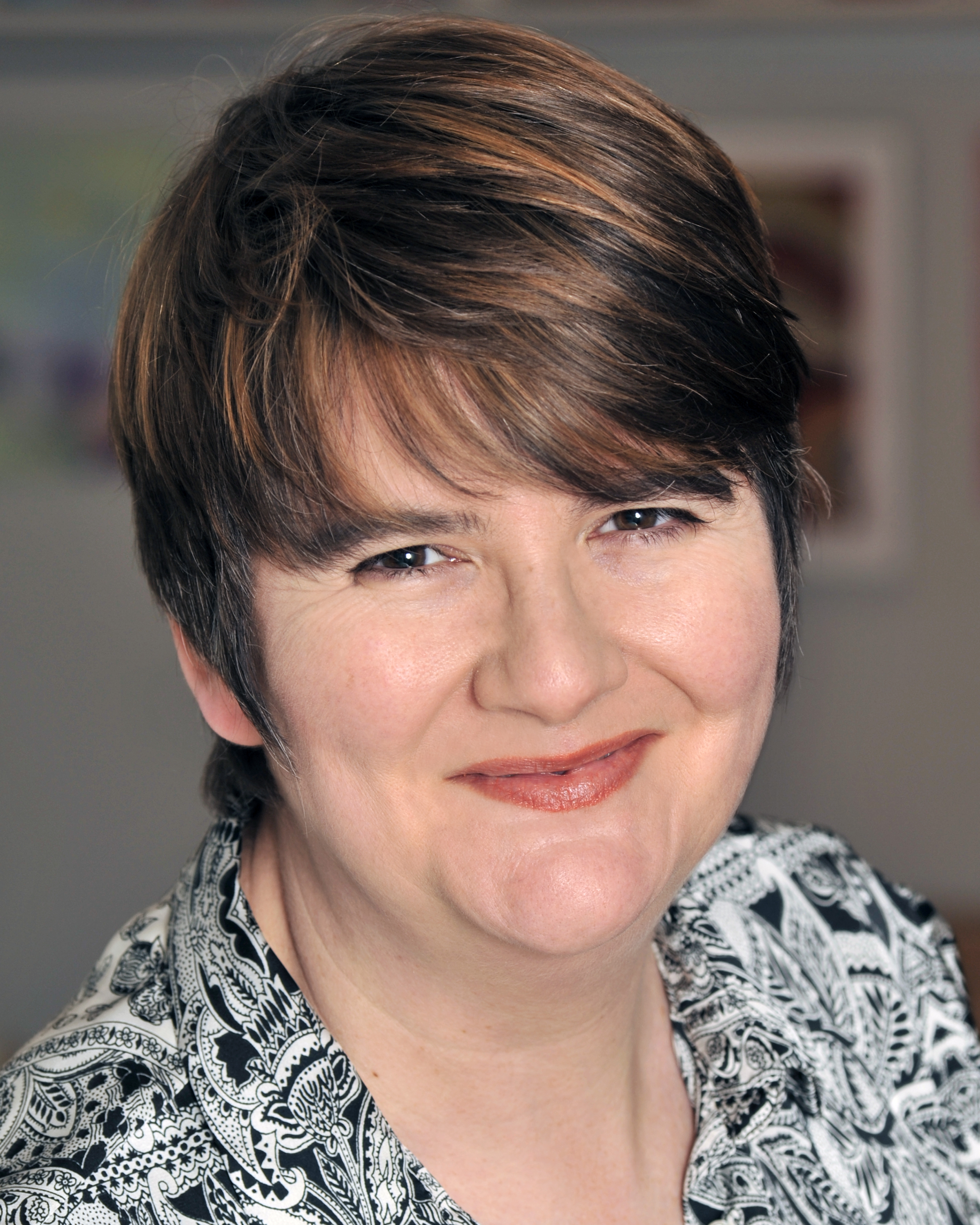
Sophie Kirtley

Sophie revealed writing a book set in a specific period can be tricky. You’ll feel the weight of responsibility to ‘get it right’. She did oodles of reading and researching about pre-historic life, but even within that different sources can offer contradictory angles and Sophie is adamant that you should not to tie yourself in knots with the pressures of absolute accuracy.

“At the end of the day, this is fiction, and we’re writers aren’t we? And we’re definitely allowed to make stuff up. Well that’s what I told myself anyway as I picked through my research, magpie-like, choosing what I found fascinating and eschewing the less fun bits.”

Sophie Kirtley

Sophie explained when you’re writing for children anything really is possible. Children are accepting of adventures in a way that adults aren’t – it’s very liberating as an author. Child readers are also incredibly judicious and deserve the best – they’re a hard audience too, because if they’re not gripped they simply won’t read on. Just like they simply won’t eat peas or cheese or whatever the foible may be. Sophie loves the challenge of writing for children – delivering them something they like the taste of.

If you want to write for children then there are two main pieces of advice Sophie offered: Read and listen. Read as many contemporary children’s books as you can and read them as a writer, learning along the way. Also listen to kids you know, how they talk, what makes them laugh, what makes them grump… or even think back to you as a child and squeeze your big feet back into those small shoes.

And one final thing, writing is always going to have its ups and downs, its good days and bad days. Just keep writing and don’t give up.

You can discover more about Sophie Kirtley on her website: www.sophiekirtley.com and follow her on Twitter @KirtleySophie.

To read the complete feature you can purchase a copy of #230 Mar2021 Writers’ Forum by ordering online from Select Magazines.

To read my future Writing 4 Children or Research Secrets interviews you can invest in a subscription from the Writers’ Forum website, or download Writers’ Forum to your iOS or Android device.
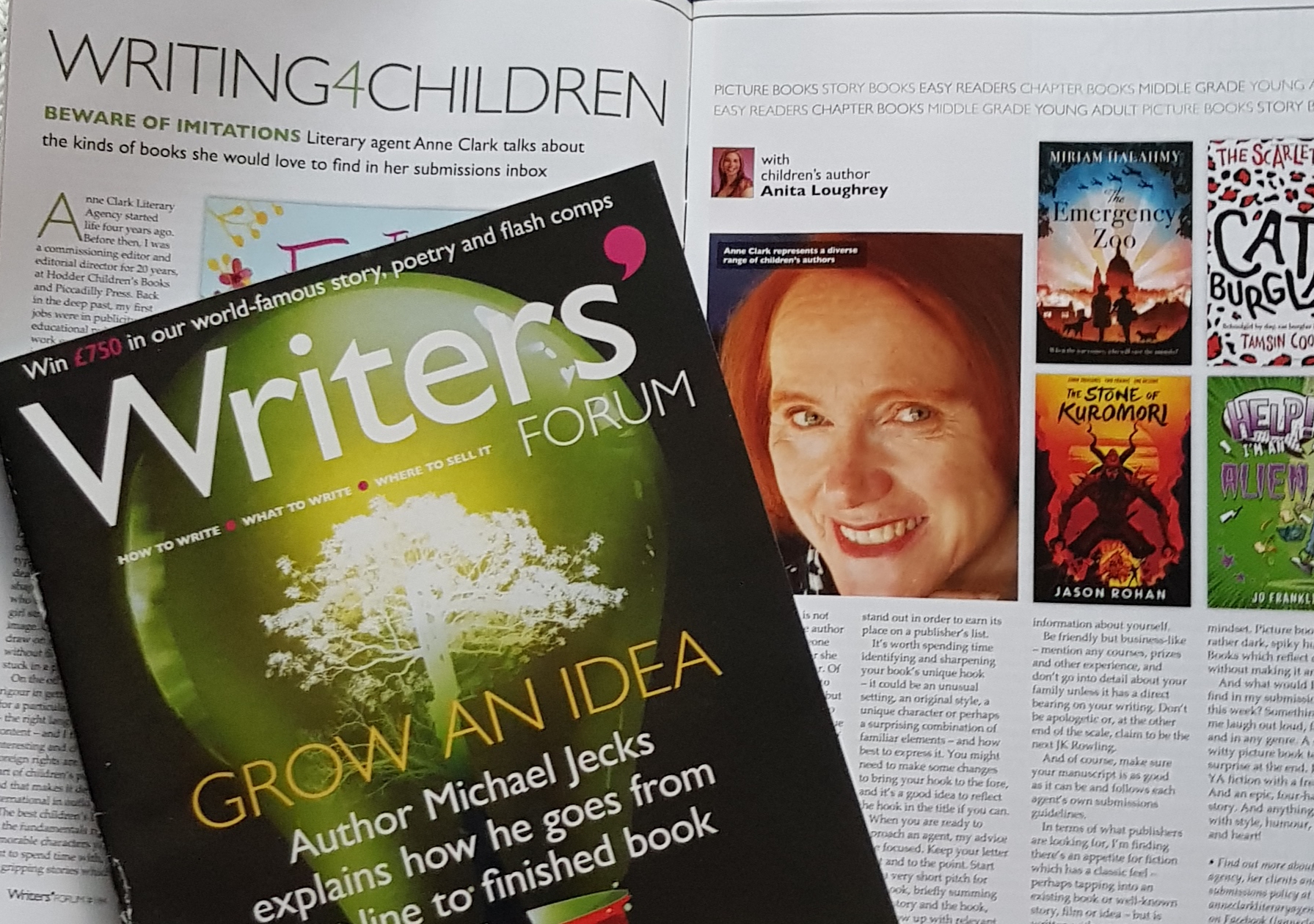
An interview with… Anne Clarke

In February 2017, I interviewed literary agent Anne Clark about her children’s book agency and the kinds of books she would love to find in her submissions inbox for Writers’ Forum.

The Anne Clark Literary Agency started life nearly eight years ago. Before then, Anne worked in children’s publishing as a commissioning editor and editorial director for twenty years, at Hodder Children’s Books and Piccadilly Press. Her first jobs were in publicity and educational publishing.

She told me that she started the agency because it was the right time for new adventure, one which meant she could still do the things I like doing most – working with authors and publishers to get new books out into the world for children and teenagers to read and enjoy.

She explained children’s books are a joy because there is such freedom and variety in terms of subject and style. In a typical morning she might be dealing with a clumsy fairy, a shapeshifting cat burglar, a boy who thinks he’s an alien and a girl struggling with her body image. Children’s writers can draw on magic and fantasy without finding themselves stuck in a particular genre. She enjoys rigour in getting things right for a particular age group – the right language, right content. She said foreign rights are also an important part of children’s publishing giving it an international feel.

Anne revealed the best children’s books get the fundamentals correct: memorable characters you want to spend time with, and gripping stories which keep you turning the pages. Successful children’s authors don’t talk down to kids and they often show young people taking control of their worlds in some way, whether it’s a four-year-old with a tricky witch or a teenager with a bullying boyfriend. They may tackle difficult subjects but they offer hope. Her favourite books also stretch readers’ minds, taking them somewhere new and interesting – maybe to a Tokyo where mythical monsters roam, wartime London or inside the head of a refugee.

“An agent needs to be a talent-spotter, able to spot a promising newcomer at a hundred paces; a nurturer of authors, offering editorial direction, honest feedback and encouragement in wobbly moments; a market expert, in touch with trends and editors’ wish lists and pet hates; a shrewd salesperson; a negotiator of deals; and a champion of her authors.”

Anne Clarke

When she opens a manuscript from a new writer, she first looks for the author’s voice, and that comes over very quickly – in the first few lines and certainly within the first page or two. If she like the voice – if it feels confident, distinctive and fresh – she’ll keep reading. But she won’t be sure I want to work on a project until she has read the whole manuscript, because she is also looking for an author who can shape a whole story and take it to a satisfying conclusion.

Anne’s tip to children’s writers is to spend time identifying and sharpening your book’s unique hook – it could be an unusual setting, an original style, a unique character or perhaps a surprising combination of familiar elements – and how best to express it. You might need to make some changes to bring your hook to the fore, and it’s a good idea to reflect the hook in the title if you can.

When you are ready to approach an agent, her advice is: be focused. Keep your letter short and to the point. Start with a very short pitch for your book, briefly summing up the story and the hook, and follow up with relevant information about yourself. Be friendly but business-like – mention any courses, prizes and other experience, and don’t go into detail about your family unless it has a direct bearing on your writing. Don’t be apologetic or claim to be the next J K Rowling. And of course: make sure your manuscript is as good as it can be; and follow each agent’s submissions guidelines!

Check out www.anneclarkliteraryagency.co.uk to find out more about the agency, my clients and the submissions policy. You’ll find the latest news at www.facebook/anneclarkliterary or twitter at @anneclarklit.

To read the complete feature you can purchase a copy of #184 Feb 2017 Writers’ Forum by ordering online from Select Magazines.

To read my future Research Secrets or Writing 4 Children interviews you can invest in a subscription from the Writers’ Forum website, or download Writers’ Forum to your iOS or Android device.
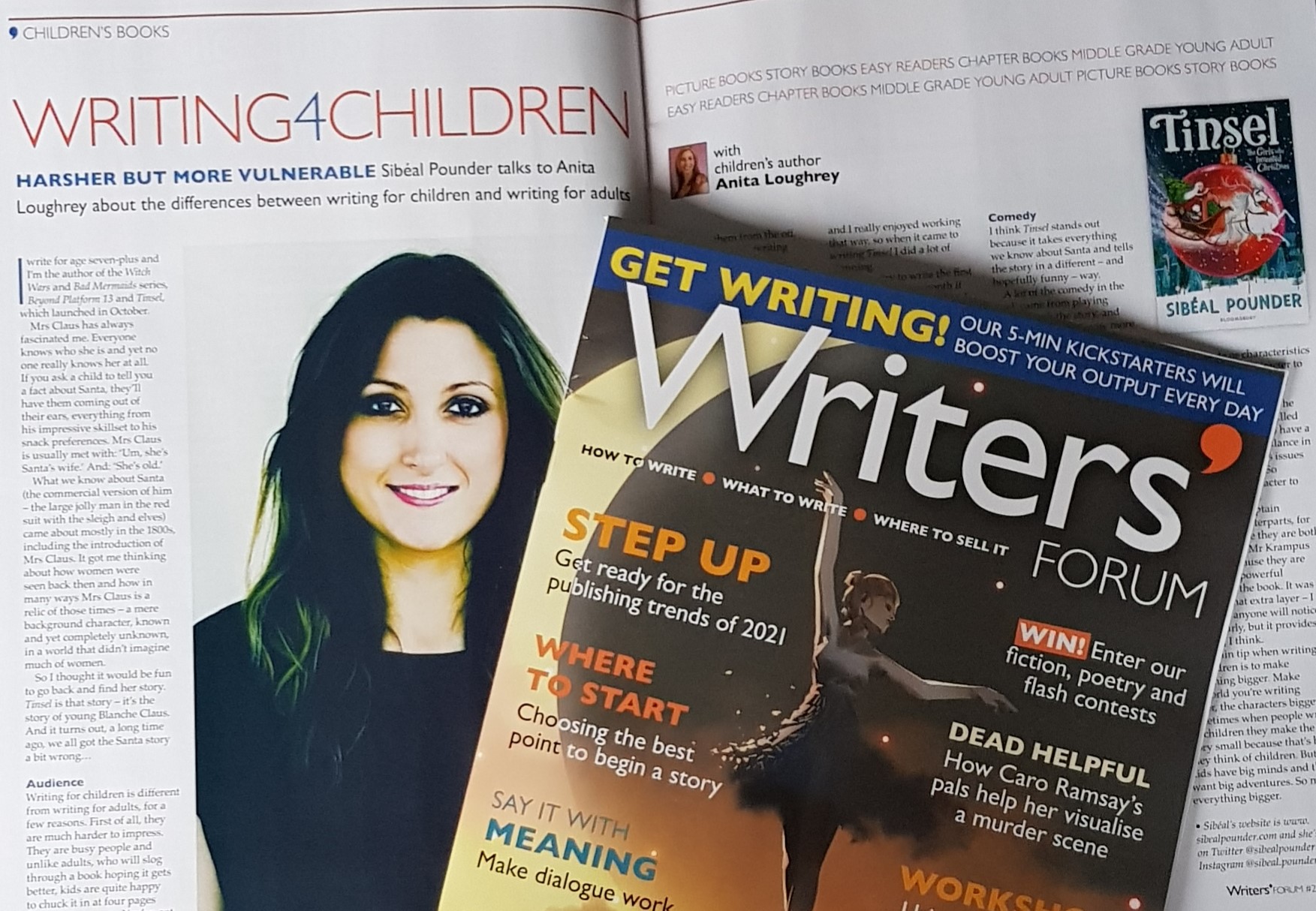
An interview with… Sibéal Pounder

For my Writing 4 Children column in Writers’ Forum this month, I interviewed Sibéal Pounder about the differences between writing for children and writing for adults.

She writes for age 7+ and is the author of the Witch Wars, the Bad Mermaids series, Beyond Platform 13 (which is the sequel to Eva Ibbotson’s The Secret of Platform 13) and Tinsel, which was launched on Oct 29th 2020.

Sibéal explained writing for children is different from writing for adults for a few reasons. First of all, they are much harder to impress. They are busy people and unlike adults who will slog through a book hoping it gets better, kids are quite happy to chuck it at four pages deep and move on. You’ve got to hold their attention, impress and entertain them from the off.

Another reason writing for children is different is they are more vulnerable as readers. I don’t mean that to be patronising, I think kids are often smarter than adults. It’s just when adults read a book we do so with a lot of context about the world already in place. We read with a clear understanding that the author’s experiences and views may inform the content, and we come to it with a robustness and a critical eye.

Adults see books as something they read, children see books as somewhere they go. They learn from what is said and how characters are portrayed, what roles they are given and how they are treated. It’s a huge responsibility to write for children – the stories can shape how they think and feel, and you have to be very careful with that.

Two books I’d really recommend on the topic are Why You Should Read Children’s Books Even Though You Are So Old and Wise by Katherine Rundell. And Sway by Dr Pragya Agarwal, which is about unconscious bias – I found it hugely useful and eye-opening. I’d really recommend it if you’re a writer, especially a writer for children.

Each book presents its own challenges. It doesn’t get any easier! I wasn’t a big planner as I felt it was quite restrictive, but I did plan Beyond Platform 13 in great detail, down to each chapter, because it was an Estate project and Eva Ibbotson’s family and the publisher had to approve the outline before the work began. I found the planning transformative and really enjoyed working that way, so when it came to writing Tinsel I did a lot of planning. She revealed:

“Mrs Claus has always fascinated me. Everyone knows who she is and yet no one really knows her at all. If you ask a child to tell you a fact about Santa, they’ll have facts coming out of their ears – everything from his impressive skillset to his snack preferences. Mrs Claus is usually met with, ‘Um, she’s Santa’s wife.’ And, ‘She’s old.’”

Sibéal Pounder

What we know about Santa (the commercial version of him – the large jolly man in the red suit with the sleigh and elves) came about mostly in the 1800s, including the introduction of Mrs Claus. It got her thinking about how women were seen back then and how in many ways Mrs Claus is a relic of those times – a mere background character, known and yet completely unknown, in a world that didn’t imagine much of women. So she decided to find her story. Tinsel is that story – it’s the story of young Blanche Claus. And it turns out, a long time ago, we all got the Santa story a bit wrong…

I think Tinsel stands out because it takes everything we know and tells the story in a different (and hopefully funny) way. With Tinsel a lot of the comedy came from playing around with what we know now about Santa and having the reader know more than the characters. It’s set over a hundred years ago when the Santa story began and, after delivering the presents, Blanche reads the newspaper reports and exclaims, ‘They think I’m an old-bearded man called Santa Claus?’ Carol the elf assures her, ‘It’ll never catch on.’

Tinsel has quite a small cast (if you don’t count the thousands of elves all called Carol), and I wanted to have a sense of underlying balance in the book as it explores issues around gender bias. So I wanted every character to have a counterpart. Blanche and Captain Garland are counterparts, for example, because they are both adventurers, Mr Krampus and Carol, because they are the two most powerful characters in the book. It was fun to add that extra layer – I don’t think anyone will notice it but it provides a balance, I think.

When writing for children make everything bigger. Make the world you’re writing bigger, the characters bigger. Sometimes when people write for children they make the story small because that’s how they think of children. But kids have big minds and want big adventures – make everything bigger.

To find out more about Sibéal Pounder visit her website: www.sibealpounder.com ofr follow her on Twitter @sibealpounder and Instagram @sibeal.pounder

You can read my future Research Secrets or Writing 4 Children interviews by investing in a subscription from the Writers’ Forum website, or download Writers’ Forum to your iOS or Android device.

An interview with… Peter Kerr

Check out the December 2020 issue of Writers’ Forum, for my Writing 4 Children interview with best-seller Peter Kerr. He talks about how he adapted his screenplay for children into his debut children’s novel, Goblin Hall.

Peter told me that he originally wrote the Goblin Hall story as a 90-minute screenplay before his first book was published, purely on spec as a self-imposed writing ‘exercise’, then he filed it away and forgot about it until transferring old files into a new computer a couple of years ago.

Goblin Hall really exists. It is a large, remarkably well-preserved subterranean chamber that lies hidden beneath the ruins of Yester Castle, near the village of Gifford, about five miles from where he lives in East Lothian. Legend has it that it was built in the 13th century – with the aid of ‘demonic forces’ – by Sir Hugo de Giffard, a Norman nobleman, who, because of his reputation as a practitioner of the ‘black arts’, was dubbed the Wizard of Yester. The legend is well known locally (Gifford’s village inn is even called The Goblin Ha’ Hotel), but has never been used as a basis for a novel until now, although Sir Walter Scott did mention it in his poem Marmion.

When Peter was twelve, he was taken on a visit to Yester Castle by a school chum who lived in Gifford. He told me what little of the ruins that still exist are well hidden by the surrounding woods, and it would have been difficult to find them without a local ‘guide’.

“I was immediately struck by the spooky atmosphere of the place, and I never forgot my immediate thought that it would make a great setting for a creepy movie. That’s probably why it became the inspiration for my experimental screenplay some forty years later.”

Peter Kerr

His idea was that the script would feature two children, a ruined castle and a haunted underground chamber. And as there weren’t any historical ‘facts’ that had to be adhered to, he had a fairly blank canvas to work on. This was not the case when he came to adapt it for the novel. Peter revealed he prefers to go with the flow when he writes rather than have a pre-conceived plan to adhere to. As he had already completed the screenplay he found that for the first time ever, he had an existing storyline to stick to, and a detailed one at that.

“It took a bit of getting used to, but it was a worthwhile exercise and another step on the learning curve that’s always in front of us, no matter how experienced we think we’ve become.”

Peter Kerr

Peter explained the main practical difficulty he discovered in converting the film script to purely narrative form was how to adjust the balance between action and dialogue. In the script, only an outline of the actual scene locations and the physical actions/reactions of the characters was required, with it being left to the film’s ultimate director to provide the visual detail.

To a certain extent the same applied to the dialogue, which was written with a view to it complementing, or being complemented by, what would be seen on screen. In other words, a sort of shorthand was employed in both regards. For example, a simple ‘Yes’ might be all that was needed to answer a question on screen, whereas a fuller response would inevitably be required in the book version.

The other major challenge was presented by the fact that the screenplay involved a lot of quick changes of fairly short scenes, which also meant changes of location and characters. Via sympathetic film editing, this could add to the tension/excitement of the movie. However, this feature could easily have become confusing and annoying to the reader of the book, so great effort had to be put into providing a more expansive narrative without losing the essential ‘pace’ of the story.

Peter’s tip on writing for childrenis to establish the characters of your main protagonists early, and then they’ll help you carry the story forward. But keep an eye on what they get up to. Stay in control, or they’ll lead you a merry dance. He says, the greatest aid to writing is reading. Read, read, read, and not just the type of books you want to write either. But above all, be original. Don’t try to squeeze yourself into other authors’ shoes, no matter how much you admire their style.

To find out more about Peter and his books go to his website: www.peter-kerr.co.uk You can also find him on Facebook @author.peter.kerr and Twitter @AuthorPeterKerr

An interview with… Natascha Biebow

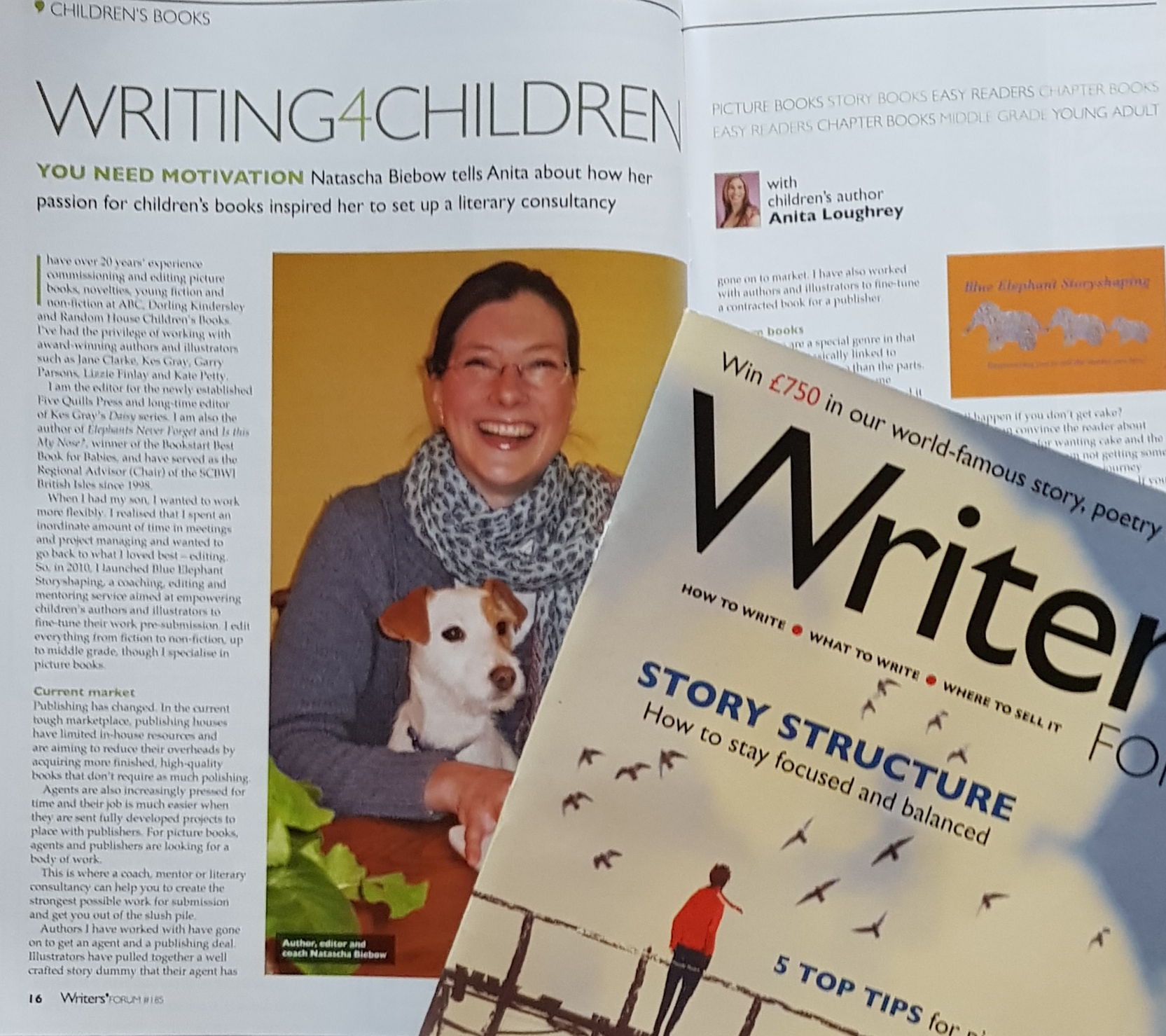
In March 2017, Natascha Biebow talked to me about how her passion for children’s books inspired her to set up the Blue Elephant Storyshaping literary consultancy. The interview appeared in my Writing 4 Children slot in the national writing magazine, Writers’ Forum.

Natascha has had over 20 years’ experience commissioning and editing picture books, novelties, young fiction and non-fiction at ABC, Dorling Kindersley and Random House Children’s Books. She has worked with award-winning authors and illustrators, such as Jane Clarke, Kes Gray, Garry Parsons, Lizzie Finlay and Kate Petty. I am the editor for the newly-established Five Quills Press and longtime editor of Kes Gray’s Daisy series. Natascha is also the author of The Crayon Man: The True Story of the Invention of Crayola Crayons, Elephants Never Forget and Is this My Nose?, winner of the Bookstart Best Book for Babies, and have served as the Regional Advisor (Chair) of the SCBWI British Isles since 1998. 

When Natascha had her son, she decided she wanted to work more flexibly. She realised she spent an inordinate amount of time as an editor at Random House attending in-house meetings and project managing and she wanted to go back to what she loved – editing. So, in 2010, she launched Blue Elephant Storyshaping, a coaching, editing and mentoring service aimed at empowering children’s authors and illustrators to fine-tune their work pre-submission.

“I edit everything from fiction to non-fiction, up to middle grade, though I specialize in picture books.”

Natascha Biebow

Natascha explained publishing is changing. In the current tough marketplace, publishing houses have limited in-house resources and are aiming to reduce their overheads by acquiring more finished, high-quality books that don’t require as much polishing. Agents are also increasingly pressed for time and their job is much easier when they are sent fully-developed projects to place with publishers. For picture books, agents and publishers are looking for a body of work. This is where she can help you to create the strongest possible work for submission and get out of the slush pile.

Authors Natascha has worked with have gone on to get an agent and a publishing deal. Illustrators have pulled together a well-crafted story dummy that their agent has gone on to market. I have also worked with author/illustrators to fine-tune an untitled contracted book for a publisher. You can find lots of testimonials on the Blue Elephant Storyshaping website.

“I get a buzz out of meeting like-minded people who share my love children’s books and story. I get a lot of satisfaction knowing I help to create books that will bring joy and maybe even change the lives of young readers.”

Natascha Biebow

Natascha revealed five of the most common mistakes new writers make when writing picture books include:

  • creating an episodic plot, which reads like a long list of things that happen sequentially with no tension, no clear climax, no story.
  • writing rhyming books that don’t have a strong story at their centre, so that the rhyme dictates the plot and not vice-versa
  • sending work off too early, thinking that writing picture books are short and therefore ‘easy’ to create
  • creating picture books that have no real hook or unique selling point, leaving readers saying, “So what?”
  • not exploring the characters’ true motivation

Natascha is passionate about storyshaping and empowering authors and illustrators to tell the stories they love.

“I work with people at all levels, including published. I am a writer and an editor, so I understand both sides of the business. I love working with illustrators who want to write, illustrators who want to develop a portfolio, as well as authors who are looking to fine-tune their work. I offer courses and 1-1 coaching, creative brainstorming sessions, as well as reviews on manuscripts and honing your pitch for submission.”

Natascha Biebow

For more information about Blue Elephant Storyshaping visit: www.blueelephantstoryshaping.com. Natascha also blogs regularly at Picture Book Den http://picturebookden.blogspot.co.uk and has a monthly Ask a Picture Book Editor column on Words & Pictures www.wordsandpics.org.

An interview with… Sarah O’Halloran

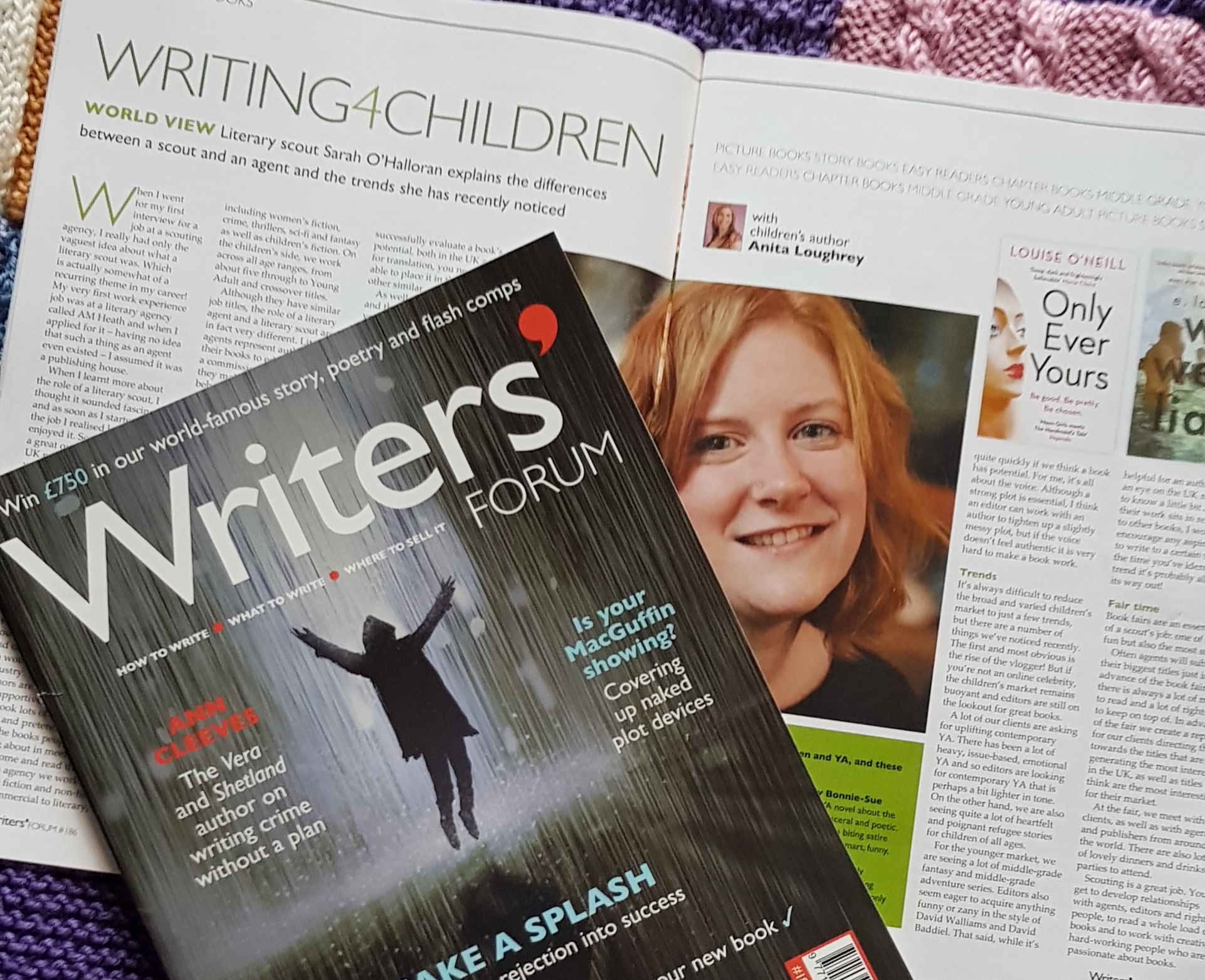
For my Writing 4 Children slot in Writers’ Forum, April 2017, children’s book literary scout, Sarah O’Halloran, explained to me the differences between a literary scout and a literary agent and the trends she has noticed in the children’s book market.

Sarah explained that although a literary scout and a literary agent have very similar job titles, the role of a literary agent and a literary scout are in fact very different. Literary agents represent authors, sell their books to editors and take a commission from any deals they make on their author’s behalf. Literary scouts don’t work with authors at all. Literary scouts work on behalf of foreign publishers, telling them what is happening in the UK market. They work with about a dozen clients around the world and it is their job to help them find titles that might work for them in translation.

In order to do this, a literary scout will develop relationships with agents to discover what authors are submitting, and with editors who will inform a literary scout what they’re receiving from agents. At its most basic, a literary scout will read and report on these manuscripts for their clients, as well as providing them with more general information about the UK book market as a whole. 

“Scouting is a great job You get to develop relationships with agents, editors and rights people, to read a whole load of books and to work with creative, hard-working people who are passionate about books.”

Sarah O’Halloran

There are some similarities between the two jobs. Both jobs rely heavily on building relationships and developing your professional network, and both require you to have a keen editorial eye, a broad understanding of the market, and to read an awful lot.

To be a good literary scout it helps if you can read quickly. It’s also important that you read very broadly in order to develop as comprehensive an understanding of the market as possible. To be able to successfully evaluate a book’s potential, both in the UK and for translation, you need to be able to place it in the context of other similar, competing titles. As well as this, organisation and the ability to prioritise your time are both really important given the volume of material we receive. Finally, you need to be quite sociable and even a little bit nosey.

Sarah revealed her own personal area of interest is teen and YA, and these are some of her favourites:   

  • The Smell of Other People’s Houses by Bonnie-Sue Hithcock is the most beautiful literary YA novel about the lives of four teenagers in Alaska in the 1970s. It is visceral, powerful, poetic, raw and honest and I loved it! 
  • Only Ever Yours by Louise O’Neill is a biting satire about society’s obsession with beauty, and it is exactly the kind of book I love. There are lots of smart, funny, angry feminist voices in YA at the moment and this was one of my favourites.
  • We Were Liars by E.E. Lockhart is a dark, utterly gripping thriller about a family with a dark secret, and it has a shocking and unexpected twist. It was a massive bestseller so I wasn’t the only person who loved it! 

As a literary scout she doesn’t work on projects herself, when she is submitted material by agents or publishers she can often tell if she thinks a project has potential before she has even looked at the manuscript. There are a number of things we look out for in an agent’s submission letter – some of them are more obvious than others – and lots of them are the same kinds of things that agents look out for in the submission letters they receive from authors.   

Sarah told me:

“It may seem obvious but a great title always helps. And if the book can be pitched in a concise and intriguing way that is also very encouraging.  A one or two sentence tag-line is often the way that agents pitch to editors, editors pitch to their marketing and sales teams, sales teams pitch to booksellers, and ultimately the way booksellers pitch to readers, so it’s impossible to exaggerate its importance. For me, it’s all about the voice. Although a strong plot is essential, I think an editor can work with an author to tighten up a slightly messy plot, but if the voice doesn’t feel authentic it is very hard to make a book work.”

Sarah O’Halloran

An agent will often compare a book they are submitting to other books, and if a book is reminiscent of a bestselling author, that suggests that there is a receptive market for that kind of story.

Sarah’s tip to aspiring children’s book writers is that although it’s helpful for an author to keep an eye on the UK market and to know a little bit about where their work sits in relation to other books, don’t try to write to a certain trend. By the time you’ve identified a trend it’s probably already on its way out.

Sarah also revealed that book Fairs are an essential part of a literary scout’s job. Often agents will submit their biggest titles just in advance of the book fairs so there is always a lot of material to read and a lot of rights deals to keep on top of. In advance of the fair a book scout will create a report for our clients directing them towards the titles that are generating the most interest in the UK, as well as titles they think are the most interesting for their market. At the fair, they meet with their clients, as well as with agents and publishers from around the world.

An interview with… Anna Fargher

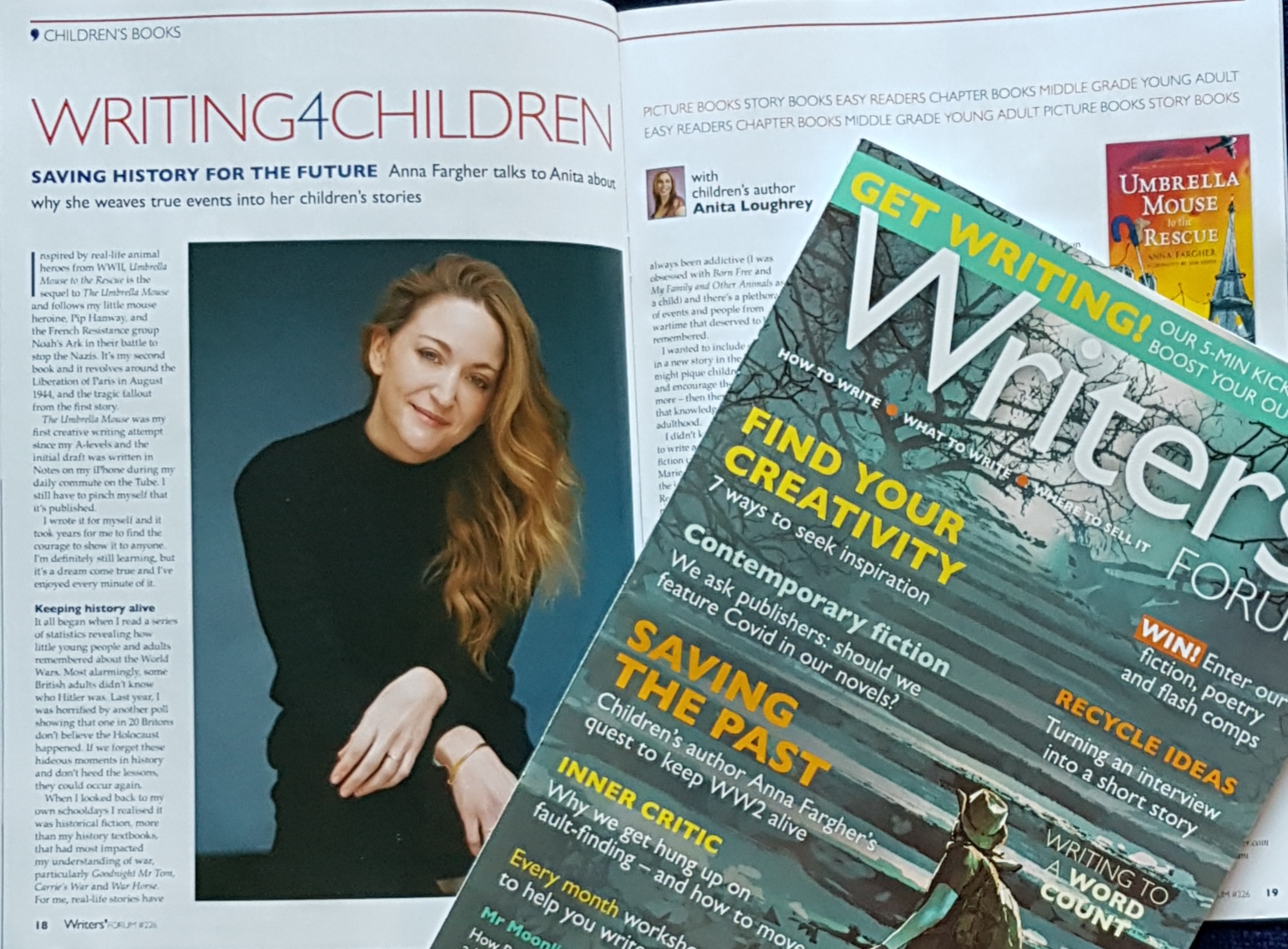
In the November 2020 issue of Writers’ Forum, I interviewed the award winning author of the The Umbrella Mouse duology, Anna Fargher. She explained to me why she weaves true events into her children’s stories.

Anna was inspired when she read a series of statistics revealing how little young people and adults remembered about both world wars. Most alarmingly, she revealed some British adults didn’t know who Hitler was. She was also horrified by another poll showing that one in 20 Britons didn’t believe the Holocaust happened.

“If we forget these hideous moments in history and do not heed the lessons of the past, they could occur again.”

Anna Fargher

For Anna, real life stories have always been addictive (she was obsessed with Born Free and My Family and Other Animals as a child) and strongly believes there are a plethora of events and people from wartime that deserved to be remembered. She realised it was historical fiction, more than history textbooks that had most impacted her understanding of war, particularly Goodnight Mr Tom, Carrie’s War and War Horse and wanted to include some in a new story in the hope it might pique children’s interest and encourage them to learn more – then they could take that knowledge with them into adulthood.

The second book of the Umbrella Mouse duology, Umbrella Mouse to the Rescue, revolves around the Liberation of Paris that occurred in August 1944 , and the French Resistance group Noah’s Ark in their battle to stop the Nazis.

She weaved true events into Umbrella Mouse to the Rescue in a number of ways. Due to the numerous battles that were key in the lead up to the Liberation of Paris, she used dialogue to covey the sense of anxiety and urgency that was felt at the time. She ten visually used key moments from the uprising as part of the rising action.

She told me that the leader of Noah’s Arc, Marie-Madeleine Fourcade’s experiences had a huge impact on the story, thematically. The Gestapo hunted her and her two young children, who she put into hiding to keep safe, and that peril is what drives her in Umbrella Mouse to the Rescue. Betrayal was a constant threat to Noah’s Ark and many of their members were captured and killed due to traitors operating amongst them, and you’ll see it occur in both Umbrella Mouse books.

By giving them characters they care about, Kurt Vonnegut said:

“Be a sadist. No matter how sweet and innocent your leading characters, make awful things happen to them – in order that the reader may see what they are made of.”

Kurt Vonnegut

Anna said, it’s important to give your hero flaws and a universal motivation – something we all want – so their struggles and their drive to succeed are relatable. In The Umbrella Mouse books, Pip is orphaned and alone. She’s grief-stricken and reckless at times. All she wants is to find her last surviving family and get to a place where she will be safe. If we were in her position, we would pursue the same things. Pip never witnesses anything too graphic, but she is placed in wartime environments, such as battles and a prisoner camp that could be too disturbing if she or her friends were human.

“By introducing these difficult emotional subjects, children have the opportunity to learn about tragic times in history, and then they can discuss their feelings with adults, such as parents, teachers or librarians.”

Anna Fargher

Anna’s tip on writing for children is to read as many children’s books you can in the genre you want to write about so you can grasp the conventions and any animal nuances, and you’ll also learn what makes a great narrative arc. But she reminds authors to be discerning. In the words of P.D. James:

“Bad writing is contagious.”

P.D. James

“Writing for children is a joy; some days are harder than others but that’s true in every endeavour. Above all, don’t give up. Discipline and dedication gets books written.”

Anna Fargher

You can discover more about anna and her books on her website: www.annafargher.com and follow her on Twitter: @AnnaFargher and Instagram: @AnnaFargher

An interview with… Isabel Thomas

For my Writing 4 Children column, in the October 2020 issue of Writers’ Forum magazine, I interviewed Isabel Thomas about writing narrative non-fiction for children using her picture book Moth: An Evolution Story as an example.

Isabel explained that Moth: An Evolution Story is a picture book retelling of a classic evolutionary biology case study of natural selection in action. The story of the peppered moth’s adaptation to the environmental effects of the Industrial Revolution here in England. This book is published by Bloomsbury and has recently been released as a paperback.

She told me how she first encountered the story of he peppered moth at university, where she studied Human Sciences, a degree that’s grounded in evolutionary biology. Natural selection and adaptation were introduced onto the primary school curriculum in England quite a few years ago, but Isabel realised children start asking the big questions about life at a much younger age, pretty much as soon as they can talk. Questions like Where do we come from? and Why are there so many different plants and animals?

“I realised the peppered moth story could the perfect way to introduced natural selection and evolution to young children, and indeed to parents who had studied it ages ago and forgotten how it works.”

Isabel Thomas

Her aim was not to create a ‘science non-fiction book’ but a read-aloud narrative that has the power to entrance audiences of any age, and conveys the beauty and wonder of natural history at the same time. Isabel uses the picture book approach to help children make meaningful emotional connections with science, so the desire to understand the world scientifically becomes part of them. Children are familiar with narrative, with the page turn of a picture book, with moments of change and peril and hope. Woven into this familiar fabric, the building blocks of the theory of natural selection aren’t presented as obstacles of hard fact but become almost intuitive for readers as they predict what will happen on the next page turn.

“My top tip is to fastidiously footnote as you go, then you will always have that link back to your sources. Once I’ve amassed information and ideas, it’s a bit like I have a huge pile of Lego bricks. The next stage is beginning to assemble it into something that is greater than these individual parts. Choosing the best way explain or convey my excitement about a subject.”

Isabel Thomas

Isabel suggests writers should try and surprise readers, whether that’s through including the very latest science (rather than sticking rigidly to curriculum-linked content), or in the way you use language, or in the way that connect different areas of life. The way to do this is to surprise yourself, rather than trying to follow a recipe. She stipulates writers aspiring to write children’s creative non-fiction should read a lot of children’s creative non-fiction, as this is the best way to absorb language level and parameters – but don’t imitate.

“Be unexpected and make each pitch and project unique to you, as this is what will grab readers’ (and publishers’) attention. If you can think like an 8-year-old, you’re on the right track.”

Isabel Thomas

Another writing tip from Isabel is not to ‘write for children’ as you will risk ending up with either dry or patronising text. Her suggestion is to write as if you were talking to a friend about something you find absolutely fascinating because a good non-fiction book doesn’t make the reader feel like they’re learning from an expert – it makes them feel like THEY are the expert.

You can find out more about the different types of non-fiction Isabel writes on her online portfolio www.isabelthomas.co.uk or follow her on Twitter @isabelwriting and on Instagram @isabelthomasbooks

An interview with… Michael Lawrence

For the #97 Sept 2009 issue of Writers’ Forum I interviewed children’s book writer Michaew Lawrence. Michael told me he does not like to specialise. His first book for children came out in 1995. Since then he has published around 50 more of various kinds, from first picture books to young adult novels.

Michael Lawrence

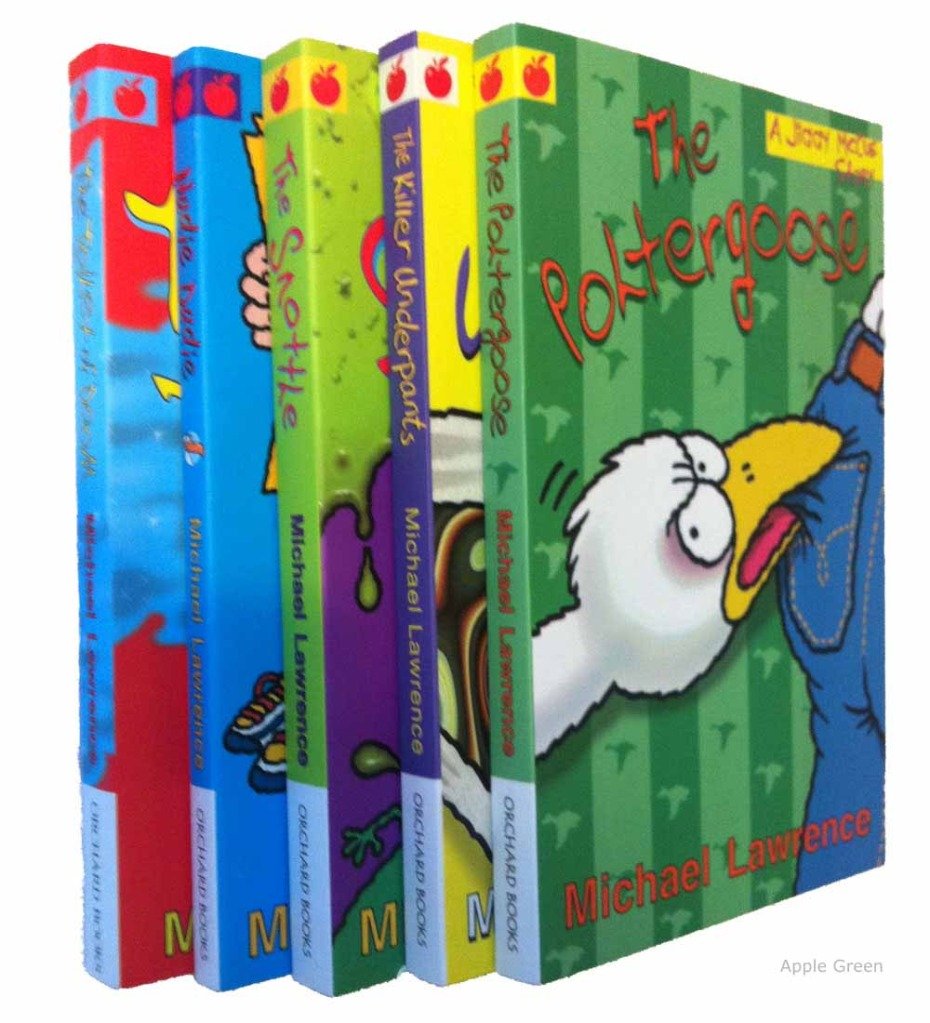
His most popular books are the Jiggy McCue novels, which include The Killer Underpants, the Toilet of Doom, The Meanest Genie and The Iron, the Switch and the Broom Cupboard. He publishes one of these a year.

Jiggy McCue books

Michael explained he does not research the Jiggy McCue stories at all, or even attempt to reflect the times the kids live in to any great extent. Mobile phones, DVDs, famous film stars and so on are mentioned, but Jiggy and Co’s school experiences are essentially his own from over half a century ago. He bases their lessons on the lessons that he still remembers so well, and some of their teachers were his actual teachers he even uses their real names. You might think this would date the books, but Micheal said that children can’t have changed as much as we imagine, because a great many of them write to him to say the books are so much like their world.

Ideas for books often come to Michael in unexpected ways and often in unlikely places. Michael told me that one very wet Sunday in August 2008, he was in Tintagel, Cornwall, walking up the hill to the site of an Arthurian battle re-enactment, when the thought came that Jiggy’s parents might be visiting or taking part in just such a show and Jiggy is either whisked back in time or a knight from the past comes forward into his time. But almost at once he dismissed this as too obvious.

Plenty of bizarre things happen in Jiggy’s world, but time travel seemed unlikely to be one of them. But then he thought, suppose someone very like Jiggy lived in a century when men wore armour, fought with swords and jousted, and by the time he got to the re-enactment the spin-off series idea was born. It will be called Jiggy’s Genes, and each book is about an ancestor of Jiggy’s who bears not only the same nickname as him, but has similar attitudes, in spite of the time he is attached to.

He bought himself a hefty hardback Le Morte d’Arthur, a new copy of Roger Lancelyn Green’s King Arthur and His Knights of the Round Table (fondly remembered from childhood) plus various books and pamphlets about life and conditions in the 15th century and also trawled the Internet for alternative insights.

In the first book Jiggy’s Magic Balls, Thomas Malory has just escaped from gaol and has an idea for a saga about knights, great battles and quests. He asks for Jiggy’s help with ideas. The Arthur that Jiggy points out to Malory is a shifty little pickpocket, and Merlin is a shyster lawyer who specialises in divorce cases. Michael explained Malory uses their names but does something rather ambitious with their characters…

For the second book in the series,Jiggy and the Witchfinder, his 17th century hero meets Matthew Hopkins, the Witchfinder General, who wants to hang Jiggy’s Nan as a witch. Michael told me:

“Any Jiggy book must have a goodly quota of laughs, but the England of the period was beset by war, disease and poverty, and saw the execution of a great many innocent people at the hands of dreadful men like Hopkins, so it hasn’t been easy keeping the story light as well as realistic.” (Michael Lawrence)

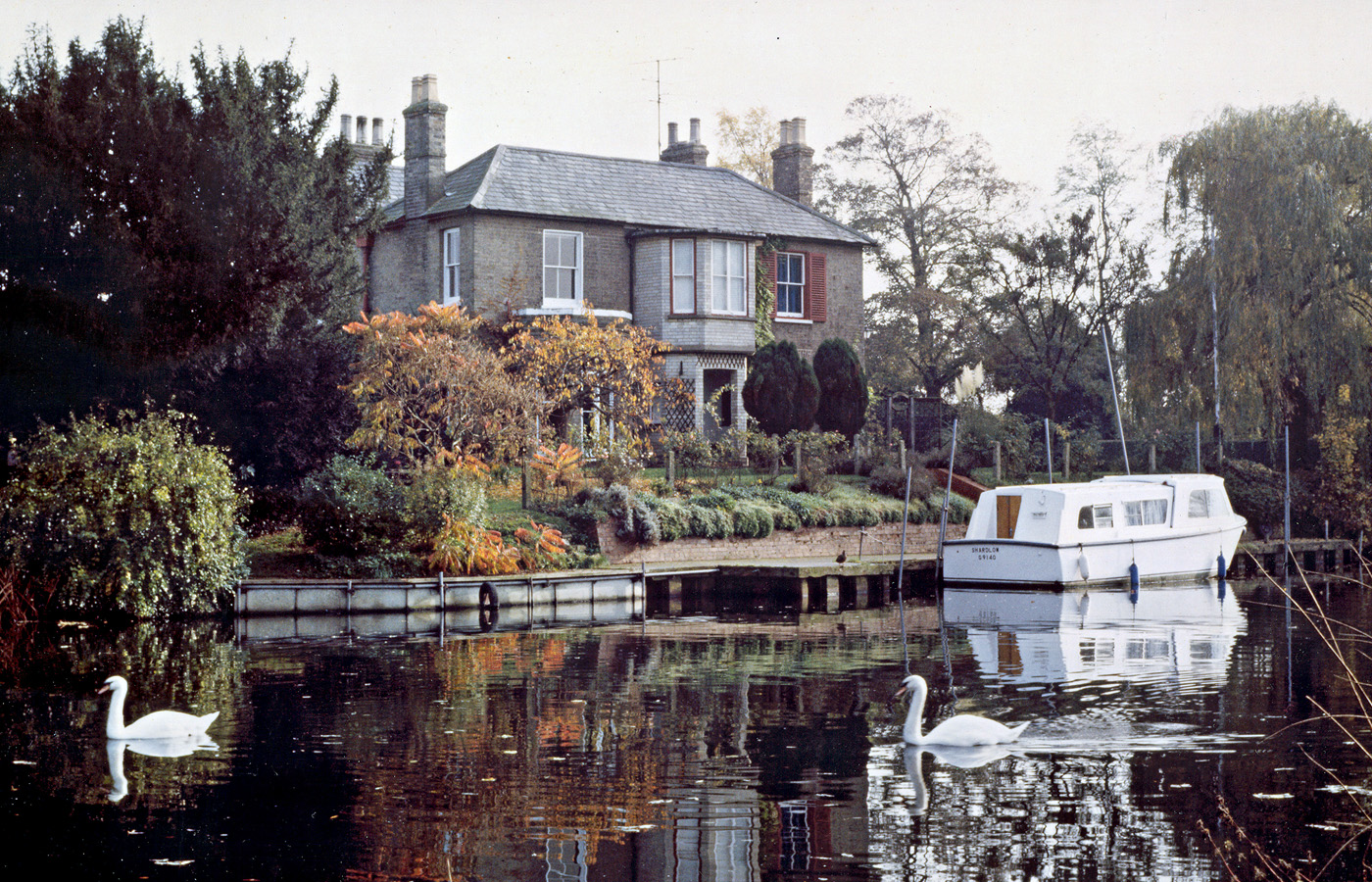
Michael’s trilogy, The Aldous Lexicon (A Crack in the Line, Small Eternities and The Underwood See) and Juby’s Rook are all set in the ruined village of Rouklye, which is based on Tyneham in southern Dorset. He used his first house as the model for Withern Rise in Small Eternities: The Aldous Lexicon 2.

ML's first house (model for Withern Rise in The Aldous Lexicon) (2)

ML’s first house (model for Withern Rise in The Aldous Lexicon) (2)

“My research for the trilogy has been literally life-long, as the setting is the house and village I was born in. In the three years it took me to write the books I returned there constantly, and during the writing my desk was littered with photographs of the house, the stretch of river on whose bank it stands, and the village and attached market town.” (Michael Lawrence)

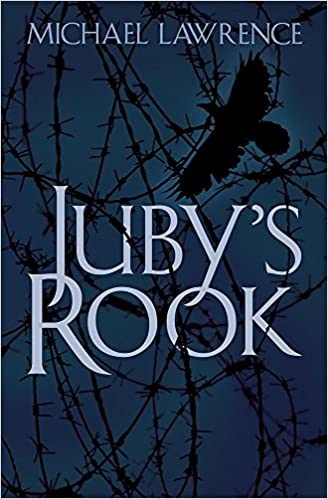
In 1943, Churchill’s War Office requisitioned the Tyneham Valley for troop training and weapons testing, evacuating everyone who lived there. They promised to return it when the war was over but never did, and today Tyneham. It is still ‘owned’ by The Ministry of Defence and is a sad, haunted ruin of a place. Juby’s Rook is set in 1999 and is about an elderly man (Juby Bench) who was a teenager in the village when everyone was turfed out.

jubys rook

He returns every August to take note of the extent of the decay and walk his old haunts. Michael has walked all of these haunts, during which, over several visits, he made extensive notes and took hundreds of photographs. Michael told me the completed book took about nine years to sell. If you haven’t heard of it, it’s because it sank without trace or a single review. Yet Juby’s Rook is one of the books he is most pleased to have got into print.

To read the complete feature you can purchase a copy of #97 Sept 2009 Writers’ Forum by ordering online from Select Magazines.

To read my latest Research Secrets or Writing 4 Children interviews you can invest in a subscription from the Writers’ Forum website or download Writers’ Forum to your iOS or Android device.

An interview with… Jo Franklin

In issue #182 Dec 2016 of Writers’ Forum I spoke to my friend, Jo Franklin, about why she prefers to write about children who feel they are on the edge of society.

Jo Franklinwood_0100

She explained that for most of her childhood she lived on a small farm in rural Sussex with hardly any social life. When she was eleven she was sent to boarding school. It was a very strange combination – the claustrophobic all female environment during term time and the boredom of the farm during the holidays. She never felt that she belonged in either place so felt very isolated. She read books as my means of escape and this led her to Sylvia Plath.

“I totally related to Esther in The Bell Jar. It was a revelation to me that Sylvia Plath could write so openly about her deepest feelings, thinly disguised in a novel and she got recognition for it. I knew that was what I wanted to do.” (Jo Franklin)

Jo joined a creative writing class at The City Lit in London and started putting words down on paper – stories about teenagers struggling with first love and identity; taking bits of her tortured soul and refashioning them into words on paper.

She discovered the important thing about writing for children is to find your inner child and reconnect to it so that your writing is convincing and real. Jo advises authors who want to write for children to ‘write who you are’ as if you can channel some of your own experience into the characters they will be rounder.

Jo found herself writing about characters who are on the edge of the society they live in – tomboys, geeks and outsiders. Some of her misfit characters wonder what they should do to fit into the mainstream. Others are more confident with who they are and the stories show that maybe society should open their hearts to the fringe characters in our world. Exploring the issues that children face is actually a way of exploring your own issues.

In her book, Help I’m an Alien, Dan feels such a misfit that when his sister tells him he’s an alien, he believes her. In Help I’m a Genius (the second title in the series) Dan is so intimidated by the brain power of the rest of his family, that when he is selected to represent the school in a National Brainiac Competition, he is convinced he is going to humiliate himself. He recognises that he doesn’t fit in and the stories explore how he feels about that. I’m interested in the range of emotions that go with searching for your own identity.

Jo doesn’t write specifically for girls or boys as she believes children’s books should be universal . 

“I hope that my stories are accessible to everyone regardless of whether the main character is male or female.They are written with a broader outlook, but publishers sometimes get hung up on which slice of the market they are focusing on selling the books to. My worst fear is a publisher giving one of my books a girlie pink cover. I was a tomboy growing up and I still hate pink.” (Jo Franklin)

Jo told me a great children’s book needs to be written from a child’s heart and soul. The voice has to resonate as true. It doesn’t matter whether a book is funny, exciting or mysterious it somehow has to lead the characters on a thrilling journey of self-discovery and include emotional insight as well as enthralling action. Some of the facts of children’s lives are different now – technology dominates their lives – but they still face the emotional journey we all went through.

Her advice is if you want to give writing for children a go, a good way to start is to work on a memory and see where it takes you. How did you feel the first time you saw your mother/father cry? Remember that time you did something wrong and you passed the blame onto someone else with disastrous consequences? What did it feel like to walk into your new school aged eleven? Choose one of these and write for fifteen minutes. See where it takes you.  Enjoy it. Don’t worry about anything other than your joy at putting words on paper.

The next step is to join a writer’s circle, critique group or creative writing class. It’s a great way to begin learning your craft and meeting like-minded people. Perseverance is the thing which differentiates a published author from the many aspiring but unpublished writers.

You can find out more about Jo Franklin, her books and writing life on her website www.jofranklinauthor.co.uk and follow her on Twitter @jofranklin2

To read the complete feature you can purchase a copy of  Writers’ Forum issue #182 Dec 2016 online from Select Magazines.

To read my latest Research Secrets or Writing 4 Children interviews you can invest in a subscription from the Writers’ Forum website or download Writers’ Forum to your iOS or Android device.