An interview with… Barbara Henderson

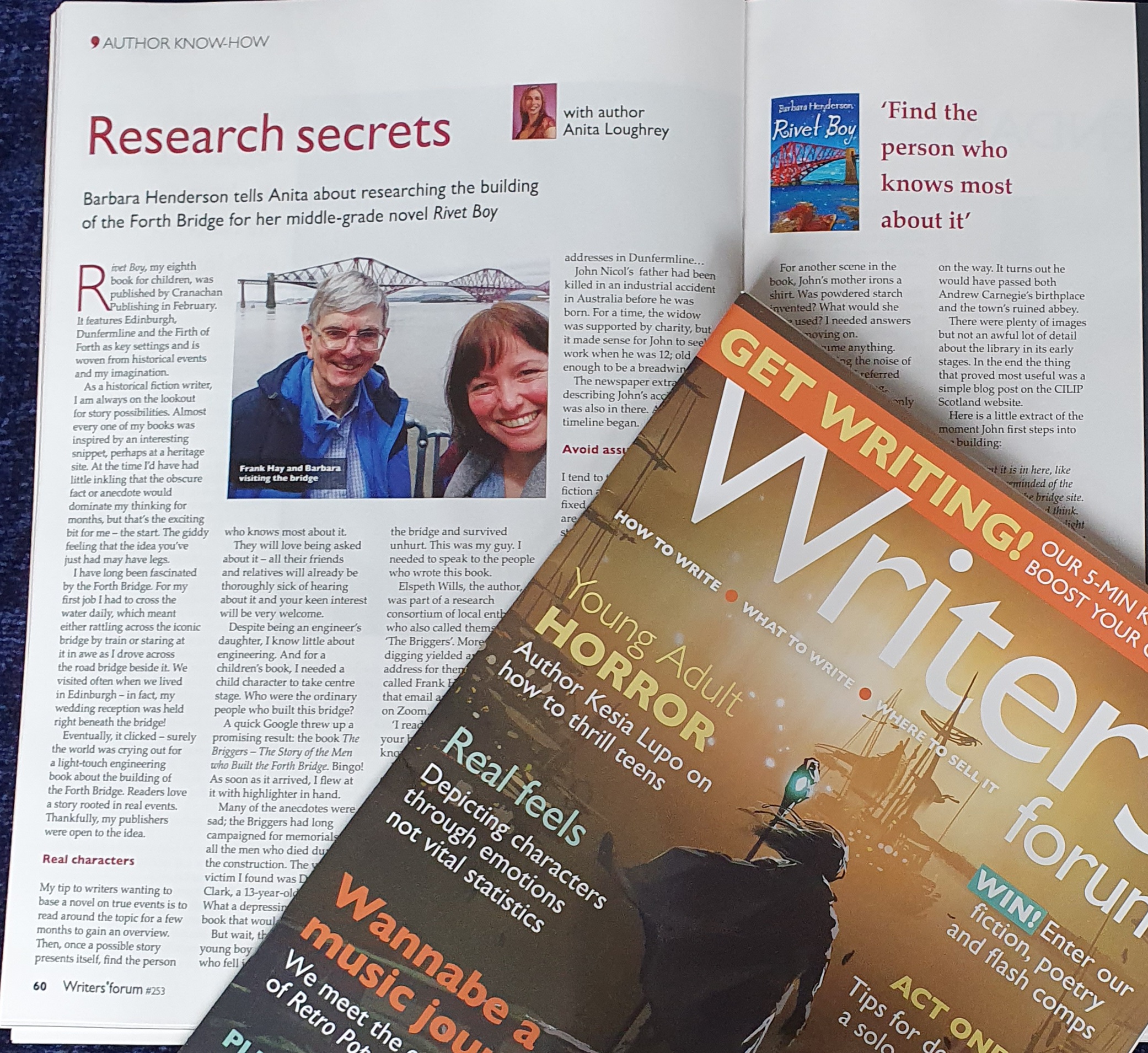
For my Research Secrets slot in this month’s issue of Writers’ Forum #253 19 Apr 2023, Barbara Henderson explained to me some of the research she did into the building of the Forth Bridge to Dunfermline for her middle-grade novel, Rivet Boy

Rivet Boy is her eighth book for children and was published by Cranachan Publishing on 16th February 2023. It features Edinburgh, Dunfermline and the Firth of Forth as key settings and is woven from historical events entwinned with her imagination.

As a historical fiction writer, Barbara is always on the lookout for story possibilities. Almost every single one of her books was inspired by reading an interesting snippet or visiting a heritage site. She told me she has been fascinated by the Forth Bridge for a long time. Her first job was across the Forth. She had to cross the water daily, which meant either rattling across the iconic Forth Rail Bridge by train or staring at it in awe as she drove across the road bridge beside it. In fact, her wedding reception was held right beneath the bridge. She said it eventually clicked – the world was crying out for a light-touch engineering book about the building of the Forth Bridge as readers love knowing a story is rooted in real events.

Barbara’s tip to other writers wanting to write a novel on true events is to read around the topic for a few months to gain an overview. Once a possible story presents itself, find the person who knows most about it. They will love being asked about it – all their friends and relatives will already be thoroughly sick of hearing about their pet interest and your keen interest will be very welcome.

Barbara explained for her children’s book, she needed a child character to take centre stage. So she researched the ordinary people who built this bridge and discovered a book called The Briggers – The Story of the Men who Built the Forth Bridge. However she found many of the anecdotes in this book of young people were depressing, and the Briggers had campaigned long for memorials to all the men who died during the bridge’s construction. The youngest victim she found was David Clark, a 13-year-old who fell and also a young boy called John Nicol who fell into the water from the bridge and survived unhurt, who became her main character.

Barbara hunted down the author, Elspeth Wills and found she was part of a research consortium of local enthusiasts who also called themselves ‘The Briggers’. More online digging even yielded an email address. Frank Hay answered her email and agreed to talk on Zoom. Barbara revealed her most valuable resource turned out to be Frank, and the others who had already studied the subject: ‘The Briggers’. When she asked for more information about John, the boy who survived, Frank spent a few days to look into it for her and sent her a ten-page document: He’d checked the census records, identified the most likely John Nicol, found his birth certificate, his parents’ marriage certificate and his two addresses in Dunfermline.

In addition, he discovered his father had been killed in an industrial accident in Australia before John was born. For a time, the widow was supported by charity, but it made sense for John to seek work when he was twelve, old enough to be a breadwinner. The newspaper extract describing John’s accident was also in there. Barbara was able to use this information to construct a timeline.

“I tend to think of historical fiction as a washing line. Your fixed events and real people are the pegs, pinning the story to the timeline. These are the things that are both true, incontrovertible and relevant to your story. In between, the washing can flutter in the wind of your imagination.”

Barbara Henderson

Construction was big for this particular book, so Barbara had to research the processes. She explained she finds it astounding that these Victorian engineers managed to calculate so accurately without the aid of modern computer technology. Much of the foundation work had to be conducted beneath the water. By the time her main character John begins his work on the bridge, the structure had emerged from the waves, but the fact that she feature so many details and incidents from real life meant that she had to constantly double and triple check that she had my order right.

In an early draft, she had the squirrel Rusty visit John on the bridge from North Queensferry – only to realise that it couldn’t have happened yet because the cantilevers weren’t connected at that point. Her tip is also not to assume anything. When describing the noise of the building site, she referred to a list along the lines of ‘hammering, drilling, scraping and shouting’ – only to be informed all drilling was done in the workshops, some way off and in advance. Many sounds added to the cacophony on the site, but drilling was not one of them.

Research can be a lonely business, as can writing. Her final tip is to join a writing group with similar interests to you. Barbara is part of the Time Tunnellers, a group of five historical fiction writers for children with weekly YouTube videos and blogs aimed at schools and historical fiction readers. Barbara told me she often learns something new from unexpected places – including my fellow Time Tunnellers’ posts.

You can discover more about Barbara Henderson and her books by following her on her website: www.barbarahenderson.co.uk, and follow her on Twitter @scattyscribbler and Instagram @scattyscribbler and @BarbaraHendersonWriter on Facebook.

To read the complete feature you can purchase a back copy of the #253 19 Apr 2023 issue of  Writers’ Forum by ordering online from Select Magazines.

To read my future Research Secrets or Writing 4 Children interviews you can invest in a subscription from the Writers’ Forum website, or download Writers’ Forum to your iOS or Android device.
Book Review: Captain Looroll

Title: Captain Looroll

Written and Illustrated by: Matt Carr

Published by: Farshore Books (an imprint of Harper Collins)

To celebrate the launch of  Captain Looroll  by Matt Carr, I am posting an impromptu book review. When this book came though the post and I read the title I could not help smiling. What a brilliant concept for a picture book. I’ve not seen a picture book so disgustingly funny since Fungus the Bogeyman. Meet Captain Looroll and her arch nemesis Toilet-Troll.

In this brand-new, high octane adventure series, captain Looroll is super strong, endlessly long and brimming with courage. However, stuck in the deadly dull surrounds of the downstairs toilet, heroic adventures could not be further away. All that changes though, when along comes a very stinky villain named Toilet-troll. Together with her band of trusty sidekicks, Captain Looroll must use her 3-play powers to save the world from imminent – and extremely messy – destruction one toilet at a time.

Best-selling author-illustrator takes toilet humour to the limits in this wild rollercoaster of a picture book. Toilet-troll is one dastardly super villain who uses one stinky exploit after the other to implement his devious plan and Captain Looroll have to work together to stop him, proving team work can save the day.

The text is fast moving and the bold comic book style illustrations portray the fantastically disgusting antics perfectly. A great supervillain and loveable hero. I’m sure young children everywhere will love this book.

I would like to thank Sarah Sleath, publicist at Farshore, for sending me a review copy.

You can buy copies of Captain Looroll by Matt Carr from your local bookshop, or online at uk.bookshop.org, an organisation with a mission to financially support local, independent bookshops.

Book Review: The Dark and Dangerous Gifts of Delores Mackenzie

Title: The Dark and Dangerous Gifts of Delores Mackenzie

Written by:  Yvonne Banham 

Published by: Firefly Press

The Dark and Dangerous Gifts of Delores Mackenzie is a tale of identity and one girl’s quest to discover where she fits in. The story opens with a chase and then after the initial adrenaline rush calms right down. Delores is sent to live with her Uncles in the Tolbooth Book Store in Edinburgh, which overlooks a graveyard because her sister, Delilah,  is afraid her powers are getting stronger and she needs the Uncles training to control them. The setting is effectively dark and gloomy creating a truly gothic experience for the reader.

We learn about Delores new home and its occupants. We get to know Delores, her hopes, fears and dreams. The plot is laced with ghostly phenomenon, spooky locations and a whole host of entertaining characters each with their own unique paranormal gift.

Delores herself is a necromancy, which means she can speak to dead people. Her friend Gabriel is a diviner. Her has the ability to read people’s emotions and uses tarot cards to foretell their fate. Prudence is Delores nemesis. She is an illusionist, able to plant suggestions and visions in people’s minds. She takes great pleasure in teasing Delores by making all her food look and taste disgusting. The Bocan are restless spirits that are drawn to Delores power. Maud is a ghost who Delores believes used to be a past student of the Uncles. Delores realises Maud is in danger from the Angel Barguest, who wants to reclaim her life, and vows to help her. In order to succeed all the characters must put aside their feelings and learn to cooperate.

This is an incredibly dark story in places with some excellent tension-filled descriptions, which certainly get your heart pumping. Delores and her companions race to escape Angel Barguest and decipher what exactly is happening. The paranormal elements have been well thought out and utilised throughout the book. We get the impression there is a larger paranormal world out there and the organisation that monitor it are not always successful. We never discover what happened to Delores parents and I believe the book is open to a sequel to delve deeper into these questions.

A dynamic adventure, full of twists and turns with plenty of mysteries to solve. Ideal for readers in Years 5 to 8 who enjoy stories about the supernatural and solving puzzles.

I would like to thank NetGalley for giving me an opportunity to review this book.

You can buy copies of The Dark and Dangerous Gifts of Delores Mackenzie by Yvonne Banham, which was released on April 6th 2023, from your local bookshop, or online at uk.bookshop.org, an organisation with a mission to financially support local, independent bookshops.

An Interview with… Kesia Lupo

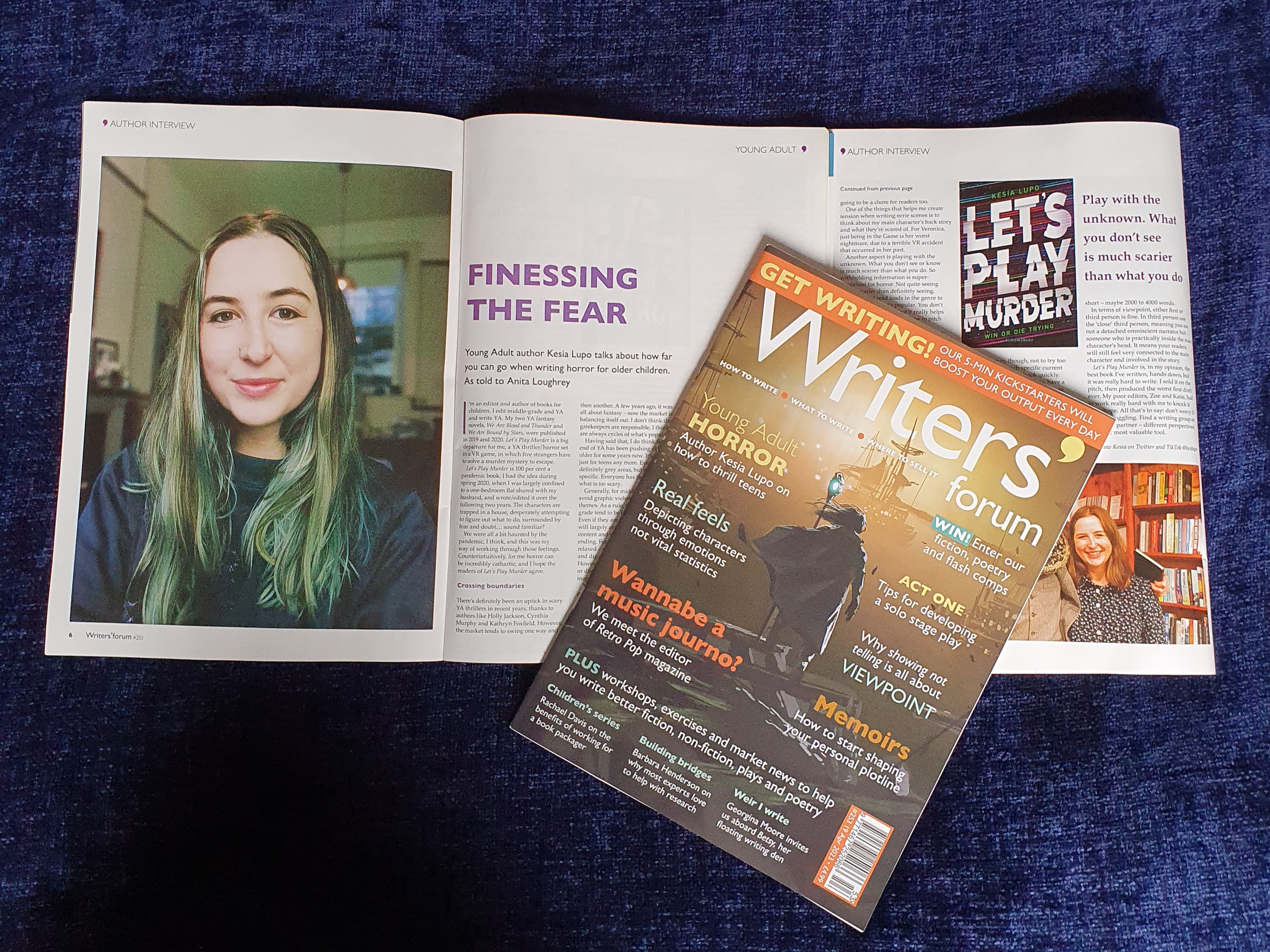
I interviewed Kesia Lupo for this month’s issue of Writers’ Forum #253 19 Apr 2023 about how far you can go when writing horror for children.

Kesia Lupo’s recent novel, Let’s Play Murder, is 100% a pandemic book. Kesia told me she had the idea during spring 2020, when she was confined to a one-bedroom flat shared with her husband, and she wrote/edited it over the following two years. The characters are trapped in a house, desperately attempting to figure out what to do, surrounded by fear and doubt… sound familiar? Kesia explained writing the book was a way of working through the feelings raised by living through a pandemic.

She said there’s definitely been an uptick in scary YA thrillers in recent years, thanks to authors like Holly Jackson, Cynthia Murphy and Kathryn Foxfield. However, the market tends to swing one way and then another – a few years ago, it was all about fantasy, now the market is balancing itself out. Kesia thinks the upper end of YA has been pushing older and older for some years now – it’s not really just for teens.

Even so there are definitely grey areas but it’s difficult to be specific. Everyone has their own sense of what is TOO scary. Generally, for middle-grade, Kesia recommends avoiding graphic violence and disturbing themes. She explained as a rule, thrillers for middle-grade tend to be focussed round a mystery – even if they are murder mysteries, they will largely avoid any truly difficult content and will generally have a happy ending. For YA, the boundaries are more relaxed – you can have violence, death and dig deep into atmospheric horror. However, there is a line: e.g. very graphic or disturbing violence will probably be inappropriate.

Kesia told me you can definitely include blood and gore – as she does in Let’s Play Murder. The first instance is where she describes, in detail, the corpse the players find at the beginning of the game… it’s pretty gross. There are multiple instances of violence on the page, too – for instance when some of the players are attacked by rogue zombies from a different game, or when certain other murders occur. Kesia believes this level of violence is appropriate for readers aged 12+.

The violence is always necessary for the story so isn’t gratuitous, nor is it of a truly disturbing nature, it’s never sexualised, and there’s no torture. Sometimes YA is classed as 14+ so may go a bit darker. Ultimately, if you’re not sure, Kesia suggests it is a good idea to share extracts with your writing group and gain other perspectives – especially if you have teachers/parents of teens to help you.

“One of the things that helps me create tension when writing eerie scenes is to think about my main character’s backstory and what they’re scared of. For Veronica, even being in the Game is her worst nightmare due to a terrible VR accident that occurred in her past. Another aspect is playing with the unknown – what you don’t see or know is much scarier than what you do. So withholding information is super important for horror. Not quite seeing is a lot scarier than definitely seeing.”

Kesia Lupo

Her tip to other writers wanting to keep teens turning the pages is to firstly, keep the story moving: in YA, every scene has to earn its place – no room for filler scenes. If she ever loses steam and finds herself writing a sort of ‘in between’ section, she ask herself: what’s the worst thing that could happen to her character at this time? Then, she makes it happen. Secondly, end every chapter on some kind of cliffhanger so that every time they take a break, your readers can’t wait to pick up the book again. And lastly, make sure YOU are enjoying writing the book. If you’re not, it’s probably going to be a chore for readers too.

“Let’s Play Murder is (in my opinion) the best book I’ve written, hands down, but it was REALLY hard to write. I sold it on the pitch, then produced the worst first draft ever. My poor editors, Zoe and Katie, had to work really hard with me to knock it into shape. All that’s to say: don’t worry if you’re struggling. Find a writing group or a critique partner – different perspectives are your most valuable tool.”

Kesia Lupo

She recommends if you aspire to write thriller/horror books for children should read loads in the genre to get a sense of what’s popular. You don’t want to follow trends, but it really helps to get a sense of voice and how to pitch your story for the age-group. Immerse yourself in the YA worlds. Also, it’s always fun to eavesdrop on conversations if you can, to pick up tips – if you’re sitting in front of a chatting teen couple on the bus, take note of how they interact. Beware, though, not to try too hard – using too much specific/current language will date the book quickly.

If you’re struggling for ideas, have a think about what really scared you as a teen – or even what scares you now. Sometimes it’s not as obvious as ghosts or vampires – it could be ‘being watched’ or ‘feeling trapped’. Can you build a story around that?

For teen or YA readers, kesia suggests 60k-80k as a rule of thumb. In terms of point of view, first or third person is fine – if third person, try to write a ‘close’ third person, meaning you are not a detached omniscient narrator but someone who is practically inside the main character’s head. This means that your readers will still feel very connected to the main character and involved in the story. Chapters should be relatively short – maybe 2k-4k.

You can follow Kesia Lupo on Twitter @keslupo and TikTok: @keslupo and on Instagram Instagram: @kesialupoauthor

To read the complete feature you can purchase a copy of #253 19 Apr 2023 issue of Writers’ Forum by ordering online from Select Magazines.

To read my future Writing 4 Children or Research Secrets interviews you can invest in a subscription from the Writers’ Forum website, or download Writers’ Forum to your iOS or Android device.
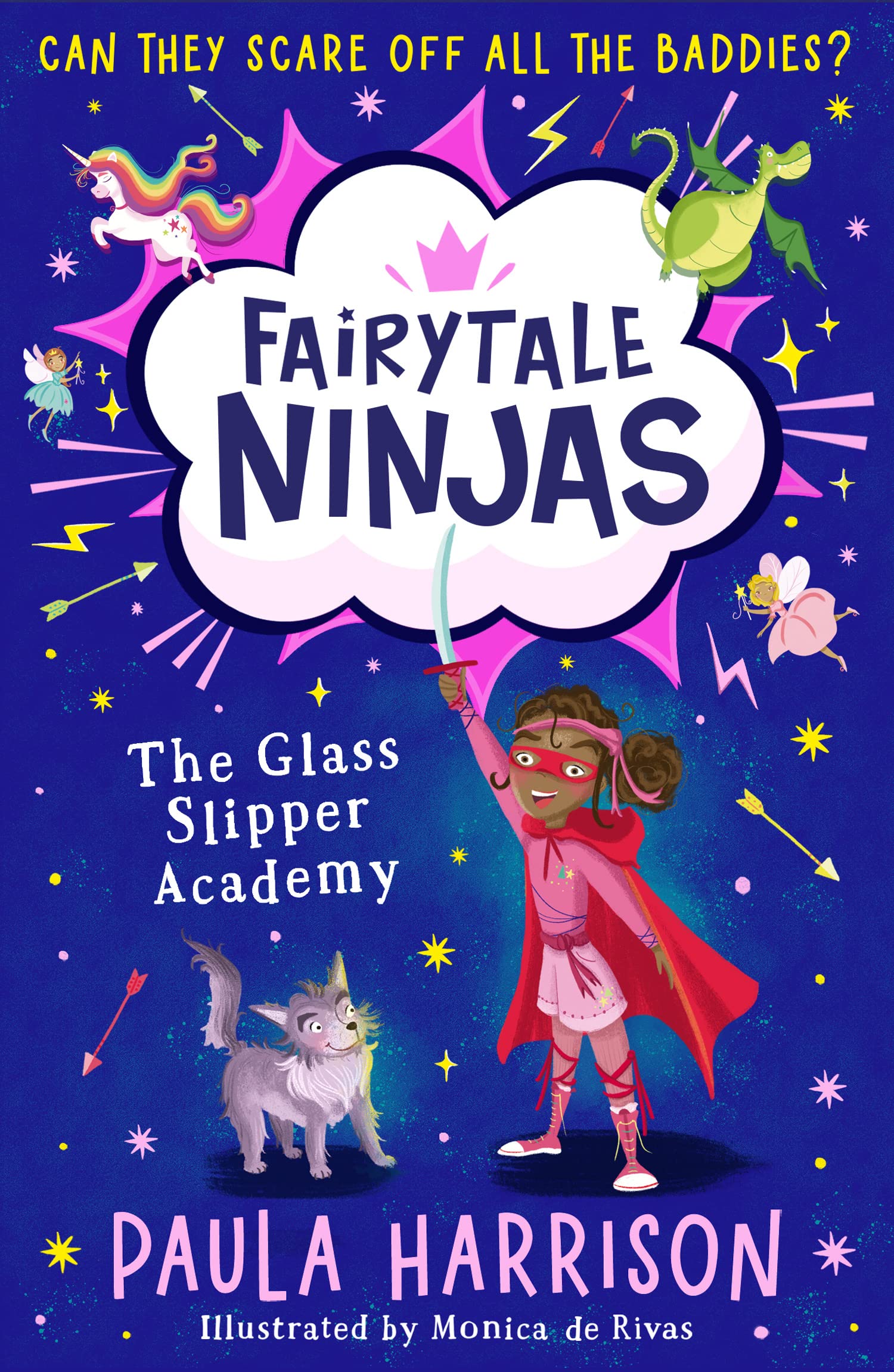
Book Review: Fairy Tale Ninjas – The Glass Slipper Academy

Title: Fairy Tale Ninjas – The Glass Slipper Academy

Written by: Paula Harrison

 Illustrated by: Monica de Rivas

Published by: Harper Collins

To celebrate the release tomorrow, 30th March 2023, I am going to review a fantastic new adventure series form the pen of Paula Harrison. Fairytale Ninjas – the Glass Slipper Academy is a fast romp full of all our favourite fairy tale characters with a few mermaids and unicorns thrown in for good measure. Red Riding reluctantly joins her friends, Snow White and Goldie Locks in attending the local ballet academy. She is bored of dance lessons she would rather be fighting trolls and giants and flying on dragons with fairies. But she should be careful what she wishes for especially when throwing a penny into the broken old wishing well that hasn’t worked for years.

Red makes an incredible discovery – hidden behind a secret door in the ballet studio is a storeroom full of costumes, swords armour and a magic carpet. Her secret discovered, their dance instructor Madam Hart agrees to give them sword-fighting lessons, explaining they are very similar to dance moves. During one of the lessons Madam Hart is arrested for the disappearance of the young Prince Inigo. Join Red, Snow, Goldie and their adorable rescue dog, Tufty as they search for the real villain behind the abduction of Prince Inigo. The intrepid gang travel to Diamond Palace to look for clues with ninja outfits from the storeroom in their backpacks.

I enjoyed this early reader chapter book. It moved at a good pace and the characters were easy to like. It was well plotted with a satisfying story arc. Young children will be excited to find out more about familiar fairy tale characters in new unique circumstances. I feel it is suitable for Key Stage One and lower Key Stage Two readers. The black and white illustrations add more depth to the characters, giving a visual impression of the characters and their actions at a glance, which is perfect for this age range. This is great for emergent readers to read alone, or for the teacher to read to the class and show the pictures, or indeed parents to read at bedtime.

A work of pure genius.

You can buy copies of Fairy Tale Ninjas – The Glass Slipper Academy by Paula Harrison from your local bookshop, or online at uk.bookshop.org, an organisation with a mission to financially support local, independent bookshops.

I would like to thank Isabel Coonjah from Harper Collins for sending me a review copy of the book.

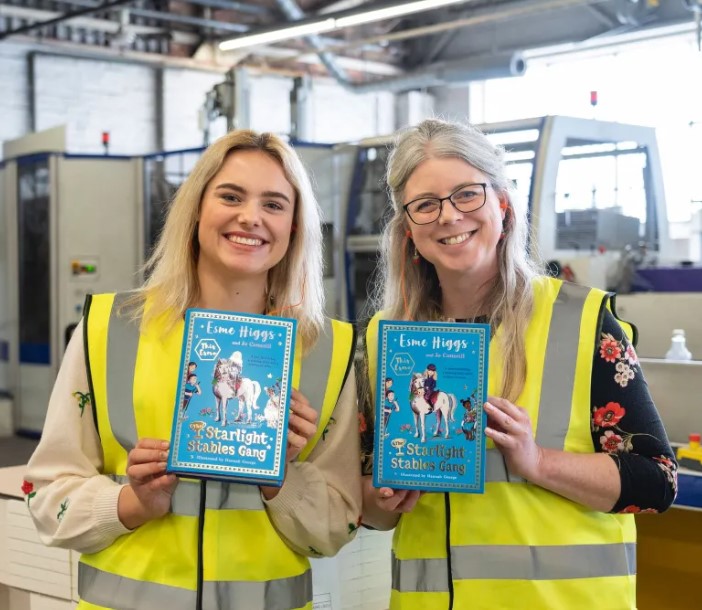
Blog Tour – The Starlight Stables Gang by Esme Higgs, Jo Cotterill and Hannah George

Today is my stop on the blog tour for The Starlight Stables Gang written by Esme Higgs and Jo Cotterill and illustrated by Hannah George.

This is Esme Higgs debut children’s book. She is one of the biggest influencers in the equestrian world – with more than one million followers. She’s a writer, presenter, video producer – and a horse-mad ordinary girl. Her online videos are a mix of tutorials, horse care videos and vlogs about her horses (Mickey, Joey, Casper and Duke) and her life.

She is also a proud ambassador for the charity Brooke, and works closely with other charities such as World Horse Welfare, and the Riding for the Disabled Association.

In contrast this is Jo Cotterill’s fiftieth published book. She has two daughters who make her laugh every day and give the best hugs. She loves the Great British Bake Off and Strictly Come Dancing. When she was younger she studied ballet, jazz and tap dance and would love to have a go at ballroom one day. When she was a teenager, she wrote a lot of music, played flute, piccolo, alto saxophone, piano and violin.

Jo is a multi-award winning writer. She has won: The Hampshire Book Award, the North East Book Award, the Coventry Inspiration Book Award, the Oxfordshire Book Award, the Stockport Children’s Book Award, the Tower Hamlets Book Award and the Fantastic Book Awards. 

The illustrator, Hannah George, works regularly with a variety of publishers and has illustrated several children’s picture books. She loves of drawing and storytelling began at a young age. As a child she carried her sketchbook everywhere capturing all her adventures and mischievous exploits.  

After graduating from Falmouth University in 2005 Hannah set about turning her favourite past time into a career. Her spontaneous use of line makes her style perfect for bringing characters to life. Hannah has worked with a huge range of clients illustrating everything from Alligators to Zebras.

And now for the moment you’ve all been waiting for, the review.

********

Title: The Starlight Stables Gang

Written by: Esme Higgs and Jo Cotterill

 Illustrated by: Hannah George

Published by: Penguin

Summer has always loved horses but she never thought she’d be able to learn how to ride them – not with money being so tight at home. Then she discovers the Starlight Stables where she meets a new gang of friends and learns how to ride in return for helping out with the horses. It’s a dream come true.

Summer falls in love with life at the stables and especially with Luna, a beautiful dapple-grey pony. But one day, Summer arrives at the stables to find that Luna has been stolen in the night. It’s up to the Starlight Stables Gang to follow the clues and rescue Luna before it’s too late.

Suitable for readers ages 7 -11, The Starlight Stables Gang, is the ideal book for all horse enthusiasts. The descriptions of the horses and the feelings of the characters are realistic and their love of horses and the equestrian life jumps off the page. It is a great plot with the ideal mystery to solve. The book opened with Summer’s relationship with Luna and you really felt for Summer when Luna went missing and could not stop turning the pages as they hunted for her and the culprits. The black and white illustrations complimented the text perfectly.

I thought the way Summer’s dyslexia was handled was sympathetic and relatable. There are a whole host of eclectic characters. My favourite is Ellie who is in a wheelchair and loves riding. She does not let her disability hold her back and is always so positive. I found the use of texts between friends great as it breaks up the page and helps even the most reluctant reader to stay engaged with the text. It is also brilliant making technology integral to the plot, as so many children’s books shy away from it but it is a huge part of a child’s life and should not be excluded.

This is a great story about friendship and team work. Perfect for all KS2 classrooms.

********

You can buy a copy of The Starlight Stables Gang by Esme Higgs, Jo Cotterill and Hannah George from your local bookshop, or online at uk.bookshop.org.

To find out more about Esme including links to her channels check out her website at: www.thisesme.co.uk You can discover more about Jo and her books at: www.jocotterill.com and view some of Hannah’s other illustrations at: www.hannahgeorge.co.uk

I would like to thank Blue Rogers at Kaleidoscopic Tours for inviting me to join the blog tour.

An interview with… Alyssa Sheinmel

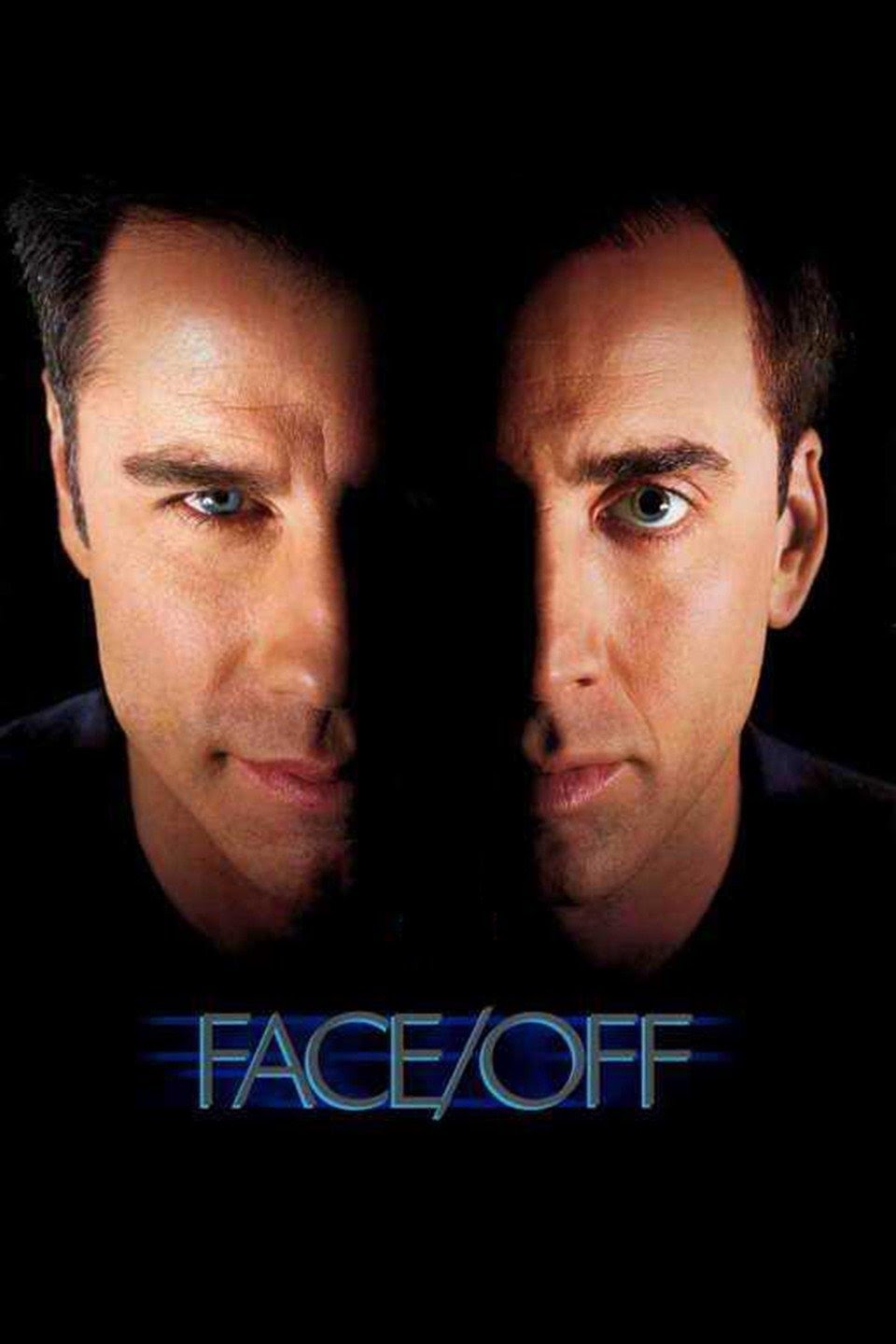
When I heard about Alyssa Sheinmel’s extraordinary research into face transplants for her novel Faceless, published by Chicken House, I was stunned the movie Face Off could have been based on reality. Face transplants are a real thing. Maybe not in the same way as in Face Off but still a possibility.

I was so intrigued to discover more I decided to interview best-selling YA author, Alyssa Sheinmel, for my regular Research Secrets section of Writers’ Forum, issue Aug 2016 #178.

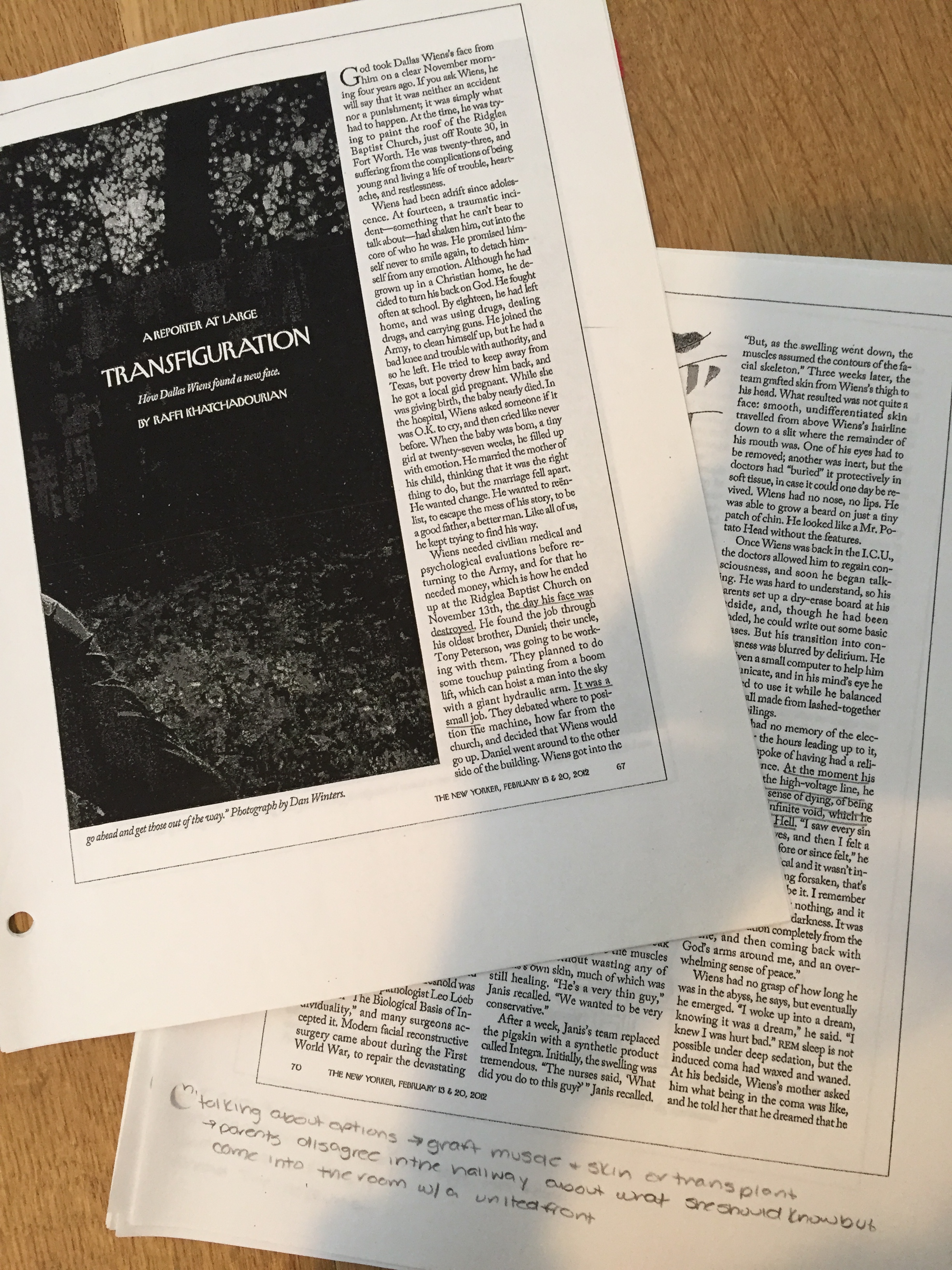
Alyssa told me she knew she wanted to write a book about a girl who was in a horrific accident, a girl who struggled to understand how much of who she was is tied to what she looked like and it was her American editor who suggested a girl for whom a face transplant was her best hope at having a normal life after reading an article in The New Yorker about a full face transplant.

“I’m pretty sure I underlined more of the article than I left blank! My favourite line came from a plastic surgeon, who explained that while other surgeons made you well by taking you apart – by cutting out the parts of you that are no longer functional, that are diseased, that have turned toxic – plastic surgeons make you well by putting you back together. (A version of that explanation made its way into Faceless.)”

Alyssa Sheinmel

She explained she began her research by reaching out to doctors she already knew – her general practitioner, a friend who’d gone to medical school and a friend of her sister who was a plastic surgeon that specialized in reconstruction who answered her myriad of questions.

In particular, she wanted to ensure Maisie’s injuries were realistic. For example, could she have been burned in such a way that she’d need to replace her cheeks, nose, and chin, but retain her jaw? This doctor explained that pretty much everything about these surgeries is unusual, so there were no hard and fast rules. He also provided Alyssa with a detail that really stayed with her: it takes a while for the nerves to grow into transplanted skin, so for a period after her surgery, Maisie’s face would feel like sort of a mask hanging off of her – it might actually feel heavy. This detail made its way into Faceless.

Even so, Alyssa revealed she was worried about taking up these doctors’ time with her incessant questions but found these experts often wanted to talk about their respective fields

“It’s challenging when you’re talking to such ‘important’ people – when I was interviewing a plastic surgeon, for example, I kept apologizing for taking up time that he could be spending with his patients. But he insisted that he was happy to give me his time and answer his questions.”

Alyssa Sheinmel

Like all transplant patients, face transplant recipients are put on immunosuppressive drug regimens. Alyssa revealed her editor had a few doctor and medical student friends who were incredibly helpful with these questions in particular. What were the side effects like? How many pills would she have to take? At sixteen, Maisie has already been told that she can’t carry a child because her medication could cause birth defects. She found what the pills looked like by searching on Google.

Alyssa explained the immunosuppressive regimen became a big part of Maisie’s journey. It’s difficult enough for Maisie that she doesn’t look like her old self, but being on these drugs keeps her from feeling like herself too. She’s tired, nauseated, achy. She’s a former straight-A student who can barely stay awake in class anymore.

For Alyssa there isn’t always a straight a line between my research and the story as everything she reads and watches teaches her something about how to tell a story. She told me as she was writing Faceless, she found herself thinking about stories she’d read and movies she’d seen that – on the surface, at least – didn’t really have much in common with her book. But they still were every bit as helpful as all the articles she read and doctors she spoke to about face transplants. There were also things going on in her life that influenced the story such as, a family member underwent surgery and her stay in the hospital and subsequent recovery impacted on Maisie’s experience, too.

The emotional aftermath of surgery was another one of those times when her unintentional research came in to play. Years ago – well before she started working on Faceless – she watched a documentary called The Crash Reel about American snowboarder Kevin Pearce. Heading into the Vancouver Winter Olympics, it looked like nothing would stop Kevin from bringing home a medal (except possibly, his long-time rivalry with fellow-snowboarder Shaun White). But during practice one day, a horrific crash sends Kevin to the hospital, where he’s treated for a traumatic brain injury. All Kevin wants to do is get back on his board, back to the life he knew before – but his friends and family are worried that snowboarding again could kill him.

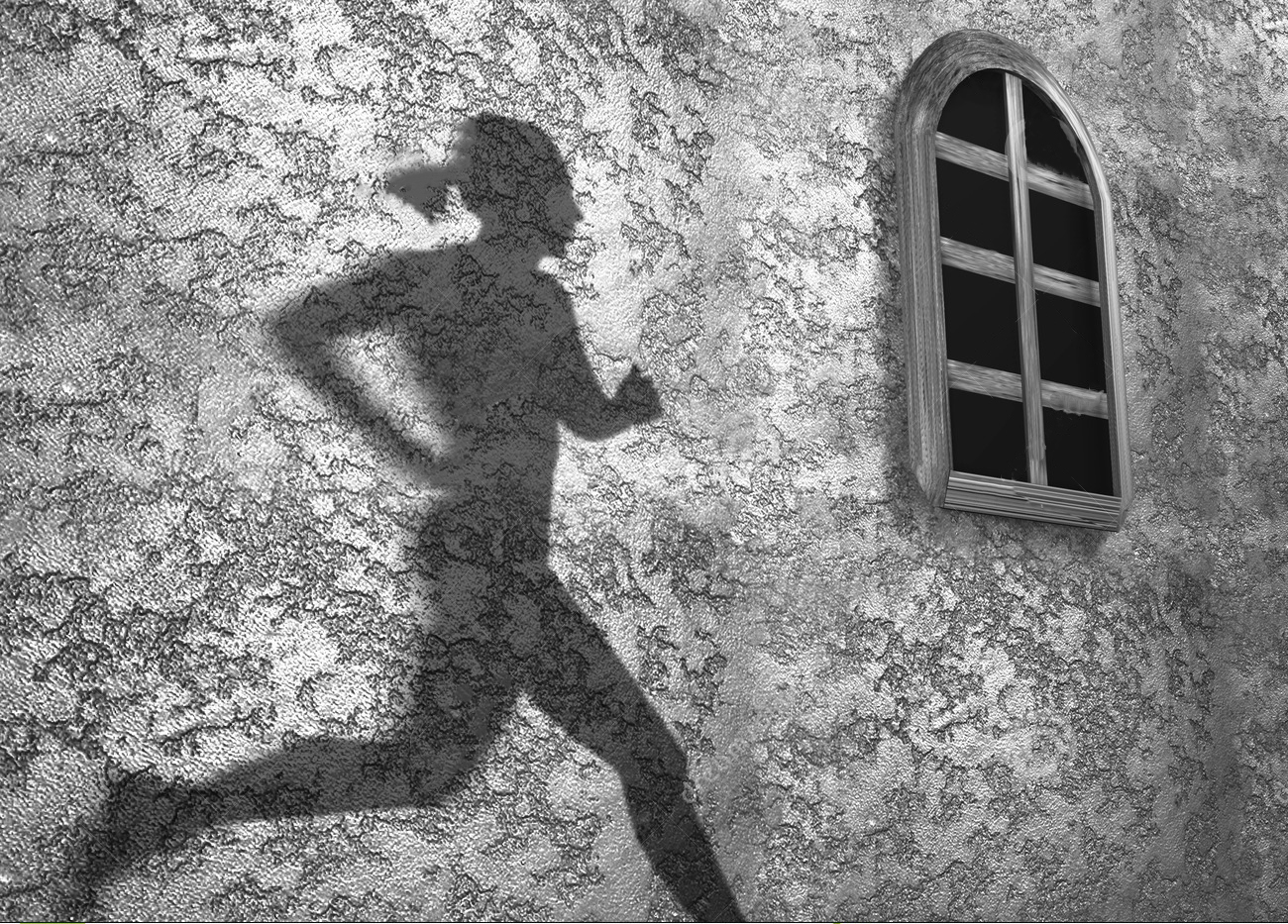
In Faceless, Maisie was a runner before her accident – she ran track on her school’s team, she ran alongside her boyfriend, she ran for fun. Running was a huge part of who she was, part of how she defined herself – and after her procedure, she can’t run the way she used to. In fact, she might never be able to run again. Just as Maisie has to give up running, in The Crash Reel, Kevin Pearce has to come to terms with his new reality – a reality that might not include snowboarding.

Another piece of unintentional research helped her with the aftermath of Maisie’s accident – a novel called The Ice Queen by Alice Hoffman, which I read years ago as well. It’s the story of an ordinary New Jersey librarian to whom the extraordinary happens: one day, she’s struck by lightning. Afterwards, the world looks different – literally: she can no longer see the colour red. Though Hoffman’s protagonist doesn’t have much in common with Faceless’s main character, Maisie (other than the fact that each have a run-in with lightning), they’re both characters whose lives are changed by somewhat random events, and they have to come to terms with a new normal.

“When I was a freshman in college, my psychology textbook taught me how to insert humour into a dry topic. Magazine articles have prompted (sometimes completely unrelated) story ideas. And certainly, when I watched a documentary about snow-boarding a few years ago, I had no idea it would someday influence a novel I wrote about face transplants.”

Alyssa Sheinmel

Alyssa’s tip to other writers when researching is to keep an open mind. She explains you never know where your next idea will come from, which book or article or essay will help you learn how to tell your story. Just keep your eyes and ears open, and learn as much as you can.

You can find out more about Alyssa Sheinmel on her website: www.alysasheinmel.com and follow her on Twitter: @alyssasheinmel.

To read the complete unabridged feature you can purchase a copy of the Aug 2016 #178 issue of Writers’ Forum by ordering online from Select Magazines.

To read my future Research Secrets or Writing 4 Children interviews you can invest in a subscription from the Writers’ Forum website, or download Writers’ Forum to your iOS or Android device.

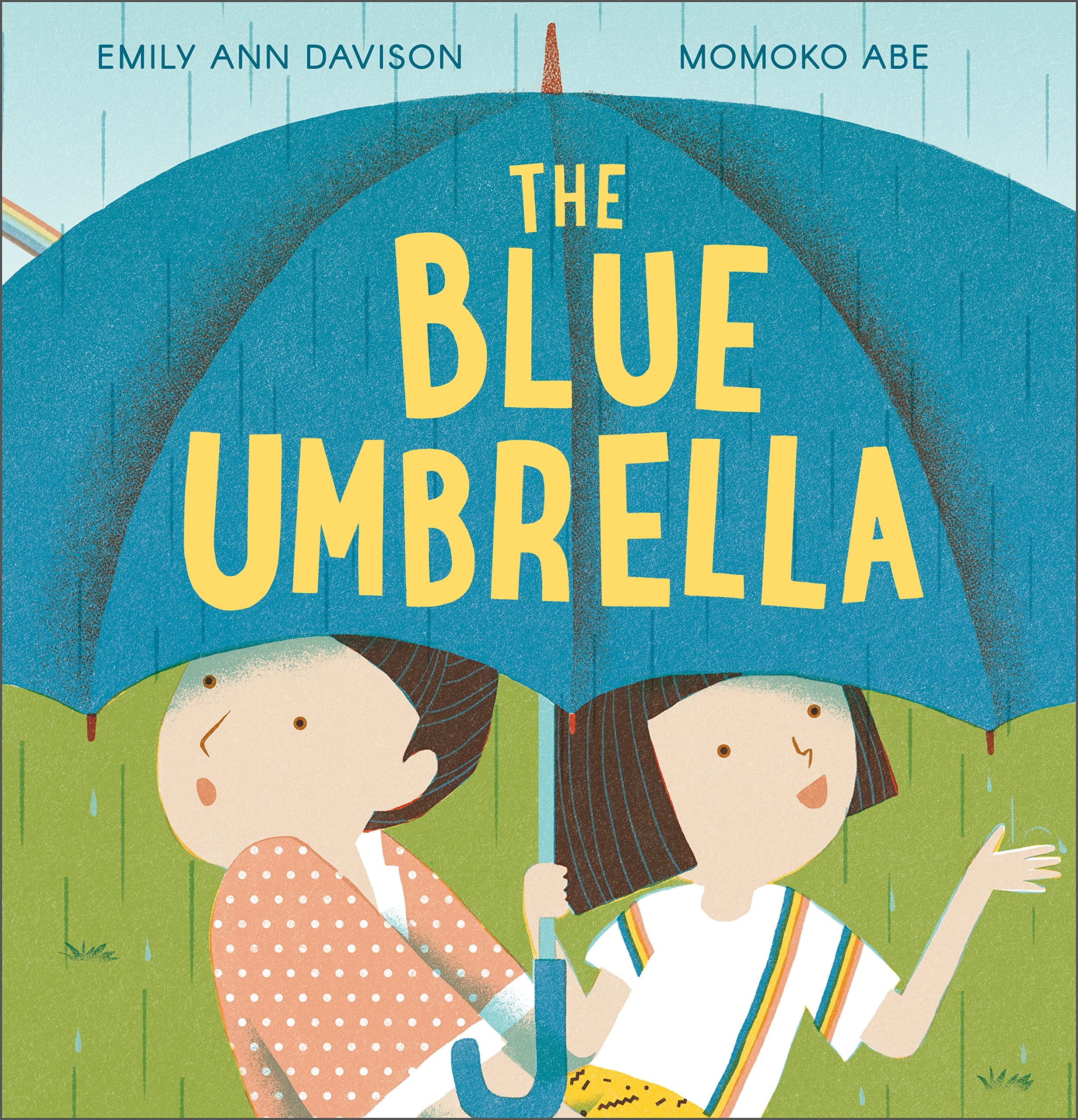
Book review: The Blue Umbrella

Title: The Blue Umbrella

Written by: Emily Ann Davison

 Illustrated by: Momoko  Abe

Published by: Anderson Press

The Blue Umbrella by Emily Ann Davison and Momoko Abe is a beautiful picture book with a theme of sharing. The pastel colours give the illustrations a satisfying sense of calm. Written in the first person it is unclear whether the main character is male or female and it could easily have been either. I liked this but for the for ease of writing this review I decided to identify them as a girl.

A blue umbrella turns up on the doorstep and all that is on it is a note saying, ‘For you’.

So our young protagonist takes the umbrella for on a walk to the park with her mother even though it is not raining. Lucky she did as it starts to rain. She realises that if she suggests her mum shelters under the umbrella with her it would mean she would get wet as there would not be enough room for both of them but she suggests it anyway. This is a truly selfless act and sets the tone of this elegant picture book.

To her surprise they both fit and she believes the blue umbrella has grown bigger to accommodate them both. Soon they are both inviting more and more people to shelter under the blue umbrella. The umbrella grows bigger and bigger to keep everyone dry.

The people have fun sharing stories and their picnics under the blue umbrella. They do not even notice when the rain stops. Being sociable, chatting to each other and making new friends opens up the world to new possibilities. From this date they come together as a community. The park becomes a gathering place to meet up and escape isolation. This is such an important message and will hopefully encourage people to be more caring and climb out of their bubbles the recent pandemic left us with.

The message is one of hope for the future.

To read my review of another of Emily’s picture books please take a look here: Book Review: Every Bunny is a Yoga Bunny

You can also read my author interview with Emily on my blog here: An interview with… Emily Ann Davison.

You can buy copies of The Blue Umbrella by Emily Ann Davison and Momoko Abe and Every Bunny is a Yoga Bunny by Emily Ann Davison and Deborah Allwright from your local bookshop, or online at uk.bookshop.org, an organisation with a mission to financially support local, independent bookshops.

An interview with… Naomi Gibson

Every Line of You by Naomi Gibson and published by Chicken House, is about a lonely girl who creates her own artificial intelligence (AI) to love her. In the 24 Mar 2022 #242 issue of the national writing magazine Writers’ Forum, I interviewed Naomi about her inspiration and writing process for this YA psychological thriller.

The inspiration for Every Line of You struck in a writing class at a local college. One evening we were given lucky dip bags with items in and asked to create a character based on those items. Naomi’s had a mini screw driver, an adaptor – things like that which she decided belonged to a teenage hacker, and that’s how Lydia was born.

All the drafts

“The class left me so inspired I went home and I did a lot of character prep. I knew Lydia inside out so when I sat down to write, the plot came naturally to me because I knew what she wanted and what she feared. Then I wrote and wrote, sometimes until three in the morning, and didn’t stop until two weeks later when I had a first draft of around 60,000 words. I completed this first draft in a hot and messy two weeks back in 2017. I ended up re-drafting about seven times.”

Naomi Gibson

Naomi uses this method for all her books she told me as I long as she knows the character backwards, the plot drives itself. She prefer to write first thing in the morning rather than pulling an ‘all-nighter’ as ideas percolate whilst she sleeps and when she wakes up it feels like her brain has sorted through it all, making for an easier writing session.

She told me she didn’t set out to write a book about artificial intelligence – the book was driven by her main character. Lydia is bullied at school and overlooked at home, and she pours all of herself into creating an AI named Henry after her dead brother. As Henry grows in sentience, he sees how Lydia is treated and helps her exact revenge on the people who’ve been mean to her. Soon his own desires grow to the point where Lydia must decide how far she’ll go to help him. It made sense to me that a lonely but intelligent girl would create her own AI. Her loneliness and desire to be loved drives the plot.

First and foremost it deals with grief and the relationship between grief and technology On another level it addresses morality and humanity, and what leads us to make decisions that might be ‘bad’ but understandable, and how certain choices are defined by our humanity – or lack of.

It was important to Naomi her characters were authentic, and to do this she leaned heavily on her own experiences and memories of being a teenager. Naomi explained it was through the use of a character questionnaire, she discovered Lydia had a very sad home life. Then she piled the stress on her: her younger brother had died – an event that tore her parents’ marriage apart and forced her dad to leave the family home, resulting in Lydia being left with her mum who was barely coping herself. She was bullied at school and there was nowhere she got any respite.

Naomi revealed she found her agent, Joanna Moult at Skylark Literary, through cold querying. She said, Jo was the only agent who ever gave her proper feedback on her manuscript and offered her a revise and resubmit. It took her a while to make the changes she suggested because she was so emotionally invested in the manuscript, but eventually she did and she is so glad.

In terms of advice, Naomi suggests approach at least 100 agents before you shelve a book. She revealed she was up to 50 rejections before she signed with Jo, and would have taken it to 100 if she had to.

“Getting those rejections is painful but the industry is so subjective. You need to approach a wider pool to give your book its best shot. I’m so very lucky that my book has sold to nine territories and been optioned for TV by Heyday Productions. None of that would have been possible without my wonderful publisher, Chicken House. They run a competition every year for young adult and middle grade writers. My writing tip to all aspiring children’s book writers is you should look into the next Chicken House competition as an alternative route to publication.”

Naomi Gibson

You can find out more about Naomi Gibson on her website is www.naomigibsonwrites.com and on Twitter, Instagram and TikTok find her @naomigwrites on all three platforms.

To read the complete feature you can purchase a copy of 24 Feb 2022 #242 issue of Writers’ Forum by ordering online from Select Magazines.

To read my future Writing 4 Children or Research Secrets interviews you can invest in a subscription from the Writers’ Forum website, or download Writers’ Forum to your iOS or Android device.

Blog Tour –  A Magical Moonglow Sleepover by Jocelyn Porter

Today is my stop on the blog tour for A Magical Moonglow Sleepover by Jocelyn Porter.

The author, Jocelyn Porter, started her writing career when she was asked to write a story for a preschool magazine. That story was the first of many. Jocelyn became the writer/editor of several preschool magazines and continued in that role for 15 years. Writing one new story every month, plus rhymes and activities was a tough gig, but very exhilarating. Time is the big difference between writing for a magazine and writing a book. You see your work on the supermarket shelves within a few weeks of completion. A book takes longer – a lot longer.

Jocelyn has to be patient now – not something she’s good at. Before becoming a writer, Jocelyn worked in higher education as International Students Officer. It was a rewarding and interesting job even though she was on call 24/7. Jocelyn also trained as a counsellor and volunteered at drop-in centres. She never knew who would arrive for counselling and had to be prepared for anything. This work gave her insight into some of the darker corners of life. Motor sport was one of Jocelyn’s early loves, she had the spine-tingling thrill of taking part in a 24-hour national rally as navigator – those were the days when rallies were held on public roads!

Jocelyn worked as an au pair in Paris in her teens. Having visited the city on a school trip, she fell in love with it, and always wanted to return. Jocelyn’s first book published by Full Media is The King Who Didn’t Like Snow, illustrated by Michael S Kane. Finn and Fred’s Arctic Adventure is her second book under Full Media and is illustrated by Leo Brown.

My stop on the tour will take the form of a book review.

********

Title: A Magical Moonglow Sleepover

Written by: Jocelyn Porter

Illustrated by: Clare Caddy

Published by: Full Media Ltd.

A sweet early reader chapter book about friendship, trust and cooperation.

Katherine Baker and her friends Sophie and Charlotte decide to have a sleep over in her shed, which is a shed in her garden. Katherine tells her friends she has a fairy godmother called Marigold Moonglow but they don’t believe her. To their surprise the fairy godmother arrives on a magical train driven by a blue elephant.

The train takes them to an enchanted carnival at Oak Tree Hollow, a little village in Fairyland, for Sophie’s birthday. However, Sophie vanishes on the carousel. With the help of Dylan the Dragon and Charlie, the boy she dislikes at school, she has to set aside her feelings and find her friend.

Claire Caddy’s black and white pencil outline drawings add a touch of magic to this charming picture book. I liked the little touch of the dragon’s tail at the end of each chapter. Suitable for children 5-7 years old.

********

You can find out more about Jocelyn Porter and follow her on Facebook here: https://www.facebook.com/jmpbooks

To follow the rest of the tour please see the dates and locations on the schedule:

To purchase a copy of A Magical Moonglow Sleepover follow the link: https://full-media.co.uk/product/a-magical-moonglow-sleepover-jocelyn-porter/

I would like to thank Rachel at Rachel’s Random Resources for inviting me to take part in this tour. Thank you Rachel.