Blog Tour – The Extraordinary Adventures of Alice Tonks by Emily Kenny

It is with great pleasure I am taking part in the fabulous blog tour for author Emily Kenny and her debut novel The Extraordinary Adventures of Alice Tonks, published by Rock the Boat, an imprint of Oneworld Publications.

Emily Kenny

The Extraordinary Adventures of Alice Tonks is about an autistic girl who finds it difficult to make friends at her new boarding school. She discovers she has switcher powers where she can speak to and change into animals. She uses her new powers to help her solve the mystery of the missing animals.

The Extraordinary Adventures of Alice Tonks
by Emily Kenny

********

Q&A session with Emily Kenny

Thanks so much Emily for agreeing to be interviewed as part of the blog tour for your debut novel, The Extraordinary Adventures of Alice Tonks. This is the ninth stop of your tour and I am thrilled to be taking part so let’s quickly dive into the first question:

Where did you get the brilliant idea for a girl who could not only talk to animals but can shapeshift into them too?

The idea came from the way in which many Autistic and neurodivergent people have a particular affinity with animals, often finding them much easier to relate to and communicate with than other humans. I just stretched this idea a bit further by having Alice learn to switch.

Tell us a little bit about the themes of friendship and self-acceptance within the book.

There are lots of different friendships in The Extraordinary Adventures of Alice Tonks: Alice and the library cat, Alice and the other animals, Alice and Ottie and Tim, and also Alice with key adults like the school chef and the librarian. I wanted to show the tricky, stop-start side of friendship as well as how wonderful a close friendship can be when it is finally achieved.

In terms of self-acceptance, I wanted to show both neurodivergent and neurotypical readers that Alice comes not only to accept but to celebrate her differences. I think that’s something we could all get better at.

How did you go about creating your cast of children and talking animals?

The animals were far, far easier than the children! The animals’ personalities came to me fully-formed, along with their voices, whereas the children needed more refinement. For Tim, I definitely wanted someone quirky but really good-hearted and loyal, whereas with Ottie I tried to keep things a bit more ambiguous, at least to begin with. The bullies who make Alice’s life unpleasant were easier to write as I remembered girls like that from school only too well…

Do you have a favourite place to write?

I like to write anywhere that’s quiet but particularly like snuggling up in bed to let my imagination run wild and get words on the page (or screen!). However, my son, who has just turned one, isn’t a big fan of letting me slip away and write so that’s proving a bit tricky at the moment…

Is there anything else you would like to tell readers about The Extraordinary Adventures of Alice Tonks?

The story takes place at a clifftop boarding school outside a little seaside town. I boarded as a teenager and I’ve tried to create a home away from home for my readers too.

What writing advice would you give to people trying to break into the children’s book market?

Write the book you need to write. Don’t worry too much about the market or what is selling for big bucks in The Bookseller. I really believe if you write the story that demands to be told then there will be a reader who needs to hear it.

Thank you Emily for giving us a peek into your writing world and your time and cooperation in taking part in the Q & A session.

********

You can find out more about Emily Kenny and her books on her website: emilykenny.co.uk, on Twitter @Emilie_London and on Facebook: @EmilyKennyauthor. She’d love to hear from you so please get in touch.

To visit the rest of Emily’s The Extraordinary Adventures of Alice Tonks blog tour take a look at the schedule below.
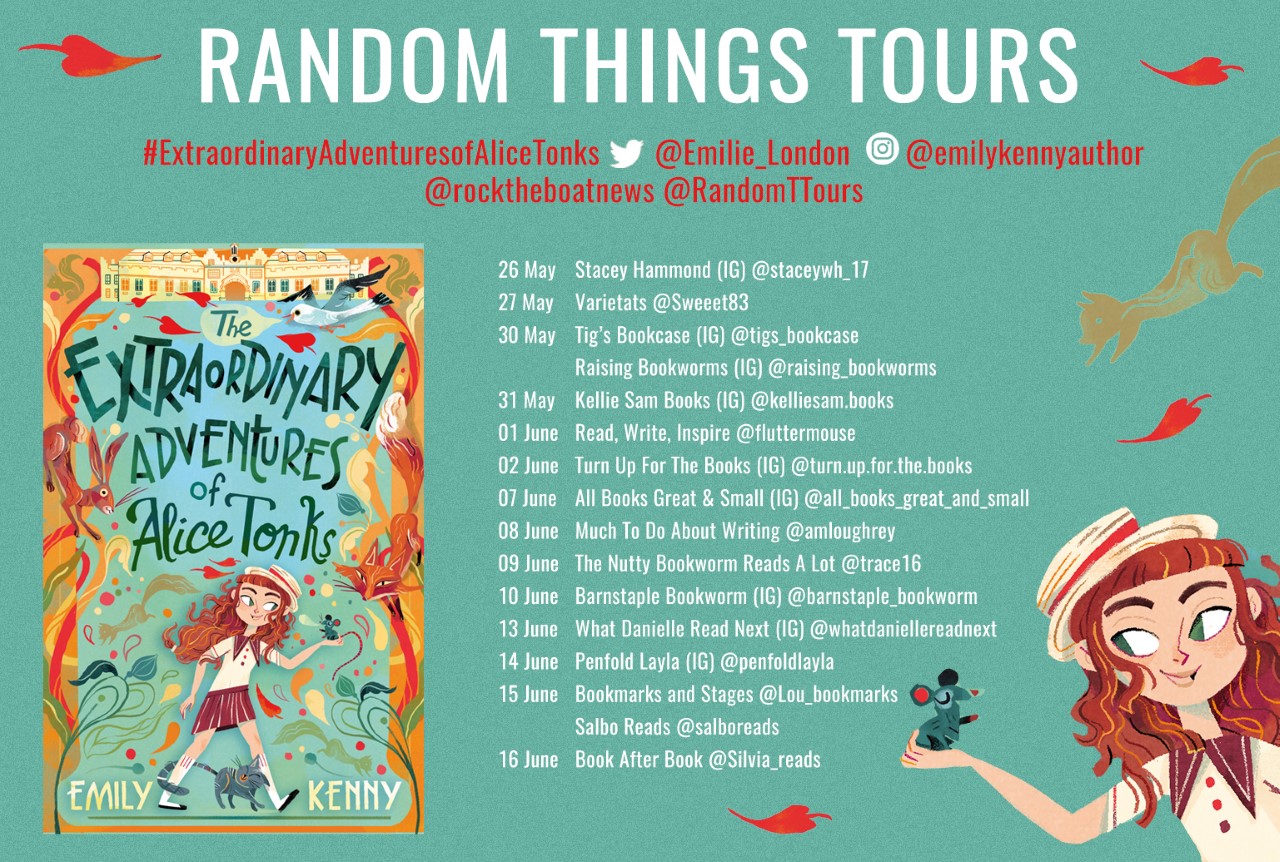
The Extraordinary Adventures of Alice Tonks is available to buy now from your local bookshop, or online at uk.bookshop.org, an organisation with a mission to financially support local, independent bookshops.

I would like to thank Anne Cater from Random Things Through My Letterbox for organising this blog tour and inviting me to take part. Thank you.

Blog Tour – Robbie, or How To Be A Detective by Caroline Conran

Today I am taking part in the book tour for Caroline Conran and her debut children’s book, Robbie, or How To Be A Detective, published by Unicorn Publishing Group. Caroline has written many cookery books before turning her hand to writing for children.

Today my stop on the blog tour will take the form of a book review.

********

Title: ROBBIE or How To Be a Detective

Written by: Caroline Conran

Published by: Unicorn Publishing Group

ROBBIE, or How to be a Detective by Caroline Conran

ROBBIE, or How To Be A Detective is about a boy who is quiet, withdrawn and lonely. He lives with his parents in the Port of Arlen, Northern Ireland. Robbie does not have any friends, preferring his own company. He lives in a world of his own, an imaginary place in which he is a detective, finding out secrets. His Dad is a very strict, dislikeable character and he is bullied at school. When he gets a pair of binoculars for Christmas, his world expands, he sees shadows, mysteries and menace all around him. Robbie has to face difficult challenges, fight for what he thinks is right and stay loyal to those he loves.

At the heart of the book is the fact that Robbie loves to sing, like his mum. He is persuaded by Julie, the receptionist at the local Art’s Centre (who is the nearest thing he has to a friend), to audition for the musical of The Little Shop of Horrors, much to his Dad’s disgust. Throughout the book, Caroline racks up the sympathy for Robbie and how he tries to cope with his dad who suddenly dies of a heart attack and the constant bullying at school, which threatens to follow him to his new school, alone.

Caroline Conran’s characterisation is spot on. Each character has their own characteristics and their own voice. In my opinion the dialogue was great. You could hear the Irish accents as you read. The settings were well described and I could imagine the port, the streets of Arlen and the art’s centre vividly. The only thing that let this book down is that it portrayed a rather dated view of a young teenager’s life. There are no mention of mobile phones, or computerised games and consoles, and the bullying takes the form of threatening notes and photos, dead rabbits and physical violence.

A good book for children who like to solve mysteries.

********

I would like to thank Anne Cater from Random Things Through My Letterbox for organising this blog tour, inviting me to take part and sending me a copy of the book to review. Thank you.

Blog Tour – Evolution by Zelda Conway

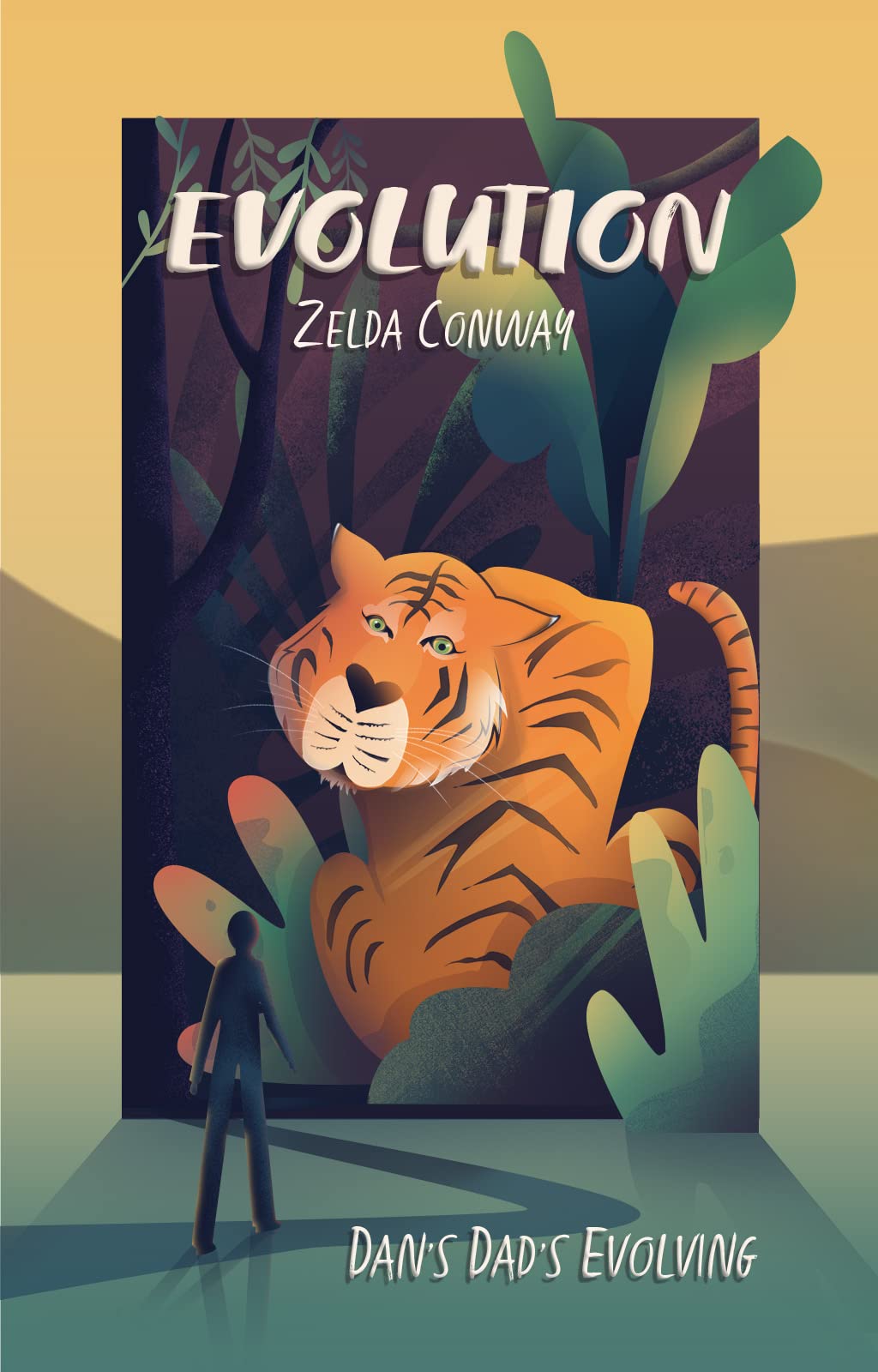
I am pleased to be hosting another author interview on my blog today. This time I am featuring Zelda Conway and her book, Evolution, published by ZunTold Publishing.

Evolution explores what it is like to have a parent who decides to have gender reassignment. This is a great book for both children and parents, and would also be a useful resource for teachers, counsellors and everyone who works with young people.

Evolution by Zelda Conway

********

Q&A session with Zelda Conway

Thanks Zelda for agreeing to be interviewed on my blog as part of your blog tour. Evolution is such a fantastic book. I think it is great to have different family lifestyles reflected in children’s fiction. This time I am kicking off the blog tour with the first stop, which is exciting. So let’s get straight to the questions:

Tell us a little about the inspiration for your novel, Evolution.

It’s based on experience. A member of my family has undergone gender reassignment and I supported her all the way. It’s a brave thing to do and is never done lightly.

Why did you decide to write a children’s book about a parent who decides they need to change from being a man to becoming a woman?

It’s brilliant that we are now more aware of gender reassignment and that it’s losing its stigma. It’s a topic that we read more and more about, but it seems to me that there’s very little in the way of books for the children of transgender parents, and for any other child who might be interested. Of course, kids with trans parents are part of the story, too. I wanted to write a book that could help kids like that, that would show them that others have been in similar situations, and that promotes understanding of gender reassignment generally. It was important to me to be honest – it can be a tough call for everyone involved – but it isn’t the end. Your mum or dad doesn’t stop loving you because they look different to how they used to.

What was the most difficult part about writing Evolution?

Deciding how much of my own experience to put in, and where it was appropriate to fictionalise without sensationalising things. It needed to have enough drama to keep young readers involved, and finding that balance was really tough. I hope I’ve got it right.

Talk us through your writing process.

For me, the story and setting are often the driving force, but with Evolution it was different. The character of Dan – the boy with the trans dad – was the starting point. Again, he’s based on someone I know, and some of his words are pretty well verbatim.

With Dan in my mind and heart, I set about creating his world – his school life, home life, family, friends and interests. I usually start to write pretty quickly and then go back and do lots of refining of what I’ve written but this was a bit different, probably because so much background stuff was decided before I started writing.

I usually know where my stories will end, but once again, Evolution was different. I knew the end would be positive, to reflect my own experience of this issue, but I had to wait for the story to unfold in its own time before I realised exactly what it would be.

Is there an aspect of writing for children you wish someone had told you when you started out?

Everyone tells you that writing for children – and getting published of course – is tough, but you can’t know how tough until you’re part of it. I wish I’d been better prepared for the highs and lows, especially the lows. You toughen up as your journey as a children’s writer continues.

What writing advice would you give to other children’s writers wanting to write about diverse family life?

Be honest. Follow your heart. Your story IS worth telling and you have the right to tell it. The great thing about writing for children at the moment is that publishers are interested in a much wider range of experience than they were ten years ago. Now is the time to let your story out into the world.

Is there anything else you would like to tell readers about Evolution?

It’s funny as well as topical. At least I think it is. I’ve tried to make it a good read. It’s not heavy handed and I think a lot of kids and even older readers will find it enjoyable. Give it a go! (Please.)

I would like to take this opportunity to thank Zelda for her time and cooperation in taking part in this interview for her Evolution blog tour. It has been a privilege to be included in the tour.

********

Zelda does not have a website or anything yet, but is working on it. If readers want to contact her, they can do so via ZunTold’s website: https://zuntold.com/. She hopes you will.

Evolution by Zelda Conway is available to buy now from your local bookshop, or online at uk.bookshop.org, an organisation with a mission to financially support local, independent bookshops.

Book Review: How Messy!

TitleHow Messy!

Written by: Clare Helen Welsh

Illustrated by: Olivier Tallec

Published by: Happy Yak

How Messy! by Clare Helen Welsh and Olivier Tallec

How Messy! is a simple yet effective text. Clare tells the story in only 116 words. The book is about Dot and Duck who go on holiday to the seaside. Dot finds Duck’s untidiness very frustrating. She likes things in their place – neat and tidy – but Duck prefers the more organic and creative approach. Read how they learn to cooperate and accept each others different personalities.

I love the way Olivier Tallec makes the action explicit through his vinaigrette illustrations. He uses a limited primary colour palette of yellow, red and green with a hint of blue, pink and orange. The expressions on Dot and Duck’s faces are superb. Other books in the Dot and Duck series are How Selfish! and How Rude!

This series of books would be ideal for KS1 and nursery children. They could be used as a starting point to stimulate discussions on manners, tolerance and accepting each others differences. Each story is very relatable and guaranteed to make the children laugh and maybe even gasp out loud at some of the character’s behaviour.

I have also previously reviewed The Perfect Shelter by Clare Helen Welsh and Åsa Gilland. You can read the review here: Book Review: The Perfect Shelter.

You can read the interview I did with Clare Helen Walsh to mark the launch of How Messy! and to launch my journey into hosting blog tours here: Blog Tour – Clare Helen Welsh.

Blog Tour – Mary : Adrift in the Sea of Sorrow by Kate Cunningham

I am delighted to welcome you to the next stop of the Mary : Adrift in the Sea of Sorrow Blog Tour, the fantastic new book published by Reading Riddle and written by Kate Cunningham.

Kat Cunningham

Mary is kept in a locked white room – alone apart from the testers who take samples from her. Vander was recently given the job as a tester and feels sorry for her. He has lived through the Red Plague and seen the choices families had to make to survive. When he releases Mary his actions trigger events that spiral out of control and change countless lives. Mary must decide what price to put on freedom.

Mary : Adrift in the Sea of Sorrow by Kate Cunningham

Thank you Kate for agreeing to be interviewed on my blog today as part of your Mary : Adrift in the Sea of Sorrow blog tour. Your book is a real eye-opener into human nature and quite poignant in the aftermath of the corona pandemic. I am fascinated to find out more about your writing process for this novel.

********

So tell us a little about yourself and the inspiration for your book Mary: Adrift in the Sea of Sorrow.

I always wanted to be a writer but it never seemed to be something an ordinary person could do, so I’ve had a few different jobs over the years, including working for a development charity and ten years teaching in large primary schools in London. In hindsight those jobs gave me the skills and knowledge I use now, and I carried on writing throughout that time, joining writing groups in the evening and at weekends. I’m married to historian Sean Cunningham, so at home a lot of our conversations revolve around research and documents, what they tell us and what they might mean for interpreting events.

Mary is inspired by a real person, Mary Mallon, more commonly known as Typhoid Mary. Many years ago I read about her and wondered what would happen if she was around now. The real Mary lived at the start of the 20th century in New York. She was employed as a cook by wealthy families, and after a number of outbreaks of typhoid, it was concluded that she was the common factor and the source of the infections, some of which resulted in deaths. She was confined to North Brother Island, in New York’s East River for many years, but refused to believe that she was responsible for spreading the disease. She was eventually released, but disappeared again. Once more she started working as a cook, and once more infections followed her. She ended up back on the quarantine island but never accepted responsibility for the outbreaks or the deaths. My Mary is also infectious, and in denial.

What comes first for you the plot or the characters and why?

Mary is unusual for me, as I normally write within the framework of a real historical moment, which in turn means I build the plot to fit around that. This is the first time my story has sprung from a person rather than event, and is set in the future rather than the past. This time it was very much character-driven and I really enjoyed having the freedom to go in any direction I (or my characters) chose.

What is a significant way your book has changed since the first draft? 

The first draft focussed on Mary telling the story in the first person, with the idea that she was an unreliable narrator. However, I needed other perspectives and more characters to drive the plot and give a wider view. Mary starts from a very limited place, physically, mentally and emotionally, so her narration would have had a lot of gaps that I felt would become frustrating. The final version is told in the third person, but I am writing a few short side stories that will be shared through my newsletter and I am tempted to explore some first person reports of the events that unfold.

If your book were made into a movie, which actors/actresses do you imagine playing your characters? 

Anya Taylor-Joy would be wonderfully mesmerising while taking Mary on her journey, and Head of the Facility was the easiest choice for me, with Tilda Swinton as Marinda. Dafne Keen would be a suitably spiky Barb and I think Idris Elba would definitely be broody and do what needed to be done as Frank, with the more gentle Amir Wilson as his son, Max. Finally, Alex Lawther would be Vander and Timothee Chalamet (with an English accent) as Shaw.

Do you have any writing rituals?

My week has a pattern with visits to schools at the start of the week and writing at the end, as I’ve found that I’m more productive with solid chunks of time to work on a manuscript. On writing days, I hustle the rest of the family out of the house to work or school, and then brew a huge mug of tea and set up my computer. If it’s been a particularly chaotic morning (or week), I play one game of patience, a version called Gaps or Montana, but it has to be with real physical cards, and just one game to clear my head.

This game involves laying out all the cards in a grid and the act of shuffling and dealing the pack sort of clears my brain of lost bus passes and arguing with my teenage son over whether he will need a coat that day. I did wonder if I was just making excuses for doing this, but there are articles about games being relaxing and releasing endorphins, so I’m feeling less guilty about it now. Computer patience absolutely does not work – that only leads to prevarication and kills productivity!

Is there a particular place you like to write?

I write at the kitchen table. It is six feet long, so has lots of space to spread papers, books, mugs of tea and all the other debris that gathers as the day goes on. It is by a glass door that looks out at our garden – which is a small bricked yard full of lots of pots and planters. We have a growing number of regular bird visitors, including the magpie who tries to get into the bathroom and has succeeded in flying off with a few things left on the windowsill.

What writing advice would you give to people aspiring to be a children’s book writer?

The core advice is to read a broad range of current children’s books, but linked to that is to support your local library and build a relationship with them. It gives you access to books and people who love books, plus libraries are essential to supporting and nurturing our future readers.

********

That has been fascinating. It has been brilliant being able to get a peek into the way the book developed and find out more about your vision whilst writing it. Thank you for agreeing to be interviewed as part of your book tour on my blog.

You can find out more about Kate Cunningham and her books on her website: www.readingriddle.co.uk, on Twitter @reading_riddle, on Instagram @reading_riddle, on Facebook: www.facebook.com/readingriddle and on TikTok: @readingriddle.

Mary : Adrift in the Sea of Sorrow by Kate Cunningham is available to buy through all bookshops, large or small, and all the usual outlets online. Kate also has a free short story, linked to Mary, which is available through the newsletter on her website www.readingriddle.co.uk.

You can check out the rest of the blog tour here:

I would like to thank Anne Cater from Random Things Through My Letterbox for organising this blog tour and inviting me to take part.

An Interview with… Simon Bowden

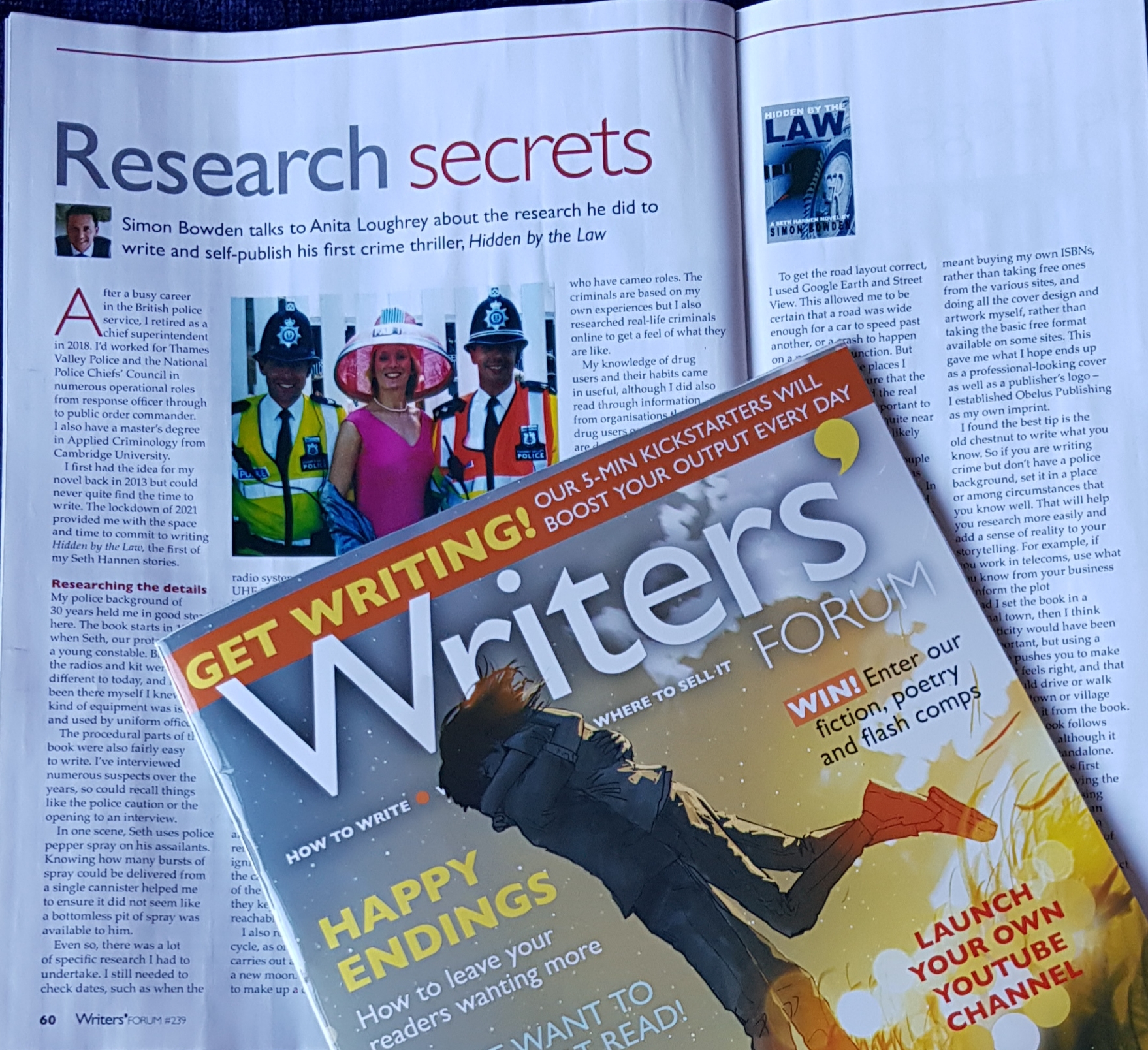
For my Research Secrets slot in the #239 Dec 2021 issue of Writers’ Forum I interview retired chief superintendent, Simon Bowden, about the research he did to write his first crime thriller, Hidden by the Law.

Simon first had the idea for his novel back in 2013, but could never quite find the time to write. The coronavirus lockdown of 2020 provided him with the space and time to commit to writing Hidden by the Law, which is the first of the Seth Hannen stories.

Simon explains the books starts in 1992, when Seth, our protagonist is a young constable. Back then the radio’s and issued kit were very different to today and Simon recalled what kind of radios and equipment were issued and used by uniform officers. He still found he needed to check dates that things like the radio system changed from UHF radios to the current Airwave Tetra system, as he knew getting that kind of detail wrong would soon be called out by police officers who may read the book. He revealed the procedural parts of the book were fairly easy to write about as he has experience of interviewing numerous suspects over the years, so things like the police caution, or the opening to an interview remain indelibly printed in his mind.

Even so there was a lot of specific research he had to undertake for Hidden by the Law. For example, the first chapter finds Seth working the Royal Ascot horse racing meeting. He told me to ensure he got this correct, he needed to check the dates for the meeting that took place back in 1992, to ensure he chose the right day for ladies’ day etc. 

He wanted his villain to be driving a new Aston Martin of the day, and there is a scene where Seth removed the keys from the ignition, while stood outside the car. So, he looked at photographs of the interior of the car to make sure the keys would be reachable from the window. If the car had a strange place for the ignition key, the scene would not have worked, and he would have had to choose a different car. 

He also researched the lunar cycle for one of the characters who carried out a burglary on an evening of a new moon. 

“It would be easy to make up a day and just say that it was a new moon, but I know some people will check that kind of detail. While the book is a work of fiction, the setting and circumstances need to feel realistic.” 

Simon Bowden

In another example, Simon told me he had one of his characters carry a gun in an ankle holster, and while he does not give too much detail on the weapon, he researched which guns would generally be able to be carried in that fashion, as it would not have worked having him carry a great big Magnum pistol on his ankle.

Simon revealed his characters are a mix of people he knows in real life. Only the cameo roles of a couple of my friends are real, the rest are based upon his own experiences of criminals or police officers. He researched criminals from online media sources to get the ‘feel’ of what they are like and how they could be portrayed. His personal knowledge of drug users and their habits came in useful, although he did also read some information from organisations that help drug users get clean to help him write the descriptions of what a drug user feels and goes through when taking drugs.

Hidden by the Law by Simon Bowden

Simon’s tip to other authors wanting to write a crime series is to write what you know, so if you are writing crime, set it in a circumstance or place that you know well. That will help you find research areas more easily and allow a real sense of reality to your story telling. For example, if you work in telecoms in London, set the story in London and use what you know from your business to inform the plot. He warned there is a lot of misinformation online so suggests you should take extra steps to verify what you find.

“For me there is a fine line between fiction that is completely false, and fiction that takes place in a real setting, place, or time.  I think had I set the book in a fictional town, then authenticity would be less important, but using a real place pushes you to make sure that it feels right, and that a reader could drive or walk through the town or village and recognise it from the book.”

Simon Bowden

Simon’s second book follows on from the first, although it can be read as a stand-alone. It follows Seth in his first assignment after leaving the police service, so will have less of an epic timeframe. He used his knowledge of human trafficking and terrorism to create a credible story of someone born and brought up with committing an act of terror in mind.

Simon blogs on his Facebook page @simonbowdenauthor, and tweets @AuthorBowden.

To read the complete feature you can purchase a copy of #239 Dec 2021 Writers’ Forum by ordering online from Select Magazines.

To read my future Research Secrets or Writing 4 Children interviews you can invest in a subscription from the Writers’ Forum website, or download Writers’ Forum to your iOS or Android device.

Book Review: The Beatryce Prophecy

Title: The Beatryce Prophecy

Written by: Kate DiCamillo

Illustrated by: Sophie Blackwell

Published by: Walker Books

The Beatryce Prophecy by Kate DiCamillo and Sophie Blackwell

The Beatryce Prophecy is a magnificent ‘folktale’ style middle grade novel set in the Medieval era. The partnership between Kate DiCamillo (who was twice winner of the Newbury Medal) and Sophie Blackwell (who was twice winner of the Caldecott Medal) is a perfect combination. The intricate black and white ink illustrations compliment and highlight the lyrical writing in a magical, atmospheric way that keeps the readers turning the pages. Each chapter begins with an enlarged, decorative, inhabited initial letter, which gives the book a historical, illuminated manuscript feel.

At the heart of the novel is Beatrice who is found by Brother Edik in the barn at the Order of the Chronicles of Sorrowing. He was shocked to discover her curled up next to Answelica, the ferocious goat, clutching the goat’s ear as a comforter.  All the monks are afraid of Answelica, comparing her to a demon, as she bites and has a nasty habit of butting them in the backside sending them flying.

The only thing Beatryce remembers is her name. she has no idea how she got in the barn. When Brother Edik finds out she can read and write he fears for her safety, as it is forbidden for girls to read and write. He shaves her head and disguises her as a young monk. Answelica is her constant companion and protector.

Kate DiCamillo expertly creates her characters with vivid evocative details to vreate an instant image in the reader’s mind, such as Brother Edik’s wandering eye that dances around in its socket and Answelica the goat’s sharp teeth and hard uncompromising head that Beatryce finds comfort in. You are carried through the pages hearing their thoughts, feeling their fears and aspirations. I particularly like the way Kate DiCamillo does not name the antagonists. Throughout the story they are nameless shadows who are hunting Beatryce because of the prophecy documented in the Chronicles of Sorrowing.

The monks are the creators and keepers of the Chronicles of Sorrowing. They record the story of what has happened and things that have not happened yet. The prophecy that was foreseen by Brother Edik and has been previously ignored, states a girl child will come who will unseat a king. This king has been manipulated by an evil counsellor. Beatryce embraces the prophecy and heads off to Castle Abelard to confront the king with the goal of finding her mother. She is joined by a misfit group of characters including Answelica the goat, 12-year-old Jack Dory who had a talent for mimicry, a bee, Brother Edik and Cannoc an old, bearded vagabond who lives inside a tree and claims he used to be king.

The Beatryce Prophecy encompasses the themes of love, courage and determination. It is the ideal book for all KS2 book corners and libraries. A great book to read to the class at the end of the school day.

This book was originally reviewed for Armadillo Magazine

You can buy copies of The Beatryce Prophecy by Kate DiCamillo and Sophie Blackwell from your local bookshop, or online at uk.bookshop.org, an organisation with a mission to financially support local, independent bookshops.

An interview with… B B Taylor

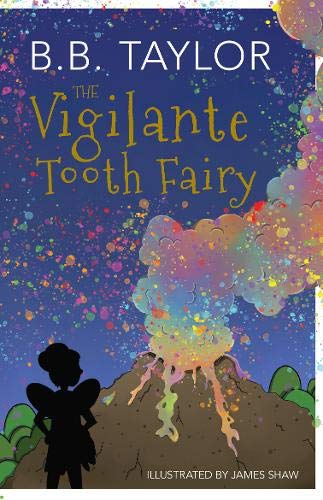
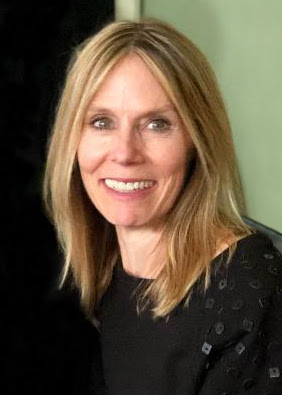
For my Writing for Children slot in #223 May 2020, I interviewed Birmingham based author, BB Taylor, about her middle grade novel, The Vigilante Tooth Fairy, published by Tiny Tree Books.

The Vigilante Tooth Fairy is a story about a determined little fairy called Mouse who wants to save magic in a world that’s stopped believing. Children have stopped leaving their teeth out for the fairies! No more teeth means no more magic and no more magic means no more fairies.

BB told me she didn’t intentionally start writing about a tooth fairy, it kind of wrote itself. She was in hospital in isolation and needed a distraction so decided to enter a competition to write the first 1000 words of a story. She wanted to write a story about magic and self-belief, to dream beyond the four walls of the hospital room she was in, so she began to daydream.

The Vigilante Tooth Fairy by B.B. Taylor and illustrated by James Shaw

Her aim was to write a fairy tale that wasn’t traditional but could still give hope and inspiration to readers. BB revealed it didn’t get anywhere in the competition and sat in a draw for about 2 years before she came across it again by accident. It was then she had a zing of an idea and that buzz of excitement that inspired her to totally rewrite her original 1000 word story.

BB explained that once she had a new first draft this was when the real work began and the editing stage is always the longest part of her writing process. As part of the process she often makes scrap books mapping out her locations and characters, so she can get to know them better and ensure they are as real and tangible as possible. 

She told me that when it is the best it can be she will send it to a friend – a writing buddy – for critique and waits for them to rip it apart so she can start the editing process all over again.

“Sometimes you’ll be so close to a story and see it so clearly in your mind you’ll miss things right in front of you on the page. Reading out loud, editing in different fonts and colours are all great ways to trick your mind into seeing any errors and editing more efficiently.”

B.B. Taylor

BB loves doing school visits and enthusiastically declares it is one of her favourite elements of being an author. She structures her visits in small bites so she can make a session as long or short as it needs to be and can adapt it for a range of ages. Her advice for anyone doing school visits is to do what feels natural to you.

“I get to dress up, have fun and build inspiration and energy in the audiences I work with. I will often bring props whether it’s a giant snail or a giant yeti I like to make my sessions as interactive as possible.”

B.B. Taylor

BB also does lots of Zoom or Skype visits. She explained the advantage of this is that you can virtually visit people all over the world. When she does a Skype visit it usually involves reading from my book a little chat about her work and then a Q & A with the audience, to give them chance to interact and learn a bit more whether it be about her books, or being an author in general.

“It can be quite frightening to look at how you present yourself and your work in the current climate. but we are so lucky that technology has evolved so much in the last decade enabling us to still reach out and connect with audiences.”

BB Taylor

Her tip on writing for children is to be yourself, don’t try and force yourself to write in the style, format or patterns of anyone else. Do what feels comfortable and write what feels good. You want that buzz when writing that readers will hopefully get when reading your work. You want to feel that excitement when exploring a new world or creating a new character that you can pass on to your readers.

“Find what works for you and you are comfortable with and nurture it and be consistent with it. Create a digital footprint that your audience can follow and connect with and use it to reach out to the world and engage with them in whatever platform you decide to use.”

BB Taylor

To book BB for an online event you can go through her website www.bbtaylor-books.com, or through her publisher Tiny Tree Books.

You can also follow BB on Twitter @bb_taylor_, Instagram @b_b_taylor, Facebook  @B B Taylor and YouTube @B B Taylor.

To read the complete feature you can purchase a copy of #223 May 2020 Writers’ Forum by ordering online from Select Magazines.

To read my future Writing 4 Children or Research Secrets interviews you can invest in a subscription from the Writers’ Forum website, or download Writers’ Forum to your iOS or Android device.

Blog Tour – Monty and the Monster by Rhonda Smiley

Today I am joining Rhonda Smiley’s blog tour for her exciting middle-grade adventure, Monty and the Monster.

Rhonda Smiley is a writer living in Glendale, California. After graduating from Concordia University in her native Montreal, Canada with a BFA in Film Production, she began writing for television – everything from family adventure to cop shows to cartoons. Her passion for storytelling led her to become an author, and her first novel, Asper, was awarded the BRAG medallion.

Rhonda Smiley

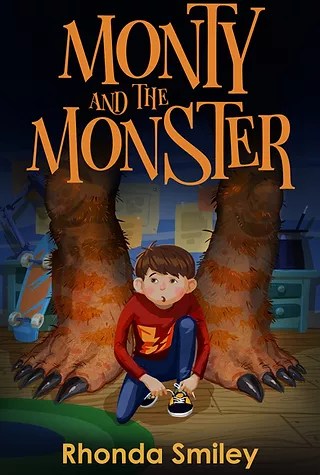
Monty and the Monster is a story of friendship and learning to trust your own instincts is about a boy who finds it difficult to make friends so decides to create his own friend using potions he discovered in a secret chamber. However, his new friend does not turn out quite as expected.

Monty and the Monster by Rhonda Smiley

Before we start I would like to thank Rhonda for agreeing to be interviewed for this stop on her blog tour. I really enjoyed reading Monty and the Monster and was intrigued to discover more about how you wrote the book. So without further ado, let’s us begin…

********

Q&A session with Rhonda Smiley

There’s a strong theme of friendship and bullying within your novel. What made you want to explore these themes?

They’re both very relatable themes, especially for children. I was shy as a child and making friends didn’t come easy. At the time, I thought I was the only one who felt that way, which of course wasn’t true. There are a lot of children who feel the same way, and I wanted to make them the hero of their own story. At the same time, I thought it would be interesting for those who do make friends easily to see through Monty’s perspective and get an idea of how it feels from the other side.

Bullying came into play when considering obstacles to Monty’s goal. Even though he can be his own biggest hindrance (can’t we all), I wanted outside complications as well, and bullying is a very real and scary one. It was important to show the emotional effects of it. It made normal everyday events, like going to school, very daunting for Monty. But I also wanted to convey that sometimes bullies have their own inner issues and use bullying as a means of acting out.

What gave you the idea of a child creating their own friend?

I wanted the book to be really funny, full of incredible adventures, and truly heartfelt, and the literal interpretation of “making” a friend was the perfect springboard for all of that.

Of course, Monty tries the conventional way to make a friend at first, but it’s a bust. I love that he doesn’t give up and proactively turns to the replication formula, which is its own humorous undertaking. And when he does make his new friend, well, that opens up a whole new set of challenges. It is a stinky hairy eight-foot-tall monster, after all.

Are you a plotter or a pantser?

I am definitely a plotter. I started out as a pantster, but when I began writing for television, I was required to do outlines. I dreaded them at first, but soon realized how incredibly helpful they were and ironically how liberating. It’s much easier to write details of a story when you have the structure plotted out and you know where you’re going. That said, if a character or situation sparks a new and exciting direction, I’m all ears, but I always refer back to the outline to make sure it fits within the overall story and that important points aren’t lost.

Talk us through your writing process for Monty and the Monster.

My writing process is pretty much the same for all my works. I start with the broad strokes of an outline, the beginning, middle, and end, and then open it up and fill in the gaps with goals and obstacles and the characters involved.

Once I have the outline, I dive into my “words on paper” draft. That’s where I just get it down and don’t worry too much about phrasing or on-the-nose dialogue. If I come across something that needs researching, like Monty’s skateboarding tricks, for instance, I make a note to do it later and don’t let it interrupt my momentum. It’s the kind of draft you’d never let anyone read, but it’s a wonderful way to lay out all the pertinent information. Once I have that, the real fun begins with finer details, character development, dialogue, and phrasing.

I’d like to say that’s my official first draft, but honestly, I do several more passes, looking for redundancies, crutch words, inconsistencies, and mistakes. When I think the manuscript is as good as it can be, I give it to an editor for overall story notes, which inevitably leads to more drafts.

After that, when I’m absolutely certain it’s as good as it can be, I send it off to beta readers. Getting outside eyes on it is extremely helpful. Of course, more drafts follow. It’s a long process, but every step adds to the depth of character, story, and the world.

How did you develop your characters and their voices so children can identify with them?

My background in children’s television has given me a lot of experience with different age groups as well as a wide range of characters. I’ve written for Little Bear, Rescue Heroes, The Adventures of Chuck and Friends, The Stinky & Dirty Show, Teenage Mutant Ninja Turtles, and Totally Spies just to name a few. From adventurous boys and girls to crime-solving teens to mutant turtles living in the sewer!

It’s really fun to lose yourself in the mind-set of a child or tween or teen (or bear or truck or turtle) and look at the world through their viewpoint. Many times I’d step back and put myself in Monty’s sneakers to understand how he’d perceive what was happening. Even though the book is on the fantastical side, the characters’ reactions and emotions are still based in reality.

What is your favourite thing about writing for children?

You can’t ask for a better audience. Children are naturally curious and open-minded. I can tackle important topics without being didactic or preachy because children are eager to learn and grow. They pick up on the themes within the entertainment.

What writing advice would you give to people aspiring to be a children’s book writer?

Research your demographic. Are you writing Chapter Books, Middle Grade, or Young Adult? It’s important to know who you’re writing for, how they see the world, and what’s meaningful to them at this stage in their lives.

If you’re writing for a younger age group, consider what parents would want their children to read since the parents are most likely buying the book. Kids can’t fall in love with your stories if they never get a chance to see them!

And finally, don’t underestimate kids. Even though you want to use language and themes appropriate for their age group, it’s okay to have a word or two they can learn from context. I learned a lot of new words from reading when I was growing up. Actually, I still do.

Thank you again Rhonda for joining me on my blog. You have given us a great insight into your writing process for Monty and the Monster.

********

You can find out more about Rhonda Smiley and her books on her website: www.rhondasmiley.com and follow her on Twitter @RhondaJSmiley.

You can buy a copy of Monty and the Monster by Rhonda Smiley from Kobo UK and Amazon UK here in the UK and in the US you can get your copy from: Amazon US, Barnes & Noble and Kobo US.

Check out the rest of the blog tour here:

I would like to thank Anne Cater from Random Things Through My Letterbox for organising this blog tour and inviting me to take part. Hopefully this will be the first of many more. Thank you.

Book Review: That’s Life!: Looking for the Living Things All Around You

Title: That’s Life!: Looking for the Living Things All Around You

Written by: Mike Barfield

Illustrated by: Lauren Humphrey

Published by: Laurence King Publishing

That’s Life, Looking for the living things all around you
by Mike Barfield and Lauren Humphrey

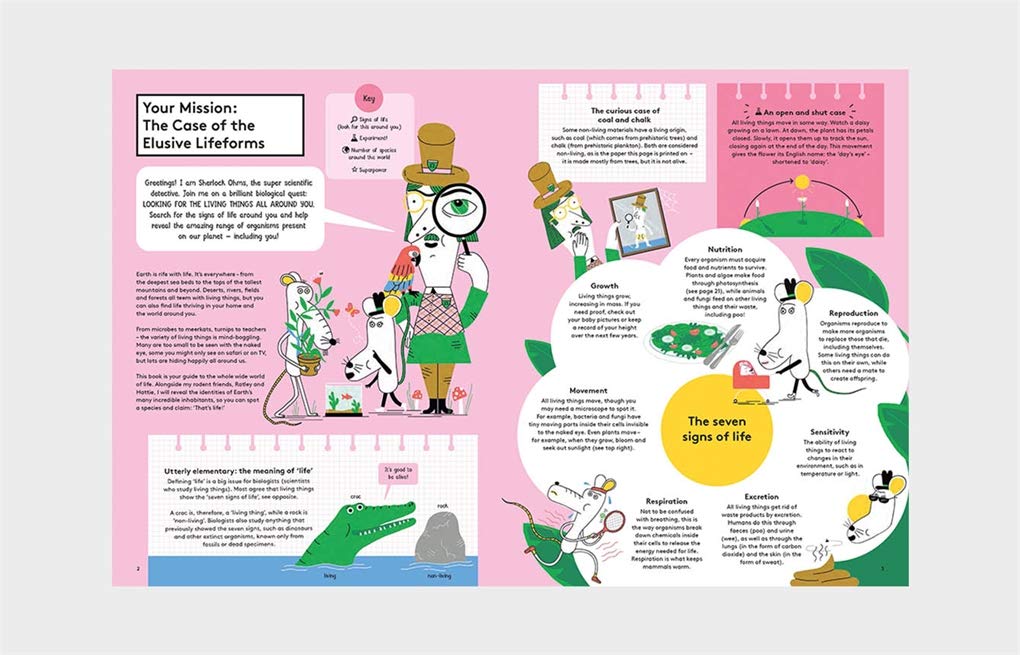
Join Sherlock Ohms on his fascinating search for the range of amazing organisms present on our planet. This book is the ideal addition to any KS2 classroom as a valuable resource to teach about plants, animals including humans, living things and their habitats, as well as evolution and inheritance. There is so much detail and interesting snippets of information about the diversity of life. I feel it would also be a great addition to a KS3 pupil’s bookshelf.

Mike Barfield starts at the very beginning by outlining the seven signs of life and how the perfect conditions helped form the first cell over 4 billion years ago.

He explains how this cell evolved and developed in complexity to become prokaryotic (of a bacterium) or eukaryotic (of an animal). He goes on to describe how the human body is formed of 37 billion cells, distinguishes between the different classification of life from archaea to animalia and outlines evolution to extinction. Throughout the book there are graphic novel style life stories to help explain our origins and the philosophy of life.

The illustrations by Lauren Humphreys are very distinctive and portray the characters in a charming yet eye-catching simplistic way. They complement and enhance the text perfectly helping eager young minds assimilate the multitude of insightful information. This book highlights he incredible variety of life on our planet in a fun and motivational way. It would be the ideal gift for a child interested in biological science.

This book was originally reviewed for Armadillo Magazine.