John Condon’s book launch

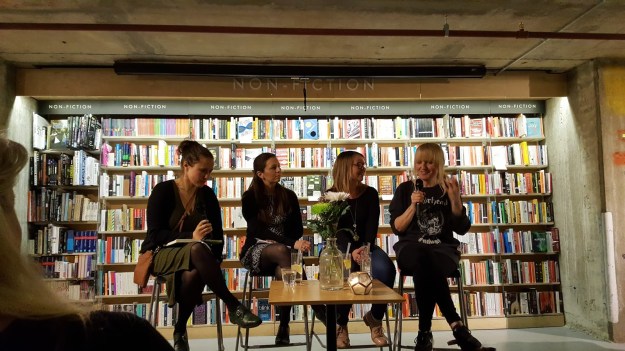
Last week Thursday, I went to John Condon’s book launch for his latest picture book, The Pirates are Coming written by John Condon and illustrated by Matt Hunt.

The Pirates are Coming

This is an ingenious picture book all about a little boy who keeps a look out everyday for pirates in a similar vain to the boy who called wolf but as John’s son, Eddie, explained the boy is not being naughty because he really believes it is a pirate ship he sees.

On arrival I was greeted by the staff of Queen’s Park Books, London, who offered me a drink, red wine, white wine and rum, which made it really difficult for me not to take an alcoholic drink as dark rum is one of my favourites. After much deliberation, I drank mango juice and managed to restrain myself from mixing it with rum. There were also some delicious pirate cupcakes.

The first person I met was John’s son, Eddie, who pointed out he was the boy in the cover of the book and indeed he was – right down to the red sash and the bell. Some of the guests also dressed up as pirates, including myself. This is a picture of me with author Matt Killeen and another of author, Cath Jones in her pirate costume. I interviewed Cath for the January 2020 issue #219 of Writers’ Forum see: An interview with… Cath Jones

John was also dressed up and he was the spitting image of he dad in the book. The likeness was uncanny. I was wondering if Matt did this intentionally.

During the launch we were entertained by violinist, Frank Biddulph, and John read the book with the help of his son Eddie who got the timing perfect and even managed an improvised squawk of the parrot.

I have also previously interviewed John about his writing process for the #216 Oct 2019 issue of the national writing magazine, Writers Forum. I have blogged about the interview here: An interview with… John Condon. In the interview John explained that even though The Pirates are Coming was accepted to be published first, due to the backlog of pirate based stories his other picture book The Wondrous Dinosaurium (illustrated by Steve Brown) was published first.

All in all a very successful book launch for another excellent picture book. I can’t wait for the next one.

To find out more about John take a look at his website www.johncondon.co.uk or follow him on Twitter @John_Condon_OTT

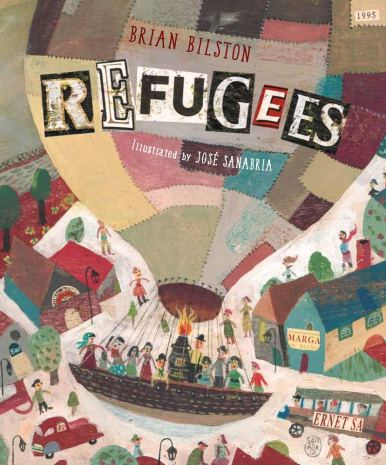
Book Review – Refugees

Title: Refugees

Written by: Brian Bilston

Illustrated by: José Sanabria

Published by: Palazzo

Edited by: Gemma Farr

Refugees

For my 200th blog post I have blogged my review of Refugees by Brian Bilston and José Sanabria.

This is ‘cleverly crafted book picture book that highlights prejudices and bigotry. The poem can be read both forwards and backwards to show two opposing views about refugees. The provides a brilliant opportunity for discussion and a way to talk about fear and hate and the need for compassion, understanding and empathy. I particularly like the way the poem is laid out on the left of the spread when read forward and on the right side when it is re-written backwards in the second half of the book.

The colours used for the illustrations also help to convey the different moods and feelings, with dark sad-faced images to show the fear and mistrust and brighter, colourful images with happy smiling faces to demonstrate people from different races and cultures are all the same all around the world, doing the same jobs, same activities and everyday routines. An excellent book to promote debate.

The book would be ideal for PSHE classes not only at KS1 or KS2 but also KS3 and KS4 as the opposing views are relevant for all ages. It would also be interesting to have children craft their own similar poems to show opposing views on this and other subjects, such as climate change, conservation and even Brexit.

This book review was previously published on the online Armadillo Children’s Book Review Magazine.

An interview with… Sarwat Chadda

Sarwat Chadda’s first novel, The Devil’s Kiss, was released by Puffin in May 2009 and was quickly followed by the sequel, The Dark Goddess. He has also written a breathtaking action adventure series for children aged 8-12 years, called Ash Ministry and writes under the pseudonym Joshua Kahn. He is currently working on a project with Rick Riordan. I interviewed Sarwat about his research in 2009 for my Research Secrets column.

He explained that for him the research comes before the writing because he loves reading about history, mythology and fairy tales way back when he was an engineer. He likes to start something on a whim and then explore the area, culture and background until he reaches a saturation point. This gives him enough information to sound convincing and have all the key characters and locations in place.

Ultimately, his books are about the character and feels everything else is scene setting. To help create his characters he looks into his life and projects how he was at the age of his protagonist. He said the core needs come from there.

Sarwat insists research shouldn’t be a chore it should be part of the fun.

“We’re not just putting words down on paper we’re offering readers our unique take on the world. If you’re finding it hard work constantly, question why you’re doing it. Writing is about passion, life’s too short to be wasted on something you don’t love.” (Sarwat Chadda)

Most of his research is done through books. In fact, he admits that his biggest cost is books, but he was buying them before he decided to become a full time writer. Sarwat believes that libraries are our greatest resource. I agree. Use them or lose them. He explained:

“The Internet has its place, but nothing beats getting really into a subject in a library and second hand book shops. They’re great since you’ll come across stuff that’s years old and since I’m writing about mythology, those sort of books just set the mood perfectly.” (Sarwat Chadda)

He said the danger is over-research and getting yourself trapped by it. But he does not have a system for the way he does his research. because he feels the best thing about writing is the license to mix it all up how you like. His tip to other writers is not to stack your books in a too organised manner. Mix them up and see what happens as you’ll come across connections otherwise impossible to see if it’s all logical.

Sarwat explained sometimes the ‘official’ version doesn’t work and you have to tweak it. This happens a lot in historical fiction, especially with combining characters and moving dates. But that’s why it’s called FICTION. In his adventures he admits he makes up all the difficult and dangerous stuff.

OLYMPUS DIGITAL CAMERA

For all that sort of practical detail on the ‘day in the life of a warrior’ he got in touch with various re-enactment societies and visited shows around England. Since his books are based on the Knights Templar, he found their working understanding of the practical nature of the arms and armour of a medieval knight, very useful.

“They explained the nitty-gritty of the sword hilt, the practicalities of the weight of armour, its properties and the weapons designed to overcome mail or plate. It’s all these details that make the story breathe with a sense of reality.” (Sarwat Chadda)

To find out more about Sarwat Chadda and his books take a look at his excellent website: http://www.ashmistry.com or follow him on Twitter: @sarwatchadda 

To read the complete feature you can purchase a copy of #93 June 2009 Writers’ Forum by ordering online from Select Magazines.

What makes me want to keep reading?

Over the past few weeks I have been thinking increasingly about this question. I am the type of person that if I get bored with a book I will not carry on. I have a very short attention span and my mind wanders very easily into my own little worlds. I have read several books where I have been told, if you get past chapter five it is great you can’t put it down, because I have stopped reading during chapter two.

Room by Emma Donoghue and Timeline by Michael Crichton are two of these books. I have started again with these books and forced myself to read on and consequently really enjoyed the books and have since, read them again. So did I give up too soon? Why did I stop reading in the first place (especially as both of these books have such brilliant concepts)?

After a lot of thought, I think that there was too much backstory for me from the onset. I know as authors we should release the thread slowly, but these books for me, in the first few chapters, were too slow. The stories felt as if they were going nowhere. Even the dialogue did not seem to me to propel the story forward. In fact, dare I say it of two best-selling authors but the beginnings were rather self-indulgent. I didn’t get the cliff-hanger or unanswered question at the end of the chapter to make me want to read on. I have posted about writing cliff-hangers before: End Each Chapter With a Cliffhanger

I’ve heard it a thousand times on creative writing courses and I know I’ve said it myself and have more than likely written it in one of my blogs before but honestly if it doesn’t move the story forward, leave it out. I will block quote that:

If it doesn’t move the story forward, leave it out.

When I come to edit a chapter book, I always re-read each chapter (which is usually a scene) separately and ask myself these questions at the end:

  • Does the chapter trigger my curiosity?
  • Has the chapter developed the characters and/or the plot?
  • Is this something I would read if I only had a few minutes to spare?
  • Would it effect the story if the whole scene was cut?

These questions really help me to focus my mind.

I love reading books, which make me want to skip parts to find out the answers before I carry on from where I left off. It is frustrating when a book ends and it says… to be continued. I actually feel really cross at the author. This is what happened to me with Teri Terry’s first book in her Slated series.

But this technique did make me buy the next book in the trilogy as soon as it was released and they are still one of my favourite all-time series of books. I have also bought and read every other book she has written – so they’ve got to be good. I think Teri Terry’s books really hits it on nail – so here is my epiphany I wanted to share with you all:

To make me want to keep reading you have to make me care about the characters from the start and keep on making me want to find out what happens to them.

It really is that simple. I hope this helps you when writing and editing your own books.

Book Review – Great Buildings

Title: The Picture History of Great Buildings

Written and illustrated by:  Gillian Clements

Published by: Frances Lincoln

Great Buildings

Gillian Clements detailed illustrations are a fantastic introduction to the wide variety of architectural styles throughout history across the whole world. The writing is concise and informative providing a wealth of information to satisfy the most inquisitive of minds. This book would be great for dipping into as well as for looking in-depth at the history of specific buildings, their designers and the impact the buildings have on architecture today.

From a teaching point of view, Great Buildings, would be an ideal book for the classroom to supplement history topics on the Romans, Greeks, Aztecs and the Egyptians, as well as supporting technology topics on bridges, skyscrapers and ICT modelling. The book could even inspire a Religious Education topic on churches. I particularly like the way it has been organised in chronological order starting with the first homes, cities and ancient monuments right through to postmodern building, contemporary and beyond.

Great Buildings is unique in that it provides excellent timelines to show what other buildings were being constructed at the time in different parts of the world, to give an overall picture, which I have not found anywhere else.

This book review was previously published on the online Armadillo Children’s Book Review Magazine.

An interview with… Helen Fry

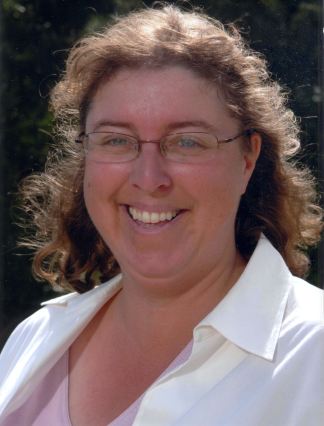
In 2009, I interviewed British historian and historical non-fiction writer, Dr Helen Fry,  for my Research Secrets feature in the #94 July 2009, issue of Writers’ Forum.

Helen photo

Helen Fry specialises in history books, specifically refugees in the British forces in the Second World War; as well as English Jewish community history. But she co-wrote with James Hamilton under the pseudonym of  J. H. Schryer for her first novel, Goodnight Vienna. It is a love-triangle within MI6 British operatives, set against Hitler marching into Vienna in March 1938, based on authentic background research which she did for some of her history books.

For example: on 10 May 1933 Hitler ordered the burning of Jewish books in Berlin, including those of Sigmund Freud. As each book was hurled into the burning pile, a ritual chant was said by the SS, SA men and students. In our novel Goodnight Vienna, we have a scene of burning of books in Vienna in 1938, this time one of the central characters, a young headstrong anti-Nazi student hurls a copy of Hitler’s Mein Kampf into the fire. It never happened in reality, neither were books burned in Vienna, but one historical event in 1933 sparked the idea for a powerful fictionalising of it in a scene for the novel.

Goodnight Vienna came out in June 2009. The sequel, Those who Avenge, came out in March 2010.

Helen enjoys interviewing war veterans, many of whom have not told their stories before. The main focus of her writing and research was refugees from Nazism who fought for Britain in the Second World War. She feels there seems to be no other historian taking down their stories, which will very soon be lost and cannot be reconstructed from official government papers.

“It is important to me to capture the human dimension of what it was like in the war. I also enjoy searching through unpublished documents and material in national archives. Shaping a wealth of diverse material into a book is an art and skill.” (Helen Fry)

A number of her books are based on the oral testimony of war veterans. She rings them up after they have replied to a search notice in a paper or journal, and arranges to visit them. Helen explained it is important that they feel relaxed and are not pressurised to tell what they find too painful. You have to build up trust and their confidence. This often necessitates two or three visits. It is a lengthy process but makes it easier if you need to interview them for a sequel book because they then have your trust.

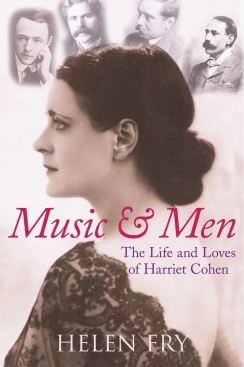
When researching, she often uses unpublished documents, papers, memoirs and the Sound Archive at The Imperial War Museum or the British Library. A prime example of this was for her book Music and Men: The Life and Loves of Harriet Cohen in which she used the archive of 3,000 letters which Harriet Cohen bequeathed to the British Library.

4817 Harriet FCP.indd

Sometimes Helen will visit the area she is writing about. For example, for Music and Men: The Life & Loves of Harriet Cohen after she discovered Harriet Cohen’s ashes were interred at Stoke Poges Memorial Park in Buckinghamshire she felt the need to go and see her final resting place, especially after having written what was an intensely emotional book, working through all her love letters. Helen discovered her final resting place was totally in character with her life. She is on her own tiny rockery island in the water garden, alongside her sister. Everything in her life was imbued with deep meaning and emotion, Helen felt this was no ordinary burial place, and so typical of her.

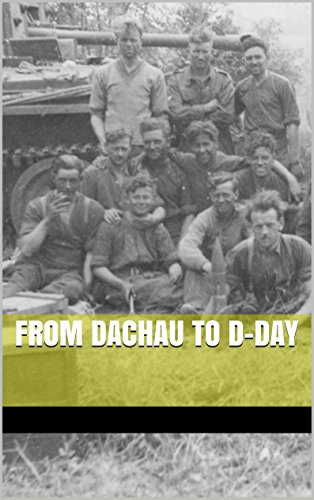
Many of her original sources are found in museum and government archives as well as specialist libraries, so for example when she was writing her book From Dachau to D-Day, it’s the story of a tank driver (originally a refugee from Nazi oppression), she used the official war diaries from D-Day to the end of the war at the Public Record Office, Kew. She also consulted the archivist at The National Tank Museum.

Dachau to D-Day

Helen revealed the Sound Archive at The Imperial War Museum was especially useful when she was adding research to my existing material from veteran interviews she had conducted. The Sound Archive contains masses of veteran interviews, some of which are specific to refugees who served in the British forces in WWII.

Helen told me she rarely, almost never, conducts research using the internet, as she believes this is how historical inaccuracies creep in.

“I believe that historians should use primary archives and sources and not rely on the internet, except to search for people who can help them with something specific. I am wary of online encyclopaedias.” (Helen Fry)

The key to her success as an author is being highly organised and methodical. Once she has carried out an interview with notes in her notebook, she types it up chronologically according to a veteran’s life story and asks the veteran to check it for errors. Then she files it in a single clear document wallet. Each veteran is given their own wallet which is then filed in a box file. Helen explains this makes it easy to retrieve when she comes to the writing-up process. She has gathered an archive of several box files of original interviews with war veterans, plus copies of photographs from their personal albums.

It is important to keep the reader’s attention throughout your book even if some of the material is heavy.

5112 Freud FCP.indd

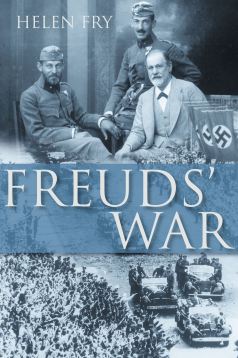
For example, material for Freuds’ War could have been overwhelming, but she came across some wonderful quotes which just summed up the moment – so used them in the text. She explained:

“I wrote something about how Sigmund Freud was wrestling with the biblical character of Moses whilst he and his family were waiting for exit visas to leave Nazi-occupied Vienna in 1938. Freud was working on his final publication before his death called Moses and Monotheism. He wrote to one of his friends Ernest Jones: “Moses haunts me like a ghost not laid.” A brilliant quote which I incorporated into the relevant chapter because it captures the voice of the person you are writing about (in this case Sigmund Freud) and lifts the text. It gives one’s writing a lively flare.” (Helen Fry)

Helen told me one of the most unusual, or seemingly obscure, research she has done was about Jews in North Devon during the Second World War. She discovered that over 4,000 Jewish refugees were in North Devon during the war and they were all the intellectuals of German and Austrian society who had volunteered for the British army and were training there. This inspired her to produce a detailed book with over 250 black & white photos. It was awarded Devon Book of the Year, was made into a mini documentary for BBC South-West and has led to commissions for over six more books published since 2007.

most_loyal_jacket

“Books once they are published take on a life of their own. They can do extraordinary and unexpected things which are fun, like a mini documentary or radio programme. Few authors are lucky to have their books made into a blockbuster film, but there are other ways in which books can make their mark, sometimes beginning in small ways. The most important point is to get published. Then one can build on what is already in print to raise the profile.” (Helen Fry)

Her tip for other historical writers is to always have an acknowledgements page in your books, to firstly thank the people who have helped you, and also for the reader to see that the research behind the book is thorough and credible.

Find out more about Helen Fry on her website: www.helen-fry.com Or follow her on Twitter @DrHelenFry

To read the complete feature you can purchase a copy of #94 July 2009 Writers’ Forum by ordering online from Select Magazines.

Do we need Celebrity Authors?

In May, 2017 I went to a very interesting Children’s Book Circle Event discussing the increase in the amount of celebrities writing children’s books. The panel consisted of:

  • Children’s reading consultant, freelance editor and blogger, Clare Zinkin
  • Award-winning picture book author, Michelle Robinson
  • YA author and ghost-writer, Siobhan Curham

CBC May panel

Children’s editor of the Bookseller magazine, Charlotte Eyre was the chair. She explained publishers are actively seeking out celebrities to write books and this is not isolated to only books for children. She told us that if a publishing house has success with a gimmick such as a celebrity author the trend is for the others to follow as it brings in the money. It was quite significant that there were no celebrities or publishers on the panel.

We must never forget that publishing is a business and all businesses want to make money. Although, whether they make money is dependent on age-group and who the celebrity is. David Walliams’ books sold over 56 million books last year whereas Chris Hoy did not even sell 5000 copies. As authors we should want our publishing houses to do well as it means there is more money to spend on debut authors.

However, the marketing can be frustrating. It is disheartening when celebrities are higher in the charts because they are getting bigger budgets and higher billing at events and festivals. In a way it is cheating because the stars are being given a head start. Authors like David Walliams are always in the review round-ups regardless. It is sad that even the Summer Reading Challenge book sorter mostly recommends celebrity books and traditional best sellers like Roald Dahl and Jaqueline Wilson. In the same way, large book shops like WH Smith and Waterstones tend to stock only the big name authors. But Michelle is proud she has got to where she is ‘the hard way’.

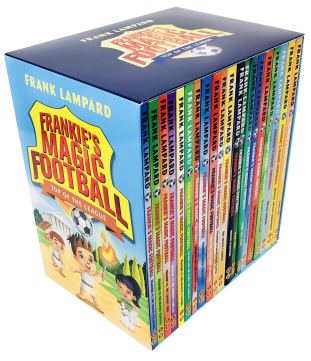
Frank Lampard

On the whole, books by sports people and other celebrities are a good thing because it gets children reading; many who may never have picked up a book before. Celebrity books tend to be light-hearted middle grade with a great illustrator. The children do not care that it is a celebrity without a background in writing all they want is a great story with amazing characters to read.

We are getting to a stage where there may be a saturation of the market with celebrity books and some are not making out their large advances. There has been a tendency for publishers to depend too much on celebrity authors. There is also a fear that because a gold medallist can also write a book in their spare time it makes writing seem easy and not hard work at all. Claire compared it to being like the celebrities creating a perfume. We need to remember Literature is a craft and we should see it as a craft. It is true many celebrities are actually writers with a proven track record and those who are not tend to have a ghost writer. As a ghost writer Siobhan sees her role as helping the celebrities tell their story.

zoesugg

Many authors in the audience felt that if a book had been written by a ghost writer they should put the ghost writers name on the books to make it clear who has written them. Siobhan explained ghost writers do not care if their name is not on the book, it is the nature of the job and anything that gets a book into a child’s hands is a good thing.

There was an overall feeling from the audience that celebrities should do more to get involved in the industry. They should make an effort to mix with other children’s book authors. It was suggested that in the same way as there are ghost writers, celebrities could advice authors on performing at events or make book recommendations to increase sales of all books and not just their own.

So my answer to the heading of this post, do we need celebrity authors, is…

…NO …we do not need celebrity authors. What we do need is great stories for children no matter who has written them.

Book Review – How to be Extraordinary

Title: How to be Extraordinary

Written by: Rashmi Sirdeshpande

Illustrated by: Annabel Tempest

Published by: Puffin Books

How to be Extraordinary

How to be Extraordinary is a non-fiction picture book containing the real-life stories of 15 extraordinary people from all over the globe, who have made incredible achievements. There is a good mix of well-known and lesser-known males and females from a wide range of nationalities and backgrounds. Each person is presented in a double-page spread, which outlines where they are from, their childhood, beliefs, jobs and their greatest accomplishments despite all obstacles, with inspirational quotes to encourage others to follow their dreams. My favourite quote is:

“What would you like to be remembered for?” (Abdul Kalam)

It is aimed at ages 5-7 years (KS1) and meets the requirements of the history programmes of study for KS1 as it documents the lives of significant individuals who have contributed to national and international achievements. The illustrations are bold and colourful. They catch the eye and will keep young readers turning the pages. But the vocabulary and size of the text is very advanced for this age range so they would mostly need adult support to get the most out of this book unless they are particularly talented and able.

How to be Extraordinary inside

I personally think How to be Extraordinary being will be more popular with children ages 7-11 years (KS2). I feel that more picture books of this high-standard containing narrative non-fiction are needed for the older primary age range, especially as the snippets of information do not have to be read in any particular order, which is great for children with low attention spans who prefer to dip in and out of the book.

This book would provide an excellent springboard for encouraging pupils to research their own extraordinary person, which could be stuck into a class book or encyclopaedia with their own illustrations or photos printed from the Internet. Throughout the book the emphasises is on how with determination and hard work anything is possible.

This book review was previously published on the online Armadillo Children’s Book Review Magazine.

Interview with… Lucie Whitehouse

In my Research Secrets this month, I interview Lucie Whitehouse who revealed how she weaves fact and fiction into her psychological thrillers, so she doesn’t jolt the reader out of the story.

Lucie Whitehouse2

Lucie told me her latest novel, Critical Incidents, launched this month had an unusual beginning. She was working on her previous novel in Brooklyn Central Library one morning when a TV producer in the UK emailed to ask if she had an idea for a female lead investigative character. She replied straight away and said she was thinking about a woman in her thirties, a single mother of a teenage girl, who’s been booted out of her job as a senior homicide detective at the Met and returns in disgrace to her hometown, Birmingham. After she hit send she sat back in surprise. She’d never consciously had the idea. Evidently, though, her subconscious had been hard at work.

Critical Incidents

In Critical Incidents, Robin, the main protagonist, is technically off the job so for Lucie, it was a gentle introduction to writing procedurals. Her first four novels were psychological suspense and she felt had a lot to learn.

She explained she researched the structure of the Met’s Homicide Command online, reading up about Major Incident Teams, what rank of officer would lead one (a DCI) and how many officers each comprises.

“The police are quite transparent, and a lot of information can be found on a force’s website. For specific queries, you can contact them directly via their site. Forces’ Facebook and Twitter accounts are great resources.” (Lucie Whitehouse)

Lucie said the trick with research is to reassure the reader that you know your stuff without boring his or her pants off, and information dumps because great chunks of undigested information will pull a reader right out of the story.

To get her facts right she does a lot of on-the-ground research in concentrated bursts when she is in the UK. She spends days in Birmingham visiting or finding locations, taking photographs, collecting flyers, pamphlets, café menus, bus tickets and perusing the local history shelves of bookshops (Waterstones on the High Street has a great range). Lucie has found that buying local history books is better done on location than on Amazon, as shops often stock things from local presses.

“Birmingham’s rich history is one of the reasons I wanted to write about it and I read several books not only about the city itself but more broadly its role in the Industrial Revolution. My favourite was A History of Birmingham by Chris Upton.” (Lucie Whitehouse)

Lucie loves stitching in little bits of her own family history. A photo of the Whitehouse Flexible Tubing helped her with the visual details. This is the factory, where her father was Managing Director. It still operates out of this building.

Whitehouse Flexible Tubing

She also enjoys going to the places her characters would go, such as Moor Street Station, the Custard Factory, Stratford Road where Gamil’s bakery is located. She told me Dunnington Road, where Robin’s parents live, is fictional but based on a real street in Hall Green that she walked up and down repeatedly on a sweltering July day and one of her favourite is The Golden Boys statue, known locally as Boulton, Murdoch and Watt, three giants of Birmingham’s proud history as a hub of the Industrial Revolution.

The Golden Boys statue

Lucie explained:

“Ninety percent of my research never comes close to the page but doing it allows me to know the world of my book properly and write with confidence. It’s wool-gathering in both senses – by researching, I collect the raw materials but I’m also creating a mental space where I can spin them into something new.” (Lucie Whitehouse)

You can find out more about Lucie and her books at https://www.facebook.com/lucie.whitehouse.9 and on Twitter @LWhitehouse5 and Instagram @lwhitehouse5

To read the complete feature you can purchase a copy of #220 Feb Writers’ Forum from your nearest good newsagents or order online from Select Magazines.

Narrative Style and Pace

Your style is unique. Do not change it. If you try to write in the style of someone else, you are changing your individuality.

street style

The pace is governed by the time frame of the story. In long stories, such as sagas, you need to find the level of the story, which has the greatest continuation of plot and have the rest in flashback. In this way, it is possible to condense three generations into a weekend. If writing thrillers, narrow it down to a week or a year. If writing a children’s book all the action could happen in a day.

roller-coaster

Get the reader feeling they are on a roller coaster, if you drag it out too much the reader will get confused. Dialogue is a good way for bridging time. Your characters could easily pick the phone up and ask someone.

room

Avoid lengthy description. It slows the pace. Take a look at the colour supplements in the newspapers because they have good examples of brief descriptions of rooms, people and moods. They sum it all up in a thumbnail. A good exercise is to go through these supplements with a highlighter pen.
Pieter_Brueghel_the_Elder_-_The_Dutch_Proverbs

The picture should be created by character and dialogue, not by lengthy description.