Book Review – Curse of the Nomed

Title: Curse of the Nomed

Created by: The Whizz Writers

Written by: B B Taylor

Illustrated by: Holly Bushnell

Published by: Weird ‘N’ Wonderful Publishing

Curse of the Nomed

The Curse of the Nomed, weaves the worries and insecurities children have when moving from primary to secondary school into an exciting adventure to defeat the ancient Egyptian God of Chaos, Sett.  This book was created in partnership with pupils from the Four Dwellings Academy in Birmingham. It incorporates the real-life experiences of the pupils when they first started secondary school.

Main protagonists, Jacob, Eleanora and Stefan discover that the ancient god Sett has disguised himself as Mr Siriso, the headmaster, and has put all the pupils under a spell with the school scarab beetle badge on their uniform.  Guided by Miss Ali the librarian (who they bought back to life) they have to find the Book of Life to save the students and ultimately prevent Sett from taking everyone’s soul to get revenge on his brother Osiris. The book is in the inner deepest vault of the House of Life and the journey is full of traps and curses.  

We learn about the main character’s backgrounds and personalities through a series of flashbacks triggered by events in the plot. They give their top tips for moving schools which include:

  • Talk to someone you trust about your feelings
  • Find out about the extra clubs and activities you can be involved in at lunchtime and after school
  • Be kind, ask questions and listen to others.

There is a lot going on in this short, easy to read novel. Not only does it have of theme of the transition from one school to another, it also touches on issues of loneliness, greed, jealousy, loss, unexpected kindness, friendship and courage. These issues and ideas could be a great discussion starter for a PSHE lesson before the children leave primary school in Year Six and during their first year of secondary school in Year Seven.

A contribution from the sale of this book goes to Partnership for Children a charity that runs school based programmes in Birmingham to encourage good mental health. In line with this worthy cause the end-pages contain inspiring quotes from award-winning authors Chris Callaghan, Gareth P Jones, Maz Evans, Tommy Donbavand, Jenifer Killick and Kathryn Evans.

My overall feeling is that The Curse of the Nomed is an ingenious enterprise that is pulled together by the dedication and cooperation of a great team of both adults and children. Holly Bushnell’s illustrations throughout the book help create atmosphere and tension. The book is neatly plotted with a great cliff-hanger ending that left me thinking there may be a sequel.

You can find out more about author B B Taylor’s books and writing on her website and follow her on Twitter @BB_Taylor and on Facebook @AuthorBBTaylor

You can find out about Holly Bushnell’s illustrations and other books on her website and follow her on on Facebook @hollybushnelldesigns and Instagram @hollybushnelldesigns

An interview with… Flying Eye Books

In 2013, I interviewed Sam Arthur about the then new children’s book imprint, Flying Eye Books, which creates beautiful children’s books to stand out in a digital age.

Sam Arthur photo

Flying Eye Books is the children’s imprint of award-winning visual publishing house Nobrow. Established in early 2013, Flying Eye Books sought to retain the same attention to detail in design and excellence in illustrated content as its parent publisher, but with a focus on the craft of children’s storytelling and non-fiction.

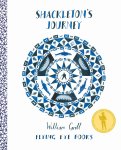
Since then, an array of stunning and innovative titles have populated the list, including the award-winning Hildafolk series by Luke Pearson, the highly acclaimed Professor Astro Cat’s Frontiers of Space from Ben Newman and Dr. Dominic Walliman and exquisite picture books and enchanting illustrated biographies from breakaway young talents like Wild by Emily Hughes and Shackleton’s Journey by William Grill, New York Times Best Illustrated Book of 2014 and winner of the 2015 Kate Greenaway Medal.

“When we started Nobrow Press one of our main sources of inspiration was children’s books. Our aim was to provide an independent platform for graphic art, Illustration and art comics in the UK and abroad. After publishing a few books aimed at younger readers under our Nobrow imprint we soon realised that we weren’t necessarily reaching our key demographic, that is to say, kids! So, after lots of hard work, the idea of a dedicated children’s imprint became a reality.” Sam Arthur

Sam told me, he can tell within a couple of pages if a submission is something they’d be interested in. Badly drawn and badly written are always a turn off. Also when someone hasn’t considered what types of books they publish, or don’t really know what Flying Eye Books do and who they are: this is just a waste of everyone’s time.

Sam revealed he never really has much time to read cover letters. He says that something along the lines of, Here’s a copy of my book, I’d love you to publish it. If you’re interested here are my contact details. Thanks for your time.’ is pretty much perfect! They are always looking for more original graphic novels for Nobrow Press and Sam is always looking for children’s picture books that fit their list.

“We firmly believe paper books are an important part of people’s lives. We feel that there is still great pleasure to be taken in the tactile nature of reading a physical book. We still like to collect tangible objects too and although the digital world is replacing some things, often it is simply providing a way to celebrate our love of the real world and the objects within it.” Sam Arthur

Sam’s advice to anyone wanting to submit their work is before you send them anything, make sure you have a good blog or website, which is up to date with your work. If they like a submission the first thing they do is check you out online to see other work you have done. An online presence could just be a bunch of drawings uploaded to a Flickr page – it doesn’t have to be a fancy website. 

“Our perception of you is based on a combination of your submission and your presence online. So my best advice is to consider this before you send anything in. If you have nothing it makes it difficult for us to get a picture of what you do and the decision to work with you will be affected by that.” Sam Arthur

wf144

You can read the full interview in the #144 issue of Writers Forum. You can find out more about Flying Eye Books from their website: www.flyingeyebooks.com.

End Each Chapter With a Cliffhanger

Cliff hangers keep your readers reading by building up the story’s tension. They literally leave your reader hanging.

cliff hanger

Cliff hangers should always involve your characters:

  • A character arrives
  • A character feels something
  • A character forgets something
  • A character is jolted into action
  • A character leaves
  • A character makes an important decision
  • A character makes an urgent demand
  • A character reacts badly
  • A character reacts internally to events
  • A character remembers something

Your reader has to turn to the next chapter to find out what happens to resolve the tense situation you have created.

Book Review – Writing From Life

Written by: Lynne Hackles

Published by: How to Books

Writing from Life

This book does exactly what it says on the cover. It is absolutely jammed packed with great ideas. So, even though `nothing much has happened to me’, just reading the book has fired my imagination.

If you are thinking about taking a writing course, I suggest you buy this book first and work though it, whether you want to write for children or adults, feature articles to gothic horror, as it will show you how your own past can make your writing come alive.

Writing from Life demonstrates how to take all those things that you thought were fairly insignificant and make good use of them. Nothing goes to waste from noticing the colour of a leaf to baking a cake for you grandson. It talks you through how you can use personal experiences to put more emotion into your writing and provide vivid settings. There are examples and anecdotes not only from the author’s life, but from a whole range of highly successful, professional writers, who talk about how they have used their personal experiences in their writing.

Each chapter contains exercises and tips that not only inspire you, but explain how YOU can make money from your writing by identifying the markets available to send your writing to.

This book is a `must have’ for every writer’s bookshelf.

I have previously published this book review on Amazon.

An interview with… Nicola Davis

For my Research Secrets, column in February 2009, I interviewed children’s natural history book writer, Nicola Davis.

nicola_davies

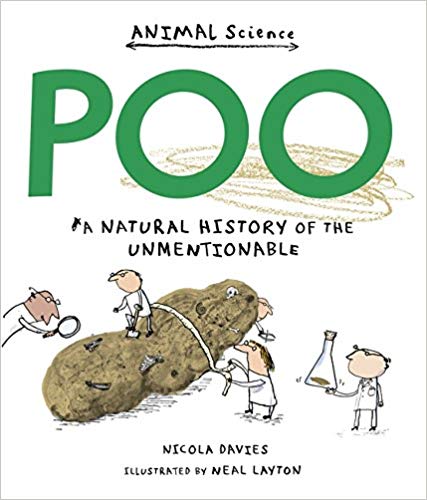
Nicola’s skill is writing narrative non-fiction in a way young children will understand. She has written several books in the Walker Read and Wonder series, including Big Blue Whale, One Tiny Turtle and Ice Bear. She has also written science books for older children, including Poo a Natural History of the Unmentionable, Extreme Animals and Who’s Eating You – a book about parasites.

poo

“I love my subject so research is a pleasure. Also, research gives me ideas for HOW to approach a subject, as well as providing the WHAT part. Writing a book makes you ask two questions: What am I going to write and HOW am I going to write it. Research a BIT to give you some of the WHAT of your book; then write an outline to give you the HOW, which will help you generate the right questions to ask to get all the rest of the WHAT.” Nicola Davis

Nicola has spent most of her life studying animals in one way or another so she is aware research doesn’t fall into a particular category. Much of the material that goes into her books is stuff she already knows. She explains she just needs to top up some of her general knowledge with a bit of Googling and library work.

She tries not to write about animals or habitats that she hasn’t seen but her work as a wildlife researcher, tour guide and TV presenter in all sorts of places certainly helps. She has visited animals in Newfoundland, Alaska, Kenya, Madagascar, Australia, Tobago – much of that time she is sailing on board various sorts of boats from 25 foot wooden sail boats to cruise ships. 

“I often use New Scientist and other more specialised scientific journals, plus a large library of zoological reference on my own shelves. It depends entirely on the project….For Ice Bear I knew most of the polar bear stuff but wanted more about polar bears and Inuit culture and both books and Internet were good for that. For Extreme Animals I collected likely material from trawling New Scientist and other journals for about six months before I put the book together.” Nicola Davis

Her aim is to show children that science isn’t a stone tablet… so if there is controversy over something, or an area where we just don’t know, she strongly believes it’s exciting, interesting and VITAL to say so.

Some information is simply too big and complex for young children. They need a background of other knowledge to understand it. Nicola’s text may not be able to deliver all of the tricky concepts, but it can, by subtle suggestion and association, prepare their minds to receive it later. For example, bat echolocation is fabulously complex, making use of frequency modulation and Doppler Effect in ways that science is only just beginning to fully understand. This is way too much for a young child, but the essence of the idea can be carried very simply:

“…bat shouts as she flies, louder than a hammer blow, higher than a squeak. She beams her voice around like a torch, and the echoes come singing back. They carry a sound picture of all her voice has touched.” (Nicola Davis from Bat Loves the Night, Walker Books 2001, page 14

It isn’t the whole story, but it’s true, accurate and lays the right foundation. Also and perhaps more importantly, it gives a feeling, an atmosphere of what is going on during echolocation; it imparts to the reader a basic emotional understanding of the facts.

You can read the full interview in the February 2009 #89 issue of Writers Forum.

You can find more information about Nicola Davis, her books and her writing at: www.nicola-davies.com

Write What Interests You

This is the opposite of write what you know. I don’t believe writers have to write what they know. You should write about what interests you and then find out more about it. In theory, if a topic interests you it will interest others.

I have a column in Writers’ Forum and authors and their research. These authors have not just written what they know they have taken interesting themes and topics and find out more through their research. In fact, some who have initially started out writing what they know have found after starting researching around the subject they did not know as much about it as they thought.

Just like mystery writer, Helen Moss, you should research around the subject and get a feel for the current theory and practice.

Helen Moss feature

When you are interested in a subject it shows in your writing. The passion and enthusiasm shines through. You might think, ‘most people are not interested in the things I am,’ but a passionate piece of writing will capture their hearts and entice them in.

Author, Nick Cook, is not a quantum physicists but it is a subject he is fascinated with. For his trilogy he used Twitter to find out the information he required to make his story believable and authentic.

Nick Cook snip

He said:

“I realised I needed to find out more about tornadoes and storm chasing to write my book. This was key… but how do you get in contact with a real expert dealing with an area that you are writing about? I tried all sorts of things, but was getting nowhere fast. What finally worked was sending out a call for help via social media, namely Twitter. Before long someone tweeted back to tell me there was this man that I should really talk to if I wanted to learn more about the storm chasing world. A few emails later Jesse agreed to do an interview with me. ” Nick Cook

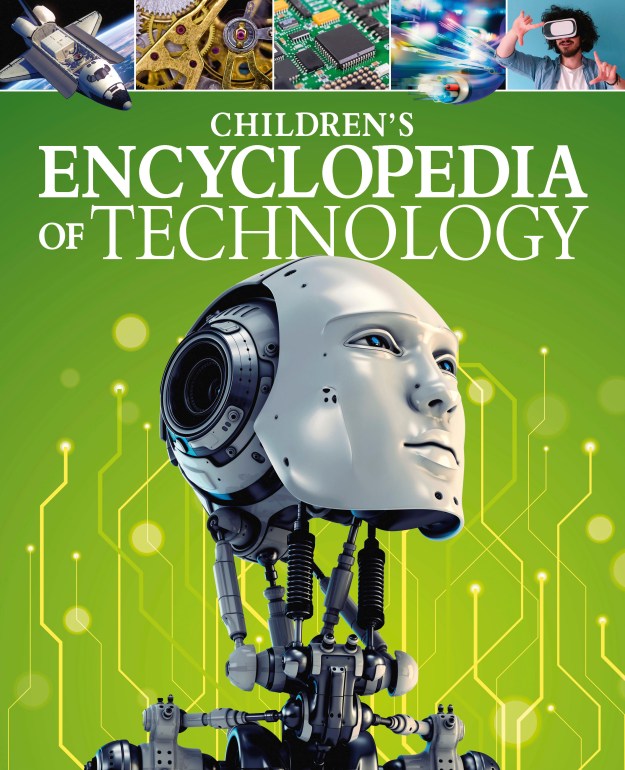
I get asked to write to commission about many subjects that I previously have very little knowledge about such as information on body technology for the Children’s Encyclopedia of Technology (co-written with Alex Woolf). In this case, specifically RFID chips, which are like business cards inserted under the skin. They can transfer contact details to smartphones and provide links to complex medical data. And Clustered Regularly Interspaced Short Palindromic Repeats (CRISPR), which exploits bacteria, in order to make changes to DNA and possibly cure genetic diseases.

ChildrensEncyclopediaOfTechnology-280x225-Cover_F-17May18

I also wrote in-depth information about ten scientists and ten great inventors for my graphic novels Heroes of Science which includes the stories of Nicolaus Copernicus, Charles Darwin, Marie Curie and Albert Einstein and Heroes of Discovery, which includes the stories of Ada Lovelace, Nikola Tesla, Tim Berners-Lee and Elon Musk.

Through extensive research I manage to write these books and I am very proud of them. I retain the knowledge for a limited time but then I seem to have a mind wipe to make way for any new information I need to know for my next book.

The message of this blog post today is if you are stuck for ideas think what you are interested in even if you don’t know anything about it and write about that.

You can find out more about me, my books and my writing career on my website: www.anitaloughrey.com or follow me on Twitter @amloughrey or Instagram @anitaloughrey

Book Review – The Scallywags

Title: The Scallywags

Written and illustrated by: David Melling

Published by: Hodder Children’s Books

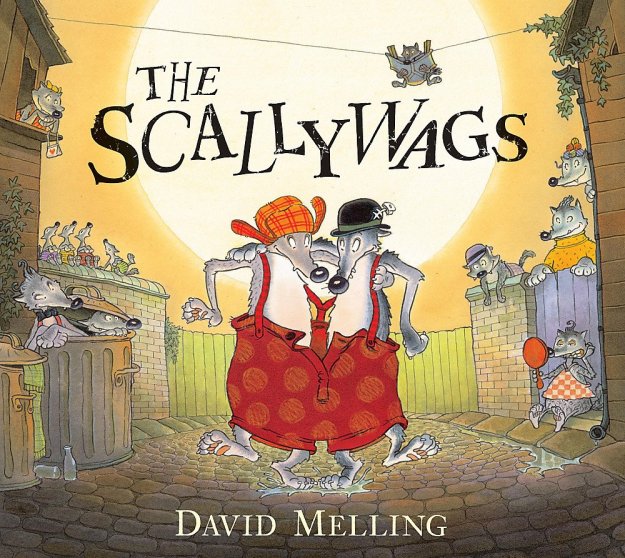
The Scallywags

This is a one of my favourite all time picture books. The Scallywags are a bunch of messy, noisy wolves who find it difficult to behave. They soon discover nobody likes bad manners and to be accepted by the other animals they will have to change their ways. David Melling’s illustrations of the wolves and their expressions will have you laughing in your seat.

His use of bold and patterned text are not just there for the sake of it but, compliment his wonderful illustrations. It is a brilliant book for reading aloud to the class or to your own children. Each of the wolves has its own distinct character, which make them stand out as individuals and extremely lovable.

The children will enjoy searching the pictures for the different ways the wolves try to improve their manners. But, I particularly liked the ending when all the other animals decide they preferred the wolves just the way they were at the start.

This book is ideal for sharing and would make the perfect addition to any book corner.

An interview with…NJ Crosskey

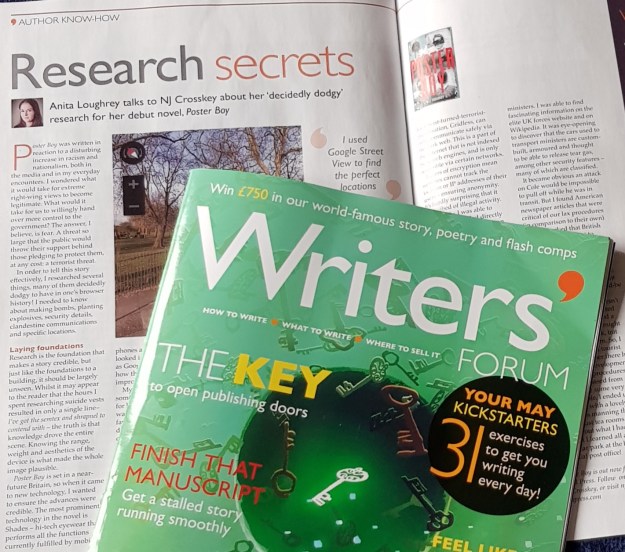
In my Research Secrets column in the national writing magazine, Writers’ Forum, this month I interview NJ Crosskey about her ‘decidedly dodgy’ research for her debut novel, Poster Boy.

Research Secrets - N J Crosskey photo2

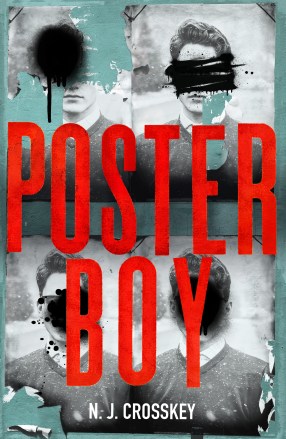
Poster Boy is about Rosa who is at her brother’s funeral with a bomb strapped to her chest. The story unfolds as a flashback showing Rosa growing up with her brother Jimmy and the events that led up to his death and ultimately turning him into a reluctant hero. This novel demonstrates how easy it is to manipulate and spin opinion using social media and fake news and how Rosa is able to see through the lies and the fear they are purposely creating.

NJ Crosskey explained to write this book she needed to know about making bombs, planting explosives, security details for government ministers, clandestine communications and specific locations. She told me:

“Research is the foundation that makes a story like Poster Boy credible. But just like the foundations to a building, it should be largely unseen. Whilst it may appear to the reader that the hours I spent online researching the construction and effects of suicide vests resulted in only a single line:

‘I’ve got the semtex and shrapnel to contend with.’

The truth is that knowledge drove the entire scene. Knowing the range, weight, and aesthetics of the device is what made the whole image plausible.” NJ Crosskey

She used Google street view to find perfect locations which she knew little about and was able to talk to experts by asking around amongst friends and on online writing forums. Her advice to other writers is to think outside the box when it comes to researching your novel. Facts are important, of course, but real human experiences and opinions are equally vital for ensuring your story comes across as authentic – no matter how fantastical your plot!

“There are so many tools these days for writers seeking information, we really are spoilt! As well as all the obvious places to find information (Google searches, newspapers and journals, text books etc), there are a whole host of other resources. You can find TED Talks by experts on almost any subject online, Ancestry.com is invaluable for those writing historical fiction, and sites such as Quora allow you to ask questions that can be answered by experts all over the world.” NJ Crosskey

Poster Boy_High res (1)

Poster Boy was published April 1st 2019 by Legend Press.

You can find out more by NJ Crosskey by following her on Twitter @NJCrosskey, or visiting her blog: https://njcrosskey.wordpress.com/

Combine Speech with Action

People rarely stand still and speak. They wave their arms, they pace, they scuff their feet, check their nails, get distracted or even make a cup of tea. I know these are all rather cliched examples but they serve the point. When writing dialogue have your characters do things whilst they speak.

child drinking

Spend some time people watching and observe for yourself the things they do when they talk. Keep in mind Anne fine’s words:

 “Don’t write about people you know, write what you know about people.” Anne Fine

And what better way to find out about people than to watch them.

“A rough estimate would be one third dialogue, one third action and one third introspection.” Diane Doubtfire

Introspection are the character’s inner thoughts.

“A character’s thoughts can greatly enhance a story: deepening characterisation, increasing tension, and widening the scope of a story.” Nancy Kress

So next time you are out and about observe some of the little actions people do that hint at their character. It all adds to the story.

Book Review – Pink!

Title: Pink!

Written by: Lynne Rickards

Illustrated by: Margaret Chamberlain

Published by: Wacky Bee Books

Pink

Pink! is a heart warming picture book about challenging stereotypes. It would be a great way to stimulate a discussion about gender both for parents at home and teachers in school. Patrick the Penguin turns pink overnight. His parents try to reassure him that it is OK to be a boy who is pink, but the other penguins tease him.

Discussing the issue of teasing and bullying could be used to encourage compassion for others and also empathy for people who have experienced sudden change. Patrick was not born pink and it was not a gradual change of colour over time. He just woke up one morning and discovered he had turned pink. This must have been a very traumatic experience for Patrick. Suddenly he is different and not because he wanted to be different he just woke up different.

Patrick does not like being different, so he decides to run away to Africa to be with the pink flamingos. But he soon discovers he is not suited to the African environment so returns home where the other penguins are eager to learn about his adventures.

Again from a teaching point-of-view this book would be useful in the classroom to discuss animal adaptations and climates in different parts of the world. The children can compare the features of Antarctica’s penguins with African flamingos and how they are suited to their environment.

The book was first published in 2008 by Chicken House. Pink! Is also a musical. Pink! The Musical, written in collaboration with Hopscotch Theatre, has toured over 200 Scottish primary schools.

This book is empowering for children and demonstrates that the colour pink is for everyone regardless of gender. I believe it will encourage children to be more confident in themselves and the way they look.