Tag Archives: Zephyr

An interview with… Natasha Farrant

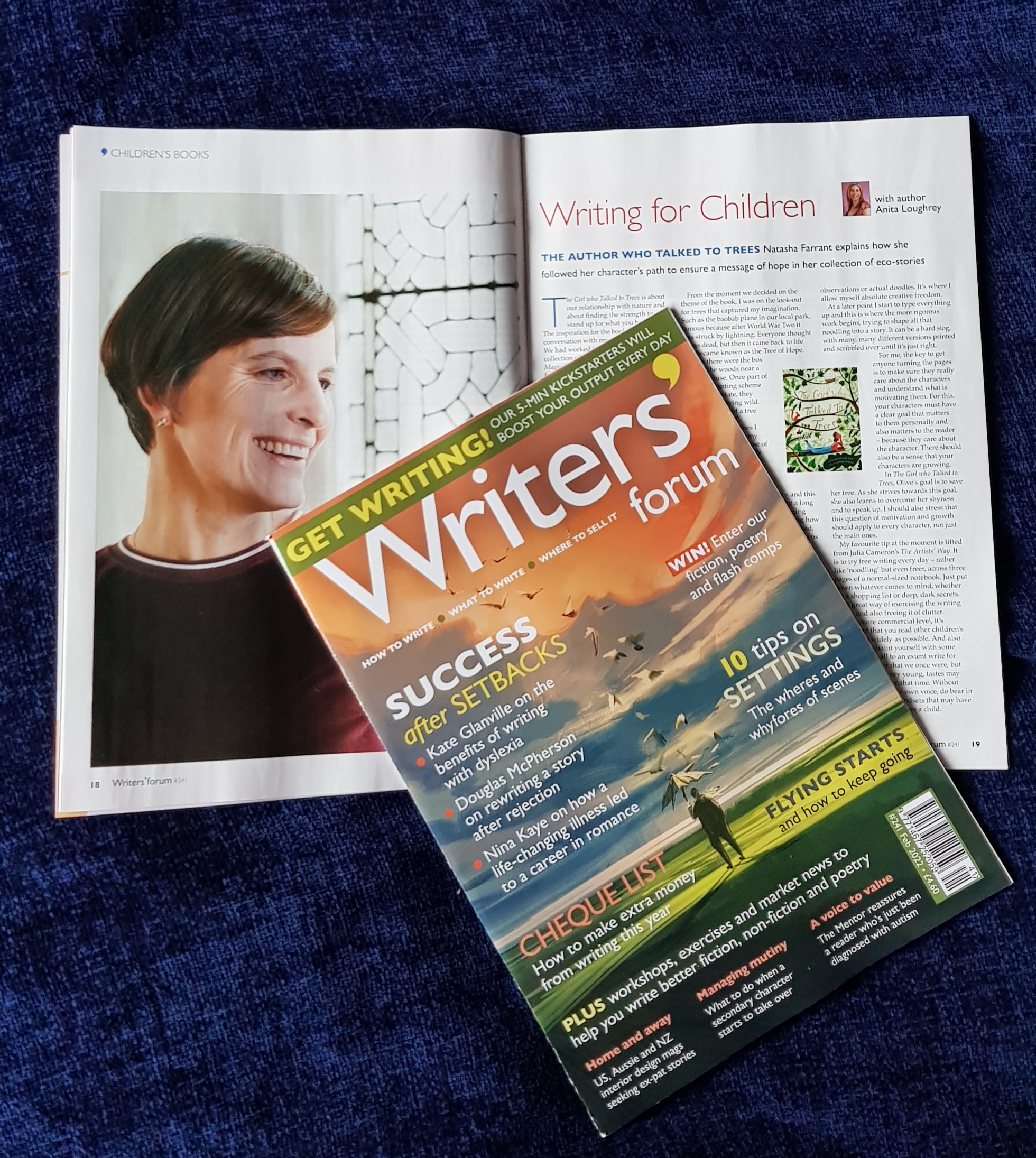
When I interviewed Natasha Farrant for issue #241 20 Jan 2022 of Writers’ Forum, she explained how she ensures there is a message of hope in her books for children.
At a fundamental level, The Girl Who Talked To Trees is about our relationship to nature and about finding the strength to stand up for what you believe in. The inspiration for the book was born of a conversation with her publisher at Zephyr. They had worked together on another collection of stories, Eight Princesses And A Magic Mirror and were thinking of ideas for a new book along a similar format. For a long time she had been thinking about how to respond creatively to the climate and ecological crisis.

She said it is so difficult to know how to do this for children – at an existential level, how do you balance the magnitude of the crisis with hope for the future? One of Natasha’s publishing friends suggested to do it through myth and fairy tale, and that really struck a chord with Natasha.

“I knew I wanted to write about the crisis but I also knew I wanted a book that would give hope for the future. I’m not saying trees are going to get us out of this mess, but they are a key part of the jigsaw – and such a relatively simple part.” 

Natasha Farrant

She continued there are two elements to the book: the major element is the stories themselves, but each story is introduced by a number of science facts. Natasha feels stories are such a powerful force in bringing about change, but without the science we’ll get nowhere.

As with all her books, though the themes are serious and the starting point in this case was so huge, the overall aim remained the same: to tell stories which would captivate and transport. She spent a long time thinking about Olive and getting to know her, wondering what traits I could give her that children could identify with.

So:

‘She was clever and kind and intensely shy and her best friend was a four-hundred-year-old oak.’

Extract from The Girl Who Talked To Trees

Which fits, because:

‘When you are so shy you dare not even look at anyone in case they want to talk to you – or worse, want you to talk to them – a tree is a very sensible choice for a friend.’

Extract from The Girl Who Talked To Trees

From the moment they decided on the theme of the book, Natasha was on the look-out for trees which captured her imagination, like the baobab plane in our local park, famous because after World War Two it was struck by lightning. Everyone thought it was dead, but then it came back to life and became known as the Tree of Hope. Then there were the box trees in the woods near one of her friend’s homes. Once part of a formal planting scheme on a grand estate, they were now growing wild. Natasha liked the idea of a tree that had escaped. 

Natasha revealed she prefers to write long hand, using a refillable fountain pen (no throwaway plastic) her husband bought her as a gift twenty years ago. She uses extra-large Moleskine notebooks because she likes their paper, and few things give her greater pleasure than the sensation of ink gliding across those smooth pages.

“This is a serious point: writing is hard, so it’s important to make those bits I can control as pleasurable as possible.”  

Natasha Farrant

The notebook writing is for doodling, or as a fellow writer calls it, noodling. Natasha sets herself a goal of three pages a day for a first draft, and tries not to think too much about what she is writing so it is more like exploring, free to go in any direction she desires. She writes on the right-hand page, leaving the left-hand page free for notes, observations or actual doodles. She allows herself absolute creative freedom.

At a later point she starts to type everything up. Natasha claims this is where the more rigorous work begins, of trying to shape all that noodling into a story. This can be a hard slog, with many, many different versions printed and scribbled over and retyped until it’s just right.

For Natasha, the key to get anyone turning the pages is to make sure they really care about the characters and understand what is motivating them. For this, your characters must have a clear goal, that really matters to them personally and – because they care about the character – also matters to the reader. There should also be a sense that your characters are growing.

In the case of The Girl Who Talked To Trees, Olive’s goal is to save her tree. As she strives towards this goal, she also learns to overcome her shyness and to speak up. Natasha stressed this question of motivation and growth should apply to every character, not just the main protagonists.

Natasha said, if you want to write for children, it’s important that you read other children’s authors as widely as possible. And also that you acquaint yourself with some children.  We all to an extent write for the child reader that we once were, but unless you are very, very young, tastes may have evolved since that time. Without losing sense of your own voice, do bear in mind trends and mindsets which may have changed since you were a child.

You can find out more about Natasha Farrant at www.natashafarrant.com, @NatashaFarrant1 (Twitter) and @natasha_farrant (Instagram)

To read the complete feature you can purchase a copy of #241 20 Jan 2022 issue of  Writers’ Forum by ordering online from Select Magazines.

To read my future Writing 4 Children or Research Secrets interviews you can invest in a subscription from the Writers’ Forum website, or download Writers’ Forum to your iOS or Android device.

An Interview with… Tania Unsworth

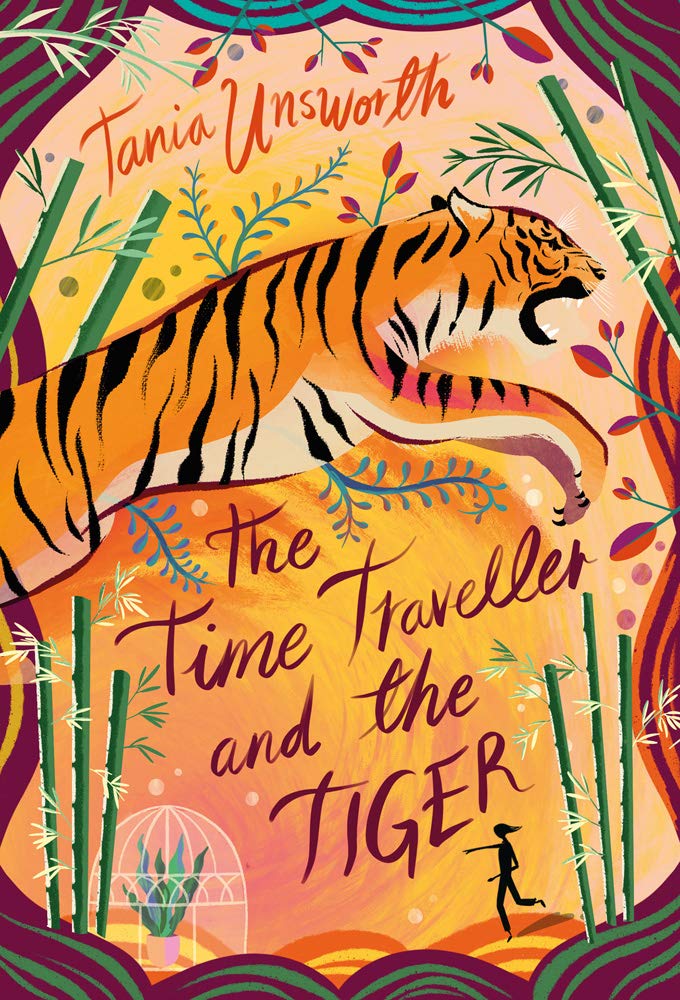
This week’s author interview is a flashback to when I interviewed Tania Unsworth For my Research Secrets slot in Writers’ Forum, issue #233 Jun 2021. Tania talked to me about how in-depth research permeates every aspect of her novel, The Time Traveller and the Tiger, published by Zephyr.

Tania told me that even before she began writing the book, she knew she needed to tell part of the story from the point of view of the tiger. But she didn’t want him to be a creature of whimsy or magic. She wanted him to be real. Or as close to real as she could manage, given the impossibility of knowing exactly what it’s like to be another animal. It was important for her to learn as much as she could about the physical characteristics and behaviour of wild tigers.

To do this she started by revisiting two classic books: My India the memoirs of legendary tiger hunter-turned conservationist Jim Corbett, and Peter Matthiessen’s powerful Tigers in the Snow. Then a quick google search turned up The Tiger by John Vaillant. Tania told me the latter extraordinary, beautifully written book was full of information and imagination-triggering insights. It also had a lengthy bibliography enabling Tania to source less well-known – but vital – texts, such as Richard Perry’s The World of the Tiger and Spell of the Tiger by Sy Montgomery.

The Time Traveller and the Tiger by Tania Unsworth

Tania explained she did far more research for The Time Traveller and the Tiger than ended up in the novel, filling her notebook with pages and pages of unused facts, along with drawings of various jungle creatures, because she approached the research in a broad, almost scattershot way, happy to go down any number of online rabbit holes, or wade through scientific accounts detailing how tigers are able to see in the dark or the life cycle of bamboo trees.

“I wasn’t always sure what I was looking for, but I knew it when I saw it; the spark of something I could use, the sudden reshaping of an idea. Casting a wide net in this way made the research process far more dynamic. It didn’t just provide authenticity for my story, it also helped me discover how to tell that story.”

Tania Unsworth

Along with books, Tania scoured YouTube for clips of tigers roaring, growling and ‘chuffing’, and watched documentaries such as David Attenborough’s Dynasties to get a sense of the physical presence of tigers – the way they move and sound and react to their environment.

Her book is set in the jungles of central India, and initially she thought it would be enough to go through Google Images for pictures of ‘Kipling country’, and do a thorough online search on the flora and fauna of the region to find out what a banyan or a peepal or a sal tree actually looked like. But she soon realized that this wasn’t going to be enough. Tania revealed spending a week in Kanha and Bandhavgarh – two tiger reserves in Madhya Pradesh changed everything.

“Setting is important to me as a writer, particularly in this book, where the beauty and fragility of the natural world is a big part of the story itself. You can’t tell what the jungle smells like (wild basil and warm grass) just from looking at pictures. And no audio recording of birds and animals can compare to standing in the forest and hearing them for yourself. The notes I made during my week in India transformed the second draft of my book and helped to bring my story to life with a hundred details. The way that termite mounds glitter with tiny fragments of mica. The sound of dew dropping from leaf to leaf in the early morning. The shafts of sunlight pouring through the trees like columns in a temple…”

Tania Unsworth

Her trip wasn’t just useful in terms of providing authentic details. It also gave herideas for plot and character development. For example, the villain iis a man called Sowerby who operates out of a remote hunting lodge. She had a lot of fun describing his study – a ghastly collection of knick-knacks and furniture, all made from animal parts. The inspiration for this came from a visit to the Museum of Science in Boston where I’d marvelled at the reconstruction of a gun room belonging to a certain Colonel Colby, crowded with animal skins and trophies.

When Tania googled ‘objects made from animal parts’ she came across hundreds of old photographs of items – from chairs to waste-paper baskets – that had been constructed out of various wild creatures. Discovering this long-ago trend for grisly home décor gave credence to my description of Sowerby’s room.

To find out more about Tania and her novels visit her website: www.taniaunsworth.com and follow her on Twitter: @TaniaUnsworth1.

You can read my review of The Time Traveller and the Tiger on my blog here: Book Review: The Time Traveller and the Tiger.

To read the complete feature you can purchase a copy of #233 Jun 2021 Writers’ Forum by ordering online from Select Magazines.

To read my future Writing 4 Children or Research Secrets interviews you can invest in a subscription from the Writers’ Forum website, or download Writers’ Forum to your iOS or Android device.

An interview with… Finbar Hawkins

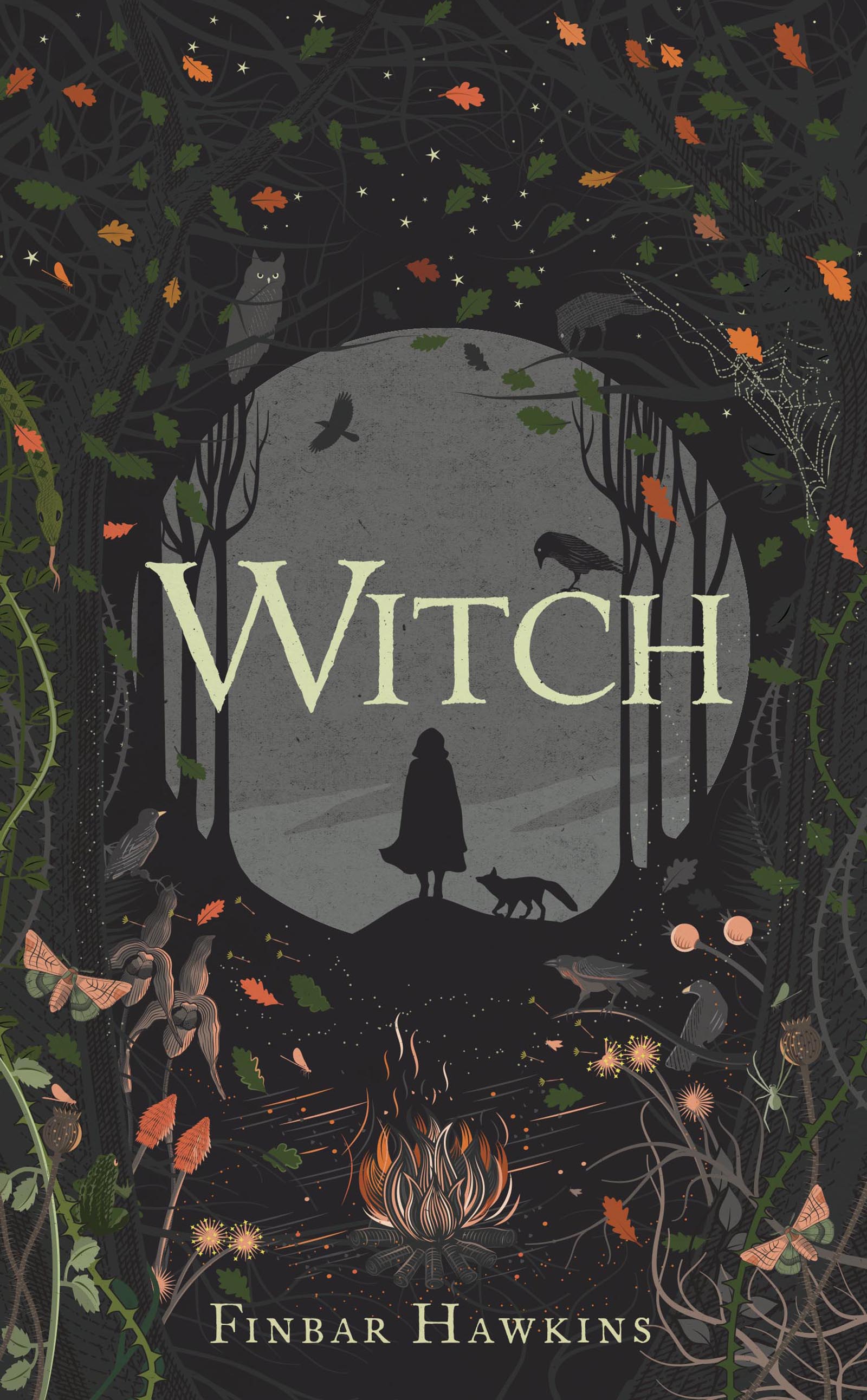
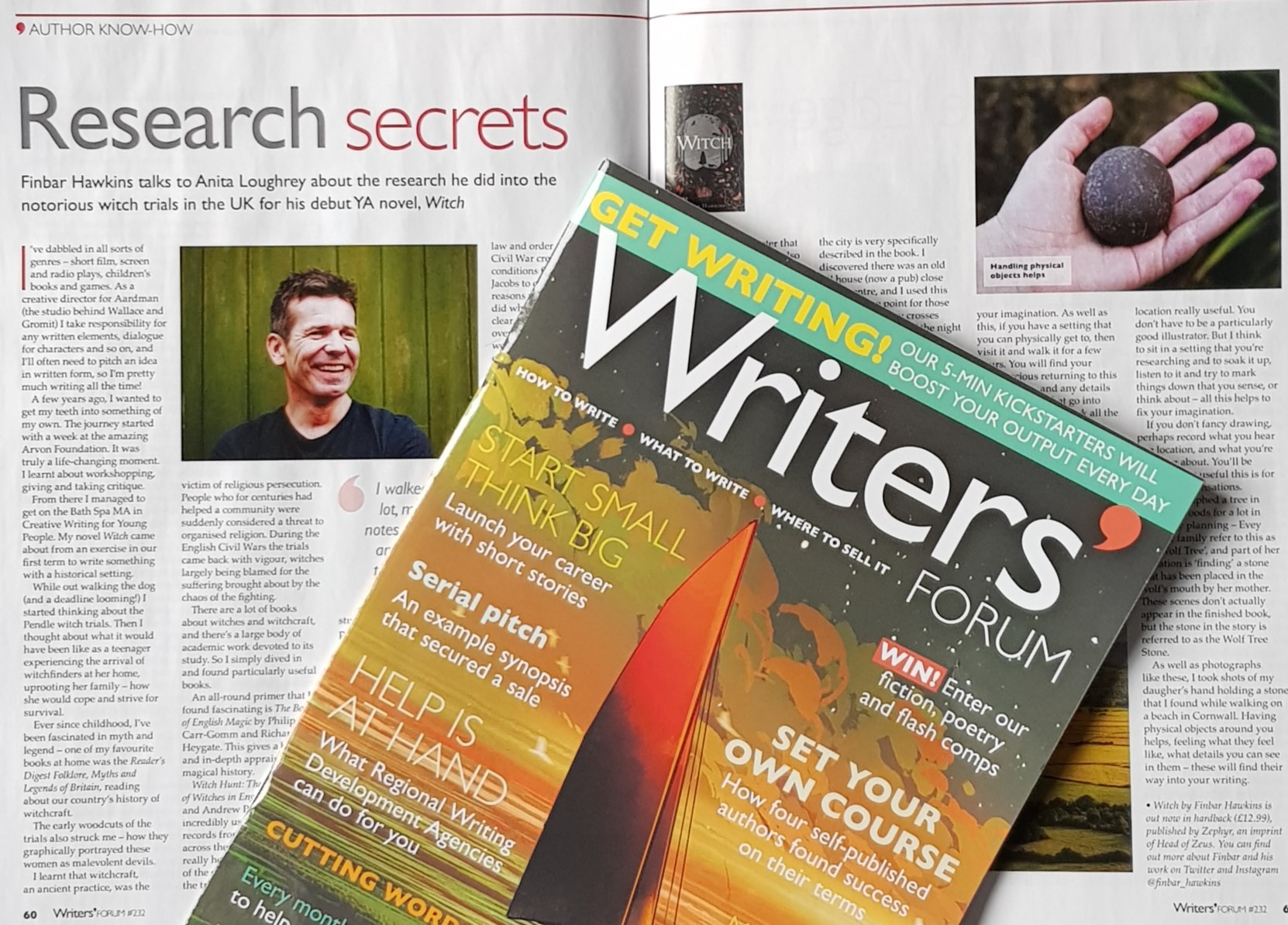
In an interview with Finbar Hawkins in April 2021, he told me all about the research he did into the notorious witch trials in the UK for his debut YA novel, Witch.

He said Witch, came about from an exercise in his first term of an Arvon foundation course where they were asked to write something with a historical setting.

“While out walking the dog (and a deadline looming!) I started thinking about the Pendle witch trials. And from there I thought about what it would have been like as a teenager experiencing the arrival of witch finders at her home, uprooting her family, how she would cope and strive for survival.”

Finbar Hawkins

Finbar explained that ever since childhood, he has been fascinated in myth and legend – one of his favourite books at home was the Reader’s Digest, Folklore, Myths and Legends of Britain, reading about our country’s history of witchcraft. The early woodcuts of the trials also struck him– how they graphically portrayed these women as malevolent devils. He learnt that witchcraft, an ancient practice, was the victim of religious persecution. People, who for centuries had helped a community, were considered a threat to organised religion. And during the English Civil Wars the trials came back with vigour, witches largely being blamed for the suffering brought upon by the chaos of the fighting.

He said there are a lot of books about witches and witchcraft, and there’s a large body of academic work devoted to its study. So he simply dived in and found particularly useful books. An all-round primer, which he found fascinating is The Book of English Magic by Philipp Carr-Gomm and Richard Heygate, this gives a brilliant and in-depth appraisal of our magical history. Witch Hunt: The Persecution of Witches in England by David and Andrew Pickering was incredibly useful, gathering records from every county across the centuries. This book really helped Finbar to build a picture of the general hysteria around the trials. And for an in-depth study into witches, their portrayal and their importance as symbols, The British Witch by P.G.Maxwell-Stuart is exhaustive and thorough.

In Finbar’s book, the witchfinder, Jacobs, is based on the real-life and self-titled Witchfinder General, Matthew Hopkins. With his associate John Stearne, this determined young man cut a swathe across the East of England over the course of a bloody year in 1646. Witchfinders by Malcolm Gaskill was his go-to piece of research to understand the circumstances that led to Jacobs’ campaign.

He also visited an exhibition of Goya’s sketches of Witches at the Courtauld Institute (https://courtauld.ac.uk/gallery/what-on/exhibitions-displays/archive/goya-the-witches-and-old-women-album.

“These sketches definitely helped with the coven and crowd scenes in my book.”

Finbar Hawkins

Finbar revealed Spellbound was a wonderful exhibition at the Ashmolean Museum in Oxford https://www.ashmolean.org/spellbound  He told me that they had a copy of Matthew Hopkins’ The Discovery of Witches (1647) which is chilling to see. Not only did this notorious man kill over a hundred women, he encapsulated and really celebrated his act for posterity.

An important part of Witch is Evey’s voice, and her way of seeing the world. Finbar wanted her to have this very specific, lyrical way of speaking, to make her sound very different to the norm. She’s also grown up in the West country so he wanted her to have that accent as part of her speech patterns. He used online accent archives to get the rhythms of her speech right. Dialectsarchive.com and also searched on YouTube for interviews with people from the West.

Witch is set in Wiltshire and in particular The Mendips area. He wanted the girls, Evey and her younger sister, Dill, to be travelling across the hills and valleys of this area. To achieve the dramatic sweep that this beautiful setting gives Finbar walked the area a lot, made notes on flora and fauna and took lots of photographs. He also found sketching in location really useful for details and sensations.

He photographed a tree in his local woods for a lot in backstory planning – Evey and her family refer to this as the ‘Wolf Tree’ and part of her initiation is ‘finding’ the stone, where it has been placed by her mother in the mouth of the wolf. These scenes never actually appeared in the final book, but the stone in the story is referred to as the ‘Wolf Tree Stone’.

“I took shots of my daugher’s hand holding a stone he found while walking on a beach in Cornwall. Having physical objects around you helps, feeling what they feel like, what details you can see in them, these will find their way into your writing.”

Finbar Hawkins

You can find out more about Finbar and his work @finbar_hawkins on Twitter and Instagram.

To read the complete feature you can purchase a copy of #231 Apr 2021 Writers’ Forum by ordering online from Select Magazines.

To read my future Research Secrets or Writing 4 Children interviews you can invest in a subscription from the Writers’ Forum website, or download Writers’ Forum to your iOS or Android device.
You can buy copies of Witch by Finbar Hawkins from your local bookshop, or online at uk.bookshop.org, an organisation with a mission to financially support local, independent bookshops.

Book Review: The Time Traveller and the Tiger

TitleThe Time Traveller and the Tiger

Written by: Tania Unsworth

Illustrated by: Helen Crawford-White and Laura Brett

Published by: Zephyr

The Time Traveller and the Tiger is a remarkable book about a young girl called Elsie who aspires to be a writer. She goes to stay with her Uncle John where she discovers a tiger skin in the spare room and an exotic flower in the greenhouse..

This book is different from other books in that it is cleverly written from several points of view. The first chapter is from John’s point of view of the inciting incident that sets the story in motion – when he killed the tiger which he regrets. The story continues from the future in Elsie’s point of view until she is transported back in time to 1940 India where Great Uncle John is a boy again. From that point the story is mainly Elsie’s point of view, with intermittent chapters from Mandeep’s and the tiger’s point of view, really getting into the tiger’s head with dramatic effect and in a humorous twist from Sowerby, the antagonist’s point of view and his untimely death. I enjoyed the different points of view and gaining a deeper understanding of the character’s motivations and emotional state.

I was captivated by Great Uncle’s John’s regretful decision to shoot the tiger and carried along with Elsie’s goal to prevent him making the same mistake again, changing both their futures and ultimately saving his brother’s life. Tania’s writing flows easily from scene to scene with realistic dialogue and amusing exchanges. She creates a stunning, colourful world set in India with her vivid and evocative descriptions of the animals and vegetation. These are enhanced by the truly breath taking charcoal illustrations of the Tiger scattered throughout the pages.

The Time Traveller and the Tiger touches on issues of sexism and racism as the attitudes and opinions of the time are perceptively portrayed and expertly balanced by Elsie’s views and feelings of these dated and bigoted opinions.

The timeless message of preserving our wildlife rings loud and true from every page as the plot highlights the plight of the tiger and other endangered species and gives young reader’s options at the end of the book how they can help protect their planet from such species dying out altogether. The timeless message of preserving our wildlife rings loud and true from every page.

This book was previously reviewed for Armadillo Magazine.

Book Review: Witch

Title: Witch

Written by Finbar Hawkins

Published by: Zephyr

Witch is a remarkable debut novel, which encompasses the themes of betrayal, family, friendship, identity, revenge, self-discovery and sibling rivalry. The graphic descriptive nature of the opening scenes makes them emotionally difficult to read but sets the tone and atmosphere of the book. The fear and superstition, which permeates this novel draws the reader in.

The fiery, red-haired main protagonist, Evey, is a fascinatingly flawed character who blunders through life, heart first. Her voice is unique depicting the time and place the novel is set – firmly in 17th century Wiltshire. She is determined to avenge her mother’s death at the hands of the vicious witch hunters which conflicts the promise she made to her mother that she would keep Dill, her younger sister, safe.

Keeping this promise is confounded by the fact she is jealous of Dill, believing she was their mother’s favourite as she inherited the magick and this is why their mother gave Dill the mysterious scrying stone and not her. This jealousy is magnified by Evey’s constant rejection of Dill’s nick-name for her, Eveline of the Birds. Their complicated relationship is well constructed and realistic.

Evey is torn between the duty of the promise, her love for Dill, and the tormenting jealousy that threatens to rip them apart. She refuses to accept magick also flows through her own veins and she is the strongest witch of them all. This refusal to accept her fate makes her an unreliable narrator.

In her anger, Evey steals the scrying stone from her sister in the night and goes to hunt her mother’s murderers who are gathering for the witch-trials. She leaves Dill with their mother’s elder sister, Aunt Grey, who unknown to them is a collaborator with the witch hunters. Finbar Hawkins clearly shows how accusations of witchcraft were used as a weapon against independent, strong and resourceful women, portraying an era where women were persecuted for using traditional herbal medicines.

A dramatic grim depiction of cruel times and the strength found in sisterhood and friendship. I particularly liked the friendship and love between Evey and Anne, ‘Green Eye’ the daughter of Lord Whitaker the local magistrate. Together they fight against the male dominated system and their betrayers. When the line between using magic to heal and using magic to harm becomes blurred, Anne is there to steer her on the correct moral path.

The plot concludes in a climatic crescendo in the final scenes when Evey is finally forced to accept her powers and realises she has to work with her sister to bring balance. Her gradual acceptance of her powers is highlighted by the change in her emotions and how she grows to understand her mother and the gifts she has inherited.

This novel is a spectacular emotional roller-coaster steeped in history, myth and folklore.