Category Archives: Writing 4 Children

An interview with… Jake Hope

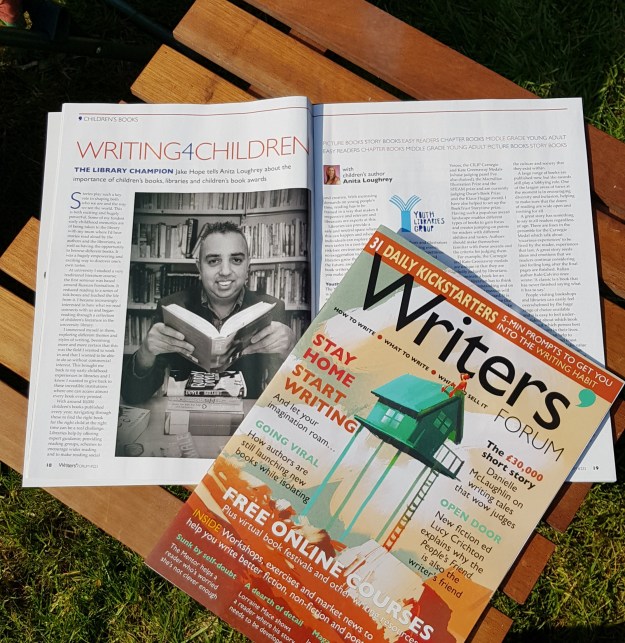
Jake Hope (Chair of CILIP’s Youth Libraries Group and Chair of the CILIP Carnegie and Kate Greenaway Awards Working Party) talked to me about the importance of children’s books, libraries and children’s book awards. He talked about how stories play such a key role in shaping both who we are and the way we see the world.
Jake_Hope feature 4

Some of his fondest early childhood memories are of being taken to the library with his mum where he would listen to stories read aloud during story times by the authors and the librarians, as well as having the opportunity to browse different books. He explained exploring and experimenting in this way is a hugely empowering and exciting way to discover and widen one’s own tastes.

Throughout his life Jake has immersed himself in exploring different themes and styles of writing. With around 10,000 children’s books commercially published every year, navigating through these to find the right book for the right child at the right time can be a real challenge. Libraries help by offering expert guidance, providing reading groups, schemes to encourage wider reading and to make reading social and creative. With increasing demands on young people’s time, reading has to be framed in a way that makes it responsive and relevant and librarians are experts at this.

Libraries can provide a safe and neutral space where this can happen and where individuals can explore their own tastes in a cost-free, risk-free environment. It is no exaggeration to say that libraries grow the readers of the future and as children’s book writers and illustrators you make this possible.

Youth Library Group

YLG logo jpg

Jake told me that the Youth Libraries Group is all about connections. They are one of the special interest groups of CILIP (the library and information association) and have over 1,500 members. The membership is comprised of librarians working with children and young people in public libraries, in school libraries and for school library services – these are organisations who tailor collections of books to meet curriculum needs and who work to provide support and advice on reading for pleasure and library provision to schools.

The Youth Libraries Group is an extraordinary collective of highly committed and knowledgeable experts who share a unique passion for reading and for library provision for children and young people. The connections the group have means we are able to support through giving advice on what has been published in the past and present, providing access to groups of young readers who can often test manuscripts or provide insight into their reading tastes. They support authors and illustrators through organising events, promotions and competitions to bring greater focus and profile to creators.

Children’s book awards

Print

Children’s book awards play a role in helping to make sure that certain types of book do not go unrecognised. Humorous writing, for example, does not always get the most recognition through awards, though funny books play such an important role in reading for pleasure. Awards like the Roald Dahl Funny Prize, as was, and the Laugh Out Loud awards, the LOLLIES, help to make sure these titles don’t get overlooked.

Jake has been a judge for many book awards such as: the Blue Peter Book Awards, the Costa, the Branford Boase, the Diverse Voices, the CILIP Carnegie and Kate Greenaway Medals (whose judging panel I’ve also chaired), the Macmillan Illustration Prize and the STEAM prize and am currently judging Oscar’s Book Prize and the Klaus Flugge award. He also helped to set up the BookTrust Storytime prize.

Having such a populous award landscape enables different types of books to gain focus and creates jumping-on points for readers with different abilities and tastes. Awards remain responsive to the culture and society that they exist within. Jake advises authors to make themselves familiar with these awards and the criteria for judging them.

“A large range of books are published now, but the awards still play a lobbying role. One of the largest areas of focus for this lobbying at the moment is in encouraging diversity and inclusion, helping to make sure that the doors of reading are wide open and are inviting for all.” Jake Hope

Jake elaborated that a great story has something to say to all readers regardless of age. Criteria are a useful way for book awards to appraise a range of different titles and styles of writing, but it’s important not to downplay the overall impact that language, characterisation, plot and style can have on a reader too.

“By working together and creating critical mass we can support one another and build new opportunities. With our combined skills and knowledge we can experiment and excite new generations of readers.” (Jake Hope)

People can easily feel overwhelmed by the huge range of choice that is available and it is easy to feel under-confident about which book might suit which person best at which point in their lives. Book awards can help to build awareness and boost confidence. In spite of the value of awards, it is important not to downplay the fact that every time a reader picks up a book and connects with it, this is the biggest win of all.

The present is not an easy time either for libraries or for authors and illustrators.  Challenging times can present real opportunities for innovation and imagination, however, and by working together and creating critical mass we can support one another and build new opportunities. With our combined skills and knowledge we can experiment and excite new generations of readers.

To find out more about Jake Hope visit his website: www.jakehope.org and follow him on Twitter @jake_hope

To find out more about the Youth Libraries Group visit: www.cilip.org.uk/ylg and follow them on Twitter @youthlibraries

To read the complete feature you can purchase a copy of #223 2020 Writers’ Forum online from Select Magazines.

To read my latest Research Secrets or Writing 4 Children interviews you can invest in a subscription from the Writers’ Forum website or download Writers’ Forum to your iOS or Android device.

An interview with… Cas Lester

In September 2017, I interviewed Cas Lester about some of the differences between writing a children’s TV series and writing a children’s book series.

Cas Lester author picture

Cas explained for both children’s dramas for CBBC and her children’s books she always looks for a fresh idea or contemporary ‘spin’ on an existing idea. For example, Mischievous fairy Nixie wears ‘doc martin’ style boots and keeps a wand in one and a spanner in the other because she’s better at DIY than she is at magic. Her Harvey Drew books are based round the contemporary topic of space trash. 

When she is developing her characters and their world she researches the story territory and then does a huge amount of playing around with the idea – she revealed usually way more than is strictly necessary. She wrote a post-it note to make herself actually start to writing the first Harvey Drew manuscript, which she stuck to her laptop. It read: Stop mucking about and write the book.

Cas told me she plans everything as she is not one of those brave writers who can simply start writing and see where the story takes them. She believes this is because she is used to multi-episodic TV dramas where there are multiple writers and they all have to go in the same direction. All the episodes have to head towards the series finale, and the various subplots can’t conflict or be inconsistent. She also writes lots different scenes and chunks of dialogue until she can see the world and hear the characters speak. She explained she can’t write unless she can run the scenes in her head like an animation or a movie.

“I always write a series bible. For the Nixie books I included a calendar of events, the fairy realm, the fairies’ characters, jobs, and catchphrases, what their little houses were like and, crucially, the rules of magic. I am fanatical about consistency of rules. Again, I think this is because of my experience of creating multiple storylines with multiple writers. Inconsistency irks me, and I can’t bear it if rules are broken or fudged for narrative convenience. It’s cheating! My books are inspired by children – sometimes my own.” (Cas Lester)

Cas siad that one of the great things about writing children’s books is that they’re often illustrated. This can help fix the characters and the settings in your head. But not when you write the first book in any series, of course. She think in pictures. So she downloads images to help her get a handle on her characters, settings and key locations.

Cas loves subplots. She explained this is because when you’re making a children’s drama series, the UK law limits the hours a child can work on any day (and rightfully so). So you have a good proportion of scenes without your central protagonist.  Inevitably, this usually means having at least a B and probably a C plot too. Children’s books seem to be more linear.

“My writing is powered by chocolate – not always my own!” (Cas Lester)

do you speak chocolate

She told me how one of the big differences in writing children’s books rather than children’s TV is that the characters on the pages don’t age the same way real children do. She elaborated:

“The fabulous Dani Harmer was, I think, 12, when we cast her to play 10-year-old Tracy Beaker. With every following series she, and the entire child cast, grew a year older. We had to reflect this in the writing. Four series on, you couldn’t have 14-year-old Tracy behaving like a 10-year-old. It also meant we had to add some new, younger, characters in the following series in order to keep the age pitch right for the audience. It was always a nightmare when the children came to the first rehearsals of any follow up series. The boys changed more than the girls. Sometimes they’d shot up several inches, their voices had broken and they’d started shaving.” (Cas Lester)

In her book series there is no passage of time between the books. The characters don’t get older. They stay exactly the same, which Cas finds a lot easier. But she does have an ongoing story line. In the Harvey books it’s the on-going story line about Harvey trying to get home to Earth. With Nixie it’s about how Adorabella the Goody, Goody Fairy is always getting her into trouble with the Fairy Godmother.

When she is pitching an idea for a series, she drafts several story lines – even if only to convince herself that the idea really does have ‘long legs’.

“I always pitch at least two or three more books in the series.  It’s important to show that the subsequent books won’t be formulaic and that there is sufficient (ideally endless) fresh territory to plunder. Interestingly, when OUP commissioned the four Nixie books they wanted one for each season of the year, to tie in with publication dates, which isn’t something that would have occurred to me.” (Cas Lester)

Her tip for other writers interested in writing for children, whether for print or TV, is to remember to write for children as they are NOW and not as they were when you were a child.

To read the complete feature you can purchase a copy of #191 Sep 2017 Writers’ Forum online from Select Magazines.

To read my latest Research Secrets or Writing 4 Children interviews you can invest in a subscription from the Writers’ Forum website or download Writers’ Forum to your iOS or Android device.

You can find out more about Cas Lester and her books on her website, www.caslester.com and on Twitter @TheCasInTheHat

An interview with… Eve Ainsworth

In December 2017, I interviewed award winning children’s author, Eve Ainsworth, about the issues she covers in her YA books and how she develops the different voices for her YA characters.

wf2

She explained:

“My YA books focus mainly on issues I experienced when I was working in schools, or issues I remember facing myself as a teen. I explore topics such as bullying, mental health, toxic relationships and self-harm.” (Eve Ainsworth)

In Damage the themes of self-harm, grief and alcoholism are explored. These are quite dark topics. In my child protection role, I had dealt with self-harm cases within the school and was trained in this area. I had regularly spoken to young people who had harmed and had been taught why so many chose to do so.

Eve told me how she had experienced a recent grief in the loss of her father and how this made the writing process extremely difficult. She’d also had direct experience of alcoholism as my older brother died of drink related illness.

Eve’s aim is to increase awareness and understanding by raising these themes and hopefully help to support those struggling.

“I know when I was young, I felt isolated at times and books helped me to tap into the feelings and emotions I was experiencing. It helped me and ultimately I hope I can help others.” (Eve Ainsworth)

Her favourite thing about writing for young adults is the characters’ voices. She love the way they are vibrant, questioning and constantly encouraging her, pushing herto break down the boundaries she might have set herself.

She reads her pieces out loud and if something sounds out of place or too adult, she’ll delete it immediately. In her head her characters have a total back story, she can tell how they’ll react to something or judge an action. She explained this is because they are part of her for a long time.

“It’s quite a strange process and difficult to describe to non-writers. They often look at me as if I’m mad.” (Eve Ainworth)

She told me that characters often send her in a new direction she wasn’t quite expecting – which is both an exciting and fairly stressful event. She discovered from a conversation in her head with Gabi she was even more vulnerable than she first thought and a lot of her pain and fears were hidden in a deep dark place within her. Eve knew she was going to be feisty and headstrong at the start of the book – but it was only through development and conversations she worked out this was just her ‘front’. Her way of preventing anyone coming too close and hurting her anymore. This is particularly evident in her relationship with her mum. Eve didn’t plan for it to be a difficult relationship. Gabi led me that way.

This information created more plot layers for Eve, so her novel became more than just about ‘self-harm’ – it was now also a book about identity and about relationships. Gabi’s relationship with her Mum became key – as the two are very similar in the way they deal with grief and pain. As the plot evolved it was clear to Eve that Gabi and her mum had to work through their demons together in order to move on and heal.

Eve explained:

“Voices come from having strong, relatable characters. Once you have a well-defined character in your mind, their voice should be unique –and as I mentioned before, the voice will be with me – in my head, like an old friend nagging at me.” (Eve Ainsworth)

Eve told me that to ensure her characters’ voices are different from each other she uses subtle differences in the writing – phrasing and sentence structures to make the characters stand out. She asks ‘would he say that?’ ‘how would she react to this’? The differences become magnified once the characters are fully formed. Development of character is key. Only once you have a strong character can you have a strong voice. Her tips to other writers who want to get the voice of their characters write is to either ‘hot seat’ or write out a questionnaire asking your character several questions.

Think how would they react to a given situation, or how would they feel if this happened? Consider how your character responds – tone, body language, facial expressions and make notes – all these factors will help you to create their unique voice.

Eve suggests you could get your characters to write to each other, a couple of letters each to help develop their different style. Or write a short monologue in the voice of one character – telling their version of a story (whether it be the one you are writing or something completely new). Then, get your other character to tell their version of events. Read both pieces out loud. Do they sound like two individuals, or the same person? If it’s the latter, tweak – look at the words used again, the sentence structure. The tone. Make them different and stand apart.

A final good exercise that Eve shared with Writers’ Forum readers is is to listen to other peoples’ conversations more. Eavesdrop. Notice how voices are unique and make notes about what people are actually saying to each other, how they say it and what they don’t say. Buses and trains are great places for this, and it’s the reason why I carry my notebook everywhere. You never know what you might discover or overhear. Writing is the perfect excuse to be a nosy beast.

You can find out more about Eve Ainsworth’s books on her website: www.eveainsworth.com and Twitter @eveainsworth


An interview with… Christopher Lloyd

For my Writing 4 Children column in the national writing magazine Writers’ Forum this month, I interview Christopher Lloyd about his inspiration for creative non-fiction books.

Christopher Lloyd1

In the interview he explains how he realised that in order for children to explore learning, their own natural curiosity knowledge needed to be stitched back together again, not chopped up into separate subjects and curriculum.

“Afterall, the brain is not divided into separate sections for maths, music, art, languages, history, science – how absurd! It is all connected! So my books became all about ways of connecting knowledge into giant narratives.” (Christopher Lloyd)

Christopher revealed he originally submitted the proposal for What on Earth Happened? as a children’s book but when Bloomsbury bought the rights, they wanted him to write it for adults, so he had to change tracks. Ten years later, the original concept has finally been published (and entirely re-written) as a children’s book: Absolutely Everything! A History of Earth, Dinosaurs, Rulers, Robots and Other Things Too Numerous to Mention.

The first Wallbook timeline books were his first children’s books and they were written as a result of his home educating experience. He stuck sixteen pieces of A4 paper together and started drawing pictures and writing captions. Three months later (and various pencil, and rubbers consumers) the blueprints for the Big History Wallbook were born.

The Big History Timeline Wallbook cover

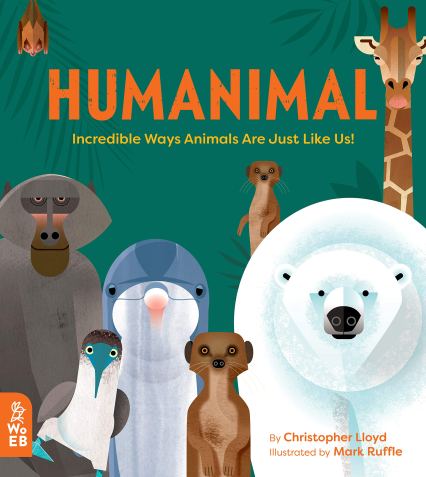
His latest book, Humanimal, explores the connections between humans and other animals. The whole concept of What on Earth Books is to find new perspectives for looking at the real world – far more amazing than anything you can make up! Once I had finished Absolutely Everything! I was left with the dangling question in my mind – how clever are humans really? Are we so much more advanced and intelligent that other life around us? Or is that just a human arrogance fuelled by ancient religions and modern scientific traditions?

He states:

“Children have an intuitive sense that humans and animals are far closer than many professional adults realise and I thought it would be good to create a book that’s scientifically rigorous but totally accessible to younger people to explore this theme further.” (Christopher Lloyd)

The title Humanimal shows his conclusions were that the links are very strong indeed – far more profound than the differences, hence the need for a new word – describing us all as Humanimal is in many ways, far more accurate than the artificial divisions we wedge between species by using traditional scientific conventions. After all, human DNA is approximately 84% similar to dogs and 98% the same as chimpanzees.

Humanimals

He explained that during the writing process he divided the book into three themes that best characterise what most people would say it means to be human – Living Together, Having Feelings and Being Intelligent. He then researched to see what other animals have behaviours that seem similar and came up with a huge list. It was then a matter of honing them down to see which ones made the best stories and could be backed up by really reliable scientific evidence. The copy then went through a rigorous editing, fact-checking process before he received it back again to make any final stylistic changes with the editor.

His tips for other non-fiction children’s writers is to think what you want to write then think what will make the child go WOW! when they turn the page. There are plenty of triggers for this rush of dopamine in our natural reward system such as powerful visuals, finding out stuff that’s surprising, giving them different routes through the information.

“I think non-fiction had traditionally been poorly served as in terms of the priority given to it by schools in reading schemes and honestly many children find learning about the world we live in so fascinating. I hope that more focus will be given to non-fiction at festivals, in schools and generally in the field of writing for children.” (Christopher Lloyd)

To read the complete feature you can purchase a copy of #222 Apr Writers’ Forum from your nearest good newsagents or order online from Select Magazines.

You can discover more about Christopher Lloyd and his What on Earth Books on his website: www.whatonearthbooks.com and follow him on Twitter: @chrislloydwoep and @whatonearthbook

An interview with… Holly Rivers

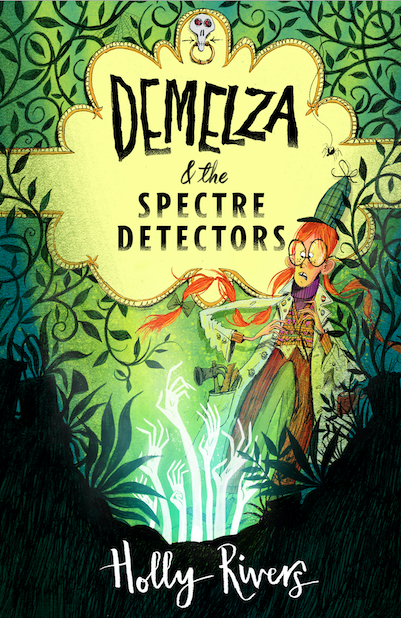
In my Writing 4 children column this month (issue #221 Mar of Writers’ Forum) Holly Rivers, explained what inspired her to write a story about a stubborn young inventor called Demelza.

Holly Rivers2

The idea struck her in 2016 and she put pen to paper immediately and very quickly realised she never wanted to stop writing.

“I could see her clearly from the very beginning: her red hair, her cosy attic room, her quirky inventions, and her thinking hat.” (Holly Rivers)

For the first time in her life she had found something she wanted to do every single day for evermore. Holly believes this realisation massively changed her life for the better, and revealed sitting down to write always makes her heart beat a little faster. She explained that she spent a year writing the (very long and very messy) first draft of Demelza and the Spectre Detectors, before spending a further year honing the manuscript on The Golden Egg Academy’s Foundation Course.

Holly told me the fact she is absolutely fascinated by anything spooky, macabre and ghostly inspired her to explore how a logical, science-minded character such as Demelza would react to finding themselves in a mysterious supernatural environment.

“Having an inquisitive stem-girl protagonist was really important to me, and I think there’s quite a lot of young Holly in Demelza. A few of her inventions were things I actually attempted to make as a child — namely the ‘Magnificent Belly Button Cleaner’” (Holly Rivers)

A lot of her inspiration comes from the sci-fi and fantasy books/films she enjoyed as a child such as: Ghostbusters, E.T, Labyrinth, Chitty Chitty Bang Bang, the books of Roald Dahl, The Goonies, Pippi Longstocking, Teenage Mutant Hero Turtles.

This slideshow requires JavaScript.

Many of her characters are inspired in part by real people, for example Grandma Maeve’s eccentricity, warmth and humour all stem from her own wonderful grandmothers. Ms Cardinal was also inspired by someone, but she wouldn’t say who. Holly said that so much great material can be mined from keeping your ears and eyes open, and I can often be found jotting down snippets of conversations that I’ve overheard, making notes of an unusual mannerism, or sketching an interesting outfit that somebody is wearing.

Demelza jacket lowres

The children she works with are huge inspirations too  and Holly has no doubt that bits of their brilliant (and often mischievous) personalities have found their way into Demelza, Percy and Miranda, and she believes this has made their characters all the richer.

She has also spent a lot of time in Mexico, where Dia de Los Muertos is the annual holiday celebrating the dead and observing the way that different cultures mark death was also a big inspiration for her book.

“Some people can have such a sombre, stiff and austere outlook on death, so I wanted Demelza and the Spectre Detectors to hopefully open up the conversation around death to a young readership in a ‘lighter’ and more accessible way.” (Holly Rivers)

Her writing tip for other children’s fiction writers is to read:

“I try and read or listen to at least one book a week, and I make sure that the titles are diverse and genre-crossing. One week I might be reading a quirky middle grade such as Beetle Boy by M G. Leonard or the latest YA from Frances Hardinge; the next I might be listening to an old Agatha Christie on audio book, and the next I might be dipping back into the Tank Girl comics (for the umpteenth time!)  I feel that most of my own development as a writer has come through exploring, savouring and digesting other people’s work.” (Holly Rivers)

To read the complete feature you can purchase a copy of #221 Mar Writers’ Forum from your nearest good newsagents or order online from Select Magazines.

Find out more about Holly and her books on her website: www.hollyrivers.co.uk, Twitter: @hollyrivers_lit and on Instagram: @hollyriversauthor

Another interview with… Mo O’Hara

In my Writing 4 Children column this month, I interview children’s book writer Mo O’Hara about writing comedy for middle grade series books. I have previously interviewed and blogged about Mo O’Hara before when I interviewed her for Papers Pens Poets. Take a look at: An Interview with… Mo O’Hara

Mo O'Hara5

She explained that she was inspired to start writing children’s books after she took a course in writing for children. Now My Big Fat Zombie Goldfish series are bestsellers here and in the US and her new series My Fangtastically Evil Vampire Pet is doing quite well too.

Mo told me:

“I definitely draw on my own experiences for all my writing – comedy included. Remembering all your embarrassing moments is a great place to start.” (Mo O’Hara)

In the feature, Mo explains how written comedy is different to stand up.  For Mo the story and the characters come first and then the jokes come out of the situation. She always starts with characters that are funny.

Mo with toys of her book characters

She did this for her graphic novel launching this year – Agent Moose. Originally the main character was a mouse who is a master of disguise. But the idea wasn’t working and did not seem funny at all She put it away and one day it hit her – a 7 foot tall moose that can hide anywhere is just more funny. The comedy just fell in place because of the character.

Agent Moose

Mo’s writing tip for other writers who want to write comedy is to write with a knowledge of the vocabulary of the age range of your reader. Kids are capable of getting the meaning of a word through context and they love funny words too – ‘Discombobulate!’ for instance. Also repeated words that are explained through context are funny sometimes. 

“If you get a kid to laugh it’s because at that moment, they had a genuine reaction and thought it was funny. That’s the emotional response I want. That’s why writing funny for kids is more rewarding for me.” (Mo O’Hara)

Her most important tip is ALWAYS read all comedy aloud. She explained that sometimes what you think is funny when it’s written loses something when spoken. It pulls up the flaws in timing.

Find out more about Mo O’Hara and her books on her website: www.moohara.co.uk and on Twitter @Mo_Ohara

To read the complete feature you can purchase a copy of #220 Feb Writers’ Forum from your nearest good newsagents or order online from Select Magazines.

An interview with… Tracey Mathias

In an interview with Tracey Mathias she told me all about how her children’s fantasy series was first published in Germany and how she got it into children’s hands in the UK.

tracey author pic

She started writing in 2005 and as a crime fiction addict and had a vague ambition to write but no real direction or conviction. That summer, whilst she was working at a children’s music school she found herself writing some last minute song lyrics, and had the sudden inspiration that she wanted to write for children.

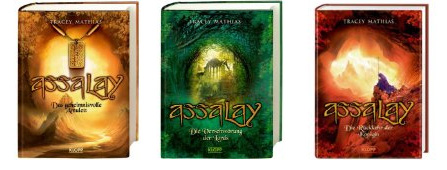
At the same time, she had an idea for a story that wouldn’t leave her alone. Over a week of sleepless nights she sketched out a rough plot for a whole novel and gave herself a year to work on the story. By the end of the summer term, she had completed the first draft of A Fragment of Moonswood, and her brain was seething with plans for volumes two and three of the Assalay trilogy – an otherworld fantasy about a land with a hidden past, facing political and ecological breakdown. She wrote the other two volumes – The Singing War and Weatherlord – over the next three years.

books german covers

The first volume of the trilogy went on submission in the UK and overseas in mid-2007. In one of the most bizarre couple of weeks of her life, she got a quick succession of offers from three German publishers. Her agent was hopeful that this would be quickly followed by a UK deal – but over the next months, rejection followed rejection, including a couple of annoyingly near misses. Tracey explained:

“I was left with an odd sense of half success, half failure. Yes, I was a published author (and unpacking your first box of author copies is thrilling whichever language they’re in!) but I was dogged by a sense of unfinished business that didn’t go away. Friends kept asking when they could read my books in English. ‘Why not self-publish?’ was a frequent suggestion, but for a long time, I clung to the hope of a conventional UK deal. “Tracey Mathias

Then, in 2015, Tracey was invited to speak to a school workshop on fantasy writing. She read the opening of A Fragment of Moonswood to a class of year 6 children, and at the end of the session, one of the boys came up to her, handed her a scrap of grubby paper for her autograph, and asked, ‘Miss, when can I read your book in English? Because I really like books like that…’

Tracey told me that this was a bit of a lightning moment! She decided pretty much on the spot just to go ahead and pursue the option of self-publishing and started to research options.

“Self-publishing is definitely a demanding route to take. It’s great to be independent and in control – but the flip side of that is having to tackle a wide variety of often quite technically detailed tasks that call for very different skills. Some of them suited me. Others, emphatically, didn’t.” Tracey Mathias

Tracey’s tip for children’s book authors who are considering self-publishing is to start by taking a long, hard look at what this is going to involve. It’s important to have a clear sense of how ‘self-publishing’ breaks down into different tasks, and how you’re going to tackle each, where you want or need help, and where you want to devote your energies.

The Assalay trilogy is published by Erika Klopp – part of the Oetinger group in Germany and can be ordered in any bookshop and on Amazon in the UK and is also available to buy from Barnes and Noble in the US.

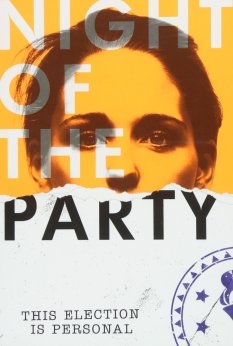
In 2018, Tracey got a traditional publishing deal with Scholastic with her very topical novel Night of the Party. It is about withdrawing from the EU and Britain is governed by a far-right nationalist party. Its flagship policy is the British Born edict, which allows only those born in Britain to live here. Everyone else is an ‘illegal’, subject to immediate arrest and deportation. ‘

Tracey Mathias

You can find extracts and links to Tracey’s books on her website: www.traceymathias.com and follow her on twitter @traceymathias. 

You can read the complete feature in Writers’ Forum #190 Aug 2017, in my Writing 4 Children column. 

An interview with… Cath Jones

Cath Jones writes picture books and early readers. I interviewed her for the January 2020 issue #219 of Writers’ Forum about the importance of early readers and how they differ from picture books.

Cath fb post

She explained how early readers usually form part of an educational reading scheme. They are aimed at readers of any age who are learning to read. Each publisher produces their own set of early reader guidelines or instructions for authors to use. These are usually based very closely on the Department of Education publication: Letters and Sounds (anyone can download this free of charge). This sets out very clearly, level by level which letters can be used, the type of vocabulary, complexity of sentences etc.

Cath told me:

“I try really hard to make my early readers stories funny and unexpected. One publisher told me that my stories are too quirky and another that they are too crazy. But children love that and so do I. I’ve had about twenty accepted for publication so far, with three different publishers.” Cath Jones

Cath explained it is important to keep the story interesting enough to engage an early and reluctant readers. Using appropriate words for the different ability levels can be quite a challenge. She told me she always tries to come up with a surprising twist at the end.

“When I write stories I have two aims in mind. I want to keep the reader interested enough to keep them reading on and more often than not, I want to make them laugh. The majority of stories I write are humorous and maybe a little quirky: a zebra who grows beetroot, chickens that knit, owls acting as hats.” Cath Jones

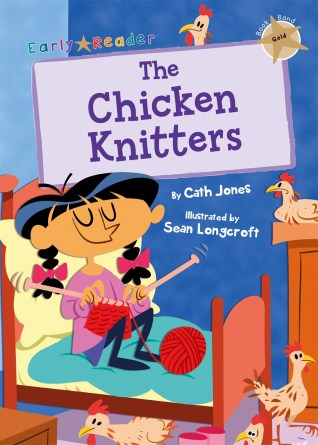
How I set about writing an early reader, depends on whether it is a higher or lower level book. For the lower levels, I have lists of all the words that are appropriate to that level. I study the lists and try to create a story (very often humorous). The story might have as few as 70 words and none of them more than three letters long. It’s like doing a puzzle. It’s a challenge but very rewarding. For the higher levels there are fewer restrictions so I just try to write the best possible story to engage a reader. One reviewer recently described Chicken Knitters as being as good as any early chapter book.

cover The Chicken Knitters JPEG

She revealed that when she first started writing stories for children, she had no idea that there were rules. She joined a local writing group and was amazed to discover that there were hundreds of books on the theory of writing.

“Getting rejections is never easy but other writers encouraged me not to give up. I remember author Jane Clarke telling me that it was those who persist who get published. She was right! In the end, all that effort paid off. In the space of a few months I had eight early readers accepted and my first picture book, Bonkers About Beetroot.” Cath Jones

Her inspiration for writing Bonkers About Beetroot was her own allotment. She also used to run school gardening clubs and for a number of years she managed a community allotment. So it’s really not surprising that gardening is a frequent theme in her stories. At the community allotment, she ran some really fun projects, including story sack making for families. She made a purple stripy zebra out of Fimo with the kids and close by was a bed of beetroot. Instantly she knew Zebra had eaten too much beetroot. The idea of a beetroot eating zebra just wouldn’t go away. It stayed in her head for years, quietly composting while she got on with life, growing vegetables and writing many, many stories.

Bonkers About Beetroot Cover LR RGB JPEG

Her writing tips for readers who may be interested in writing for the younger age range is it’s really important to know who you are writing for. Think about the age group that might read your story and ask yourself what they are interested in. If they are beginner readers, make sure your story gets going fast and keep up a good pace. If they get bored they won’t read on.

To find out more about Cath Jones and her books check out her website: @cathjoneswriter

You can read the complete feature in #219 Jan 2020 of Writers’ Forum magazine.

An interview with… Cathy Cassidy

I interviewed Cathy Cassidy for my Writing 4 Children double page spread in the national writing magazine, Writers’ Forum, in 2016. She revealed some of her writing secrets and tips.

WF-CC5

Cathy explained to me writers do not really get to choose the voice or genre they write, it is more of an organic process.

I’m not sure you get to choose your voice or genre… not always, anyway. I have always worked with and for young people, as an art teacher, a teen mag agony aunt, a journalist etc… that age group did and still does fascinate me, perhaps because it was a part of my life I didn’t manage especially well. When I finally did work out how to write a book length story, it turned out to be young teen rather than the YA I had envisaged. 

Cathy Cassidy

Most of Cathy’s readers fall between the ages of nine and fourteen and she calls the genre, ‘real-life, growing up’ books, as she often tackles quite difficult themes. But generally her books are about family, friendship and fitting in.

Cathy told me that she thinks the most important thing for any writer is to find your own voice and find your story, and then stay true to it

Don’t assume that children’s books are somehow less important than those aimed at adults, because that’s not the case. Often, the books we read as children are the ones that shape us, the ones we remember forever… let’s make them awesome!

Cathy Cassidy

Her top tip on writing for children is to write from the heart, and put everything you have into what you’re writing. If this means re-arranging your to-do list for the day, do it – writing has to come first, for the duration of the book at least. Set yourself a challenge to write a certain amount each day – it may just be 1000 words, but if you stick to it, those words will soon mount up. And when you start to doubt yourself and feel like throwing your laptop out of the window, don’t. 

Her message is write because you love it, because you can’t help it, because you love words and stories. Don’t do it for fame, fortune or an easy life, as those things are most unlikely to happen.

I’m lucky enough to write full-time now, but when I say full-time I mean it… sometimes it is seven days a week, and I can’t recall a break where I didn’t bring my laptop with me. If you love something, put all have into it… it’s worth it when you love what you do, I promise.

You can find out more about Cathy Cassidy and her books on her website: www.cathycassidy.com

An interview with… Peter Bunzl

For my Writing 4 Children slot in the national writing magazine Writers’ Forum I interview Peter Bunzl about his Cogheart series, published by Usborne.

PBfeature

Peter told me his inspiration to write the Cogheart ‘steampunk’ Victorian adventure series, was sparked when he was reading about real clockwork robots that existed in Georgian and Victorian times. They were called automatons and were incredible pieces of engineering. Here is an example of some of them from youtube so you can see how amazing they are.

Automatons were built to do simple tasks like write their name or a few lines of poetry, or play an instrument, or a card trick or some of them were clocks with moving figures on. Peter wondered, what would happen if the technology back then had got so good that they could make clockwork robots that could do everything and anything. Robots made of bits of metal that were almost human and alive. Could they feel and think? Could the spark of life ever exist inside them? What would that mean for their inventors and owners? And what kind of world could I set a story be in where all this would take place?

There are four books in the series now, and they all take place over roughly a year. So the characters don’t really age that much physically, although emotionally they go through a lot.

Peter explained the reason his main characters, Robert and Lily, stay the same age is because, at thirteen-fourteen, they are already at the top end of what’s considered a middle-grade hero, and so, if they got much older, they would be more teens and their concerns would probably stray more into teen story lines, which would change the tone and themes of the books considerably.

Though they feature the same heroes in each book, the stories themselves are stand-alone, with different settings and different villains who have different goals in each, so there isn’t necessarily an overarching conflict to the series. Peter told that when writing a series, it is important to get the details consistent because once the series got to the third book, Skycircus, Peter realised everything was getting a little complicated, so he designed a big chart with all the main characters on,which clearly displayed their backstory, when they were born, what they looked like etc. Now he can easily refer to his chart when he needs to check a detail.

To find out more about Peter Bunzl you can check out his website www.peterbunzl.com 

Or follow him on Twitter @peterbunzl

To read the complete feature take a look at #218 Dec 2019 of Writers’ Forum magazine.