Anita Loughrey's blog. This is my journal about my experiences and thoughts on writing. As well as news about me and my books, it includes writing tips, book reviews, author interviews and blog tours.
For more information about me and my books see my website: www.anitaloughrey.com. Follow me on Twitter @amloughrey, Facebook @anitaloughrey.author and on Instagram @anitaloughrey
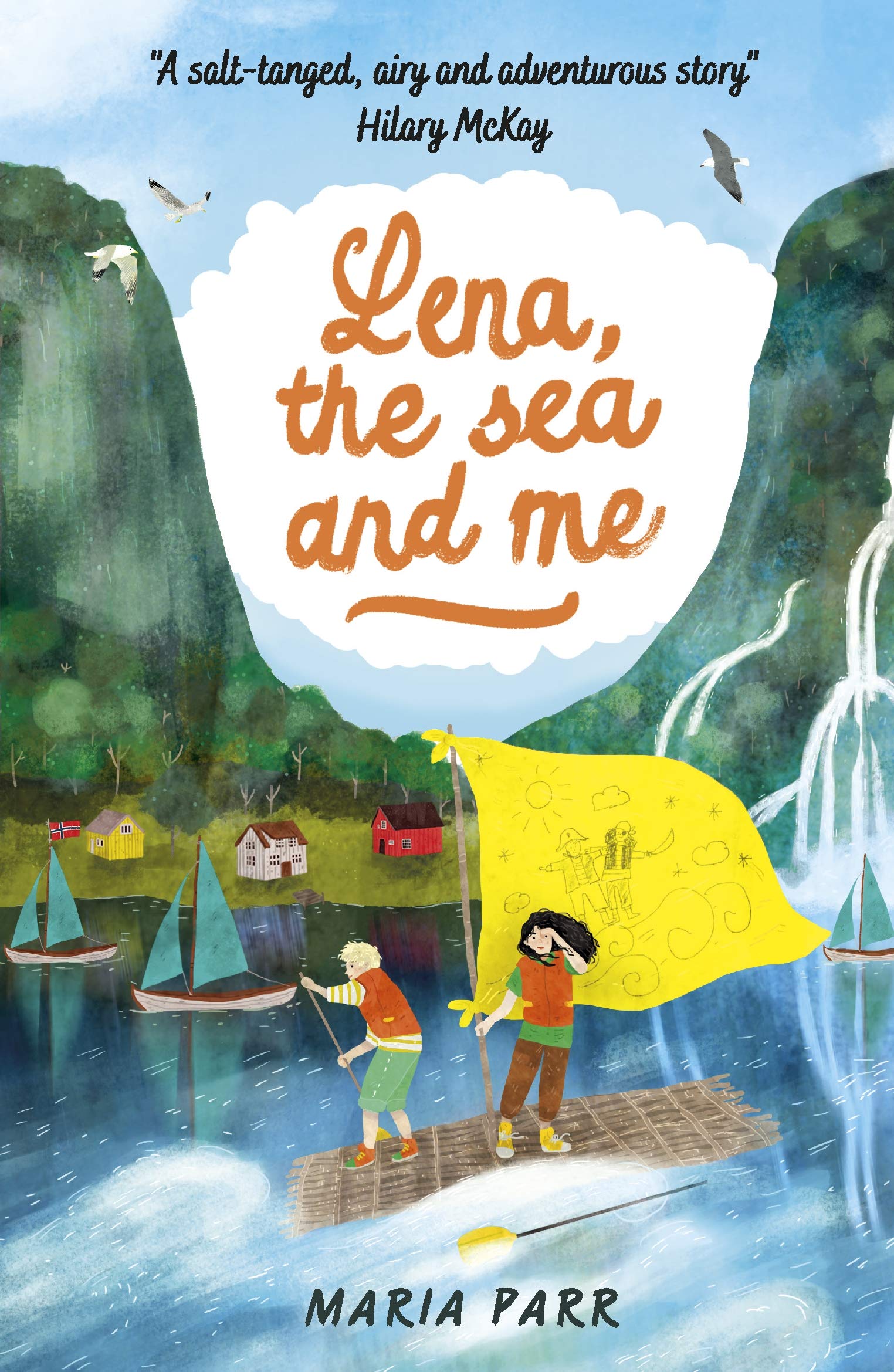
Lena the Sea and Me follows a year of adventures with Trille and his next door neighbour and best friend Lena. To emphasise this Lena the Sea and Me is split into seasons. This book is the much awaited sequel to Maria Parr’s debut novel Adventures with Waffles (also published under the title Waffle Hearts), which was translated into twenty languages and won several awards around the world. Both books are set in Mathildewick Cove in Norway and portray a realistic relationship of the highs and lows of friendship and growing up.
Written from Trille’s point of view we learn a lot about both Trille and his next-door neighbour and best friend Lena’s characters and families. The stage is set for a dramatic year ahead, dark clouds are looming and a horrific storm hits Mathildewick Cove, Norway. Trille and Lena have to fight the elements and their own emotions in that Lena has to wrestle against the new football’s coach sexism and nepotism when she is benched from her position as goalkeeper, even though she is by far the better player and Trille is infatuated with the new girl, Brigit, who has moved into the bay but when his grandfather has a serious injury on his boat, Troll, Lena is there to help him and refuses to let Grandpa or Trille give up hope.
All the characters are well formed and seep under your skin, staying with you long after you have finished the book. The reader feels like they know them and understand them. I would like to read more about the lives of Trille and Lena.
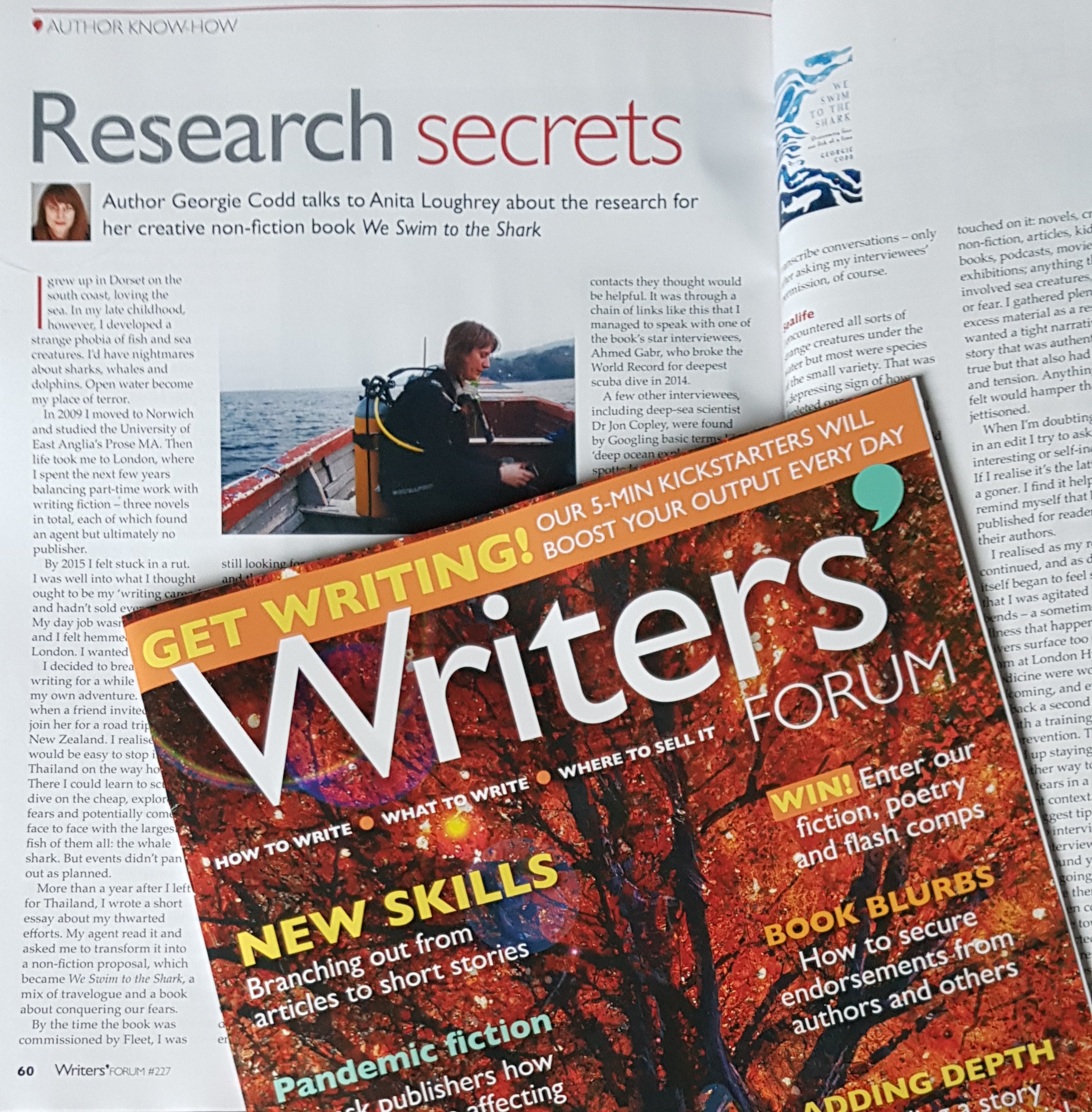
For the December issue 2020 of Writers’ Forum, I talk to Georgie Codd about her research for her creative non-fiction book, We Swim to the Shark, published by Little Brown.
Georgie’s adventure began when a friend invited her to join her for a road trip around New Zealand, she wanted to stop at Thailand on the way home so she could learn to scuba dive to explore her fears of the sea and potentially come face-to-face with the largest fish of them all: the whale shark. But events didn’t pan out as she planned. More than a year after she left for Thailand, she decided to write a short essay about her thwarted efforts. Her agent read it, and asked her to transform it into a non-fiction proposal. By the time the book was commissioned, she was still looking for whale sharks, and was three years into her quest.
Almost all her research for We Swim To The Shark began online with basic, initial searches about where to go, when to go, how much things cost, etc. For extra detail, she would comb through the travel section in her nearest library.
When she became a part of the scuba diving community, she started to receive heaps of recommendations from fellow divers, which she jotted these down, asking as many practical follow-up questions as she could – which dive schools were best, who to contact, things like that – and soon she had a web of suggestions to explore.
Georgie explained that once you enrol on an Open Water course with the Professional Association of Diving Instructors (PADI), you’re given access to a manual that covers various scuba essentials, including the physics of pressure and buoyancy. It contains several sections about dive equipment. She scoured through these before she went under.
“I’ve never dived without a qualified instructor. They would provide – and help me set up – my kit, would brief me on what to expect, and would guide me through each site.”
Georgie Codd
Her first port of call for UK-based research was a diving shop in south London, which many experienced divers tended to visit. Georgie told me that after emailing the owner, James, she received an invite to pop in. When she did, she was thrilled to hear James’s stories, and those of his expert customers. She asked if I could be his ‘writer in residence’ from time to time, sitting on a stool by the counter, seeing who came in. That put her in contact with all sorts of characters. Their stories added context and depth to the book.
This ‘residency’ also helped her discover, early on, that many of the experts had experienced moments of panic in the water. Hearing how they’d managed their fears gave me personal insights that she could put to the test, and eventually share with her readers.
When it came to face-to-face interviews, she mostly made quick notes in pencil, typing them up on her laptop straight after the chat while details like expressions and weather were still fresh in her mind. As time progressed, however, she discovered the slow speed of her note-taking held her back. So she bought an affordable dictaphone to record and transcribe conversations. (Only after asking her interviewees’ permission, of course.)
Her main preoccupation while researching marine life was the elusive, enormous whale shark. Much of her quest involved trying to learn more about these giants; separating the facts from the myths. To do this she contacted several experts, including Jason Holmberg, who created a pioneering programme called Wildbook, which uses NASA technology to map the sharks’ markings and identify them. Jason then told Georgie about the Marine Megafauna Foundation; a tip that unlocked a goldmine of knowledge, advice and humour from its co-founder, Dr Simon Pierce.
Georgie’s research tip for research relates to interviewing:
“Try, if your interviewee has time, to talk around your subject, as well as going all out on the topic you’re there for. More relaxed, open conversations often led me towards weird and unexpected connections. I found it extremely satisfying to explore those sudden tangents.”
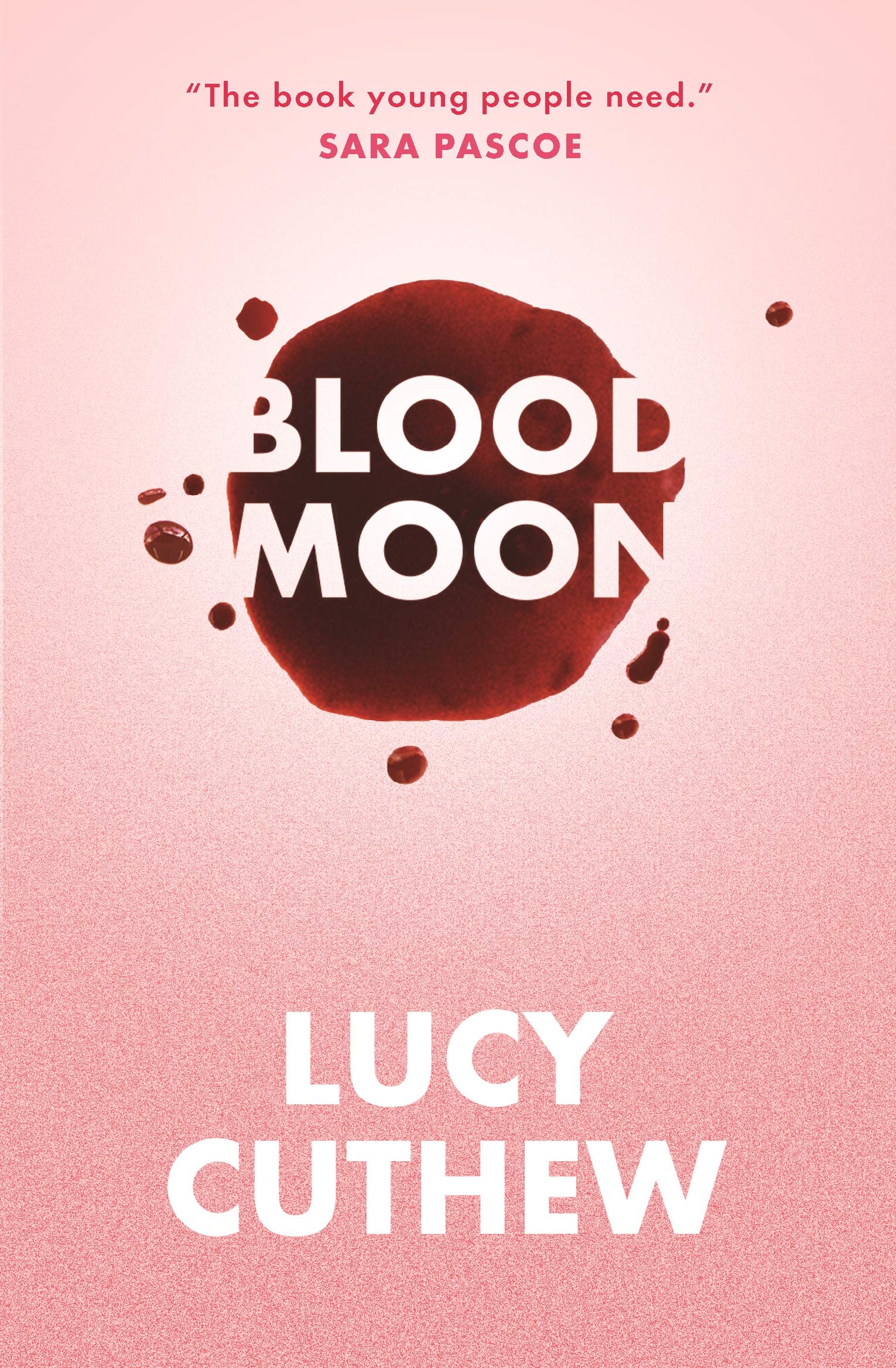
An excellent book which I highly recommend. Blood Moon follows astronomy lover Frankie and her experience of period shaming. During her first sexual experience with Benjamin from her class, Frankie’s period starts. They both agree it’s only blood and it isn’t an issue. The next day it is the talk of the school. Frankie believes Benjamin must have been bragging to his friends. Then a graphic meme goes viral turning their private intimate afternoon into something disgusting, mortifying and damaging. She blames her previously best friend, Harriet, as they recently had a falling out. The online shaming takes on a disturbing life of its own – the meme spreads to other schools, people in town recognise her, she is suspended from her part-time job at the planetarium and she starts to receive abusive and threatening messages. Frankie does not know where to turn or who she can talk to.
The novel is Lucy Cuthew’s debut novel and is written as a poem, which includes messages through social media between friends. Described by Lucy as ‘a verse novel about periods’. There is a very powerful message to all about how people should not made to feel ashamed of their bodies. I found myself laughing and crying along with Frankie as she attempts to navigate her way through the devastation to her life that follows this horrible act of cyber bullying. I particular like the way Lucy puts dialogue and thoughts to the right of the page and friend’s comments to the left and the way she uses onomatopoeic writing to give her words more depth. I also like the metaphor between the forecasted blood moon, which she plans to watch and the turn of events.
The characterisation portrays real teenagers, living very real lives. It shows how friendships can change and teenager’s relationships with their parent’s shift. In my opinion this book should be made essential reading for all pupils to highlight the effects and seriousness of online bullying and would be ideal for discussion in PSHE classes. I look forward to reading Lucy’s next book.
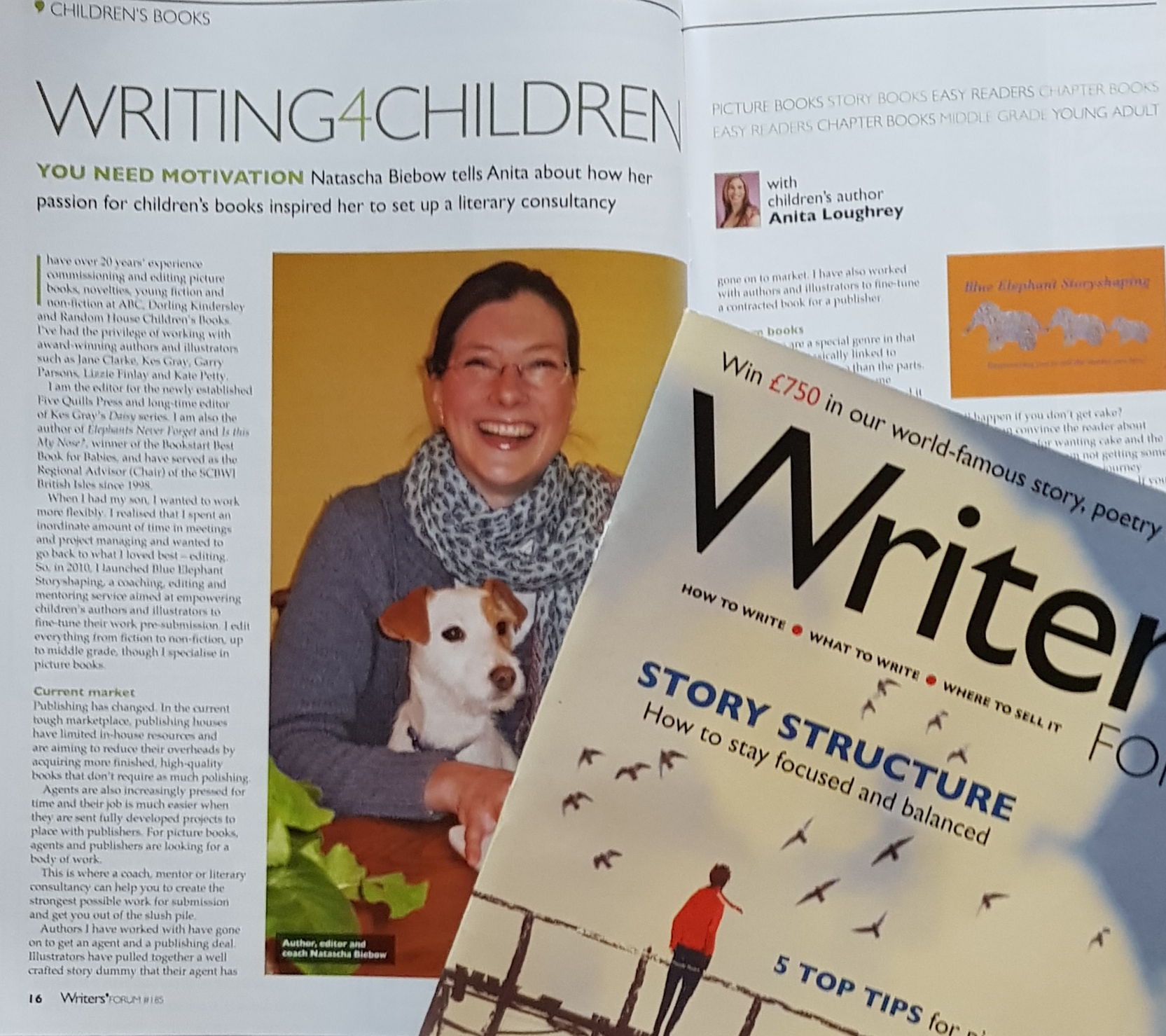
In March 2017, Natascha Biebow talked to me about how her passion for children’s books inspired her to set up the Blue Elephant Storyshaping literary consultancy. The interview appeared in my Writing 4 Children slot in the national writing magazine, Writers’ Forum.
Natascha has had over 20 years’ experience commissioning and editing picture books, novelties, young fiction and non-fiction at ABC, Dorling Kindersley and Random House Children’s Books. She has worked with award-winning authors and illustrators, such as Jane Clarke, Kes Gray, Garry Parsons, Lizzie Finlay and Kate Petty. I am the editor for the newly-established Five Quills Press and longtime editor of Kes Gray’s Daisy series. Natascha is also the author of The Crayon Man: The True Story of the Invention of Crayola Crayons, ElephantsNeverForget and Is this My Nose?, winner of the Bookstart Best Book for Babies, and have served as the Regional Advisor (Chair) of the SCBWI British Isles since 1998.
When Natascha had her son, she decided she wanted to work more flexibly. She realised she spent an inordinate amount of time as an editor at Random House attending in-house meetings and project managing and she wanted to go back to what she loved – editing. So, in 2010, she launched Blue Elephant Storyshaping, a coaching, editing and mentoring service aimed at empowering children’s authors and illustrators to fine-tune their work pre-submission.
“I edit everything from fiction to non-fiction, up to middle grade, though I specialize in picture books.”
Natascha Biebow
Natascha explained publishing is changing. In the current tough marketplace, publishing houses have limited in-house resources and are aiming to reduce their overheads by acquiring more finished, high-quality books that don’t require as much polishing. Agents are also increasingly pressed for time and their job is much easier when they are sent fully-developed projects to place with publishers. For picture books, agents and publishers are looking for a body of work. This is where she can help you to create the strongest possible work for submission and get out of the slush pile.
Authors Natascha has worked with have gone on to get an agent and a publishing deal. Illustrators have pulled together a well-crafted story dummy that their agent has gone on to market. I have also worked with author/illustrators to fine-tune an untitled contracted book for a publisher. You can find lots of testimonials on the Blue Elephant Storyshaping website.
“I get a buzz out of meeting like-minded people who share my love children’s books and story. I get a lot of satisfaction knowing I help to create books that will bring joy and maybe even change the lives of young readers.”
Natascha Biebow
Natascha revealed five of the most common mistakes new writers make when writing picture books include:
creating an episodic plot, which reads like a long list of things that happen sequentially with no tension, no clear climax, no story.
writing rhyming books that don’t have a strong story at their centre, so that the rhyme dictates the plot and not vice-versa
sending work off too early, thinking that writing picture books are short and therefore ‘easy’ to create
creating picture books that have no real hook or unique selling point, leaving readers saying, “So what?”
not exploring the characters’ true motivation
Natascha is passionate about storyshaping and empowering authors and illustrators to tell the stories they love.
“I work with people at all levels, including published. I am a writer and an editor, so I understand both sides of the business. I love working with illustrators who want to write, illustrators who want to develop a portfolio, as well as authors who are looking to fine-tune their work. I offer courses and 1-1 coaching, creative brainstorming sessions, as well as reviews on manuscripts and honing your pitch for submission.”
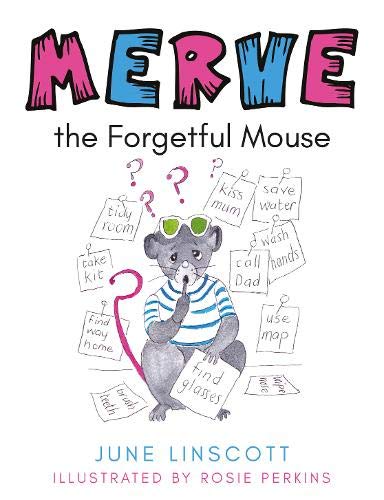
This book is a fun and easy read for young pre-school and nursery children. It is written largely in rhyming couplets this book uses colourful text and different sized fonts to its advantage to create a memorable and heart-warming tale of Merve the Forgetful Mouse and how he forgets his way home. The illustrations are simple black and white drawings with a minimal colour palette that is fun and grabs the reader’s attention.
Merve may be forgetful but he is determined and inventive. It may have been more interesting a plot if Merve did not simply curl into a ball each time to avoid the predators it would have been nice to see other ways of escape.
But on the whole a good use of repetition and contains useful sight words that will encourage emerging readers.
For my Research Secrets feature in the January 2010 issue of Writers’ Forum I interviewed crime writer, Simon Beckett, about how he was inspired to write fiction by a visit to the outdoor Anthropology Research Facility in Knoxville, Tennessee.
OLYMPUS DIGITAL CAMERA
Simon has written a series of novels about the fictitious forensic anthropologist, David Hunter. Before writing novels, he wrote for the Daily Telegraph Magazine. In 2002, he went to Knoxville, Tennessee to write an article on the outdoor Anthropology Research Facility, more commonly known as the Body Farm. They run a National Forensic Academy there, offering intensive – and exceptionally realistic – forensic training for US police officers and crime scene investigators.
In fact, there is no other research facility in the world where you can excavate human remains. They have training courses with staged crime scenes using real bodies. The bodies are donated, either by the individuals themselves or their families. The training and research undertaken has revealed a lot about body decomposition, the time it takes for hair to slough off a body, the role of insects on decomposition, even the differing effects that light and shade will have on the process of decay. This information is has proved invaluable for determining the time of death.
The academy goes to extreme lengths to ensure that their reconstructions are realistic. The theory is that the more life-like the recreations are, the better prepared the students will be when they encounter the genuine thing. It was a great privileged to be allowed in and I was hugely impressed.
During the five days Simon spent there, he watched the students put through their paces with a variety of simulated crime scenes, all recreated as closely as possible using actual human remains.
“One day I was cheerfully told to put down my notepad and tape recorder and help with recovering the two bodies that the students were carefully unearthing from a woodland grave. Sweating in the heat and dirt as the skeletal remains slowly emerged was a sobering, yet fascinating experience.”
Simon Beckett
Back in the UK, he was inspired by the idea of a novel based around what he’d seen and experienced in Tennessee. Gradually, the concept for Dr David Hunter took shape: a British forensic anthropologist schooled in the techniques and science being developed at the Body Farm.
“The research is everything in my books as there is loads of scientific background behind the plot. I like to find out the general principles of the crime so I do not come across any pitfalls where it would not be able to work out like that. Each book works out differently. I enjoy talking to people and this often leads to a re-jiggle in terms of plot.” (Simon Beckett)
Simon revealed he has a growing collection of forensic textbooks for anthropology and botany. He keeps a record of conversations and a lot are done by email so can look up who has helped. Sometimes it is friends and not necessarily a complete stranger. Most people are glad to help.
Simon explains it is possible to get too bogged down in the research. Don’t let the research dominate the stories and characters. It can be tricky what you use and what you cut out. The last thing you want is an info dump. When reading through the manuscript if you come across anything that is there for the sake of it get rid of it. It has to be there for the sake of the story.
You can find out more about Simon Beckett, his research and his novels from his website: www.simonbeckett.com
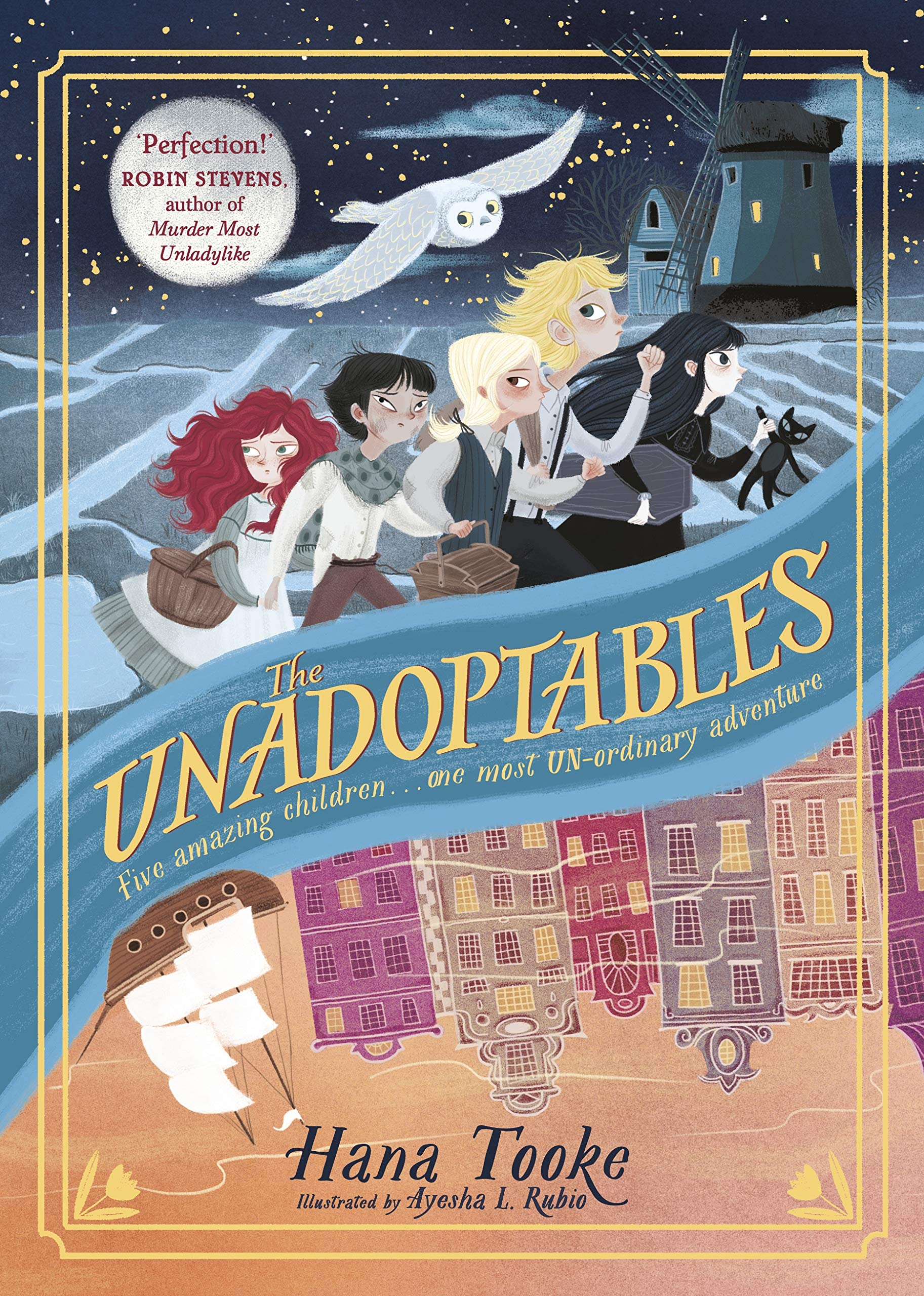
The opening chapters of The Unadoptables is written in the style of Lemony Snickets. It draws you into this unique story, which follows the orphans Milou, Sem, Lotta, Egg and Fenna who were all left at the Little Tulip Orphanage in strange and unusual ways.
Even though they have been described as ‘unadoptable’ the matron Miss Gassbeck because they do not look cute with freckles and pleasant features, each of the children have their own set of special skills that helps them on their adventures. Milou is an amazing story-teller, Sem is brilliant at sewing, Lotta has a fantastic grasp of science, Egg is an expert cartographer and Fenna has a lovely touching way with animals. Hana Tooke creates believable and realistic characters who pull on your heart-strings and carry you away on their epic journey.
Milou believes her parents will return to the orphanage to claim her. Milou finds a beautiful pocket watch hidden inside the cat puppet that was left on the orphanage roof with her. The watch contains coordinates so when they discover Miss Gassbeck, plans to sell all five ‘unadoptables’ to the disreputable Mr R they decide to run away from the orphanage and go to the mysterious coordinates in the hope it may lead them to the truth of who Milou’s parents are and why she was left on the roof of the orphange.
Set in and around Amsterdam during 1886, the five brave and determined children set off through 19th century Amsterdam on an adventure packed with puppets, clock-makers, cruel villains and pirate ships. On the way they discover what it means to have a real home with a real family. There are underlying themes of love, truth and identity.
This is the ideal book for a child to read alone or to listen to in the book corner at story time. The ideal book for any book corner.
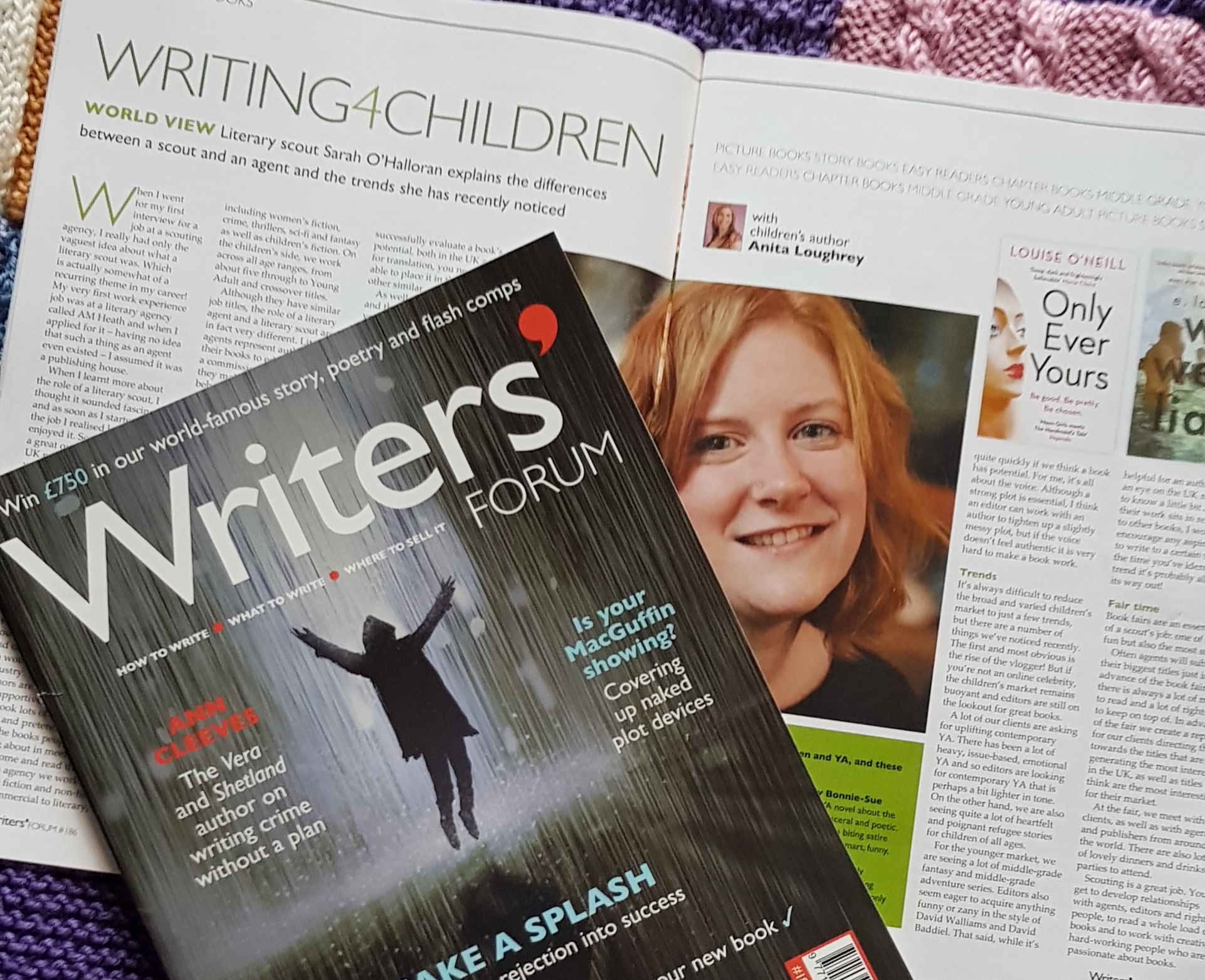
For my Writing 4 Children slot in Writers’ Forum, April 2017, children’s book literary scout, Sarah O’Halloran, explained to me the differences between a literary scout and a literary agent and the trends she has noticed in the children’s book market.
Sarah explained that although a literary scout and a literary agent have very similar job titles, the role of a literary agent and a literary scout are in fact very different. Literary agents represent authors, sell their books to editors and take a commission from any deals they make on their author’s behalf. Literary scouts don’t work with authors at all. Literary scouts work on behalf of foreign publishers, telling them what is happening in the UK market. They work with about a dozen clients around the world and it is their job to help them find titles that might work for them in translation.
In order to do this, a literary scout will develop relationships with agents to discover what authors are submitting, and with editors who will inform a literary scout what they’re receiving from agents. At its most basic, a literary scout will read and report on these manuscripts for their clients, as well as providing them with more general information about the UK book market as a whole.
“Scouting is a great job You get to develop relationships with agents, editors and rights people, to read a whole load of books and to work with creative, hard-working people who are passionate about books.”
Sarah O’Halloran
There are some similarities between the two jobs. Both jobs rely heavily on building relationships and developing your professional network, and both require you to have a keen editorial eye, a broad understanding of the market, and to read an awful lot.
To be a good literary scout it helps if you can read quickly. It’s also important that you read very broadly in order to develop as comprehensive an understanding of the market as possible. To be able to successfully evaluate a book’s potential, both in the UK and for translation, you need to be able to place it in the context of other similar, competing titles. As well as this, organisation and the ability to prioritise your time are both really important given the volume of material we receive. Finally, you need to be quite sociable and even a little bit nosey.
Sarah revealed her own personal area of interest is teen and YA, and these are some of her favourites:
The Smell of Other People’s Houses by Bonnie-Sue Hithcock is the most beautiful literary YA novel about the lives of four teenagers in Alaska in the 1970s. It is visceral, powerful, poetic, raw and honest and I loved it!
Only Ever Yours by Louise O’Neill is a biting satire about society’s obsession with beauty, and it is exactly the kind of book I love. There are lots of smart, funny, angry feminist voices in YA at the moment and this was one of my favourites.
We Were Liars by E.E. Lockhart is a dark, utterly gripping thriller about a family with a dark secret, and it has a shocking and unexpected twist. It was a massive bestseller so I wasn’t the only person who loved it!
As a literary scout she doesn’t work on projects herself, when she is submitted material by agents or publishers she can often tell if she thinks a project has potential before she has even looked at the manuscript. There are a number of things we look out for in an agent’s submission letter – some of them are more obvious than others – and lots of them are the same kinds of things that agents look out for in the submission letters they receive from authors.
Sarah told me:
“It may seem obvious but a great title always helps. And if the book can be pitched in a concise and intriguing way that is also very encouraging. A one or two sentence tag-line is often the way that agents pitch to editors, editors pitch to their marketing and sales teams, sales teams pitch to booksellers, and ultimately the way booksellers pitch to readers, so it’s impossible to exaggerate its importance. For me, it’s all about the voice. Although a strong plot is essential, I think an editor can work with an author to tighten up a slightly messy plot, but if the voice doesn’t feel authentic it is very hard to make a book work.”
Sarah O’Halloran
An agent will often compare a book they are submitting to other books, and if a book is reminiscent of a bestselling author, that suggests that there is a receptive market for that kind of story.
Sarah’s tip to aspiring children’s book writers is that although it’s helpful for an author to keep an eye on the UK market and to know a little bit about where their work sits in relation to other books, don’t try to write to a certain trend. By the time you’ve identified a trend it’s probably already on its way out.
Sarah also revealed that book Fairs are an essential part of a literary scout’s job. Often agents will submit their biggest titles just in advance of the book fairs so there is always a lot of material to read and a lot of rights deals to keep on top of. In advance of the fair a book scout will create a report for our clients directing them towards the titles that are generating the most interest in the UK, as well as titles they think are the most interesting for their market. At the fair, they meet with their clients, as well as with agents and publishers from around the world.
This is an exciting picture book all children will want to read again and again, not only those fascinated by dinosaurs. Written mostly in rhyming couplets this dynamic picture book challenges gender stereotypes in a fun way with a hilarious twist at the end.
There is an underlying theme of sibling rivalry, as Maisy is fed up with her brother Ed as he won’t share his toys, claiming his toys are for boys and not for girls, so she conjures up her own female dinosaur the ‘She Rex’ that is just as fierce, strong and loud as any boy dinosaur. In true brother and sister style Ed makes fun of the ‘She Rex’ but Maisy is not going to be out done and proves her dinosaur may be a girl but in no way could it be described as ‘girlie’.
Deborah Allwright’s use of a limited background for the illustrations highlights the colourful dinosaurs and their antics and draws the eye to the characterisation that will capture even the most reluctant readers imagination. I particular like the use of the use of multi-colour for the female dinosaurs rather than one single block colour.
A great book to stimulate discussion at home, or in the classroom, about gender stereotypes and also family relationships. She Rex could also be used to compliment topic work on dinosaurs.
In the November 2020 issue of Writers’ Forum, I interviewed the award winning author of the The Umbrella Mouse duology, Anna Fargher. She explained to me why she weaves true events into her children’s stories.
Anna was inspired when she read a series of statistics revealing how little young people and adults remembered about both world wars. Most alarmingly, she revealed some British adults didn’t know who Hitler was. She was also horrified by another poll showing that one in 20 Britons didn’t believe the Holocaust happened.
“If we forget these hideous moments in history and do not heed the lessons of the past, they could occur again.”
Anna Fargher
For Anna, real life stories have always been addictive (she was obsessed with Born Free and My Family and Other Animals as a child) and strongly believes there are a plethora of events and people from wartime that deserved to be remembered. She realised it was historical fiction, more than history textbooks that had most impacted her understanding of war, particularly Goodnight Mr Tom, Carrie’s War and War Horse and wanted to include some in a new story in the hope it might pique children’s interest and encourage them to learn more – then they could take that knowledge with them into adulthood.
The second book of the Umbrella Mouse duology, Umbrella Mouse to the Rescue, revolves around the Liberation of Paris that occurred in August 1944 , and the French Resistance group Noah’s Ark in their battle to stop the Nazis.
She weaved true events into Umbrella Mouse to the Rescue in a number of ways. Due to the numerous battles that were key in the lead up to the Liberation of Paris, she used dialogue to covey the sense of anxiety and urgency that was felt at the time. She ten visually used key moments from the uprising as part of the rising action.
She told me that the leader of Noah’s Arc, Marie-Madeleine Fourcade’s experiences had a huge impact on the story, thematically. The Gestapo hunted her and her two young children, who she put into hiding to keep safe, and that peril is what drives her in Umbrella Mouse to the Rescue. Betrayal was a constant threat to Noah’s Ark and many of their members were captured and killed due to traitors operating amongst them, and you’ll see it occur in both Umbrella Mouse books.
By giving them characters they care about, Kurt Vonnegut said:
“Be a sadist. No matter how sweet and innocent your leading characters, make awful things happen to them – in order that the reader may see what they are made of.”
Kurt Vonnegut
Anna said, it’s important to give your hero flaws and a universal motivation – something we all want – so their struggles and their drive to succeed are relatable. In The Umbrella Mouse books, Pip is orphaned and alone. She’s grief-stricken and reckless at times. All she wants is to find her last surviving family and get to a place where she will be safe. If we were in her position, we would pursue the same things. Pip never witnesses anything too graphic, but she is placed in wartime environments, such as battles and a prisoner camp that could be too disturbing if she or her friends were human.
“By introducing these difficult emotional subjects, children have the opportunity to learn about tragic times in history, and then they can discuss their feelings with adults, such as parents, teachers or librarians.”
Anna Fargher
Anna’s tip on writing for children is to read as many children’s books you can in the genre you want to write about so you can grasp the conventions and any animal nuances, and you’ll also learn what makes a great narrative arc. But she reminds authors to be discerning. In the words of P.D. James:
“Bad writing is contagious.”
P.D. James
“Writing for children is a joy; some days are harder than others but that’s true in every endeavour. Above all, don’t give up. Discipline and dedication gets books written.”