The Art of Plotting

Here are a few pointers about plotting I have come across over my time of writing for children.

climb a mountain

  • Every scene must serve more than one purpose. This could be developing your characters, giving brief background information, creating atmosphere, world building or clarifying motivation. If it does not move the plot forward then cut it.
  • Always consider the motivation of your protagonist. Think about their actions and why they are doing them. They should not be doing things just because your plot demands it. if this is the case you need to have a serious rethink.
  • The protagonist’s motivation should change and deepen over the course of the plot they discover new facts and truths that change the way they view and interact with their world.
  • By the end of the novel the character should be changed by their experiences. this might be for he better but it can also be for the worse. Make sure it is a realistic emotional journey. The protagonist should learn and grow during the process. This growth usually conveys the theme of the story.
  • Ensure all the scenes progress logical with no giant leaps. it is amazing how easy it is for logic to become muddled to suit the plot. You can see it in many TV series all the time. It is frustrating to the reader. Always think in terms of what is happening, why has it happened, what are the results of this either directly or indirectly and how will this effect what happens next.

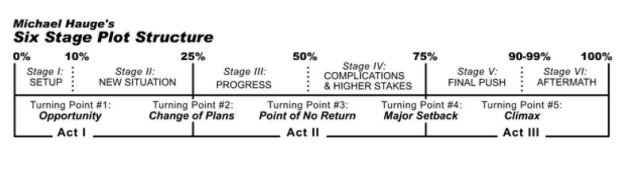
The basic sequence of plot stages is: arrival of conflict, initial success of the main character, reversals, final victory, and outcome. The success-reversal sequence may repeat. I find Michael Hauge’s six stage plot structure useful when writing fiction – this includes novels and picture books.

Michael Hauge's plot structure

The plot is built around a conflict involving the main character—for instance, with another character, or with circumstances, or within themselves. Conflict often takes the form of a problem the main character must resolve. The character should succeed or fail at least in part through their own efforts.

In my opinion a story for children should open with conflict. Aristotle said the most important thing in any story is the sequence of events. Each event has a cause and effect, and each is connected in the plot. According to Aristotle there are six stages of plot development:

  • The opening
  • The arrival of conflict
  • The early achievement
  • The twist and the change
  • The denouement
  • The final outcome

The conflict should result in increasing dramatic tension, which peaks or ‘climaxes’ towards the end, then resolves. A novel may have several conflicts, but a short story or picture book should have only one. Think about the story arc.

Story Arc

In this way, a story can be broken down into six elements:

  • Balance – all is well at home, nothing interesting is going on
  • Disharmony – the mood changes for good or bad
  • Inciting incident – just when things were looking better a change of mood provokes a change to something ‘other’
  • Problem – there is now an even more serious dilemma that needs solving
  • Resolution – the story can be brought to a conclusion
  • Outcome – the purpose of the story unfolds

Move the plot forward with events and action, rather than with internal musings and I know I’ve said it before but show, don’t tell. It may be a rocky climb to the top of your story arc but when you get there the view’s are worth it.

top of mountain

You can see some of my other posts on plot here:

Re-evaluate your plot

Plot

The Art of Story

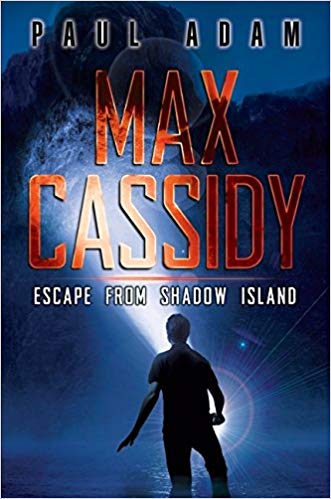
Book Review – Escape from Shadow Island

Title: Max Cassidy: Escape from Shadow Island

Written by: Paul Adam

Publisher: Corgi Books, Random House

Max Cassidy Escape from Shadow Island

At first it made me smirk when I read the Random House warning in the front of the book telling the readers not to try any of the stunts as home, as escapologists have had years of training before they attempt them… and then I read the first page. The hero Max is handcuffed, chained, put in a sack and lowered into a tank of cold water. He has thirty seconds to escape, or freeze to death. Red lights flashed in my head as I thought of my own sons and I honestly considered writing to Random House to tell them to put the warning in CAPITAL LETTERS.

This is the first Max Cassidy adventure in the trilogy. Max’s Houdini-style stunts have the reader gripped from the start. When Max finds out his father may still be alive, you are carried into one impossible situation after another and you can’t help wondering, ‘How on Earth is Max going to escape from this?’ There are several clever twists and the characters are very believable. This murder-mystery thriller action-adventure will have boys gasping for more.

This book review was previously published on the online Armadillo Children’s Book Review Magazine.

An interview with… Julie Cohen

Julie Cohen writes romantic comedy for Headline’s Little Black Dress imprint and novels for the Mills & Boon’s Modern Heat imprint and is a Richard and Judy bestselling author. I interviewed her for my Research Secrets column in the #92 May 2009 issue Writers’ Forum.

She told me she loves research because it means she gets to do stuff she wouldn’t normally do. She has ridden roller coasters repetitively for a roller-coaster designer hero; gone to famous restaurants for a celebrity chef hero; rode on the back of a BMW motorcycle at 80 mph down the M4 for a motorcycling hero; ran from South Street Arts Centre in Reading to the station in high heels just to see how fast it could be done; visited art deco cinemas, retro diners, art galleries, cities and parks to research settings for her books. But, Julie believes the best resource is to get out there and talk to people.

Her original sources are all people. She explained talking to them is utterly inspirational and helps her get into the heads and lives of my characters. She has also met some really cool people who she has looked up online, in the phone book, or through research books.  Usually she emails or pick up the phone and rings. She has found that most people are happy to talk to you about what they know and told me their opinions are just as useful as the facts for developing characters.

She explained it is always important to acknowledge experts who have taken time to help or whose expertise you’ve used extensively. She like to send a thank-you email or note and often sends them a signed copy of the book when it comes out.

It is not until she is about half to two-thirds of the way through a book that she begins to see what information she actually needs.  That’s when she starts making lists of questions to ask, and that’s generally when she start calling experts and asking for interviews.  Because her books are more focused on the characters and the story than on research details, she does not see the point in getting huge amounts of information she probably won’t need.  Instead, she pinpoints what she has to know for the story and only uses (and often only find out in the first place) what’s vital to the story, or what seems to add vital flavour.

“I’m not a plotter when I write, and generally my first forays into research are pretty vague.  I use the internet first – and then the local library and bookshop. I’ll just dabble around in a subject finding out some stuff to see if any of it inspires me. My books centre round people and relationships rather than facts.” (Julie Cohen)

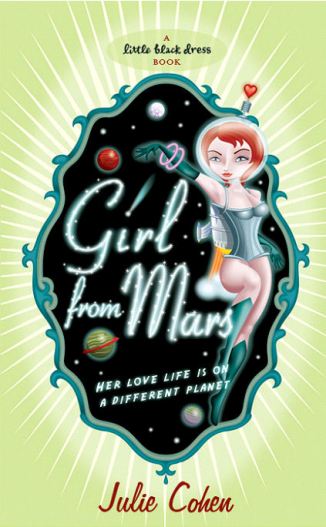
Julie told me that quite often, doing her research, she will find a central metaphor that she can use and examine through the whole book. For example when researching comics for Girl from Mars, she was intrigued by the concept of the gutter, which is the name for the blank spaces between panels.

girlfrommarslge

Because comics are static but portray action, the reader actually fills in the action between panels. The blank gutter is extremely important to make this happen. In her story, it became a metaphor for change happening when you’re not looking, for filling in the blanks, which are both key themes to the story.

You can find out more about Julie Cohen and her books on her website: www.julie-cohen.com

To read the complete feature you can purchase a copy of #92 May 2009 Writers’ Forum online from Select Magazines.

Writers’ Holiday

Last weekend I went for my annual weekend away to Wales on the Writers’ Holiday to concentrate on my writing. I took my Work In Progress and (spoiler alert) got absolutely loads done. I’ve been to Writers’ Holiday for several years as the atmosphere is so brilliant and I always manage to come back with a few thousand words written.

If you have not been to Writers’ Holiday you don’t know what you’ve been missing. It was set up in 1986 by Anne Hobbs, is run by writers, for writers and receives no financial assistance from any source whatsoever, wrapped up in a totally informal and relaxed setting. It’s up to you what you choose to do but it’s all there for you just take what you want. You get to choose a wide selection of courses or you can use the time to work on your own WIP, or if you prefer just to chill and relax.

One of the great things about Writers’ Holiday it is not too much money. In fact, you get a lot for your money.  The fee includes breakfast, lunch and dinner, all weekend workshops and collection / return to Fishguard and Goodwick train stations.

The venue is The Fishguard Bay Hotel which nestles in rich woodland above Fishguard Harbour and overlooks some of the most beautiful and spectacular coastline in Wales, guests can view the lower town in the distance across the bay.

20200226_172615

This was setting for Dylan Thomas’ Under Milk Wood, when stars like Glynis Johns, Richard Burton, Peter O’Toole and many others stayed here. It was also the base for the filming of Moby Dick. In 1979, this former Great Western Railway hotel was designated as a building of historic and architectural interest. Set in a commanding position overlooking Cardigan Bay, the hotel offers an atmosphere second to none with oak panelled walls, high ceilings and an air of Victorian splendour.

I set off in plenty of time, having started my packing a few days before. It was hard as my son was home that week from University but as my husband and boys planned to paint the hallway, stairs and landing walls, it was probably better I was out of it.

The course I choose to do was Get your Non-fiction Book Written and Published with Simon Whaley. I’ve done Simon’s courses before and they are always inspirational and motivational. So I did not research the course as much as I would have done a new course or venue. Even so, I decided to write down a few questions of things I wanted to know about writing non-fiction books to make my life easier. The last thing I wanted was to not ask and get home and wish I did . I’ve learnt the hard way not to be afraid of asking questions.

I also thought about what I really wanted from the course. Was I just looking for a fun weekend away or did i have a goal in mind I had a goal or two, firstly I am on a tight schedule with my latest commission so needed to get a lot of work done and the ideal time was on the train there and back. The other reason is that although I have written some non-fiction books, I have a few more non-fiction book ideas I want to write. My aim was to kick start myself into doing it. It was a small group which is often nicer as you can get more from a course this way.

It wasn’t all work there is also some fantastic meals you get a buffet breakfast and a choice from three starters, main meals and puddings for lunch and dinner.

There is also a book room where both the course leaders and delegates can bring there own published books to sell.

20200223_084850

You’ll be pleased to know, I managed to work on three non-fiction book ideas and developed them and also my latest commission which I had given myself a daily schedule. Now all I have to do is carry on the momentum and make an effort to write the book.

Book Review: Mustafa’s Jumper

Title: Mustafa’s Jumper

Written by: Coral rumble

Illustrated by: Charlotte Cooke

Published by: Wacky Bee

Mustafas Jumper

Mustafa’s Jumper is based on a poem of the same name also by Coral Rumble. The poem won the prestigious Caterpillar Poetry Prize in 2018. Rewritten in prose this story gives a child’s point of view of having a refugee who speaks no English, temporarily in your class at school and how they feel when the child is sent back to the country they were trying to escape from, which is highlighted by the single school uniform jumper that is left behind in the cloakroom.

It is written in Milo’s point of view, a quiet introvert boy whose best friend, Eddie, is the total opposite. Eddie get chosen to look after the new boy but has no idea what to say or do with a boy who can’t speak his language. Milo understands what it is like to feel like an outsider so he does what he can to include him: he plays with him, shows him what to do and where to go, and invites him home to tea. Milo and Mustafa become good friends.

Throughout the book it highlights patience and kindness by showing how Milo helps his new friend. The ‘show not tell’ plot is ideal for demonstrating and developing empathy in young children.

This is a great book for triggering discussion in the classroom about immigration, asylum seekers and refugees. There is a page at the back that talks about reasons why people have to leave countries and how sometimes people leave their homes because of war, a natural disaster or terrorism means it is too dangerous to stay. It also highlights how difficult it can be starting from scratch in a new country and explains some people like Mustafa are sent back. Could be used for discussion in both KS1 and KS2.

An interview with… Holly Rivers

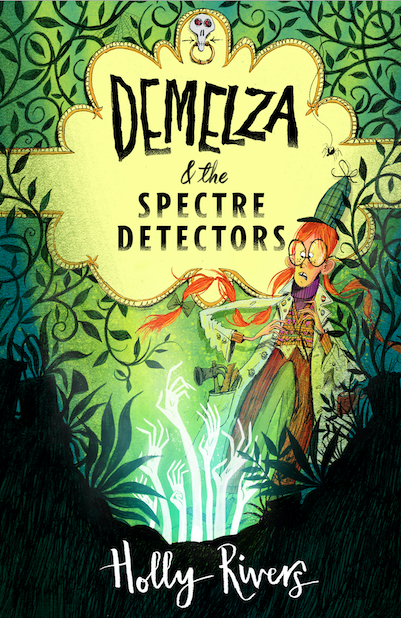
In my Writing 4 children column this month (issue #221 Mar of Writers’ Forum) Holly Rivers, explained what inspired her to write a story about a stubborn young inventor called Demelza.

Holly Rivers2

The idea struck her in 2016 and she put pen to paper immediately and very quickly realised she never wanted to stop writing.

“I could see her clearly from the very beginning: her red hair, her cosy attic room, her quirky inventions, and her thinking hat.” (Holly Rivers)

For the first time in her life she had found something she wanted to do every single day for evermore. Holly believes this realisation massively changed her life for the better, and revealed sitting down to write always makes her heart beat a little faster. She explained that she spent a year writing the (very long and very messy) first draft of Demelza and the Spectre Detectors, before spending a further year honing the manuscript on The Golden Egg Academy’s Foundation Course.

Holly told me the fact she is absolutely fascinated by anything spooky, macabre and ghostly inspired her to explore how a logical, science-minded character such as Demelza would react to finding themselves in a mysterious supernatural environment.

“Having an inquisitive stem-girl protagonist was really important to me, and I think there’s quite a lot of young Holly in Demelza. A few of her inventions were things I actually attempted to make as a child — namely the ‘Magnificent Belly Button Cleaner’” (Holly Rivers)

A lot of her inspiration comes from the sci-fi and fantasy books/films she enjoyed as a child such as: Ghostbusters, E.T, Labyrinth, Chitty Chitty Bang Bang, the books of Roald Dahl, The Goonies, Pippi Longstocking, Teenage Mutant Hero Turtles.

This slideshow requires JavaScript.

Many of her characters are inspired in part by real people, for example Grandma Maeve’s eccentricity, warmth and humour all stem from her own wonderful grandmothers. Ms Cardinal was also inspired by someone, but she wouldn’t say who. Holly said that so much great material can be mined from keeping your ears and eyes open, and I can often be found jotting down snippets of conversations that I’ve overheard, making notes of an unusual mannerism, or sketching an interesting outfit that somebody is wearing.

Demelza jacket lowres

The children she works with are huge inspirations too  and Holly has no doubt that bits of their brilliant (and often mischievous) personalities have found their way into Demelza, Percy and Miranda, and she believes this has made their characters all the richer.

She has also spent a lot of time in Mexico, where Dia de Los Muertos is the annual holiday celebrating the dead and observing the way that different cultures mark death was also a big inspiration for her book.

“Some people can have such a sombre, stiff and austere outlook on death, so I wanted Demelza and the Spectre Detectors to hopefully open up the conversation around death to a young readership in a ‘lighter’ and more accessible way.” (Holly Rivers)

Her writing tip for other children’s fiction writers is to read:

“I try and read or listen to at least one book a week, and I make sure that the titles are diverse and genre-crossing. One week I might be reading a quirky middle grade such as Beetle Boy by M G. Leonard or the latest YA from Frances Hardinge; the next I might be listening to an old Agatha Christie on audio book, and the next I might be dipping back into the Tank Girl comics (for the umpteenth time!)  I feel that most of my own development as a writer has come through exploring, savouring and digesting other people’s work.” (Holly Rivers)

To read the complete feature you can purchase a copy of #221 Mar Writers’ Forum from your nearest good newsagents or order online from Select Magazines.

Find out more about Holly and her books on her website: www.hollyrivers.co.uk, Twitter: @hollyrivers_lit and on Instagram: @hollyriversauthor

Electronic Piracy in Publishing

Following on from the pirate theme at John Condon’s book launch and blogging about the launch last week see: John Condon’s book launch, I was reminded of a very informative and fascinating talk I went to a while back at the Society of Authors. It was all about the online piracy of books. This mainly concerns educational books but, I did see some fiction up there too.

copyright

At the meeting I found out there are three types of sites that will put up digital copies of books for download. These are peer-to-peer sites, document sharing sites and file hosting sites. At the risk of boring you, I will go into a little more detail.

P2P
This is not a Playstation site. P2P stands for peer-to-peer. The books, pdf’s, etc are not physically on a website but on somebody else’s computer and are distributed via email, or such like. It is difficult to stop this type of piracy. The websites will list files they have available. To find a more detailed explanation of what P2P is, check out wikipedia Peer-to-peer.

It is a very similar system to the music website Spotify, which allows users to share their favourite tunes for free. Some sites which index a lot of torrent educational book files include: http://www.thepiratebay.org/ and http://www.isohunt.com/. You can check if your books are featured on these sites by using the search function.

Nicholas Tims warned us to be careful of false positive hits (sponsored links) on some P2P sites, such as http://www.freshwap.com/ and http://www.torrentpump.com/.

Battle_of_Copyright_symbol

Document-sharing
These again are all legal, law-abiding websites. They also react promptly to requests to have your work removed. Such sites include: http://www.scribd.com/http://www.issu.com/ and http://www.docstoc.com/.

They describe themselves as having:

“Millions of documents and books at your fingertips! Read, print, download, and send them to your mobile devices instantly. Or upload your PDF, Word, and PowerPoint docs to share them with the world’s largest community of readers.”

These sites are different from P2P websites as, it is possible to view and read the books available on the site.

File hosting
Again, these are legal websites. they normally react quickly to takedown requests. You must provide them with correct and detailed informationa dn they do not engage in correspondence.

Some of the biggest include: http://www.rapidshare.com/ and http://www.mediafire.com/. They are different from the other two in that the files are hosted by the Interent service and are specifically designed to store static content.

What can you do?
To find out if your books appearing on such sites, you can set up a ‘Google Alert’ on your book titles and on your name. I have talked about this before in my post: Can’t find it but, it will appear here when I do!!! Honest!

You can also check if your publishers are a member of the Publisher’s Association where it is possible to check on the copy right infringement portal to see sites which respond well to take down requests and those that don’t.

Pirate_Flag

Social Publishing sites

There are also websites such as Scribd that scan and make textbooks available on the world wide web. Scribd is a social publishing site, where tens of millions of people share original writings and documents. They do not ask the author’s permission to put their books online. For authors who write for royalties from the amount of books they have sold, this means they are losing money. This is not just a concern for Eduational Publishing but for fiction as well.

These sites eventually remove unlicensed content from the web but they have to be petitioned to do so. There is a Copyright Infringement Takedown Notification on the Scribd website and they provide a Takedown Notification Template for authors.

But, surely they should have not put the books available for free download on line in the first place. They should be the ones seeking permissions and paying for licenses not teh authors having to fight for the right to get paid for their hard work.

Advice from the Society of Authors is to be vigiliant and to search for titles online on a regualr basis. If you find anything suspicious it should be reported to the publishers. The Publishers Association has set up a Piracy Portal to share information about copyright infringement. There is also a Copyright Infringement Portal, which targets websites offering infringing copies for free download, and will soon evolve to also target peer-to-peer sharing via torrents.

Book Review – Magnetic First Words

Title: Magnetic First Words – Days Out

Written by: Michelle Trowell

Illustrated by: Barry Green

Published by: Top That! Publishing

Magnetic First Words - Days

This hard-board book contains over 100 magnetic first words around the theme of Days Out. It has been designed to promote literacy skills, help hand-eye coordination and to encourage parent-child interaction. The pages are magnetic so the words and numbers do not easily fall off and the pages can be turned leaving the magnets in place.

Barry Green’s bold, double-page spread illustrations contain a lot of action, ideal for prompting discussion whilst matching the words to the pages. The children can also invent their own sentences linked to the lively pictures which include children playing by the lake, at the fair and on the beach.

The book contains many of the high frequency sight words the children are required to learn from reception upwards. In my opinion the book will make learning fun and will definitely help with sight recognition of these high frequency words (such as: we, she, look, on, can, etc.) as they have to search through all the words provided for the correct word to match.

Suitable for children aged three upwards, I think they would also make an ideal activity for KS1 children in a reading corner. You will need a pretty little pot to keep all the magnets in though once you have taken them out to use.

An interview with … Anne Rooney

For the latest issue of my Research Secrets column in Writers Forum I have interviewed Anne Rooney about her research process for her non-fiction children’s books.

Anne Rooney3

Anne Rooney’s books range from lavish, large-format to smaller, cheaper books. Dinosaur Atlas (2017) and Animal Atlas (2019) for Lonely Planet are good examples of the first type, with fold-out maps, flaps, and fantastic illustrations. How to be an Eco-Hero (2020) is an example of the smaller format and has line drawings.

Anne loves doing research. She said:

“There’s a childish part of me which goes ‘Wow! look what I’ve found!’ — and that’s essentially what my books are. My older daughter says my job is basically being a perpetual student, and that’s pretty much true.” (Anne Rooney)

Anne explains that research can take you to all kinds of places: the distant past, deep below Earth’s surface, the furthest reaches of outer space or far inside your own (or something else’s) body. This is why she finds it more adventurous than writing fiction. Throughout the interview she used her book, Dinosaur Atlas (illustrated by James Gilleard), to demonstrate what she meant and discuss the research she covered.

“It covers the whole world and 160 million years, so it is quite ambitious. It sounds like it’s just ‘find out about dinosaurs’, but it’s far more than that.” (Anne Rooney)

Dinosaur Atlas

Anne explained how her research varies considerably from one book to another and how it differs slightly between fiction and non-fiction, but not necessarily more than between different types of non-fiction or different types of fiction. She told me the real difference is whether you are completely immersing yourself in an unfamiliar environment — 16th-century Italy, say — or checking details, such as which flavour crisps were available in 1980. The same applies in non-fiction. Some topics take tons of in-depth research and others take far less.

Anne said:

“Perhaps research for fiction can get you into more trouble more easily. In Off the rails (Evans, 2010; reissued, Readzone, 2014), a boy witnesses a crime from a moving train. I took the train journey, found the right spot, and tracked the other locations and journeys on Google maps. A few days later, my younger daughter challenged me: what had I done? Why did Google maps have an overlay marked ‘dump body here’? That doesn’t happen with non-fiction — though my lists of street prices of illegal drugs have raised eyebrows occasionally.” (Anne Rooney)

Anne also spelled out why there’s as much work to do understanding and sometimes explaining how we know something as what we know. Do we know what colours dinosaurs were? Why not/how? How do we know what they ate? In a world with a very cavalier attitude towards facts and truth, books for children need to set a good example by showing how truth is rooted in rigorous investigation that can be replicated and explained. Dinosaur Atlas features life size photos of bits of dinosaur. Anne suggests that museums are the best source for this: actually seeing a tooth the size of a banana makes it clear that absolutely has to go on the page.

dinosaurs

To research a book like Dinosaur Atlas, first Anne sets out what she needs to know. The parameters are set by the format of the book, including illustrations. An important part of research is providing an artwork brief and reference – that is, pictures the artist or picture researcher can use as a guide. The better and more detailed the ref is, the more likely they are to come up with a suitable picture the first time round.

My PhD supervisor told me years ago that you don’t need to know everything, you just need to know people who know everything you need to know. One of the best resources is people. I’m lucky to know lots of knowledgeable and helpful people! I had a consultant on this book, Dr David Button, who works at NHM in London and could answer any tricky questions I couldn’t resolve on my own.

Dr David Button, who works at NHM in London

Dr David Button

She explained that with a book like Dinosaur Atlas, the reference has to be accurate, and that means knowing which sources are reliable and which not.

“There’s a lot of dinosaur stuff out there and it’s important to know which sources are reliable and which not. You need to look for things that cite authoritative sources. It’s not all reading. I also watched YouTube videos produced by reputable channels such as PBS and the BBC to get some kind of idea of dinosaurs as living creatures.” (Anne Rooney)

She mentioned there are some brilliant professional paleolithic artists out there and Computer Generated Imagery  (CGI) created by experts where you can see the exact posture for theropods, because dinosaurs such as the T-rex didn’t stand upright as they are often shown, but had a more horizontal posture.

posture for theropods

Her starting point for choosing dinosaurs was to get a good geographic spread. She started with the Natural History Museum’s Dino Directory  as you can search about 300 dinosaurs by date, by type (eg theropod, sauropod, ankylosaur) and by continent, so it was a great way to get an initial list of possible candidates. Anne told me for details of specific dinosaurs, there are some great online databases, such as Prehistoric Wildlife  and blogs such as Everything Dinosaur.

Her research tip for other non-fiction book writers, it to integrate research into your life.

The world is buzzing with fascinating information. Keeping your research antennae alert all the time and note down everything that might be useful for any book you might ever want to write, anything that sparks your curiosity, even if you don’t have any immediate use for it.

She also explains you need to keep on top of your particular areas of expertise. Read the relevant magazines or journals, subscribe to email updates from all the relevant organisations and not everything potentially interesting and suggests that you keep track of your sources rigorously. Footnote everything. Keep the library call marks and the URLs of all your sources. You never know when you might need to go back to them.

Find out more about Anne Rooney, her research and her books on her website: http://www.annerooney.com, Twitter @annerooney and Instagram @stroppyauthor

To read the complete feature you can purchase a copy of #221 Mar Writers’ Forum from your nearest good newsagents or order online from Select Magazines.

Writers’ forums

As you all know by now I write for Writers’ Forum a national writing magazine. I have two columns each month, one about authors and their research and the other about writing for children. Each is approximately 1200-1500 words.

Today on my blog though I thought I would write about my thoughts on writers’ forums that is somewhere where people can get together online to discuss writing. There are hundreds of professional and aspiring writers out there and basically we are all in the same boat submitting our manuscripts to agents and editors, with similar wishes and desires for success.

Forums bring people together to chat and talk about their writing. There are different forums for different types of writing. I used to belong to a lot of yahoo Groups when I first started out but I found I outgrew them and Yahoo groups do not not run in the same way anymore, if at all. Nowadays most forums seem to be on Facebook, or run through a society’s websites such as SCBWI and NIBWEB. It is part of your virtual network. I have posted about Virtual networking before, See: Virtual networking

blog-forums

I try to limit myself to three forums so I do not get too many distractions from my work. On these forums, people often asked the same sort of questions But, these were sometimes questions that I may have been pondering over for weeks and just wasn’t brave enough to ask myself.

Sometimes little debates linked to writing go on with everyone adding their point of view. These can be fascinating. Sometimes I listen in or add my own snippet. It is important to contribute to forums to get the most out of them, although I am sure there are plenty of ‘lurkers’. One thing for certain is they definitely counteract the feeling of being alone.

forum 2

It is also important to keep it positive. If someone says something controversial my advice is – keep quiet. Remember some of the members may be very highly-regarded authors or editors and you want to make a good impression.

And probably most importantly, when you post to a forum every single member gets to read what you have written so keep it relevant. If you want to ask a specific person a question it might be a good idea to do it more privately through email.

If you belong to any forums, which are different to the ones, mentioned above, whether they are for children’s writers or writing for adults why not add a comment. I’d be interested to know a little about them and how they have helped you.