An interview with… Sarah Stewart

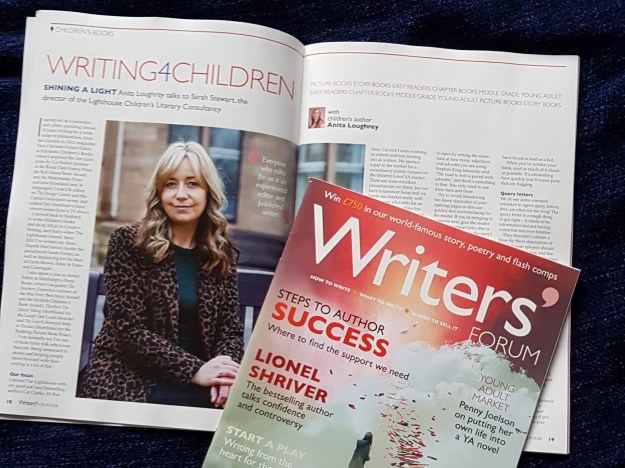
In the February Issue of Writers’ Forum I have interviewed Sarah Stewart the director of the Lighthouse Children’s Literary Consultancy about her career and the services she offers to children’s and YA book writers.

writing 4 children - lighthouse4

She started The Lighthouse with her good friend, Cat Clarke, when they were both working as editors. Sarah was the UK editor of The Hunger Games at Scholastic and has also worked for the excellent Edinburgh based publisher, Floris Books.

The feature contains valuable advice about opening lines and query letters. They also link up writers with agents  when they feel they’ve read a good, strong submission.

Some of Sarah’s advice includes:

If you’re writing for younger children, a sense of immediacy is a bonus in an opening; I like a bit of meandering description when I am read adult fiction, but not if I’m looking at something aimed at seven year olds.

You can read the full interview in the Feb 2019 #208 issue of Writers Forum. To find out more about the Lighthouse Children’s Literary Consultancy and their services you can view their website: www.lighthouseliterary.co.uk or follow them on Twitter at: @thelighthouseuk 

My Writing Tips

Here are some more writing tips that you may find useful. They are not in any particular order.

notebook and pen2

  • If you want to write a big book, pick a big theme.
  • Write rich characters with rich backgrounds (and I’m not talking about money.)
  • Finish each chapter on a cliffhanger.
  • The plot must race along at breakneck speed.
  • Mix fact with fiction so that the reader does not know where the truth ends and the fiction starts.
  • Be clear of all the underlying themes and what is going on in the background.
  • Look at the opening – does it grab you?
  • Think about the title.
  • A good story has a great plot and loads of action.
  • Be careful the ending is not an anti-climax.
  • Make up your own secret society if you want.
  • The ‘What if…?’ button, is the most important key on the keyboard.

Book Review – Is it a Mermaid?

Title: Is it a Mermaid?

Written by: Candy Gourlay

Illustrated by: Francesca Chessa

Published by: Otter-Barry Books
is it a mermaid

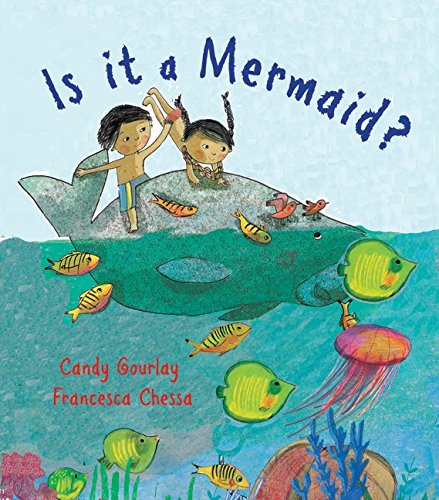
This book is full of interesting facts about the dugong and its history. Bel and Benji meet a dugong whilst playing on a beach in the Philippines. The dugong insists she is a mermaid. Bel is swept away by her imagination and instantly believes this. After all, in Malay the word for mermaid is ‘duyong’. Benji is harder to convince. He does not believe in mermaids and tells the dugong she is nothing but a Sea Cow. Understandably, this upsets the dugong. It is lucky that mermaids are so forgiving. By the end of the book even the most sceptic reader will believe in mermaids.

The story is enhanced by Francesca Chessa’s beautiful Monet-style illustrations. The colours take you on a journey through time, from the morning, to midday and then the glorious sunset and finally the deep blues of twilight when they have to pack up their fun day on the beach to go home. Even the end pages are illustrated as part of the story.

On the surface the themes of Is it a Mermaid? are friendship and kindness but this book carries a deeper message about how the dugong’s habitat of seagrass is under threat.

“They have been listed as vulnerable to extinction by the International Union for Conservation and Natural Resources (IUCN).” Candy Gourlay

Seagrass are flowering plants that live in shallow sheltered areas along coastlines all over the world. They are different from seaweed, have bright green leaves and are very important for the biodiversity around our planet.

  • Seagrass meadows act as a natural sea defence by trapping sediment and slowing down currents and waves.
  • They provide a home for many baby fish, including Cod, Plaice and Pollack around our shores.
  • Seagrass meadows absorb and store large amounts of carbon and are vital in the fight against climate change.
  • They absorb nutrients, pollutants and bacteria and help to keep our coastal waters clean.”

Project Seagrass

In the British Isles there is over 22,000 hectares of seagrass that is threatened by pollution and human damage such as boat propellers and chain moorings that can hinder its ability to produce new growth. Two species of seahorse depend on shrimp which inhabit the British Isles seagrass meadows and cuttlefish lay their eggs in these underwater fields.

I love the fact that Candy Gourlay ends the book with this educational message and points readers in the direction of an app called SeagrassSpotter designed by the charity Project Seagrass.

“SeagrassSpotter is a conservation, monitoring and education tool to help us better understand seagrass meadows around our coat.

By using SeagrassSpotter and becoming a Citizen Scientist with Project Seagrass, you can help us learn more about the seagrass meadows in your area, so that together, we can protect them.” Project Seagrass

This book would be ideal to use in the classroom to support work on habitats and conservation.

Is it a Mermaid? is a book to treasure.

To find out more about Candy Gourlay and her books visit www.candygourlay.com or follow her on Twitter @candygourlay and Instagram @candygourlay

To find out more about Francesca Chessa and her illustrations visit https://francescachessa.format.com/hello  or follow her on Instagram @hollysredboots and Twitter @hollyredboots

To find out more about Project Seagrass visit www.projectseagrass.org

To find out more about the app SeagrassSpotter visit www.seagrassspotter.org or search in the App Store or Google Play.
An interview with… Penny Joelson

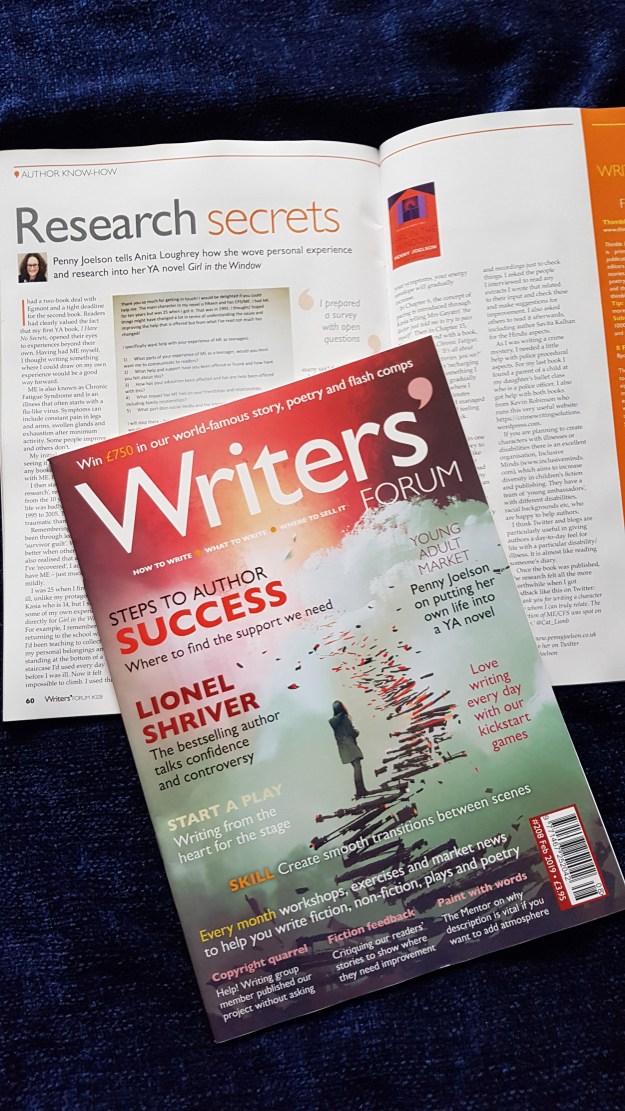
My Research Secrets slot in Writers’ Forum features YA writer, Penny Joelson. She explained how she wove personal experience and research into her YA novel, Girl in the Window.

research secrets - penny joelson4

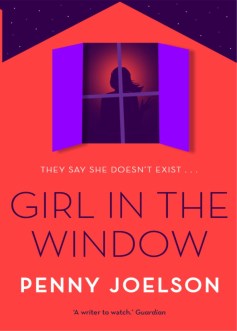
The book is about a teenage girl called Kasia, who has ME so spends most of her time staring out the bedroom window. Nothing ever happens on Kasia’s street so when she sees what looks like a kidnapping, she’s not sure whether she can believe her own eyes. she notices a girl in the window opposite and hopes she saw something too but when Kasia goes to find her she is told there is no girl.

In the feature you can see a copy of the interview that Penny used as part of her research to gain a young teenage perspective of ME.

I prepared a survey with open questions and an option to add further information. I was overwhelmed with the response and the moving stories I read.

Penny explained that while some research needs to be done before writing, she prefers to write a first draft and then do more research, check facts and add details. This stops her from info dumping and the feeling she must include everything she discovered.

covers

You can read the full interview in the Feb 2019 #208 issue of Writers Forum. You can find out more about Penny Joelson and her books on her website: www.pennyjoelson.co.uk or follow her on Twitter @pennyjoelson

Characterisation

Something that has always interested me is characterisation.

When I write fiction I always start with the character. I decide who my protagonist is going to be and what interesting character traits that could have. For me, character comes before plot. I always do a character questionnaire that I have devised to get all my ideas down on paper before I forget them. The questionnaire is designed to make me think more deeply about my characters. I use it in my creative writing workshops.

I am very aware that in a children’s book the protagonist needs to be a child. but, not any old child – it needs to be a child who is pro-active, brave and can use their initiative. This is true of all fiction. The characters can’t just sit there and expect other people to sort out their problems.

Alice

I have learnt over the years to trickle information about character into my writing rather than write blocks of character description. Andrew Melrose, the senior lecturer at King Alfred’s University in Winchester, once said in a workshop at a SCBWI Conference in Winchester, many years ago:

“Make your characters whole, make them real, make them people. Leak the clues deliberately and at a good pace. Let them evolve.” Andrew Melrose

I like this quote it is written in a few of my notebooks so I come across it regularly. I have always tried to follow this advice. However, I have also found that sometimes you need to state the obvious, as it is not always obvious to the reader. When you get to know your characters it is easy to forget that everyone else does not know as much as you do.

Book Review – The Salvation Project

Title: The Salvation Project

Written by: Stewart Ross

Published by: Blean Books

salvation project

A fast-paced, exciting dystopian set in a world with no adults. This novel is the conclusion to the Soterion Mission trilogy where a very contagious mini-flu mutated everyone’s DNA, accelerating the ageing process so the human race only live a few weeks after their nineteenth birthday. A scary but brilliant concept. This young adult novel is full of tension and emotion.

With no education and no technology, the population split into two fractions: Zeds and Constants. The narrative unfolds into an emotional roller-coaster of totally believable reactions to such an apocalyptic disaster. A skilful and commendable modern version of William Golding’s Lord of the Flies with hints of Mad Max.

The characters are heart-wrenchingly realistic but coming into the story at the last book I couldn’t help feeling I was missing something. Stuart Ross does provide a very comprehensive ‘previously…’ prologue but I would recommend reading all three books in order to get the full impact of the story and all its complexities.

The haunting ending hits home as it encompasses the fundamental truth that resistance to change is human nature. As with all good books, I was thinking about the conclusion and the character’s struggles to get there, long after the book was finished.

An interview with… Rebecca Colby

In the January 2019 #207 edition of Writers’ Forum, I interviewed high-concept picture book writer, Rebecca Colby about the importance of rhyme and rhythm in children’s books.

RebeccaColby-9

Rebecca told me:

When I began writing children’s picture books, I naturally gravitated towards writing in verse. But the industry professionals at the writing events I attended warned against it. Phrases I heard many times included:

  • Rhyming books are too difficult to translate.
  • We can’t sell co-editions.
  • It’s hard to rhyme well.

While I knew these statements to be true, I also knew that children love rhyme, and these warnings didn’t stop publishing houses from buying books in rhyme.

In the feature she demonstrates how she uses onomatopoeia, repetition, juxtaposition and prediction to write fun and imaginative that children love. Here is an example from her picture book Motor Goose Rhymes that Go! published by Feiwel & Friends.

Motor Goose_Spread 2sm

Her message to other writers who want to write rhyming picture books, is to try and come up with fifty ideas and give these ideas plenty of time and space to grow.

Rebecca Colby3

In a forthcoming book entitled How to Write Picture Books that Knock Editors (and Agents!) Socks Off, Rebecca Colby will share some games which makes the task of starting to write less daunting and provides loads of tips for writing high-concept picture books. More details will be available on her website later in the year.

Find out more here: www.rebeccacolbybooks.com and follow her on Twitter: @amscribbler


Ideas! Ideas! Ideas!

Apparently authors are always being asked where do you get your ideas from. You know what? I have never been asked this. Maybe because I am constantly spouting weird ideas, they are too scared to ask me.  I do have a rather vivid imagination.

But just in case you were interested here is a list of places I often find ideas. I put them in an idea cloud using: www.wordart.com

idea cloud2

There are loads of places brimming with ideas to be scribbled down. Sometimes I am like a tree with spreading branches reaching out into the far corners of the world, storing each idea on my leaves ready to drop them into a new book.

spreading branches.jpg

There are millions of ideas waiting to be explored. Some days though, it seems every topic imaginable has already been done, or that my ideas are too obscure for anyone else to be remotely interested. But, maybe that has more to do with the mood I’m in rather than the actual flow of ideas.

From the day I decided I want to be a writer, I started to carry a notebook on me. I write down everything, as my memory for trivia is awful. Talking to children, and listening to children, also gives me loads of ideas. Although, I am no longer teaching I am lucky, as I have three children who liked to get into mischief and that triggered lots of ideas too. My children are all grown up now but they are still a great source of new ideas.

Sometimes, I really have to make myself notice what is going on around me, as when I am working on a project, I find I mull it over in my mind and walk through real life in a daydream. Not such a good idea when you’re driving or trying to explain why you’ve reversed into the tree at the edge of the driveway… again.

tree

I tend to get my best ideas for things that I’m already working on when I’m reading something else. Surprisingly, it never has anything to do with what I’m actually reading. I think it might have something to do with cognitive processes. I did a degree in Behavioural Sciences, so I can say things like ‘cognitive processes’ and know what I’m talking about. Pity no one else does.

But what do you do with these ideas once you’ve got them? Often an idea needs time to grow and sort itself out in my head. I tend to draft scenarios in my notebook, then re-write them on the computer and print them off. You can tell if something is really rubbish when you see it in print. I also pretend I am the character and act out the scenes blow by blow in m,y study, or sometimes I act out little scenes in my head.

Opps! There’s that tree again.

Book Review – The Poo that Animals Do

Title: The Poo that Animals Do

Written by: Paul Mason

Illustrated by: Tony DeSaulles

Published by: Wayland

The Poo that Animals Do

Are jellyfish smelly fish? What does it mean if a rhino kicks up a stink? How can elephant poo fuel a house? Find out many fascinating facts about animal poo, from modern day use to funny animal habits.

This is an innovative and informative book that will catch the eye of even the most reluctant reader. The Poo that Animals Do is full of exceptional snippets and fun facts all about different animal’s poo. The illustrations compliment the facts perfectly and add their own touch of humour.

There are three things I challenge the reader NOT to do when they flick through the pages of this book:

  1. I challenge you NOT to laugh;
  2. I challenge you NOT to hunt for the poo;
  3. I challenge you NOT to learn something.

A child may pick this book up because they think it is fun, silly or even a little bit naughty and they may spend their whole time giggling whilst they read, but when they finally put the book down they really will definitely have learnt something. It may be whether or not jellyfish poo, or how poo is used as camouflage, or even what humans use poo for. What they do with these impressive facts, I’ve no idea!

I believe this is an essential book for class book corners all over the world.

This book review was previously published on the online Armadillo Children’s Book Review Magazine.


An interview with… Savita Kalhan

Savita Kalhan’s latest novel The Girl in the Broken Mirror published by Troika Books and nominated for the Carnegie Medal 2019 is the story of Jay, a 15-year-old British Asian girl who is raped. Savita told me all about the resources and techniques she used to research this YA novel for my Research Secrets column in the national writing magazine Writers’ Forum.

Savita Kalhan6

Savita explained:

Sadly, as the #metoo and #timesup movements have illustrated in recent times, the incidence of sexual assault is much more prevalent than once thought, and stories of survivors have been publicly accessible. I drew on these experiences of survivors when I was writing this book. I also talked directly, and in confidence, to women who have been sexually assaulted about their experiences and how they dealt with them. I also spoke to friends and relatives of victims.

Savita does not have a set pattern for her research but her tip to other writers is even though you can get caught up in your research and you may feel you have wasted your time it is better to know far more about the themes and subject of your book than to know less. But the best tip she was ever given was:

The best writing tip I was ever given was to sit down and write, and then read, edit, fact-check, and rewrite, because that’s what writing is all about.

You can read Savita Kalhan’s Research Secrets feature in the January issue #207 of Writers Forum.

You can find out more about Savita and her books on her website www.savitakalhan.com

Or follow her on Twitter @savitakalhan