Tag Archives: SCBWI British Isles

Inspirations from the Bookshelf – Alice Hemming

Check out SCBWI British Isles online magazine, Words & Pictures, to read the interview I did with Alice Hemming about how she is inspired by Hans Christian Andersen.

Alice hemming writes for children of all ages. She has over 50 books published in the UK and internationally, including picture books and chapter books. She has also written for websites, reading schemes and even a talking bear! Two of her books were selected for the National Library Summer Reading Challenge.

Alice Hemming

Alice recalls how The Little Match Girl by Hans Christian Andersen captured her attention when she was a child. She revealed that when revisiting the story as an adult, it was difficult for her to imagine what appealed to her four-year-old self, but she believes it had something to do with the comfort that is to be found within the tale in the flashes of warmth provided by the matches as the little girl tries to keep warm in the snow. A ‘polished stove’. A table set with a mouth-watering feast. A Christmas tree ablaze with candles. And, above all, the hug from the grandmother.

The Little Matchgirl

From that moment on Alice was hooked on Hans Christian Andersen. She told me she has even read Andersen’s autobiography, The Fairy Tale of My Life, although she still prefers the 1952 film with Danny Kaye!

Danny Kaye in the Hans Christina Snderson movie

She explained:

“Andresen hasn’t influenced my writing style, in that every Andersen fairytale I’ve read has been in translation, but he’s had a huge impact on my storytelling.”

Alice Hemming quote from Inspirations from the Bookshelf Interview

Her book The Frozen Unicorn (Scholastic 2022), is the first to reference Hans Christian Andersen and her absolute favourite story (or seven stories) of Andersen’s: The Snow Queen.

The Frozen Unicorn by Alice Hemming

Alice Hemming’s protagonist in The Frozen Unicorn, crosses a snowy landscape to confront an antagonist with a frozen heart, to save her lost love. She meets a hostile stranger in a flower garden, magically blooming in the snowy landscape. Alice has taken these ideas and made them her own. She captures the feeling of magical warmth and safety she found in Andersen’s work.

She explained she is sure she will continue to draw on Andersen’s stories for inspiration and the stories of Hans Christian Andersen will always give her a warm glow.

To read the complete feature please take a look at: Inspirations from the Bookshelf Hans Christian Anderson

You can find out more about Alice and her books on her website: https://alicehemming.co.uk
Inspirations from the Bookshelf – Lynn Stuart

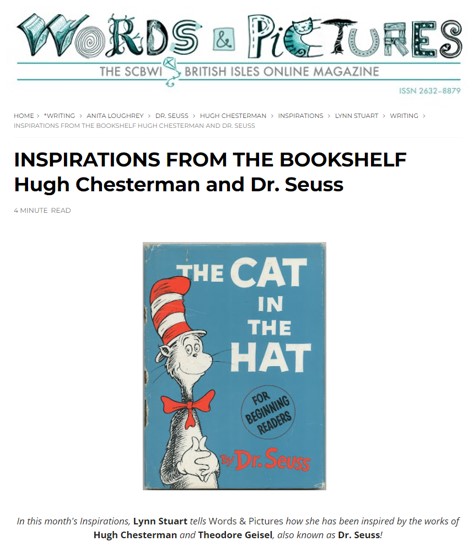
For a recent issue of the SCBWI British Isles online magazine, Words & Pictures, I interviewed Lynn Stuart about what authors have inspired her writing. She explained that she is inspired by the work of Hugh Chesterman and Dr Seuss.

She told me how she was introduced to Hugh Chesterman after purchasing Number 11 Joy Street in 2007. The illustrations reminded her of the Dr Seuss books as both authors have a great sense of fun and adventure. Lynn elaborated that her most vivid memory of Dr Seuss is reading The Lorax to her daughter in 1995 and the enjoyment on her face.

“The more I read by Hugh Chesterman and Dr Seuss, the more I am impressed with them. It’s just my opinion, but I believe Dr Seuss was inspired by Chesterman in the same way he has inspired me.”

Lynn Stuart

Lynn recommends children’s authors should read The Lorax by Dr Seuss, as it is a book very much ahead of its time about industrialisation and its effect on nature.

To read the complete feature take a look at: Words & Pictures – INSPIRATIONS FROM THE BOOKSHELF Hugh Chesterman and Dr. Seuss.

An interview with… Natascha Biebow

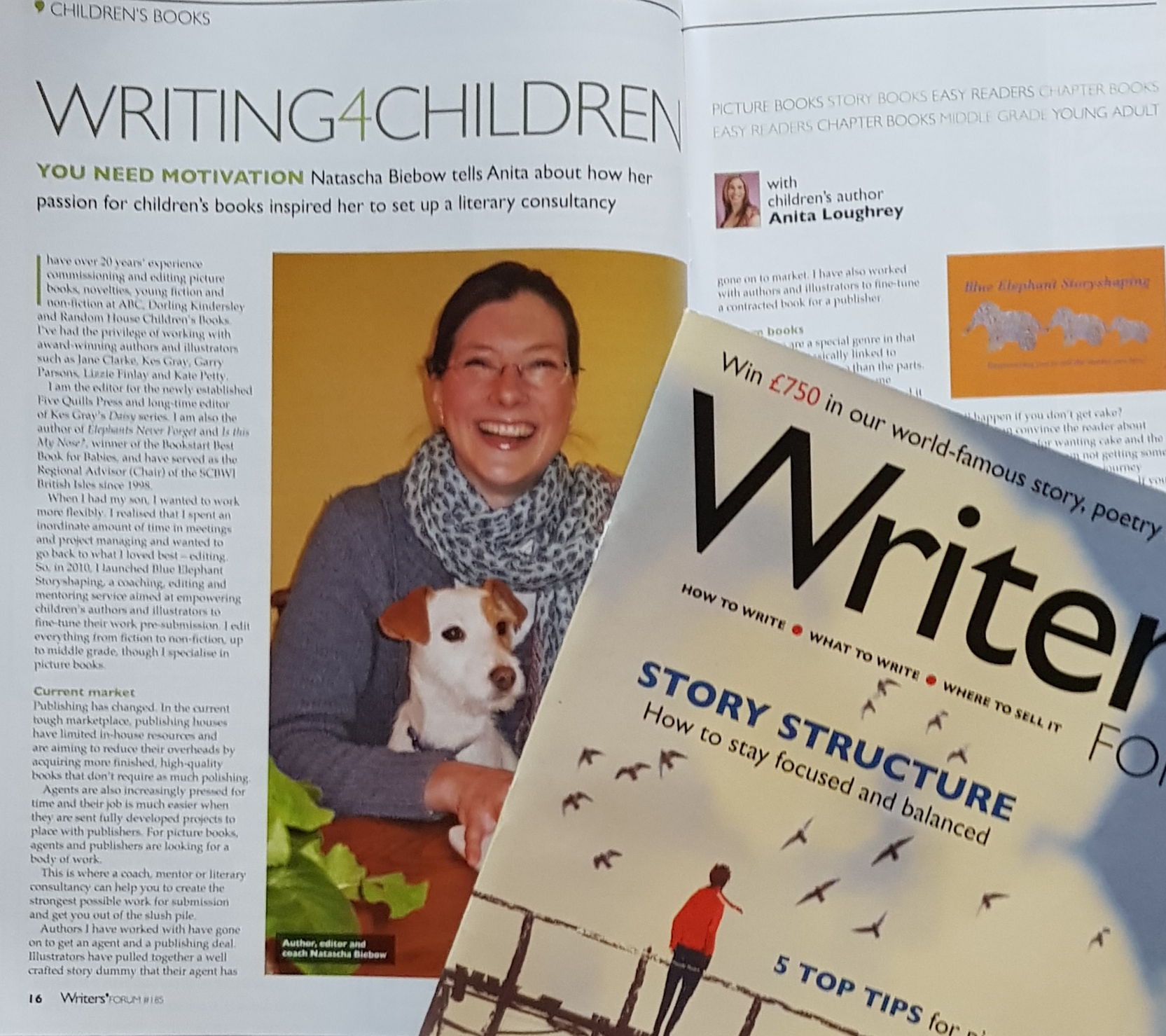
In March 2017, Natascha Biebow talked to me about how her passion for children’s books inspired her to set up the Blue Elephant Storyshaping literary consultancy. The interview appeared in my Writing 4 Children slot in the national writing magazine, Writers’ Forum.

Natascha has had over 20 years’ experience commissioning and editing picture books, novelties, young fiction and non-fiction at ABC, Dorling Kindersley and Random House Children’s Books. She has worked with award-winning authors and illustrators, such as Jane Clarke, Kes Gray, Garry Parsons, Lizzie Finlay and Kate Petty. I am the editor for the newly-established Five Quills Press and longtime editor of Kes Gray’s Daisy series. Natascha is also the author of The Crayon Man: The True Story of the Invention of Crayola Crayons, Elephants Never Forget and Is this My Nose?, winner of the Bookstart Best Book for Babies, and have served as the Regional Advisor (Chair) of the SCBWI British Isles since 1998. 

When Natascha had her son, she decided she wanted to work more flexibly. She realised she spent an inordinate amount of time as an editor at Random House attending in-house meetings and project managing and she wanted to go back to what she loved – editing. So, in 2010, she launched Blue Elephant Storyshaping, a coaching, editing and mentoring service aimed at empowering children’s authors and illustrators to fine-tune their work pre-submission.

“I edit everything from fiction to non-fiction, up to middle grade, though I specialize in picture books.”

Natascha Biebow

Natascha explained publishing is changing. In the current tough marketplace, publishing houses have limited in-house resources and are aiming to reduce their overheads by acquiring more finished, high-quality books that don’t require as much polishing. Agents are also increasingly pressed for time and their job is much easier when they are sent fully-developed projects to place with publishers. For picture books, agents and publishers are looking for a body of work. This is where she can help you to create the strongest possible work for submission and get out of the slush pile.

Authors Natascha has worked with have gone on to get an agent and a publishing deal. Illustrators have pulled together a well-crafted story dummy that their agent has gone on to market. I have also worked with author/illustrators to fine-tune an untitled contracted book for a publisher. You can find lots of testimonials on the Blue Elephant Storyshaping website.

“I get a buzz out of meeting like-minded people who share my love children’s books and story. I get a lot of satisfaction knowing I help to create books that will bring joy and maybe even change the lives of young readers.”

Natascha Biebow

Natascha revealed five of the most common mistakes new writers make when writing picture books include:

  • creating an episodic plot, which reads like a long list of things that happen sequentially with no tension, no clear climax, no story.
  • writing rhyming books that don’t have a strong story at their centre, so that the rhyme dictates the plot and not vice-versa
  • sending work off too early, thinking that writing picture books are short and therefore ‘easy’ to create
  • creating picture books that have no real hook or unique selling point, leaving readers saying, “So what?”
  • not exploring the characters’ true motivation

Natascha is passionate about storyshaping and empowering authors and illustrators to tell the stories they love.

“I work with people at all levels, including published. I am a writer and an editor, so I understand both sides of the business. I love working with illustrators who want to write, illustrators who want to develop a portfolio, as well as authors who are looking to fine-tune their work. I offer courses and 1-1 coaching, creative brainstorming sessions, as well as reviews on manuscripts and honing your pitch for submission.”

Natascha Biebow

For more information about Blue Elephant Storyshaping visit: www.blueelephantstoryshaping.com. Natascha also blogs regularly at Picture Book Den http://picturebookden.blogspot.co.uk and has a monthly Ask a Picture Book Editor column on Words & Pictures www.wordsandpics.org.

My Top Ten Tips

With over 100 children’s books published by a wide range of traditional publishers, I thought I might share with you today my top ten tips for becoming a children’s book writer:

My top ten tips

Join Writers’ groups

These can be local or online writers’ groups. By joining writers’ groups you will be able to network, learn about the publishing world, obtain feedback on your work and make friends with similar interests. The Society of Children’s Book Writers and Illustrators (SCBWI) have a large network of online and local critique groups.

Read a lot of recent children’s books

Take notice of what you like and what seems to work. Study the writing. You’re reading for research first, pleasure second. Actively look for recent releases. Ask your librarian. Send for publisher’s catalogues or pick them up from book fairs. It is important to keep up with the market and what’s being published. If a book with a similar story line has been published in the last few years, your story is unlikely to be published, no matter how good it is.

Know the different types of children’s books

Take into consideration the various age groups when writing your own books. Think about the word lengths, language, style, etc.

Write the type of children’s books you enjoy the most.

If you enjoy the books you are more likely going to write something someone else enjoys too.

Write every day if possible

Practice makes you a better writer.

Take courses on writing for children

There are lots of writing courses specifically aimed at writing for children out there. Take a look at the SCBWI masterclasses or those offered by NAWG. 

Enter competitions specifically for writing for children

There are a lot of competitions for aspiring children’s book writers. Check the rules and the closing dates. Some of the competitions specifically for children’s writers I am aware of are:

Extend your CV

Seek ways of filling your writer’s CV with publishing credits, such as writing articles and short stories. Contact your local newspaper about writing a column or regular slot or write fillers for magazines.

Send your manuscript out to publishers and agents.

Get a copy of the latest Children’s Writers and Artists Yearbook and find out who takes unsolicited manuscripts for the age-range you are writing for. Check if they take emails submissions or prefer them to be posted. Usually they want the first three chapters, one page synopsis and a covering letter. It is very important the book is finished.

Have FUN!


Writers’ forums

As you all know by now I write for Writers’ Forum a national writing magazine. I have two columns each month, one about authors and their research and the other about writing for children. Each is approximately 1200-1500 words.

Today on my blog though I thought I would write about my thoughts on writers’ forums that is somewhere where people can get together online to discuss writing. There are hundreds of professional and aspiring writers out there and basically we are all in the same boat submitting our manuscripts to agents and editors, with similar wishes and desires for success.

Forums bring people together to chat and talk about their writing. There are different forums for different types of writing. I used to belong to a lot of yahoo Groups when I first started out but I found I outgrew them and Yahoo groups do not not run in the same way anymore, if at all. Nowadays most forums seem to be on Facebook, or run through a society’s websites such as SCBWI and NIBWEB. It is part of your virtual network. I have posted about Virtual networking before, See: Virtual networking

blog-forums

I try to limit myself to three forums so I do not get too many distractions from my work. On these forums, people often asked the same sort of questions But, these were sometimes questions that I may have been pondering over for weeks and just wasn’t brave enough to ask myself.

Sometimes little debates linked to writing go on with everyone adding their point of view. These can be fascinating. Sometimes I listen in or add my own snippet. It is important to contribute to forums to get the most out of them, although I am sure there are plenty of ‘lurkers’. One thing for certain is they definitely counteract the feeling of being alone.

forum 2

It is also important to keep it positive. If someone says something controversial my advice is – keep quiet. Remember some of the members may be very highly-regarded authors or editors and you want to make a good impression.

And probably most importantly, when you post to a forum every single member gets to read what you have written so keep it relevant. If you want to ask a specific person a question it might be a good idea to do it more privately through email.

If you belong to any forums, which are different to the ones, mentioned above, whether they are for children’s writers or writing for adults why not add a comment. I’d be interested to know a little about them and how they have helped you.

Why write a synopsis?

A few weeks ago on my blog, I talked about how a personal synopsis, or breakdown, of your novel can be a useful planning tool and map to help you complete your novel. See here. Last week I explained the difference between a synopsis for publishers and agents and a book proposal. See here.

Today I am going to talk about whether agents and publishers even read the synopsis. A question that is often asked at writing meetings and events is:

Do we need a synopsis?

This is a very controversial question. Romantic novelists, Dee Williams and Iris Gower, who I met at a Writers Holiday event many years ago, told me they had never had to write a synopsis.

writing1

Others, like Marti Leimbach, writer of contemporary fiction for adults and young adults, admitted writing a synopsis is often harder to write than the actual novel. Whereas, some very lucky people, like Lee Weatherly, claim they are easy to write. Unfortunately, I lost my notebook which had all my notes from the Lee Weatherly talk – I kept saying to myself it was bound to turn up but it never has. I may have left it on the train!

stickynotes

I have been told at a couple of SCBWI conferences by agents and publishers on various panels they don’t even read the synopsis. You should have heard me groan at that news. I spend hours and hours on mine and they’re not even going to read it. I could have stood up and screamed. Even at the recent SCBWI-BI Agent’s Party, three out of the five agents on the first panel said they do not look at the synopsis. Joanna Moult prefers a cracking first page and Kate Shaw will look at the cover letter and sample first. Zoe Plant from the Bent Agency does not even ask for a synopsis in the submission package.

So is a synopsis a waste of time?

NO! I do not think so. Other editors and agents, such as Chloe Seager, have said they do read the synopsis first and prefers to be told how the book is going to end. Some other agents have said if they don’t like the synopsis they don’t bother reading the rest. This is just as scary as I have always believed the most important thing is how strong your writing is.

What should we do?

I still think, the most important thing is how good your writing is but I also think we need a synopsis to show the editor or agent how well the story hangs together and prove it has a defined beginning, middle and end. So even though Megan Carroll does not like spoilers in the synopsis, my advice is persevere with your synopsis. It might help you to clinch the deal.

SCBWI Outstanding Contribution Award 2018

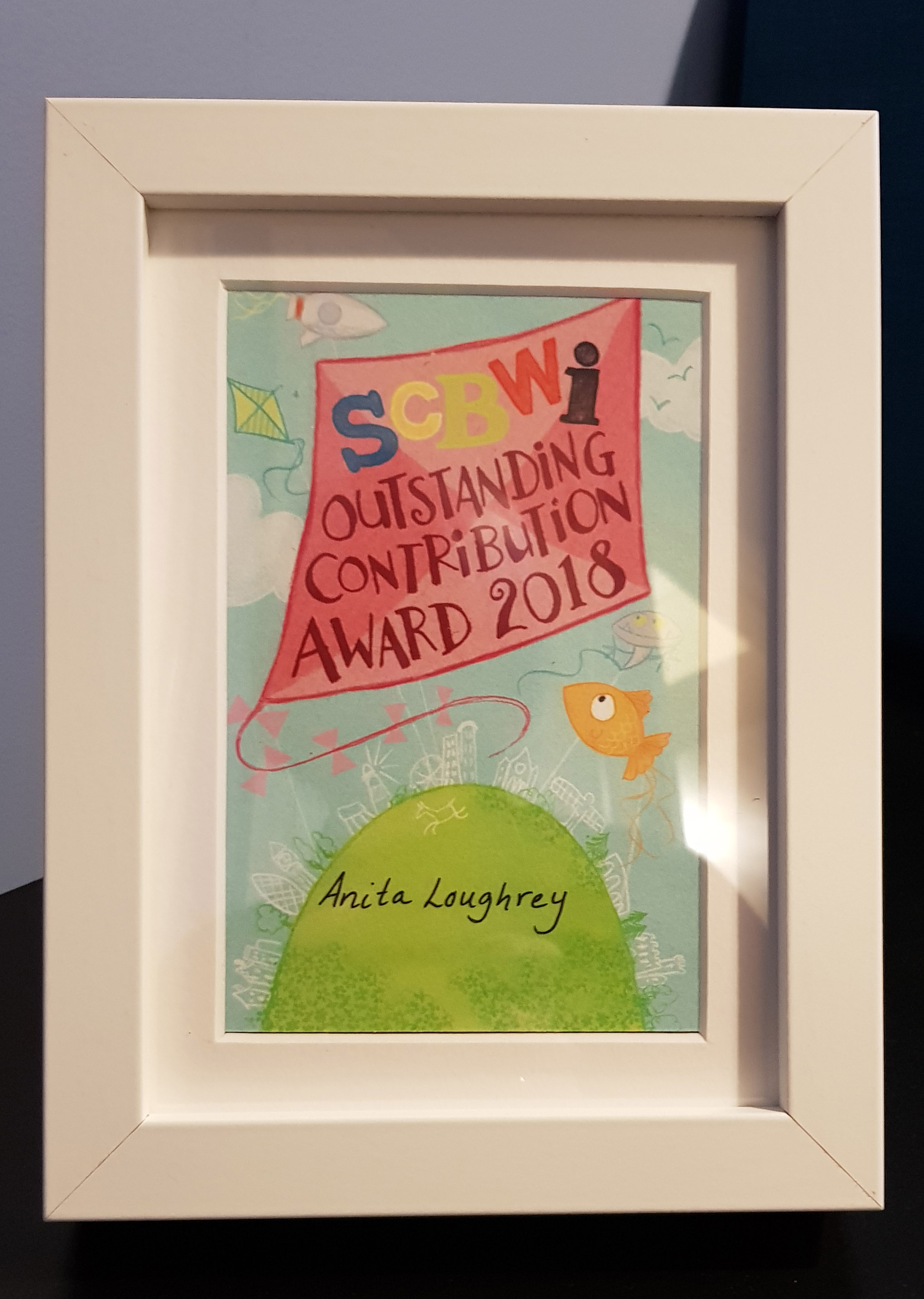
At the SCBWI Winchester Conference 2018 I received an Outstanding Contribution Award for the work I have done within SCBWI as a Volunteer. Unfortunately, I was unable to attend the conference this year but the award arrived in the post this week. Thank you 🙂

OCA 2018

Here is the citation:

Anita Loughrey has served as our Membership Coordinator for too many years to count! She remembers times when we didn’t have the networks or even online sign-ups… when keeping on top of membership admin was not for the faint-hearted. Anita is often the first welcoming contact for new members, sending out the welcome pack and answering their queries about SCBWI. She works closely with the Networks and events organizers to provide updated monthly membership lists and follows up on renewals. As many will know, she also served for many years as the Networks Coordinator for London and the South East, forging many personal contacts with members, too. Anita is a shining example of a volunteer who is willing to tackle admin with all-important reliability and always with a smile.

OCA 2018 citation

I have been a member of the Society of Children’s Book Writers and Illustrators (SCBWI) since October 2002, sixteen years ago. I first started volunteering in an official capacity in April 2006, when I became Network Organiser for London. This involved planning monthly socials for members at different venues around London with a special guest each time. I also introduced the monthly London SCBWI brunches which were run by Miriam Craig and the monthly London SCBWI Write-ins. I don’t and have never lived in London but I did the job for ten years before handing the job over to the very capable hands of Tania Tay,  who has built on what I started and made the London network a strong and cohesive group.

In October 2011, I also took over the SCBWI British Isles membership coordinator role from my wonderful friend Sue Hyams. Over the seven years I have been doing this role I have streamlined the whole membership system for the British Isles and introduced our own British Isles membership pack jam-packed full of useful information on how to get the most out of your membership. I also campaigned to add a dropbox to the online joining form so people could select their network area. Before this was introduced the Network Organisers had to sort out which members were theirs themselves.

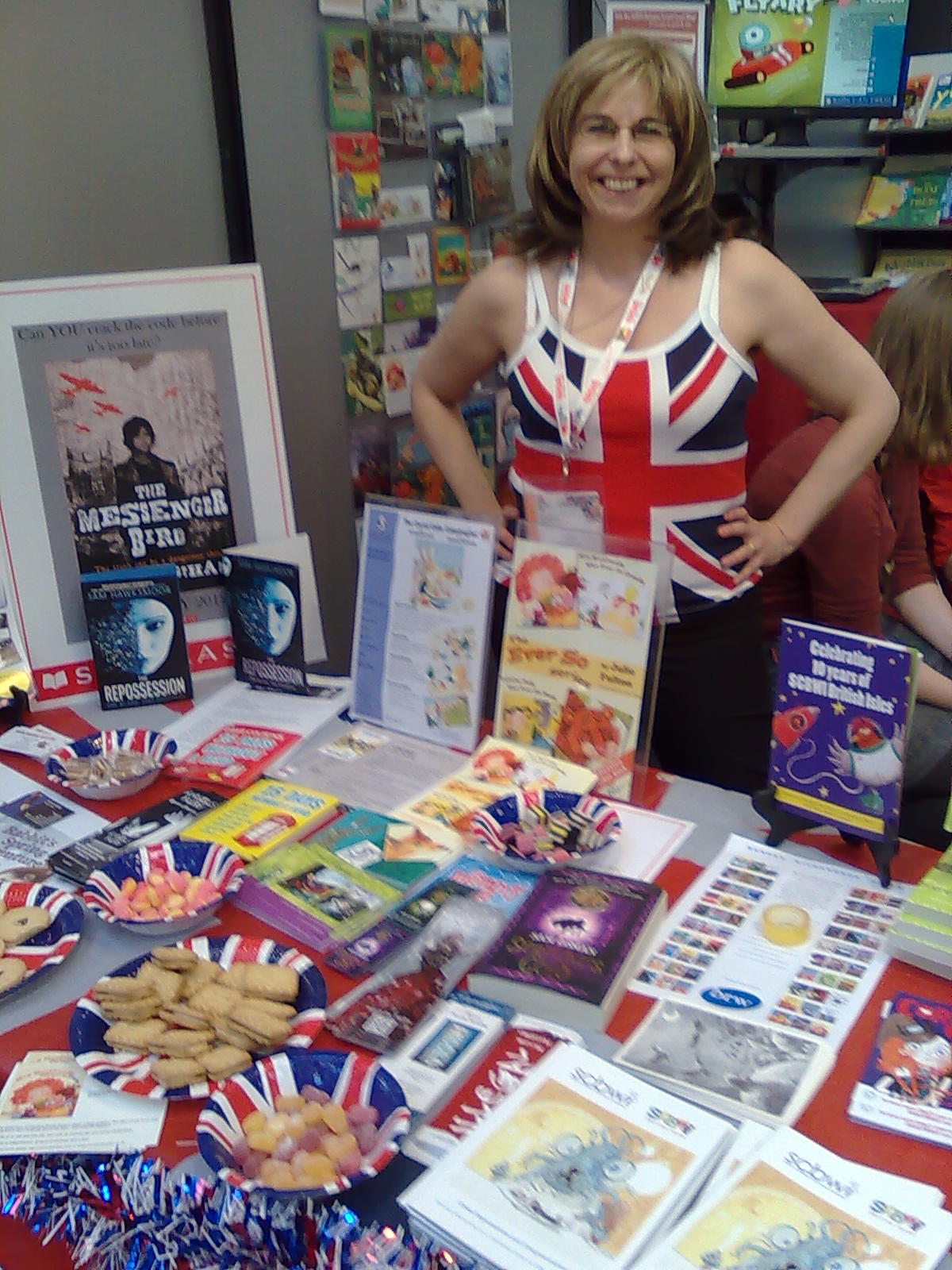
One of the highlights for me as a volunteer was going to the Bologna Children’s Book Fair in 2012 to represent the SCBWI British Isles and showcase our members published books. It was fun.

aBologna2012 British Isles stall

In 2016, I became the South East Network organiser. During the two years I did this job I visited critique groups in Oxford and Southampton and I ran a weekly write-in in Newbury every Wednesday morning. I passed on the mantle at the beginning of this year to Fiona Barker.

Over the twelve years I have been volunteering for SCBWI I have achieved and done quite a lot. I am looking forward to continuing this work. I would also like to say a big congratualtions to all the other SCBWI volunteers who received a SCBWI British Isles Outstanding Contribution Award this year. Well done 🙂