Tag Archives: Anita Loughrey

Book Review – The Hamburger of Doom

Title: Jonny Jakes Investigates… The Hamburger of Doom

Written by:  Malcolm Judge

Illustrated by: Alan Brown – Advocate Art

Published by: Curious Fox Books

Jonny Jakes Investigates… The Hamburger of Doom

Jonny Jakes is an undercover reporter for the banned school newspaper, The Woodford Word. Nothing will stop his pursuit of the truth. Not teachers. Not parents. Not double detention. He is always looking for that next big story so when a new Headteacher arrives halfway through term and introduces some weird and wonderful new routines, Jonny smells a rat. Hamburgers for lunch? Sweets in class? He’s determined to get to the bottom of it, because Jonny Jakes investigates the same way he eats his hamburgers: with relish.

This is a fantastic concept, well written in the style of the Wimpy Kid diaries and the Tom Gates books. The fact the school newspaper has been banned has you hooked from the start. It is the first book in a new series which will is sure to capture even the most reluctant reader’s attention.

In Jonny Jakes Investigates… The Hamburger of Doom you follow Jonny on his quest to save the school from aliens, whilst not only avoiding being licked to death but also preventing both the children and parents from becoming morbidly obese. Jonny Jakes talks you through the mounting evidence and how he comes to his amazing deductions which provide his hilarious, hard-hitting headlines. Find out if Jonny manages to meet his deadline to get the next copy of The Woodford Word out on time.

This book highlights why you should never take sweets from strangers and how healthy food, herbs and spices can save your life.
Working title

If I have not been given a title by the publisher who has commissioned the book, I often start by giving my books a working title just so I can have something written on the page. A blank page is daunting and I always write something to start myself off even if I go back and change it later.

Inkedblank book_LI

It is better not to get too attached to your working title as publishers often want to change them anyway. I learnt this the hard way and it was definitely a case of killing your darlings. Nowadays I never expect the same title to be on the finished published article, short story or book. I have written quite a few short stories for a variety of national women’s magazines and most of them were published under different titles.

However, it never hurts to give the title of your stories, features and books some serious consideration as this will be the first words the editors and publishers read when looking at your submission, whether it has been commissioned, or not. First impressions are important. A title that stimulates interest or intrigue stands out more amongst the competition, especially if it is on the slush pile. 

books

A good working title will  open up the meaning of the story, revealing layers of character, theme and subtext that goes beyond the actual plot. It will also give the editors and publishers an idea of what the book is about and the tone of the book.

A working title should inspire you to write, fill you with confidence and help you to get your words onto paper because it focuses you on the story. This will give you the momentum to move forward.

When I first started out writing for children I took my first three chapters to a critique group meeting and they got so hung up on the working title even though  I explained it was just a way to focus me on the themes of the book, they did not really give me any advice on the essential first three chapters.

Book Review – Simon Thorn and the Wolf’s Den

Title: Simon Thorn and the Wolf’s Den

Written by:  Aimée Carter

Cover Illustration by: Sam Hadley

Published by: Bloomsbury

This is the first book of the trilogy about searching for identity.

Twelve -year-old Simon Thorn’s life has never been easy, but being bullied at school and living in a cramped Manhattan apartment with his Uncle Darrell is nothing compared to his biggest secret: he can talk to animals.

When his Mum arrives on a very rare visit, she is kidnapped by ferocious rats and Simon is plunged into a terrifying mission to rescue her. He discovers he can do more than just talk to animals. He belongs to secret race of animal shape-shifters, known as Animalgams.

In the first book, while searching for his mother, he finds the Animalgam Academy located deep beneath Central Park Zoo. There he learns about the fractured five kingdoms – Mammals, Birds, Insects, Reptiles and Underwater and discovers his father was the Beast King who had the ability to shift into any creature he desired. Simon does not know if he will shift into an eagle like his mother or whether he, or his twin brother, will inherit his father’s abilities.

What he does realise is – the Animalgam world is in danger of ripping itself apart and he is the only one who can stop them.

Simon’s character as a loner who finds it difficult to make friends is established from the start alongside the strong themes of loyalty and bravery. No longer is Simon’s only threat the school bully, Bryan Barker, there is a whole underworld of talking beasts after him and it is not clear whose side is the right side to be on. Simon and the reader have no idea who to trust and where their loyalties should lie. The adults in the book are no help as they insist on keeping secrets from him and he is left to discover his true identity alone. Even the few friends he manages to make along the way are innocent by-standers, as he solves the mystery of his destiny.

Aimée Carter takes us on a fast-paced adventure full of twists and turns reminiscent of Percy Jackson. At the end of each book you are left wanting more.

An interview with… Nicola Morgan

One of the first interviews I did when my Writing 4 Children column launched in 2016 was with the esteemed Nicola Morgan. She is one of my writing idols.

At St Pauls Manchester

She had a strong, realistic  message to tell people who wanted to write for children as a full time career.  Nicola said:

You will have to do school events

They are exhausting, can be demoralising and will sometimes test your resilience beyond its max. They can also be soul-nourishing, highly rewarding and are almost always eye-opening, which is good. Try to take all their benefits and learn to love your audiences by focusing on the vast majority of the students who are listening avidly. And when something undermining happens, laugh (afterwards, not at the time).

You will be seriously underpaid for almost all your children’s/teenage writing

If you want to earn a lot, you need to write a certain sort of book, usually a trilogy/series (though many of those fail before they’ve started.) And you’ll still need luck. Make sure you are paid for events because they can be your only way to survive financially.

Bad things, small or big, will happen in your career

They will often be things you have to keep to yourself or a close circle of friends. This is true for all artists who put their heart and soul out into the world to be judged by others. So value those friends, as they will support you in those bad times. And realise that all the multi-garlanded, apparently uber-successful authors you’ve been following on Twitter etc also have moments (if they’re lucky or incredibly thick-skinned) and months (the rest of us) of darkness and gloom, that we all have angst and inadequacy written through our veins, and that there are more ways to get under the skin of a creative person than there are ways to write a novel. But the emotional rewards are huge. Being published and read is worth the pain.

wf179-september-2016

Nicola’s tips for children’s book writers were read a lot of modern children’s books and if your book has a message keep it hidden.

You can read the full interview in the #179 Sept 2016 issue of the national writing magazine, Writers Forum.

Find out more about Nicola Morgan and her writing at: www.nicolamorgan.com or on Twitter @nicolamorgan

Emotional reaction

Emotional reaction is key to producing 3D characters in your writing.

snake

To make your protagonist and antagonist come alive you need to show their reactions to other characters and events. this will show the reader what frame of mind they are in and help to engage their sympathy and understanding. Even the bad characters can become loved if their reactions are based in emotional motivation.

Emotional reaction is a powerful tool. It helps you as the writer get to the heart of the characters and their problems. This can often be achieved in just a few well structured words.

Think about all your characters and how they would react to seeing a snake – would they scream and run away, would they pick up a stick and try and fight it off, would they freeze and be unable to move, or would they try to talk to it and befriend the snake, or would they react in an entirely different way.

How would these characters react to seeing a snake?

Each of these reactions portrays their different personalities. 

Now think about how these characters would react if they came across a snake.

How would your characters react to a snake? Would all your characters act in the same way? Or do they each have their own particular way of reacting?

And yes… you are right… it does depend on the snake and the snake’s own personality.

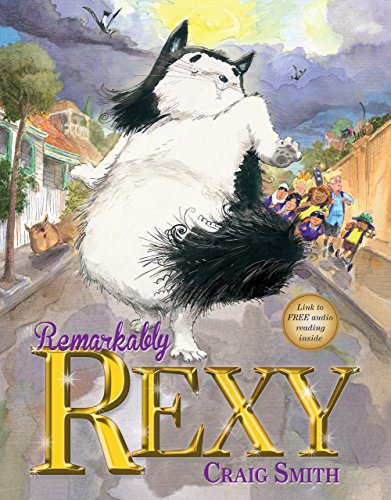
Book Review – Remarkably Rexy

Title: Remarkably Rexy

Written and Illustrated by: Craig Smith

Published by: Allen & Unwin

Remarkably Rexy

The thing I love most about this book is the fantastic illustrations by Australian illustrator and children’s book writer, Craig Smith. It is a story about two cats competing for attention. Everybody loves Rex. He is the most dazzling cat on Serengeti Street. The school kids who pass by are always impressed by his moves… until one day, an interloper threatens to take all his attention away.

The beautiful detailed illustrations portray the cat’s features realistically that you can’t help falling in love with this extraordinary vain cat. If you own or simply adore cats this picture book hits the spot. It also comes with a link to a free audio reading, superbly read by Erick Mitsak.

I loved the wide array of vignettes that portrayed Rexy preparing to greet the children on their way home from school and how Pamela tries to out-cute him. I also liked the end papers showing Rexy so large, lounging over all the gardens in the street because they belong to him. Lots for children to explore in every illustration. A book to treasure and will have the children wanting you to read it over and over again.

This book review was previously published on the online Armadillo Children’s Book Review Magazine.

To find out more about Craig Smith, his books and amazing illustrations visit: www.craigsmithillustration.com

An interview with… Simon Whaley

In my Research Secrets column in the national writing magazine Writers’ Forum this month #215 Sep 2019, I interview Simon Whaley about the research he does for his magazine articles.

Simon Whaley 2

Simon told me:

“What I love about research is the plethora of ideas for potential articles that it generates. You can be researching about one thing, and then come across one small fact that triggers an idea for an entirely different article, for an entirely different market.”

Simon Whaley

He said he uses a program called Evernote to store and organise all his research as it enables him to ‘tag’ notes. He often tags notes with useful contacts, the types of activity, such as event, attraction, tourist, walk and also with the locations such as county, country, towns and villages. This means when he searches something such as Walks and Shropshire it will bring up every note with those tags no matter which project he originally collected the information for.

Simon explained he always makes written notes when researching his articles, even if he has his Dictaphone switched on while interviewing someone. He explained he was once commissioned to undertake a walking route for Country Walking magazine when they discovered he wrote all his routes down in a notebook. The staff writer had dictated the route description into their smartphone, only to discover when they got back to the office four hours later that their smartphone had failed to record. You don’t have that problem writing in a notebook.

He labels all his notebooks and they in turn are an excellent resource.

(c) Simon Whaley

Simon’s notebooks

Simon told me how he had to endure a luxury overnight stay at Weston Park, home of the Earl of Bradford. Not only did he have to experience a 5-course meal sat at the same table used by the Heads of State when the G8 summit was held there, but he also had the opportunity to interview the Head Butler and the Head Gardener.

Photo of Graeme Currie, the Head Butler at Weston Park

Photo of Graeme Currie, the Head Butler at Weston Park (c) Simon Whaley

He said he finds his written notes invaluable when he comes to write his articles. He also takes lots of photographs, which he can refer to.

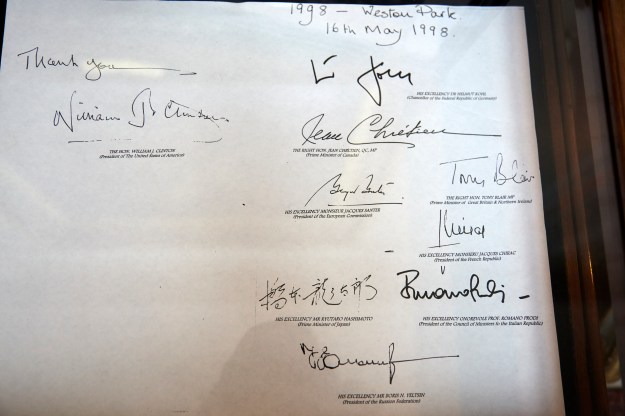
I take photos of everything: information panels, pages inside books, entry fee panels, accommodation rooms I stay in … everything! How many windows on the ground floor at the front of Weston Park? Eight. (I have a photo.) Which Heads of State were at the G8 summit at Weston Park? Clinton, Kohl, Chretien, Santer, Blair, Chirac, Hashimoto, Prodi and Yeltsin. (I have the photo.)

Simon Whaley

Commemmorating the G8 summit visit to Weston Park on 16th May 19

Photo of the Heads of State signatures at the G8 summit at Weston Park (c) Simon Whaley

Simon’s research tip was to take photographs of the information panels as it is the best way to capture all the details and you can read it at your leisure when you get home.

You can find out more about Simon Whaley and his writing on his website:

Website: www.simonwhaley.co.uk

Twitter: @simonwhaley

Facebook: https://www.facebook.com/SimonWhaleyAuthor

Consider the Environment

People do not develop in isolation they are shaped by the world in which they live and grow.

Multiethnic Diverse People in a Circle Holding Hands

There are so many factors that can influence a person’s character and beliefs, such as:

  • their family background and structure,
  • social class,
  • available opportunities,
  • encouragement and ridicule from peers and family,
  • how they were raised and by whom,
  • their friends and how they were raised,
  • money,
  • outlets for their talents and skills,
  • pets,
  • school,
  • subjects chosen to study,
  • the politics and structure of the society they grew up in,
  • whether they grew up in times of peace or war.

All these things should be considered when developing your own characters for your writing. Everybody is different. It is what diversity is all about.

I often spend hours creating character sheets about my characters and not just the main protagonist. I want to know everything about them and I think how these things would influence what they say and how they react. It is more than just jotting down their physical detail.

what sayin

My writing group once laughed at me when I showed them my five-side character sketch for my main protagonist.

After I have developed the character I try to think of scenarios (not necessarily to do with the story I am writing) and jot down how they would react if they were angry, happy, sad, etc. I really want to delve into their mind, know what they are thinking and how they would phrase things in different states of mind.

Try it for yourself and see what happens.

Book review – World-wide Waste

TitleWorld Wide Waste: It’s Not a Load of Rubbish 

Written by: Caren Trafford

Illustrated by: David Wilsher and Jessica Laurentia

Published by: Etram Publishing

World-wide Waste

Caren Trafford, expertly uses narrative non-fiction to examine the enormous waste issues around the world and urges everyone – children, parents, teachers and politicians – to take pro-active measures to help clean up our environment. This book is full of fascinating facts and witty wisdom to make conservation fun. It is written as an interview with Dumpi, a paper bag rapper (wrapper) who wants to be the most recycled bag on the planet, and his friends. They have uncovered the way to stop world-wide waste and create an eco-friendly 21st century.

Full of bright imaginative illustrations that bring the quirky characters alive, World-wide Waste: It’s Not a Load of Rubbish, focuses on issues, such as the acceleration of pollution and climate change. These have to be one of the greatest challenges of our time and the gang are wasting no time, in bringing you the biggest scoop of the century: cover ups, bad smells, danger, destruction and the quest to save our world.

This book highlights this important environmental message in a fun and motivating way. It would make the ideal gift for any child interested in the environment and would be an excellent resource in the classroom to support topics on green issues, recycling and conservation. It could also be used for triggering discussion and encouraging empathy.

An interview with… Jasmine Richards

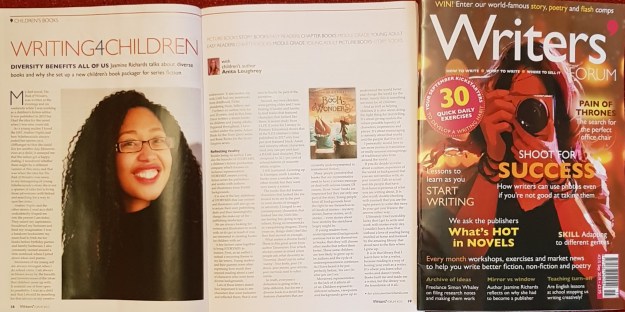
In the September 2019 #215 issue of Writers’ Forum, I talk to author and editor, Jasmine Richards, about diverse books and why she set up STORYMIX a new children’s book packager for series fiction.

Jasmine Richards 2

She explained that although her first novel, The Book of Wonders, was written in 2010 she had the idea when she was nine years old. Her inspiration was 1001 Arabian Nights and other stories she had read as a child. Jasmine has also written under the pseudonyms, J D Sharpe, Adam Blade and Rosie Banks.

dav

Here is a video showing what Jasmine’s books are about.

As an author she noticed a recurring theme in her fan mail. the readers and their parents often expressed how much they enjoyed reading about the diverse character backgrounds in her stories.

This and the desire to see more contemporary characters that looked like herself having adventures,  were two important factors that motivated Jasmine to set up a children’s fiction production company that focuses on diverse characters and inclusive representation.

She explained:

“It is one of the key ambitions of of STORYMIX that our writers and illustrators will also go on to secure their own publishing deals and thus meaningfully change the make-up of the publishing landscape.”

Jasmine Richards

When asked what makes a diverse book Jasmine sent me this quote from Tananarive Due to explain:

quote

She told me:

“Many people perceive that books that are representative need to have a serious message or deal with serious issues. Of course, those issue books are important but they are only a part of the story. Young people from all backgrounds have the right to see themselves in all kind of stories – mystery stories, horror stories, sci-fi stories…”

Jasmine Richards

She explained that a recent study from CLPE (Centre of Literacy in Primary Education) has shown of the 9,115 children’s titles published in 2017 only 4% featured black, Asian and minority ethnic characters.

STORYMIX are always looking for writers and illustrators to work with. You can find out more about STORYMIX and the books they develop here: www.storymix.co.uk

You can find out more about Jasmine Richards and her books on her website: www.jasminerichards.com

Read the full interview in the #215 Sep 2019 issue of Writers Forum, which is available in shops now.