Tag Archives: Writers Forum

An interview with… Helen Lipscombe

In the #217 November issue of Writers’ Forum Helen Lipscombe told me all about researching both espionage and ballet for her debut children’s novel, Peril En Pointe.
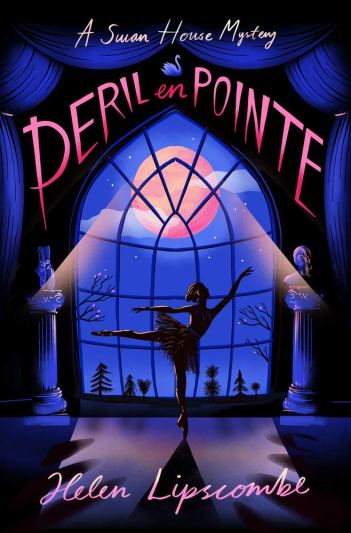
Peril En Pointe book cover

Her main character, Eva, needed physical strength, mental resilience, the ability to speak several languages and an excuse to travel the world. Helen explained how Natalie Portman from the 2010 movie, The Black Swan was her inspiration for the book.

2010 film, The Black Swan - Natalie Portman

From the moment she saw her dark eyes gazing at her through that mask Helen knew Eva would be a ballerina and her setting would be a ballet school for spies. This lead her to research for accurate accounts of the lives of female spies. On the Imperial war Museum’s website, she read all about a spy called Odette Samson.  Odette was also the name of the White Swan in Swan Lake and inspired Eva’s code-name ‘O’.

“I read that Odette Samson had been awarded a George Cross for her refusal to name her fellow secret agents during the second world war. Despite having three young girls, she had volunteered to work for the Special Operations Executive (SOE), but in 1944, was captured and brutally tortured. (The Nazis extracted her toenails; a feature I bestowed on Swan House’s battle-worn Spy Craft teacher, the Captain).”

Helen Lipscombe
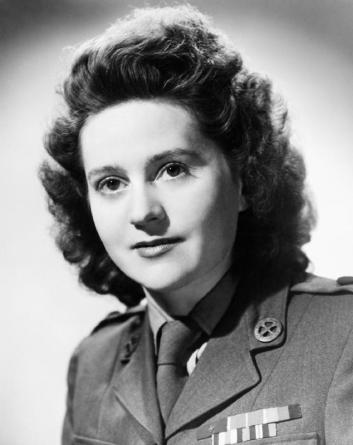
Odette Samson

Odette Samson

In order to capture the heightened atmosphere of a live performance, Helen revealed she went to see Swan Lake by the Russian State Ballet and the Royal Ballet’s production of Romeo and Juliet.

“I also took part in a backstage tour of the Royal Opera House which proved particularly worthwhile. Walking through the maze of corridors as the dancers do every day; standing amongst the sets and lighting; handling the ballet shoes, headdresses and props, and watching the dancers rehearse gave me a real feel for the setting.”

Helen Lipscombe

To read the complete interview check out the #217 Nov 2019 issue of Writers’ Forum.

You can find out more about Helen Lipscombe you can follow her on Twitter @Helen_Lipscombe or Instagram @helenlipscombe
An interview with… Steve Antony

My Writing 4 Children column was launched in Writers’ Forum in 2016. The first picture book writer I interviewed for this column was the extremely talented writer-illustrator Steve Antony.

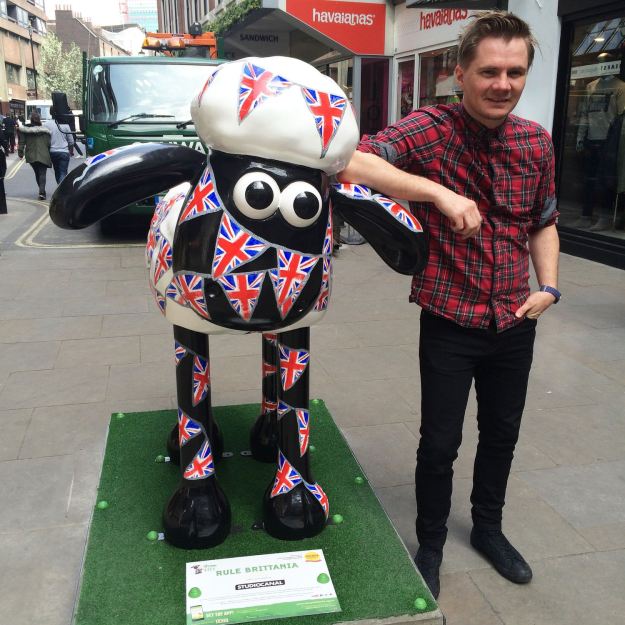
me and my Queens Hat inspired Shaun the Sheep in London

He talked about his writing and illustrating process and explained why there is a fine art to writing and illustrating a picture book. Firstly, you’ve normally only got 12-spreads to tell your story. This, in itself, is very challenging. He told me that when he writes a picture book – sometimes an image comes first – sometimes a title or a phrase comes first. But his books almost always begin by forming a visual narrative in the form of a storyboard, which consists of 12 panels (one for each double-page spread).

“At this very early stage in the process I work out where the text will go and I also consider how the information in the text relates to the information in each image. I can spend days, if not weeks, perfecting each page turn. The storyboarding process can sometimes take as long as a month, even for the simplest of stories. In fact, it’s the simplest stories that often take the longest.” Steve Antony

Steve said a great picture book needs humour, heart and a brilliant ending. An educational element can be useful too, especially for teachers looking for new and creative ways to teach young pupils. He explained how he tries to find fun and interesting ways to marry the text with the imagery. The text alone can say one thing and the image alone can say something else, but together they tell the whole story. Once he has struck the perfect balance of words and pictures, he edits out all the unnecessary clutter.

Steve claimed the most difficult part of producing a picture book is perfecting the pace of the story. He revealed it took him around two months to perfect the pacing and rhythm to his first Please Mr Panda: book, about a panda intent on inciting the magic word with a tray of colourful doughnuts, because sometimes a tiny change to an image or a piece of text can knock everything off balance.

Please Mr Panda bookcover

Steve told me:

“I use words in my books that a very young child would struggle to understand and read independently. Words like truce, intrepid or Trafalgar Square. I sometimes include animals that some children won’t recognise. For example, there are several lesser-known animals in the London Zoo spread of The Queen’s Hat. It’s also worth knowing that, in most cases, picture books are read to children by an adult or older sibling.” Steve Antony

He advised aspiring illustrators to consider the market beyond English-speaking countries because some rhyming texts have the potential to sell very well in English-speaking territories but publishers have to also consider how well the book will translate into other languages.

To find out more about Steve take a look at his website: www.steveantony.com or follow him on Twitter @MrSteveAntony and on Instagram @mrsteveantony

You can read the full interview in the #180 Oct 2016 issue of the national writing magazine, Writers Forum.

An interview with… John Condon

In my Writing 4 Children slot in Writers’ Forum this month, picture book writer, John Condon, tells me how he discovered his love for writing picture books whilst he was working on a screenplay for a play he planned to direct.

Since then he has had two pictures book accepted for publication: The Wondrous Dinosaurium released by Maverick Arts, 2018 and illustrated by Steve Brown and The Pirates are Coming due to be released by Nosy Crow in 2020, illustrated by Matt Hunt.

John explained that even though The Pirates are Coming was accepted first, due to the backlog of pirate based stories The Wondrous Dinosaurium was published first. This is the nature of the publishing world. He is currently working on a whole load more picture books with his agent Felicity Trew.

In the feature he talks through his writing process and how he keeps the pages turning for young readers. John said:

“I use several tools to ensure readers continue to turn the pages – Action, unpredictability, and an active character the reader will care about. If a reader wants to know what happens next, you will keep them turning the pages.” John Condon

Some of his writing tips for new writers include getting someone else to read your story aloud to you to build a strong support network around you of people with similar writing interests.

To find out more about John take a look at his website www.johncondon.co.uk or follow him on Twitter @John_Condon_OTT

You can read the full interview in the #216 Oct 2019 issue of the national writing magazine, Writers Forum.

An Interview with… Francesca Capaldi Burgess

I have been told about such a wide range of resources that writers have used over the years I have been doing my Research Secrets slots in the national writing magazine Writers Forum. Resources are a writer’s best friend when researching for your writing and everybody has their own unique resource bank.

Francesca Capaldi writes short stories for anthologies and national women’s magazines such as My Weekly and The People’s Friend. In the October issue of Writers’ Forum she told me how she has gathered together a large selection of social history books, many secondhand, for her historical based research.

Research books

She explained books are not the only resources she turns to again and again. When researching locations her research always involves a map and sticking it on her whiteboard.

Old map Littlehampton

Francesca revealed:

“Back in my youth I did a history degree and discovered that there’s nothing better than first hand research, and even better if you’re using primary sources. I used to love sitting in the records’ office, wading through a census or tithe map, gathering information not necessarily found in a book. I love social history, that of ordinary, everyday folk.” Francesca Capaldi Burgess

Some other resources she talks about in the feature are: Google Maps, town websites, Pinterest, libraries, museums, local archives, ancestry.co.uk, newspapers, teh met office and documentaries. She said:

“If I’m at a talk or watching a documentary, I always take copious notes as I find I remember the details better. I also jot down ideas as I go along.”  Francesca Capaldi Burgess

Danger For Daisy by F Capaldi coverHer pocket novel for My Weekly, Danger for Daisy, came out on January 2019. It is about the newly single Daisy Morgan who is excited about celebrating her first Christmas away from home with her extrovert flatmates. Then she meets intriguing university lecturer Seth, who offers a completely alternative Christmas – an archaeological dig on a secluded island. As she gets to know the diverse bunch of people working on Sealfarne, and romance blossoms with Seth, she begins to enjoy her adventure. But a series of bizarre occurrences convince her all is not as it seems, and there may even be murder involved…

To read the complete interview check out the #216 Oct 2019 issue of Writers Forum.

You can follow Francesca on Facebook @FrancescaCapaldiAuthor or on twitter @FCapaldiBurgess

An interview with… Nicola Morgan

One of the first interviews I did when my Writing 4 Children column launched in 2016 was with the esteemed Nicola Morgan. She is one of my writing idols.

At St Pauls Manchester

She had a strong, realistic  message to tell people who wanted to write for children as a full time career.  Nicola said:

You will have to do school events

They are exhausting, can be demoralising and will sometimes test your resilience beyond its max. They can also be soul-nourishing, highly rewarding and are almost always eye-opening, which is good. Try to take all their benefits and learn to love your audiences by focusing on the vast majority of the students who are listening avidly. And when something undermining happens, laugh (afterwards, not at the time).

You will be seriously underpaid for almost all your children’s/teenage writing

If you want to earn a lot, you need to write a certain sort of book, usually a trilogy/series (though many of those fail before they’ve started.) And you’ll still need luck. Make sure you are paid for events because they can be your only way to survive financially.

Bad things, small or big, will happen in your career

They will often be things you have to keep to yourself or a close circle of friends. This is true for all artists who put their heart and soul out into the world to be judged by others. So value those friends, as they will support you in those bad times. And realise that all the multi-garlanded, apparently uber-successful authors you’ve been following on Twitter etc also have moments (if they’re lucky or incredibly thick-skinned) and months (the rest of us) of darkness and gloom, that we all have angst and inadequacy written through our veins, and that there are more ways to get under the skin of a creative person than there are ways to write a novel. But the emotional rewards are huge. Being published and read is worth the pain.

wf179-september-2016

Nicola’s tips for children’s book writers were read a lot of modern children’s books and if your book has a message keep it hidden.

You can read the full interview in the #179 Sept 2016 issue of the national writing magazine, Writers Forum.

Find out more about Nicola Morgan and her writing at: www.nicolamorgan.com or on Twitter @nicolamorgan

An interview with… Simon Whaley

In my Research Secrets column in the national writing magazine Writers’ Forum this month #215 Sep 2019, I interview Simon Whaley about the research he does for his magazine articles.

Simon Whaley 2

Simon told me:

“What I love about research is the plethora of ideas for potential articles that it generates. You can be researching about one thing, and then come across one small fact that triggers an idea for an entirely different article, for an entirely different market.”

Simon Whaley

He said he uses a program called Evernote to store and organise all his research as it enables him to ‘tag’ notes. He often tags notes with useful contacts, the types of activity, such as event, attraction, tourist, walk and also with the locations such as county, country, towns and villages. This means when he searches something such as Walks and Shropshire it will bring up every note with those tags no matter which project he originally collected the information for.

Simon explained he always makes written notes when researching his articles, even if he has his Dictaphone switched on while interviewing someone. He explained he was once commissioned to undertake a walking route for Country Walking magazine when they discovered he wrote all his routes down in a notebook. The staff writer had dictated the route description into their smartphone, only to discover when they got back to the office four hours later that their smartphone had failed to record. You don’t have that problem writing in a notebook.

He labels all his notebooks and they in turn are an excellent resource.

(c) Simon Whaley

Simon’s notebooks

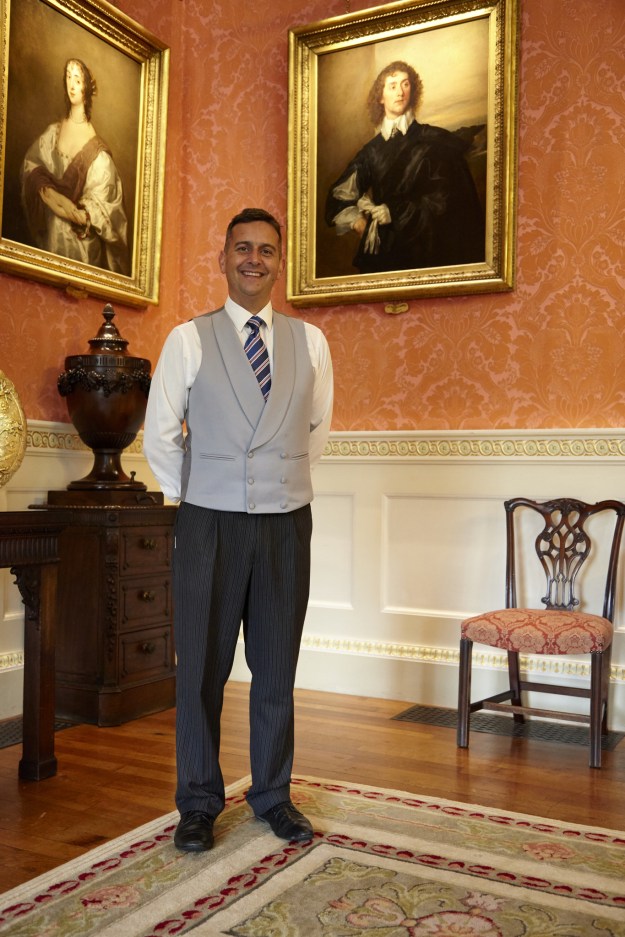
Simon told me how he had to endure a luxury overnight stay at Weston Park, home of the Earl of Bradford. Not only did he have to experience a 5-course meal sat at the same table used by the Heads of State when the G8 summit was held there, but he also had the opportunity to interview the Head Butler and the Head Gardener.

Photo of Graeme Currie, the Head Butler at Weston Park

Photo of Graeme Currie, the Head Butler at Weston Park (c) Simon Whaley

He said he finds his written notes invaluable when he comes to write his articles. He also takes lots of photographs, which he can refer to.

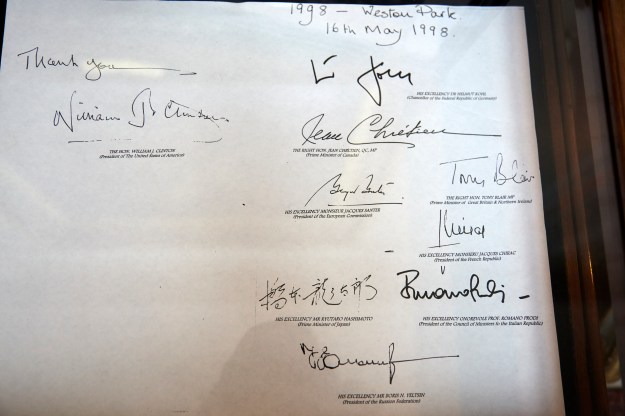
I take photos of everything: information panels, pages inside books, entry fee panels, accommodation rooms I stay in … everything! How many windows on the ground floor at the front of Weston Park? Eight. (I have a photo.) Which Heads of State were at the G8 summit at Weston Park? Clinton, Kohl, Chretien, Santer, Blair, Chirac, Hashimoto, Prodi and Yeltsin. (I have the photo.)

Simon Whaley

Commemmorating the G8 summit visit to Weston Park on 16th May 19

Photo of the Heads of State signatures at the G8 summit at Weston Park (c) Simon Whaley

Simon’s research tip was to take photographs of the information panels as it is the best way to capture all the details and you can read it at your leisure when you get home.

You can find out more about Simon Whaley and his writing on his website:

Website: www.simonwhaley.co.uk

Twitter: @simonwhaley

Facebook: https://www.facebook.com/SimonWhaleyAuthor

An interview with… Ally Sherrick

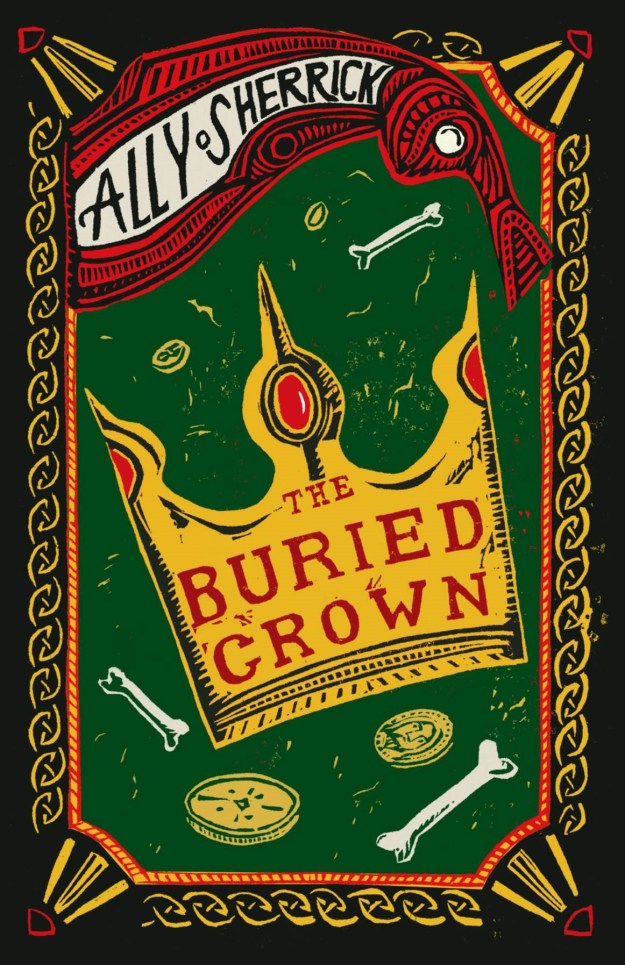
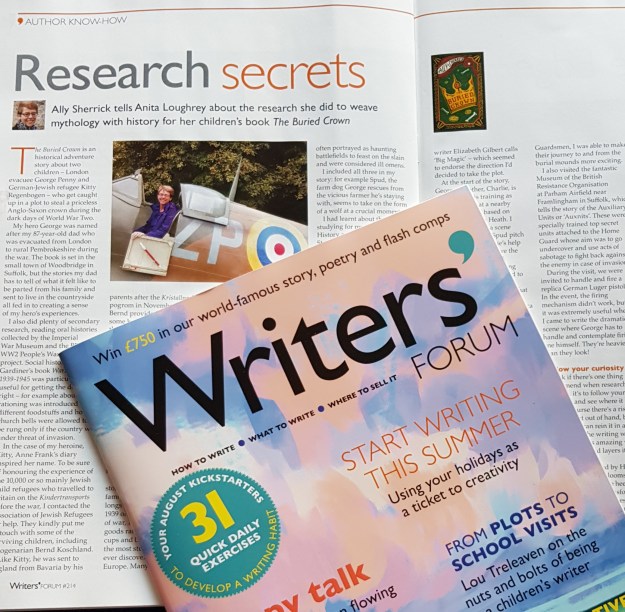
In my Research Secrets column in the national writing magazine Writers’ Forum this month #214 Aug 2019, I interview Ally Sherrick about the research she did to weave mythology into WWII historical events for her children’s adventure book, The Buried Crown.

BC Cover Final HR

Ally Sherrick set her story at the Sutton Hoo site,  where the famous early 7th century longship burial and grave of what is believed to be Redwald, King of the East Angles and High King of Britain was discovered in 1939 on the eve of the outbreak of war. The ship contained grave goods ranging from humble domestic items such as cups and buckets to some of the most stunning treasures ever discovered in northern Europe. Many of the most precious items, including the famous Sutton Hoo helmet, shield and sword belt, are decorated with dragons which the Anglo-Saxons believed liked nothing better than to sit beneath burial mounds jealously guarding treasure hoards.

Buckle replica

This was the inspiration for her idea of a story about a dragon-headed crown based during WWII. Ally told me:

A sense of place is very important to me in my writing, both as a source of inspiration, and also as a character. I had visited the burial mounds and museum at Sutton Hoo, run by the National Trust, a number of years ago, but of course, once I started writing my story, I knew I would have to go again. And I was keen to revisit Woodbridge, where George meets Kitty and where her granddad’s museum – loosely based on Woodbridge Museum – is located.

Her novel is full of realistic descriptions of what it was like for a child to be a refugee during WWII. She did extensive research into the Jewish child refugees who travelled to Britain on the Kindertransports. She was also inspired by the stories her dad use to tell her about what it was like to be parted from his family and sent to live in the countryside.

Ally Sherrick

As the story is set in rural Suffolk, Ally wanted to be sure to try and capture elements of the local accent for characters like Bill Jarvis, the cruel farmer George lodges with. Ally explained this involved listening to recordings of Suffolk voices on the internet and identifying little idiosyncrasies of pronunciation which would give a flavour of the difference in speech between Londoners George and Charlie and the Suffolk-based characters.  For example for words with ‘ing’ endings, Bill Jarvis will always say ‘en’ instead.

Though all the German characters in the Buried Crown speak English pretty fluently, Ally did have them use German phrases at certain moments for emphasis or added drama. She told me that even though she does not speak German herself, she was able to run things past a good friend who is German, and her publisher, Chicken House, also had this double-checked too.

Ally said:

I am extremely grateful to everyone who helped me with checking the various elements of my story. Some of them were acquaintances, but others I approached via museums or special interest societies, the contact details for which I sourced from the internet. All were more than happy to help, and I know the book is more authentic as a result. As I say in the acknowledgements, all errors are my own! 

Ally’s tip for other writers is to follow your curiosity wherever it may lead you. She found it added extra dimensions and layers to her novel.

You can read the full interview in the August 2019 #214 issue of Writers Forum.

You can find out more about Ally Sherrick and her books on her website: www.allysherrick.com and follow her on Twitter: @ally_sherrick

An interview with…Ana Johns

In my Research Secrets column in the national writing magazine Writers’ Forum this month #213 Jul 2019, I interview Ana Johns about the research she did for her novel, The Woman in the White Kimono. This novel can be described as Romeo and Juliet meets Madam Butterfly.

Kimono High Res Cover (002)

The main protagonist is a twenty-first century investigative reporter who embarks on the most personal story of her life. She is trying to discover the truth about a woman with whom her father had a forbidden relationship with more than a half century ago. As her father’s secret past unfolds, the truth will reveal as much about him as about the woman and baby he left behind. 

Ana Johns feature2

Ana told me that she worked backward, borrowing heavily from her father’s life, his ship, his military records, his cancer, and forward using her imagination by asking, “what if?” What if they preceded with the wedding without her parent’s blessing?  What if she were pregnant? To answer those questions, she studied 1950s international marriage and birth registry laws for the United States, Japan, and the military. Ana told me all the information was attainable online.

She explained:

This is where search engines are a writer’s best friend, even if you don’t know where to look for specific records, a single query will provide several links that point you in the needed direction. These sources, along with countless articles on the bureaucratic red tape those laws created, provided the working story structure for my dual narratives—the bones if you will. Ana Johns

Ana told me that she found internet articles and blogs invaluable but it was the real-life connections she made through various Japanese Facebook groups and military forums that gave the novel real authenticity.

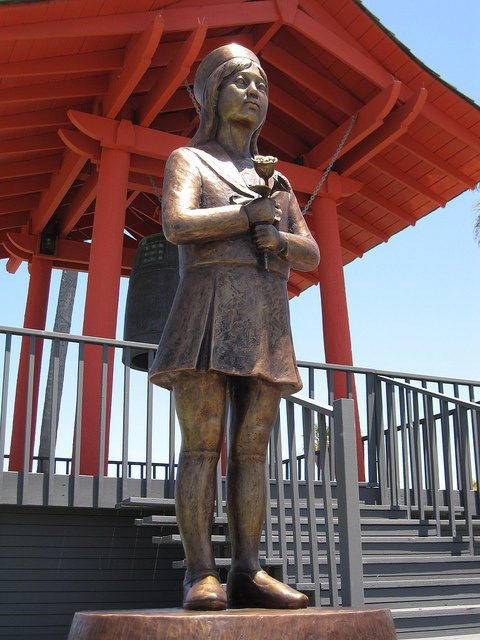
Through the forum, the adoptees invited me to join their private Facebook community (again, I can’t stress the importance of these groups) where I was then invited to attend the first US Elizabeth Saunders Home reunion in San Diego on Shelter Island where the US statue of The Girl with Red Shoes stands for informal face-to-face interviews. Ana Johns

Girl With Red Shoes CA

The adoptees also inspired several of the character’s backstories that Naoko meets in a maternity home.

“Jin is somewhat lucky. At least she only battled one demon.”

My heart drops. Tears follow. Their moisture floods my fingertips and seeps through. That is why she took Jin under her wing. Stood up for her. Mothered her. I didn’t know. I didn’t guess. I didn’t ask.

“So, you see?” Her lips pull high and her shaky words fight to work through them. “When my child asks his or her new parents, ‘Why was I given away? Where did I come from?’ They won’t have a wedding story of magical lights and forbidden love to share. They will have nothing to offer, because with a story as horrible as mine, I have nothing to leave.”

“You leave life, Hatsu.” I slide close, wrapping her in my arms and whisper through tears. “You leave life.”

Extract from The Woman in the White Kimono by Ana Johns

Ana revealed that even the fictional outcast village where Naoko and Hajime rent a home was based on a discovered headline “Google crosses line with controversial old Tokyo maps”

It’s not the run-down little house that causes my alarm, but the community. It’s in a region that houses Eta, outcasts. The Burakumin are at the bottom of the social order. They are poor, some of mixed blood, and work necessary trades of death: butchers, leather tanners, undertakers. Therefore, they’re deemed tainted, unclean and unlucky.

I am the unlucky one.

My family will forbid it. To live here would damage Father’s reputation and Taro’s prospects to earn one.

Extract from The Woman in the White Kimono by Ana Johns

The novel may have begun with Ana’s father’s story, but through her diligent research it evolved into a story that belongs to many.

You can read the full interview in the July 2019 #213 issue of Writers Forum.

You can find more information about Ana Johns and her writing at: www.anajohns.com

An interview with… Alec Price

In my Writing 4 Children column this month, I interviewed Alec Price about the pros and cons of mainstream publishing v self-publishing. He had some very interesting things to say about the two processes of becoming a published author.

alec Price feature 1

His children’s books are about the Trogglybogs, strange children who are only two feet tall and covered all over in brown fur. they live deep in the caverns on Brinscall moors. These cheeky mischief-makers enjoy nothing more than sneaking up on people who are picnicking on the hills and stealing their food.

Trogglybogs book cover

Alec told me that in the end of experiencing both methods he prefers the self-publishing route. he said:

I think it is much more satisfying, and more profitable, to do the whole publishing process yourself. It’s not that hard.

Alec Price

For both ways of getting published Alec explained he has to do most of his own self-promotion. The publisher did put his book on Amazon and other online book sites. He contacted local papers and radio stations, he organised his school visits and he also set up his own mobile book stall to take to fair and summer fetes. Alec said:

With self-publishing you have complete control of your book; it is your baby. you can make it a success and reap the rewards.

Alec Price

For more about Alec Price and his books you can check out his website: www.alecpricewrites.co.uk

You can read the complete feature in Writers’ Forum Magazine #213 July 2019

An interview with… Jennifer Rees

To commemorate the centenary of women police force in the Metropolitan Police Jennifer Rees and her co-author Robert J Strange have written a fascinating and enlightening non-fiction book, Voices from the Blue: The Real Lives of Policewomen (100 Years of Women in the Met) .

Voices from the Blue cover

I interviewed Jenny Rees for my Research Secrets column in the national writing magazine Writers’ Forum. Jenny explained how archives were a great source of inspiration for their research. The National Archives hold many of the historical files for the Metropolitan Police. There was also the Metropolitan Police Archives in Camden, which hold the judicial histories of London and the London law courts.

Pic1

Jenny told me:

“Researching through the eras from those at the start of women in the Metropolitan Police to the complete assimilation of women into full integration with their male counterparts in 1973/4. The roles of women changed, they were expected to work alongside the men and deal with an increasing diversity of roles and crimes.” Jennifer Rees

Voices from the Blue tells the story of the hundred years of service of female police officers within the Metropolitan Police through the voices of the women who fought their way towards equality and won the respect of both their colleagues and the public. The authors have interviewed hundreds of former and serving policewomen and with the co-operation of the Metropolitan Police and the Women’s Police Association now have access to the files and stories of thousands of former officers who served over the past hundred years. Those police archives, together with material held by the National Archives and private libraries, provide a detailed and fascinating oral history of the challenges women police officers faced down the years.

Jenny explained:

“Context was the key factor for us. If the historical research brought context to the stories in a particular chapter we used them, but we were critical of each piece of research we used. Some were essential and made it into the finished version of the book, others unfortunately went by the wayside as we had a publisher word count constraint.” Jennifer Rees

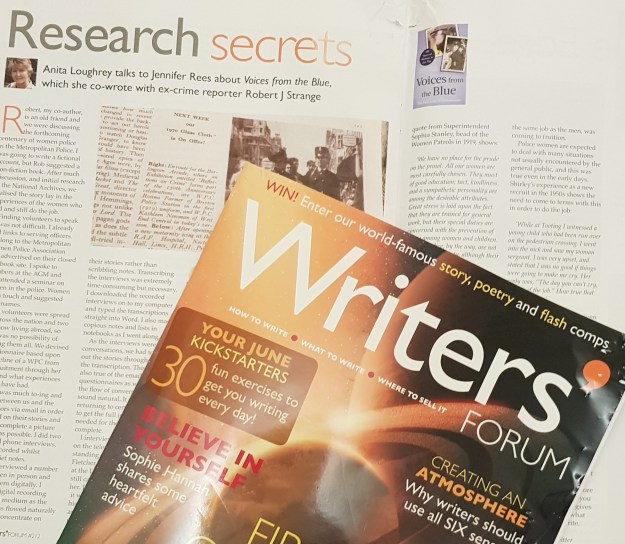
You can read the full interview in the May 2019 #212 issue of Writers Forum.

You can follow Jennifer Rees and Voices from the Blue on Twitter @Namkha211