Tag Archives: Anita Loughrey

Keep Focused

This is a real problem for me. I am very easily distracted. Today I saw this post on Facebook and thought it really summed me up. I can’t remember who posted it now but thank you.

keep focused

Over the years I have developed strategies to help me keep focused on my writing. I thought I would share a few of them with you today.

I have found making lists of what I need to do helps. But I have narrowed it down to three things a day. Each day I ask myself:

“What three things do I want to achieve by the end of today?”

This helps me prioritise and makes my goals manageable. I have even started messaging my now grown-up children three tasks they should concentrate on each day. My daughter has even messaged me on occasions to ask what her tasks for the day are.

However, it is no good if you make the task too large such as: ‘Write a picture book’. This is not helpful. The task for writing a picture book needs to be broken down into smaller parts such as:

  1. Brainstorm ideas for a picture book.
  2. Decide who is going to be the main character.
  3. Think about what the main character wants to achieve.

This may be enough for one day’s work.

The other thing I have found that helps me to concentrate is tidying my study.  When I have been working on a commission I tend to accumulate books, printed research and pieces of paper with rough notes doodled on them that pile up on the desk and the floor. Before I can start a new commission I clear everything away so I can start fresh with no potential distractions. A tidy environment helps me to keep a tidy mind.

I hope you find these ideas helpful.

Book Review – Two brothers and a Chocolate Factory

Title: Two brothers and a Chocolate Factory

Written by: Juliet Clare Bell

Illustrated by: Jess Mikhail

Published by: Bournville Village Trust

Two brothers and a Chocoalte Factory

Two brothers and a Chocolate Factory: The Remarkable story of Richard and George Cadbury is a beautifully written narrative non-fiction interlaced with quotes. It explains how the brothers Richard and George Cadbury endeavoured to make their father’s chocolate factory a success. They dreamed of making the world a better place to live and work despite all odds, sceptics and circumstance.

It would appeal to children who are fascinated by social history and also to those that just love chocolate and want to find out more how Cadbury became one of the biggest producers of chocolate in the UK.

Jess Mikhail’s use of colour to contrast the good times and the bad times in the illustrations compliments the text perfectly and adds depth. The detail given to the clothing, hairstyles and homes during Victorian times helps to bring the book alive.

This inspiring picture book would be a great addition to schools and libraries not only in Birmingham where it is set, but all over the world as it recalls how people can achieve anything if they put their mind to it. The theme of following your dreams echoes from every page.

An interview with… Michael Rosen

I interviewed Michael Rosen about the research he does for his writing in 2009, when he was children’s laureate . 

Michael Rosen WBD 08 (84 of 147)

He explained when researching, he uses a mixture of the British Library, Internet, newspapers, Cecil Sharp Library and the state library of Melbourne (re Cuffay). He often starts with Google and goes from there. He revealed he often uses Carpenter’s Oxford Guide to Children’s Literature as a starting point.

Michel Rosen told me:

“In phase one of your research, you should allow yourself to be distracted by anything and everything that you discover. In Phase Two, you have to be ruthless and only stick with the subject in hand, or you’ll never finish the work.”

Michael Rosen

There is no pattern to the way he researches. He said he usually puts everything he discovers either physically into piles in his office, or log it into the computer. He likes to follow his nose – let one thing lead to another.

“Asking ‘what if’ and speculating are two important research techniques to discover a coherent narrative and ear-catching moments.”

Michael Rosen

In one of his ‘following his nose moments’ he discovered  museums in Britain kept the heads (or at least one head) of aboriginals who had been killed. Michael Rosen used this idea in You’re Thinking about Tomatoes when the protagonists hear the sound of bubbles and wheezing, and when they get to see what’s going on, it’s the head of an aboriginal man talking to them.

You’re Thinking about Tomatoes  and You’re Thinking about Doughnuts are two books that explore how things we see today, a museum and a stately home, owe their appearance and exhibits to aspects of the past.

You can find out more about Michael Rosen and his children’s books on his website: www.michaelrosen.co.uk

Flat fees v Royalties

This is a very old debate in the world of writing educational resources. These books were written by me and my editor at the time Steve Rickard. He wrote the non-fiction at the front of the book and I wrote the stories at the back of the book. They were published under the pseudonym Cathy West. I am very proud of these books. I received 5% royalties as they were co-written. I do not think I have made much from these titles although, they are excellent for school visits.

Starstruck Collage

In the Society of Authors’ magazine The Author, Winter 2006 issue, Jenny Vaughan said amongst other things:

You should ensure you’re not being taken advantage of.

This is good advice. It is so easy for all authors to undersell themselves. However, both forms of payment have their advantages and disadvantages.

On the plus side, flat rate fees are very useful as you can receive an often vital income quickly, whereas royalties provide a more long-term gain. But sometimes, you can spend ages writing a book, which is to be paid by royalties only and have very little come back if it does not sell well. Whereas, with flat rate fees it often means you sign your rights away and you are usually writing to a very specific and tight brief. I wrote these books for a flat fee. I am very proud of these books too. They have been sold all over the world in many languages and are still in print. Sometimes I wonder how much money I could have made if I were getting royalties.

Season collage

Remember you should re-negotiate your fee on second editions. The publisher should pay a top-up fee and you should check the rights revert back to the author if the book goes out of print. The NUJ provides a very useful Freelance Fees Guide.

Book Review – The Story of the Olympics

Title: The Story of the Olympics

Written and Illustrated by:  Richard Brassey

Published by: Orion Books

The Story of the Olympics

This book is written in graphic novel style and is part of Richard Brassey’s The Story of… series, which includes such titles as: The Story of England, The Story of Scotland, The Story of London, The Story of World War One and The Story of the World Cup.

The Story of the Olympics is certainly a new slant on an old subject. It is full of the most amazing, obscure facts. Things I most certainly never knew before and never even thought to ask. Some of these facts would make great starting points for a wide range of speaking and listening activities in the classroom or even in a discussion with your child, especially the information he gives about how politics have interfered with the games.

The book compares the ancient and modern Olympics in an exciting and informative way – a favourite with teachers who are covering the Olympics as part of their topic on Ancient Greece. The bright and adventurous pictures capture the imagination and keep you turning the pages to discover the fascinating snippets of information about each of the Olympic Games and the winners, throughout history from 1908 and goes as far as the 2016 games held in Rio de Janeiro. The information is conveyed in a chatty, humorous way which will keep the attention of even the most reluctant reader.

I particularly like the way it starts with the Olympic truce and the Olympic ideal, two things which are often neglected in other books about the Olympics. This is certainly a book to keep your eye on if teaching about the Olympics or the Greeks or even World War Two, especially with Tokyo 2020 looming next year.

Book Review – Frankie Foster Pick ‘n’ Mix

Title: Frankie Foster Pick ‘n’ Mix

Written by:  Jean Ure

Published by: Harper Collins

All Frankie Foster wants to do is help people. She wear a tee-shirt that says Here to Help. She loves fixing people’s problems. But, her help is not always welcome as more often than not, she leaves disaster in her wake. Eventually though, Frankie does always fix things.

Pick ‘n’ Mix is the second book in the series about accident-prone Frankie Foster. Mum has agreed to let her friend’s daughter, Emilia, stay for a while so her friend can get a little respite. But, this means Frankie has to move out of her tiny attic bedroom and share her sister’s bedroom with Emilia, to her sister’s disgust. Frankie finds she has taken on more than she has bargained with Emilia, whose behaviour leaves a lot to be desired, creating some dramatic and very funny twists in the story.

The book is aimed at girls 9+ and is written in the first person. As with Jean Ure’s other novels, the characters leap off the page, making an immediate and lasting impression.

I would recommend this book to anyone who enjoys reading Jacqueline Wilson’s and Anne Fine’s books.

Dream a little dream…

Does anyone else out there dream their stories?

sleep
Well, I have very vivid dreams and more often than not I remember them when I wake up. I can dream whole plot lines. When I was stuck on a plot of a recent book I was writing I would read where I’d got to in the story just before I went to bed and somehow when I woke up I had a vague story line. Granted I think the story probably needs a lot more work and maybe a lot more sleep.

20160630_140748

I keep a notebook by my bed most nights and often write down the stories I have dreamt. One day, I am going to write them all up as different novels. Right after I finished the commission I am working on at the moment. But for now, I can officially say I am still working even when I am asleep.

Book review – The Words that Fly Between Us

Title: The Words that Fly Between Us

Written by: Sarah Carroll

Cover illustrated by: Thy Bui

Published by: Simon & Schuster
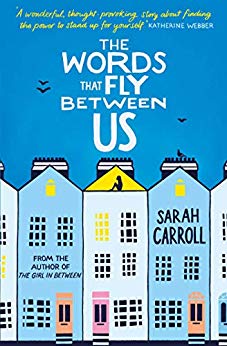
The Words that Fly Between Us

An excellent YA book about learning to stand up for yourself and also covers the transition from one school to another. For me it was not so much the plot of the book that resonated with me but the underlying messages hidden within the plot.

The Words that Fly Between Us is about thirteen year old Lucy Fitzsimons whose family life is not as perfect as people think. In public her dad is warm smiles and sweet words. He look like the perfect loving husband and father and as far as Lucy can remember he used to be before he became over-stressed with work, and bullied himself by the owner of the bank. But behind closed doors he becomes another person, as she vividly portrays in her drawings. He is sour and bitter and the words that come out of his mouth are vicious and suffocating. Yet the words he does not say hurt just as badly. Lucy wakes up each morning hoping her dad is in a good mood.

Her best friend Megan is also being bullied by words from Hazel, a girl she knows from orchestra. On the surface Hazel pretends to be Megan’s friend but she is always making snide comments about the way Megan looks and acts. Lucy can’t believe Megan does not notice but in the same way Lucy pretends everything is ok at home, Megan pretends everything is ok with Hazel.

The whole book is a metaphor for how words can hurt just as badly as sticks and stones. Throughout the book, Sarah Carroll, expertly describes how the words that fly from her father’s mouth stick to surfaces, hide in wallpaper and drop to the carpet like invisible stains, lingering and filling the house with sadness. But it is not only the words people say. Sarah Carroll cleverly compares this to the words people write as well because Hazel not only bullies Megan with the things she says but also with the comments she anonymously writes on Megan’s blog.

The themes of truth, friendship and not believing the things other people say, ring strong and clear on every page, even in the beliefs Lucy has about her neighbour Ms Cusack. Her dad has told her Ms Cusack is poor, crazy cat woman. Lucy starts to explore the secret lives of her neighbours, in some cases by using the attic that is connected to every house on her side of the street, and she finds out her father’s words are not always true.

Through Lucy’s desire to help people she discovers words can help people too. The words in the books Ms Cusack give her are a source of knowledge that helps her to make sense of her own world and the note a young tramp gives her in exchange for train money, that simply says ‘I hope you feel safe all day’ provides Lucy with a new perspective and understanding. In the end, both Lucy and Megan gain the courage to stand up to their bullies. Lucy also realises the truth will set her free when she reveals the shady deals her father and his associates are involved with. In the long run it helps free her dad from his bully, as well as freeing her from her dad.

An excellent book to use in the classroom as a means to discuss bullying and trolling. It is also a great book for empowering young people to stand up for themselves and to not keep bullying a secret. The Words that Fly Between Us clearly demonstrates that once the bully is exposed, action can be taken to stop them. This book really makes you think.

An Interview with… Lou Treleaven

In my Writing 4 Children column this month, I interviewed Lou Treleaven about the nitty-gritty aspects of being a children’s book writer. In the feature Lou talks about how she broke into writing for children, her own writing process and doing school visits.

A big part of being a children’s book author is doing school visits. Lou offers a ‘pick and mix’ package for schools, which includes a number of different activities that can be slotted together to make a whole day or even several days. She explained that for younger children she usually reads a couple of picture books a followed by a related craft activity.  she also loves creating collaborative poems with the children after a reading. For the older children, she reads from her Pluto series and encourages the children to write replies to letters from aliens she has made in advance and bought in with her. She even provides an alien postbox to post them in.

20190708_133442

Lou’s tip for other children’s book writers is to use simple but interesting language. She said:

Think poetry, even when you are writing prose.  A well chosen word replaces a dozen.  You have to leave room for the illustrations so your words can only take up a small part of the page, yet they need to tell the story, engage the reader and create tension.  Your words need to be the very best they can be.

Lou Treleaven

Lou has her own critique service where she focuses on all the different facets of what makes a story: characterisation, plot, language, tension and the message in the story, as well as how to lay out the text and craft a submission letter and synopsis.

For more about Lou Treleaven and her books and critique service you can check out her website: www.loutreleaven.com You can you can find her on Twitter at @loutreleaven and Facebook at www.facebook.com/loutreleaven

To read the complete feature take a look at Writers’ Forum Magazine #214 August 2019.

Walk the dogs

20171024_204853

If you find yourself stuck for ideas, or unable to think what to write next, don’t sit and stare at your computer or your notebook, go for a walk. You’ll be amazed at what pops into your head. I alkso find I am so much more productive after I’ve walked the dogs.

This slideshow requires JavaScript.

This slideshow requires JavaScript.

As well as being an excellent tip, this is an ideal opportunity to post a slideshow of my gorgeous dogs.

smiley face